GR4VY

Optimizing payments for mobile wallets: Apple Pay, Google Pay, etc.


Mobile wallets have transformed the way consumers pay, offering seamless, secure, and contactless transactions. By 2026, Apple Pay, Google Pay, and Samsung Pay have become integral to e-commerce and in-store purchases, with adoption rates soaring worldwide. Businesses that optimize their payment systems for mobile wallets can reduce friction at checkout, improve customer satisfaction, and increase conversion rates.

In this guide, we explore key strategies for optimizing for mobile wallets, covering technical implementation, security best practices, and the role of payment orchestration in streamlining mobile payments.

Understanding mobile wallets: how they work

Mobile wallets store payment credentials securely on a device, allowing users to make transactions via NFC (Near Field Communication) or QR codes. These digital wallets offer an extra layer of security with tokenization, which replaces card details with encrypted tokens, minimizing fraud risks.

  • Apple Pay – Integrated with iOS devices, Apple Pay provides biometric authentication and seamless payments across apps and websites.
  • Google Pay – Available on Android, Google Pay supports online, in-app, and in-store payments with advanced security measures.
  • Samsung Pay – Features both NFC and MST (Magnetic Secure Transmission) technology for broader acceptance.
  • Regional alternatives – Platforms like Alipay, WeChat Pay, and Paytm cater to specific global markets, expanding mobile payment options.

Why businesses must prioritize mobile wallet optimization

Optimizing for mobile wallets is no longer optional—it’s a necessity. Here’s why:

  • Faster checkout – Reduces friction, improving customer experience and decreasing cart abandonment.
  • Enhanced security – Tokenization and biometric authentication lower fraud risks.
  • Higher conversion rates – Customers are more likely to complete purchases with one-click payment options.
  • Growing consumer demand – Mobile payments are becoming the default method for transactions globally.

Step-by-step guide to optimizing for mobile wallets

Ensure mobile-friendly website design

A seamless mobile experience starts with a responsive website. Make sure:

  • Checkout pages load quickly and function well on all screen sizes.
  • Mobile wallets are visibly displayed as payment options.
  • Autofill is enabled for payment details, improving efficiency.

Integrate Apple Pay and Google Pay

Integration can be done through major payment service providers (PSPs) that support mobile wallets. Businesses should:

  • Choose a PSP or payment orchestration platform that facilitates Apple Pay and Google Pay transactions.
  • Implement native payment buttons within mobile apps and websites.
  • Test mobile wallet payments for smooth execution.

Streamline checkout flows

A complicated checkout process leads to cart abandonment. Optimize by:

  • Allowing one-click payments.
  • Reducing unnecessary form fields.
  • Enabling guest checkout with mobile wallet options.

Optimize for biometric authentication

Face ID and fingerprint authentication provide a secure and frictionless payment experience. Ensure:

  • Mobile wallets leverage device authentication features.
  • Payment authorization is instant and requires minimal user input.

Maintain PCI DSS compliance

Mobile wallets enhance security, but businesses must still comply with PCI DSS standards to protect customer data. Compliance measures include:

  • Using tokenization to minimize exposure of sensitive cardholder information.
  • Encrypting transactions and ensuring secure data storage.
  • Regularly updating security protocols to prevent breaches.

The role of payment orchestration in mobile wallet optimization

Payment orchestration platforms help businesses simplify the integration and management of multiple mobile wallet providers. Instead of relying on a single PSP, payment orchestration allows merchants to:

  • Route transactions dynamically to the most efficient payment provider.
  • Improve authorization rates by selecting the best-performing PSPs for different regions.
  • Offer local mobile wallets alongside Apple Pay and Google Pay for international customers.
  • Reduce costs by optimizing processing fees and minimizing failed transactions.

For businesses expanding into global markets, using a payment orchestration platform ensures flexibility and scalability. Learn more about how payment orchestration improves checkout efficiency.

Mobile wallets and cross-border payments

As mobile wallets become more prevalent in international commerce, businesses need to account for:

  • Currency conversion fees – Transparent pricing helps reduce unexpected costs for customers.
  • Local mobile payment options – Integrating platforms like Alipay and GrabPay increases acceptance rates.
  • Regulatory compliance – Ensuring compliance with PSD2 and strong customer authentication (SCA) requirements.

Overcoming challenges in mobile wallet adoption

Addressing security concerns

Despite their advanced security features, some consumers and businesses remain hesitant about mobile wallets. To build trust:

  • Educate customers about the benefits of tokenization and encryption.
  • Offer fraud protection guarantees to encourage adoption.
  • Implement regular security audits to identify and address vulnerabilities.
  • Encourage the use of additional privacy tools, such as a VPN with free trial, to secure online transactions.

Ensuring compatibility with multiple devices

Different devices and operating systems handle mobile wallets differently. To maximize adoption:

  • Test mobile wallet functionality across various smartphones, tablets, and browsers.
  • Ensure seamless integration with both iOS and Android platforms.
  • Provide clear instructions for customers on setting up and using mobile wallets.

What is the mobile wallet payment mechanism?

A mobile wallet payment mechanism enables users to store payment card details digitally and conduct transactions through their smartphones or wearables. This is achieved using:

  • NFC technology – Enables contactless payments via a tap-to-pay system.
  • QR code payments – Used for online and in-store payments where NFC is not supported.
  • Tokenization – Converts sensitive card data into a unique token for secure transactions.
  • Biometric authentication – Uses fingerprint or facial recognition to approve payments.

The mobile wallet mechanism ensures fast, secure, and hassle-free transactions, making it a preferred choice for modern consumers.

What is the difference between e-wallet and mobile payment?

E-wallets and mobile payments are often used interchangeably, but they have key differences:

  • E-wallet refers to digital platforms that store card details, cryptocurrencies, and loyalty rewards (e.g., PayPal, Venmo, Alipay).
  • Mobile payment is a broader term encompassing transactions made via smartphones, including mobile wallets, direct carrier billing, and QR code-based payments.

While all mobile wallets are e-wallets, not all e-wallets function as mobile wallets. The distinction lies in how the transactions are processed and the level of integration with the device’s hardware.

What are mobile payment solutions?

Mobile payment solutions provide businesses with the infrastructure to accept payments through digital wallets and mobile-based systems. These solutions include:

  • Merchant payment gateways – Enable secure transactions from mobile wallets.
  • QR code-based payments – Allow users to scan and pay without entering card details.
  • In-app payment solutions – Integrate payment systems into mobile applications for seamless transactions.
  • Peer-to-peer payment apps – Platforms like Venmo and Cash App facilitate direct transactions between users.

These solutions play a critical role in modern commerce, making payments faster, safer, and more accessible across different industries and geographies.

  • Wearable payments – Smartwatches and other IoT devices are expanding the use of mobile wallets.
  • AI-driven payment experiences – Personalized and predictive payments enhance customer convenience.
  • Decentralized identity verification – Blockchain-based authentication could further secure mobile transactions.

FAQs: everything you need to know about mobile wallet optimization

How secure are mobile wallets?

Mobile wallets use tokenization and biometric authentication, making them more secure than traditional card payments.

Can small businesses implement Apple Pay and Google Pay?

Yes, through PSPs or payment orchestration platforms, small businesses can easily integrate mobile wallets.

Do mobile wallets reduce fraud?

Yes, their built-in security features significantly lower fraud risks compared to manual card entry.

How do mobile wallets impact transaction fees?

While fees vary by provider, increased transaction approval rates often outweigh any additional processing costs.

Mobile wallets are the future of payments, and businesses that optimize for them will see higher conversion rates and improved security. By leveraging a payment orchestration platform, companies can seamlessly integrate mobile wallets, reduce fraud, and expand into global markets.Contact Gr4vy today to learn how our payment orchestration solutions can help you optimize mobile wallet transactions and enhance your checkout experience.

The largest payment methods in Europe: A comprehensive guide

When was the last time you thought about how your customers prefer to pay? For businesses venturing into Europe, this question isn’t just theoretical—it’s the foundation of success. In a region where payment methods can vary dramatically from one country to the next, failing to meet local expectations means leaving money on the table.

Imagine offering only credit cards in a market dominated by digital wallets or neglecting local payment solutions like iDEAL in the Netherlands or Bancontact in Belgium. The result? Frustrated customers, abandoned carts, and missed opportunities.

Europe’s payment landscape isn’t just diverse; it’s rapidly evolving. Mobile payments, buy-now-pay-later options, and stringent regulations like PSD2 are reshaping how consumers transact online. To stay competitive, businesses must go beyond merely accepting payments—they need to craft a payment experience tailored to each market they serve.

This guide is here to help. We’ll break down the most popular payment methods in Europe, uncover key trends driving change, and provide actionable insights for optimizing your checkout process. Whether you’re expanding into new territories or looking to refine your existing operations, this is your roadmap to getting paid in Europe.

Europe’s top payment methods: A regional overview

1. Digital wallets: Leading the charge

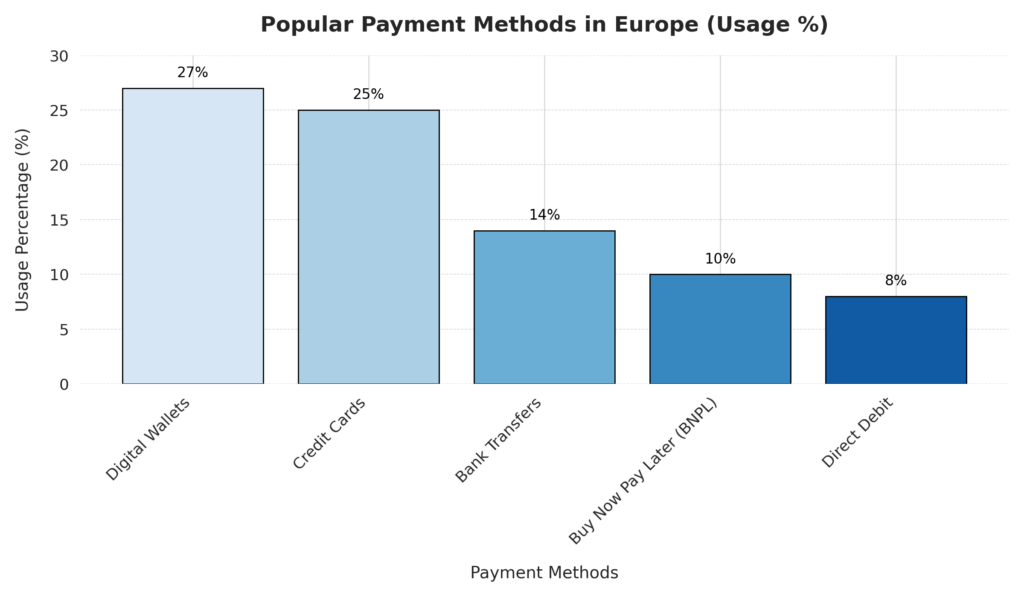
Digital wallets are revolutionizing e-commerce in Europe, offering speed, convenience, and security. According to recent reports, digital wallets account for over 27% of online transactions in the region, surpassing traditional credit cards.

  • Key players: PayPal, Apple Pay, Google Pay, and Klarna.
  • Advantages: One-click payments, mobile integration, and enhanced security through tokenization.
  • Trends: The rise of mobile-first consumers and contactless payments has fueled the adoption of digital wallets.

2. Credit and debit cards: A consistent favorite

While digital wallets are on the rise, credit and debit cards remain a cornerstone of European e-commerce, accounting for 25% of online payments.

  • Popular providers: Visa, Mastercard, American Express.
  • Regional differences: Cards dominate in Western Europe, particularly in countries like the UK, France, and Italy.
  • Security: Strong customer authentication (SCA) under PSD2 regulation has bolstered trust in card payments.

3. Bank transfers: A preferred method in certain regions

Bank transfers are particularly popular in countries like Germany, Austria, and the Netherlands, where consumers prioritize security and direct payments.

  • Germany: Sofort and Giropay lead the way.
  • Austria: EPS is widely used.
  • The Netherlands: iDEAL processes a significant percentage of online transactions.

4. Buy now, pay later (BNPL): Gaining traction

BNPL solutions like Klarna and Afterpay are becoming increasingly popular, especially among younger consumers. These options allow shoppers to spread payments over time, boosting affordability and encouraging larger purchases.

  • Growth areas: Scandinavia, Germany, and the UK.
  • Trends: BNPL is particularly appealing for high-ticket items and in the fashion industry.

The chart below illustrates the current usage percentages of popular payment methods across Europe, highlighting the dominance of digital wallets and credit cards.

Learn how Baby Bunting achieved an uplift in authorization rates with Gr4vy. Read the Baby Bunting case study.

Country-specific payment preferences

Germany

  • Popular methods: PayPal, Giropay, Sofort.
  • Consumer behavior: Germans value security and transparency, often favoring payment methods that allow them to pay after delivery.

France

  • Popular methods: Credit cards, Cartes Bancaires, PayPal.
  • Trends: Digital wallets are gaining ground, particularly among younger demographics.

The Netherlands

  • Popular methods: iDEAL dominates online transactions.
  • Consumer behavior: Bank transfers are preferred, with high adoption rates of secure, direct payment options.

Nordic countries

  • Popular methods: Klarna, MobilePay, Swish.
  • Trends: Scandinavia leads in mobile payments, with a strong emphasis on digital wallets and BNPL.

Poland

  • Popular methods: Blik, bank transfers.
  • Trends: A growing e-commerce market with a strong preference for local payment methods.

Belgium

  • Popular methods: Bancontact, credit cards.
  • Trends: Consumers rely heavily on Bancontact for online and in-store purchases.

Italy

  • Popular methods: PostePay, credit cards, PayPal.
  • Trends: A preference for prepaid cards like PostePay reflects a cautious approach to online payments.

Spain

  • Popular methods: PayPal, credit cards, Bizum.
  • Trends: Peer-to-peer payment solutions like Bizum are gaining traction.

See how ARO Digital leveraged Gr4vy to scale payment capabilities efficiently. Explore the ARO Digital case study.

The rise of mobile commerce

With smartphone penetration exceeding 80% in most European countries, mobile commerce is driving payment innovation. Mobile-friendly solutions like Apple Pay, Google Pay, and region-specific apps such as Swish are transforming how consumers shop online.

The demand for local payment methods

Consumers in Europe often trust and prefer local payment options over global ones. This trend highlights the importance of offering region-specific methods to boost trust and conversions.

Cross-border e-commerce

As cross-border shopping grows, businesses must adapt to diverse payment preferences. Supporting multiple currencies, languages, and payment methods is critical for capturing international customers.

The impact of regulations

Regulations like PSD2 and strong customer authentication (SCA) are shaping the payment landscape, ensuring security while challenging businesses to enhance their checkout experiences.

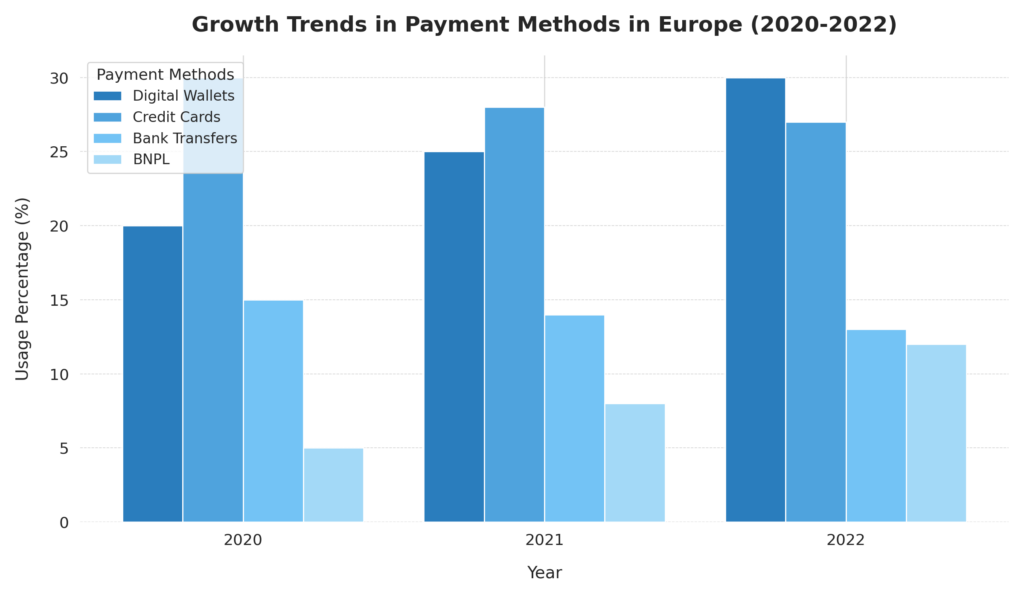
The following chart depicts the growth trends for different payment methods over the past three years, showing the rapid rise of digital wallets and BNPL.

Optimizing your checkout for European customers

Offer diverse payment options

To cater to European consumers, ensure your checkout supports popular local methods alongside global ones. For example:

  • iDEAL in the Netherlands.
  • Bancontact in Belgium.
  • EPS in Austria.

Focus on mobile optimization

Mobile commerce is growing rapidly. Simplify forms, enable autofill, and integrate mobile wallets to enhance the user experience.

Prioritize transparency

Display all fees, taxes, and terms upfront. Hidden costs are a major reason for cart abandonment.

Leverage payment orchestration

A payment orchestration platform can help businesses manage multiple providers, optimize routing, and reduce payment failures. Gr4vy’s platform is designed to streamline this process while ensuring scalability and security.

Want to enhance your e-commerce experience for international customers? Read our guide on optimizing your checkout for global payments.

Payment methods in Europe: Frequently asked questions

What is the most popular payment method in Europe?

Digital wallets like PayPal and Apple Pay lead in popularity, accounting for over 27% of online transactions in Europe.

Why are local payment methods important in Europe?

European consumers trust local payment methods and often prefer them over global options. Supporting these methods enhances customer trust and boosts conversions.

How can businesses optimize payments for Europe?

Offering diverse payment methods, ensuring mobile optimization, and using payment orchestration platforms are key strategies.

What role do regulations like PSD2 play in payments?

PSD2 enhances security through strong customer authentication (SCA), reducing fraud while requiring businesses to refine their checkout processes.

Understanding and adapting to the diverse payment preferences in Europe is essential for e-commerce success. From digital wallets to local bank transfers, offering the right mix of payment methods can significantly enhance customer satisfaction and drive conversions. By leveraging payment orchestration and focusing on transparency, businesses can navigate the complexities of the European market and unlock new opportunities.

Ready to optimize your payment strategy for Europe? Contact Gr4vy today to learn how our solutions can help you succeed in this dynamic region.

How to optimize your checkout: Proven tactics to increase conversion rates

Your checkout process is a critical touchpoint in your customer’s journey—a make-or-break moment that directly impacts your bottom line. While your marketing efforts may drive traffic to your store and your product pages might generate interest, it’s at the checkout where that interest turns into revenue. Yet, many businesses underestimate the importance of optimizing this crucial step.

Cart abandonment rates remain alarmingly high, with studies showing that nearly 70% of online shoppers abandon their purchases at checkout. The reasons are varied: hidden fees, lack of preferred payment methods, a cumbersome process, or even concerns about security. Addressing these pain points isn’t just about reducing abandonment; it’s about creating a checkout experience that builds trust, enhances customer satisfaction, and drives repeat purchases.

This article explores how businesses can transform their checkout process through payment orchestration and payment optimization. We’ll delve into the technologies and strategies that make a tangible difference, from dynamic payment routing to personalized experiences. With practical insights and proven techniques, you’ll learn how to eliminate friction, meet customer expectations, and ensure every shopper who adds to their cart completes their purchase.

Why conversion rates matter for your checkout

Conversion rates are one of the most critical metrics for evaluating the success of your e-commerce operations. They tell you what percentage of visitors to your website actually complete their purchase, and a higher conversion rate directly translates to increased revenue. Here are some compelling reasons to optimize for conversions:

  • Improved revenue: Even small changes to checkout can lead to noticeable revenue growth.
  • Better customer experience: Simplified and seamless processes make customers more likely to return.
  • Competitive advantage: A higher conversion rate means your business is outperforming competitors in converting traffic.

Payment orchestration: The foundation of seamless transactions

Payment orchestration centralizes your entire payment ecosystem by integrating multiple providers, gateways, and payment methods into a unified platform. This not only simplifies management but also ensures a more efficient and reliable checkout experience.

The benefits of payment orchestration

  1. Higher transaction success rates: With intelligent payment routing, failed payments are minimized by rerouting through alternative gateways.
  2. Global payment capabilities: Supporting multiple currencies and local payment options increases accessibility.
  3. Increased scalability: Easily add new providers or payment methods as your business grows.
  4. Fraud prevention at scale: Orchestration platforms consolidate security measures to protect your operations across all channels.

To learn how to optimize your checkout for global customers, check out this guide on global payments by Gr4vy.

Advanced features of payment orchestration

Payment orchestration platforms go beyond basic transaction management by offering advanced features that elevate the checkout experience.

Intelligent transaction routing

With real-time analytics and dynamic routing capabilities, payment orchestration ensures that each transaction is processed through the most efficient and cost-effective channel. This reduces payment failures and enhances customer satisfaction.

Seamless integration with multiple providers

Orchestration platforms support seamless integration with a variety of payment gateways, PSPs, and alternative payment methods. This flexibility allows businesses to cater to a diverse global audience without compromising on operational efficiency.

Enhanced security protocols

Modern orchestration platforms include advanced security measures like tokenization, encryption, and real-time fraud detection. These features not only protect sensitive customer data but also help businesses comply with international payment regulations.

Learn more about these advanced features in Gr4vy’s payment performance tips.

How to optimize for better conversion rates

Optimizing your checkout isn’t just about simplifying forms—it’s about rethinking the entire process to meet customer needs. Below are practical strategies to improve conversion rates through payment optimization.

Provide multiple payment options

Shoppers expect to pay with their preferred method. Whether it’s credit cards, digital wallets, or local payment options, offering diversity makes your business accessible to a broader audience. Research shows that businesses incorporating popular local methods see a significant boost in conversions.

For more tips on catering to diverse payment preferences, explore Gr4vy’s payment optimization guide.

Focus on mobile-first checkout design

Mobile commerce continues to dominate online shopping trends, but poorly optimized checkouts can drive mobile users away. Ensure that:

  • Forms are simple and easy to fill out.
  • Payment methods are optimized for mobile use.
  • Features like autofill and biometric authentication are supported.

Reduce payment failures with dynamic routing

Payment failures are a leading cause of lost revenue. Dynamic routing—a core feature of payment orchestration—ensures that transactions are routed through the best-performing payment gateway. This minimizes failures and improves the overall experience.

Gr4vy’s article on boosting payment performance offers detailed insights into reducing payment failures.

Build trust through transparency

Hidden fees and unclear pricing are common reasons for cart abandonment. Ensure that:

  • All costs are displayed upfront.
  • Taxes, shipping, and fees are broken down clearly.
  • Return and refund policies are easily accessible.

Leverage analytics to refine your checkout

Use payment data to uncover patterns in customer behavior, identify bottlenecks, and adjust your strategy accordingly. Analytics tools offered by payment orchestration platforms can reveal which payment methods perform best or why certain transactions fail.

Real-world applications of payment orchestration

Supporting subscription-based businesses

Subscription models require reliable, recurring payment processing. Payment orchestration platforms can automate subscription billing, reduce churn caused by failed payments, and provide actionable insights to improve retention rates.

Facilitating multi-regional expansion

When expanding into new markets, businesses must accommodate local payment methods and currencies. Payment orchestration platforms simplify this process by integrating local providers and offering currency conversion tools, ensuring a frictionless experience for international customers.

Case study: The impact of checkout optimization

An e-commerce retailer expanding into international markets faced challenges with high cart abandonment rates and payment failures. By implementing a payment orchestration platform, they achieved:

  • A 25% increase in completed transactions through support for local payment methods.
  • A 15% boost in mobile conversion rates after optimizing their mobile checkout.

The result? A scalable and reliable checkout process that supports business growth while improving customer satisfaction.

Advanced techniques to enhance conversion rates

Personalization in checkout

Personalized checkout experiences can significantly impact conversion rates. Tailoring the process to customers’ preferences—from saved payment methods to localized currencies—creates a seamless experience. For example:

  • Returning shoppers can benefit from one-click payments using stored payment details.
  • International customers can be presented with their local currency and preferred payment methods.

By employing payment orchestration, businesses can implement these personalization strategies at scale, ensuring consistency across markets. Gr4vy’s guide to payment optimization offers actionable strategies for integrating personalization into your checkout process.

Utilizing payment orchestration for A/B testing

Payment orchestration platforms allow businesses to run A/B tests on different payment gateways and methods. These tests provide valuable data to:

  • Identify which payment methods lead to the highest conversions.
  • Optimize gateway performance by selecting providers with the best success rates.
  • Test user reactions to new payment options like digital wallets or buy now, pay later (BNPL).

Gr4vy’s article on boosting payment performance offers insights into using data-driven techniques to refine checkout processes.

Real-world examples of checkout optimization success

Baby Bunting: Increasing authorization rates

Baby Bunting, a leading retailer, implemented Gr4vy’s payment orchestration platform to address issues with failed transactions. By optimizing routing and integrating new payment providers, they achieved:

  • A measurable uplift in authorization rates.
  • Enhanced customer satisfaction due to fewer payment failures.

Read the full story: Baby Bunting case study.

Setplex: Empowering OTT payment acceptance

Setplex, an OTT platform, faced challenges with global payment acceptance. With Gr4vy’s orchestration, they integrated diverse payment methods, ensuring:

  • Smooth transactions for international customers.
  • Increased trust and conversion rates.

Discover how they transformed their checkout process: Setplex case study.

ARO digital: Scaling with payment orchestration

ARO Digital Strategy utilized Gr4vy to expand their payment capabilities efficiently. Key results included:

  • Scalability to support rapid business growth.
  • Improved checkout experiences tailored to their audience.

Learn more: ARO Digital case study.

Frequently asked questions

What are conversion rates in e-commerce?

Conversion rates measure the percentage of website visitors who complete a desired action, such as making a purchase. Higher conversion rates indicate effective sales strategies and user-friendly experiences.

How does payment orchestration improve conversion rates?

Payment orchestration enhances conversion rates by:

  • Reducing failed payments through intelligent routing.
  • Offering diverse payment methods to cater to a global audience.
  • Providing analytics for data-driven optimization.

How can analytics help improve checkout processes?

Analytics tools provided by payment orchestration platforms can:

  • Identify bottlenecks causing cart abandonment.
  • Highlight payment methods with high failure rates.
  • Provide insights into regional payment preferences to refine strategies.

Why is transparency important in checkout?

Transparency builds trust. Clearly displaying taxes, fees, and return policies reduces surprises for customers, increasing the likelihood of purchase completion.

How can I optimize my checkout for mobile users?

To optimize for mobile users, businesses should:

  • Simplify forms with autofill and minimal required fields.
  • Use responsive design to ensure the checkout adapts to any screen size.
  • Offer mobile-friendly payment options like digital wallets.

Transform your checkout with Gr4vy

Optimizing your checkout process is not just about improving numbers; it’s about creating a seamless and trustworthy experience for your customers. Whether you’re addressing cart abandonment, expanding globally, or looking to personalize your payment process, Gr4vy’s payment orchestration platform can help you achieve your goals.

Gr4vy offers the tools and insights needed to:

  • Integrate multiple payment providers seamlessly.
  • Ensure scalability for growing businesses.
  • Provide in-depth analytics to guide optimization strategies.

Ready to elevate your checkout experience and drive more conversions? Contact Gr4vy today to learn how our solutions can revolutionize your payment strategy.

Payment orchestration vs. payment aggregators: Which is best for your business?

As businesses strive to meet the demands of an increasingly global and digital market, choosing the right payment solution becomes a strategic decision. Whether you’re a startup launching your first online store or a global enterprise expanding into new markets, the tools you use to handle payments can significantly impact your success.

Two leading solutions, payment orchestration platforms and payment aggregators, offer distinct approaches to simplifying and managing payments. But their capabilities, benefits, and limitations cater to different business needs. In this article, we’ll explore how these two models work, the advantages they bring, and how to determine which one aligns with your goals for growth and scalability.

What is a payment aggregator?

A payment aggregator simplifies the payment process by allowing businesses to accept various payment methods through a single platform. Aggregators eliminate the need for merchants to establish individual accounts with each payment provider, making it an attractive choice for small and medium-sized enterprises (SMEs).

Key features of payment aggregators

  • Simplified onboarding: Quickly set up payments without negotiating multiple agreements.
  • Shared merchant account: Operate under a single account managed by the aggregator.
  • Basic reporting: Access standard transaction data.

Pros of payment aggregators

  1. Ease of use: Ideal for businesses looking for a quick start with minimal technical know-how.
  2. Lower upfront costs: Aggregators often charge lower setup fees, making them accessible for smaller businesses.
  3. Streamlined compliance: Aggregators handle fraud prevention and compliance, reducing administrative burden.

Cons of payment aggregators

  1. Limited control: Businesses have fewer customization options.
  2. Risk of account holds: Aggregators may freeze accounts if they detect suspicious activity.
  3. Transaction fees: Aggregators’ fees can be higher in the long run for high-volume businesses.

What is payment orchestration?

A payment orchestration platform acts as a centralized hub, integrating multiple payment gateways, service providers, and payment methods through a single API. Unlike aggregators, orchestration platforms offer businesses complete control over their payment ecosystems.

Key features of payment orchestration

  • Dynamic routing: Optimize transaction success rates by directing payments through the most efficient channels.
  • Integration flexibility: Connect with multiple PSPs, gateways, and alternative payment methods.
  • Advanced analytics: Gain actionable insights to enhance payment performance.

Pros of payment orchestration

  1. Enhanced scalability: Ideal for businesses planning to expand globally.
  2. Improved redundancy: Reduce downtime with backup payment processors.
  3. Cost optimization: Negotiate better rates with multiple providers and route transactions intelligently.

Cons of payment orchestration

  1. Initial setup complexity: Implementation may require more effort than aggregators.
  2. Higher costs for smaller businesses: Orchestration platforms’ advanced features may not be necessary for smaller operations.

Key differences between payment aggregators and payment orchestration

Control and flexibility

  • Payment aggregators: Limited options for customization and payment routing.
  • Payment orchestration: Full control to design bespoke payment workflows tailored to business needs.

Scalability

  • Payment aggregators: Best for SMEs with straightforward payment requirements.
  • Payment orchestration: Suited for enterprises with complex global payment needs.

Risk management

  • Payment aggregators: Fraud prevention and compliance are managed by the aggregator.
  • Payment orchestration: Businesses can implement tailored fraud detection and compliance measures.

Why payment orchestration is growing in popularity

As businesses scale, payment needs become more complex. A payment orchestration platform offers a strategic advantage by enabling:

  • Global reach: Seamlessly accept payments in multiple currencies and regions.
  • Payment redundancy: Avoid transaction failures by leveraging multiple providers.
  • Customer personalization: Offer preferred payment methods tailored to local preferences.

According to Gr4vy’s insights on payment orchestration, businesses leveraging this approach report higher success rates and lower operational friction.

Real-world examples of use cases

A small business choosing an aggregator

Consider a small online retailer looking to start accepting payments quickly without heavy investment. Using a payment aggregator allows them to integrate popular payment methods like credit cards and e-wallets without individual agreements with each provider. The simplified setup and lower costs make aggregators an ideal choice for this scenario.

A growing enterprise adopting payment orchestration

Now imagine a rapidly expanding e-commerce platform targeting global markets. Their customer base demands local payment methods, multi-currency support, and seamless transactions. By using a payment orchestration platform, the business can integrate multiple payment gateways, optimize routing to reduce costs, and enhance the customer experience with tailored options.

How to decide which solution fits your business

When deciding between payment aggregation and orchestration, consider the following factors:

Transaction volume

High-volume businesses benefit from orchestration’s cost optimization and redundancy. Aggregators, on the other hand, suit smaller businesses with limited volumes.

Growth plans

Expanding into new markets? Orchestration platforms’ ability to manage multiple currencies and regional payment methods makes them an excellent choice.

Customization needs

If you require dynamic routing or advanced fraud prevention, payment orchestration provides unmatched flexibility. Aggregators work best for businesses with simpler needs.

Frequently asked questions (FAQ)

What is payment orchestration?

Payment orchestration refers to the process of managing multiple payment providers, gateways, and methods through a single platform. It enables businesses to optimize payment routing, improve transaction success rates, and maintain flexibility. Learn more about payment orchestration here.

What is the difference between a payment aggregator and a payment processor?

A payment aggregator allows merchants to process payments through a shared account, simplifying setup. A payment processor, on the other hand, handles the backend transaction process between the merchant, the customer’s bank, and the acquiring bank.

What is the difference between PSP and payment orchestration?

A Payment Service Provider (PSP) offers access to various payment methods through a single service. Payment orchestration goes further by enabling businesses to manage multiple PSPs, optimize routing, and gain deeper insights into payment performance. Learn more about PSPs vs. orchestration here.

What is the difference between PG and PA?

A Payment Gateway (PG) captures and transfers payment data from the customer to the acquiring bank. A Payment Aggregator (PA) processes transactions through a shared account, handling compliance and risk management. Learn more about gateways vs. aggregators here.

Why payment orchestration is the future

As businesses grow, so do their payment needs. While aggregators offer simplicity for smaller operations, payment orchestration provides the control, scalability, and insights needed to thrive in competitive markets. Investing in the right solution now can streamline operations and boost customer satisfaction.

Ready to elevate your payment strategy? Contact Gr4vy today and discover how our payment orchestration platform can empower your business to scale efficiently.

Hidden fees of payment processors: What every merchant needs to know

Hidden fees in payment processing can slowly steal profit from businesses working silently in the background and chewing through profit unnoticed. Although payment processors advertise streamlined transactions and convenience to customers, the inherent complexity of their fee schedule typically makes it a battle for merchants to navigate unexpected charges. Knowledge of these charges is also very important to help the businesses develop the payment strategies that can bring the highest profit.

Payment orchestration emerges as a game-changing solution. It allows merchants to realize more revenue by improving authorization rates and reducing the number of steps in transaction routing. In this guide, we’ll uncover the various hidden fees, explore why they exist, and explain how payment orchestration can help businesses minimize costs while maximizing efficiency.

Understanding payment processors fees

What are payment processors fees?

Payment processors fees are the fees that retailers pay to run their customers’ transactions. These fees generally consist of:

  • Interchange fees: Paid to the issuing bank.
  • Assessment fees: Paid to card networks like Visa and Mastercard.
  • Processors markups: Charged by the payment processor for their service.

Merchants’ incurred costs vary depending on their pricing strategy:

  • Flat-rate pricing: A fixed percentage (e.g., 2.9%) and a per-transaction fee.
  • Interchange-plus pricing: An open pricing model that separates the rates of interchange, assessment, and markup.
  • Tiered pricing: A mixed approach with rates assigned based on eligibility but often obscured behind hidden costs.

Hidden fees in payment processing

What are hidden fees?

Hidden fees are any fees absent from a merchant agreement but still charged. Common examples include:

  • PCI compliance fees: Charged for meeting data security standards.
  • Batch processing fees: A fee for processing a batch of transactions at the end of each day.
  • Early termination fees: Penalties for ending a contract prematurely.
  • Monthly minimum fees: Charged if transaction volumes fall below a certain level.

By employing tools like Gr4vy’s payment orchestration platform, merchants can uncover hidden fees and optimize their payment workflows.

What is a hidden swipe fee?

Swipe fees are charges applied to card-present transactions. These often include hidden fees, especially on premium, reward, or corporate credit cards with higher interchange rates. Factors influencing swipe fees include:

  • Card type: Debit, credit, or premium.
  • Transaction type: In-person vs. online.
  • Merchant category: Retail, dining, or digital services.

Payment orchestration enables merchants to route transactions through the cheapest processing schemes, reducing hidden swipe fees.

Why are payment processing fees so high?

High payment processing fees arise due to factors like:

  • Interchange rates: Set by card networks and passed down to merchants.
  • Regulatory compliance: Fees for adhering to standards like PCI DSS.
  • Fraud prevention: Costs for fraud tools and chargeback protection.

Payment orchestration reduces these costs by optimizing transaction flows for the best price and highest authorization chances. Learn more about approval rate optimization

Exploring swipe fees and commission structures

What is the swipe processing fee?

Swipe fees, or interchange fees, are charges for point-of-sale transactions. They vary based on factors like:

  • Debit card swipe fees: Typically lower than credit cards.
  • Credit card swipe fees: Ranging from 1.5% to 3.5%, depending on card type and merchant category.

What is the commission for card swipe?

Card swipe commissions are the profit margin for payment processors. They may include:

  • Surcharges on premium cards.
  • Fees for foreign transactions.

Merchants can further reduce costs by using Gr4vy’s payment orchestration platform to consolidate payments and route them efficiently.

Hidden fees in subscription and recurring payments

Why subscription fees add complexity

Merchants offering subscription services face hidden fees such as:

  • Retry fees: Costs incurred when payment attempts fail.
  • Billing errors: Expenses related to disputes or chargebacks in automated billing systems.
  • Dunning management fees: Costs for processing customer payment failures.

Optimizing subscription payments

Payment orchestration helps merchants streamline subscription payments through:

  • Intelligent retries: Automatically reattempt failed payments at optimal times.
  • Multi-PSP connections: Ensures availability and reduces downtime during high-volume billing cycles.
  • Fraud prevention: Reduces disputes with robust security measures.

The role of real-time analytics in managing fees

How analytics reduce hidden fees

Real-time analytics help merchants identify inefficiencies such as:

  • High-cost routing: Transactions routed through expensive providers.
  • Excessive declines: Issues with specific PSPs or payment methods.
  • Cross-border inefficiencies: High costs for international payments.

With Gr4vy’s centralized dashboards, merchants gain insights to:

  • Optimize routing for cost savings.
  • Negotiate better terms with processors.
  • Monitor approval rates across providers.

Example: Using analytics to reduce swipe fees

A merchant discovers premium card transactions have higher fees. By reorganizing routing flows to prioritize lower-cost transactions, they significantly reduce processing charges.

Strategies to avoid payment processors hidden fees

Read contracts carefully

Before signing with a payment processor, merchants should:

  • Look for vague terms like “miscellaneous fees.”
  • Avoid contracts with rigid termination clauses.
  • Request a breakdown of interchange, assessment, and markup fees.

Leverage payment orchestration

Payment orchestration simplifies processing by integrating multiple vendors into one platform. With features like intelligent routing and dynamic failover, it ensures:

Understanding Visa and Mastercard swipe fees

Visa and Mastercard charge different interchange rates based on:

  • Transaction type: In-person vs. online.
  • Card type: Standard credit vs. rewards cards.
  • Region: Domestic vs. cross-border payments.

For example:

  • Standard credit card transactions: Around 1.8% to 2.5%.
  • Rewards cards: Higher fees due to additional benefits.
  • Cross-border payments: Extra charges for currency conversion.

Gr4vy’s payment orchestration platform can reduce these fees by routing cross-border transactions through local acquirers, avoiding double conversion costs.

Hidden fees in cross-border transactions

International transactions often include additional charges such as:

  • Currency conversion fees.
  • Cross-border fees: Typically 1% to 3% of the transaction amount.

Using local acquiring options and eliminating double conversions, Gr4vy’s platform helps merchants minimize cross-border fees.

The real cost of hidden fees

Hidden fees significantly impact merchants by:

  • Reducing revenue: High fees eat into profit margins.
  • Deterring customers: Passed-on costs may discourage repeat business.
  • Increasing admin tasks: Manual reconciliation of hidden charges wastes time.

FAQs about payment processors

What are payment processors fees?

Fees encompassing interchange, assessment, and processing markups to facilitate transactions.

Why are payment processing fees so high?

High fees result from interchange rates, compliance costs, and processor markups.

How can merchants avoid hidden fees?

By reviewing agreements carefully, clarifying terms, and using payment orchestration platforms like Gr4vy.

What are Visa and Mastercard swipe fees?

Fees for card transactions with varying rates based on card type, transaction type, and region.

What is the swipe processing fee?

A cost shared between the issuing bank and card network for each card-present transaction.

Hidden fees in payment processing are a significant challenge for merchants. By understanding these complexities and adopting payment orchestration, businesses can enhance revenue through improved authorization rates and cost efficiency.Take control of your payment stack with Gr4vy, a payment orchestration platform that automates workflows, reduces fees, and offers unmatched transparency. Contact us today to streamline your payments and increase profitability.

Payment settlement: A complete guide to how it works and optimization

At the churn point of the digital world, payment settlement is not just a technical matter, but the very thing that ensures the transaction is “closed. Whether you’re a global enterprise or a small business, ensuring smooth and timely payment settlement is essential for maintaining cash flow, building customer trust, and achieving operational efficiency.

As settlement mechanisms are growing up to keep up with the level of interconnession of transactions, enterprises are faced with a portfolio of problems related to settlement latency, regulatory compliance, and high price. This guide explores the intricacies of payment settlement, offering actionable insights into its processes, challenges, and optimization strategies, with a focus on how modern tools like payment orchestration can revolutionize your approach.

What is payment settlement?

Authorization (transaction check) and clearing (preparation of and modification of transactional data).

For example, at the moment of online purchase of a product from a customer with a credit card, the issuing bank (customer’s bank) and the acquiring bank (merchant’s bank) work together in transferring funds. Settlement guarantees that the merchant gets the money they are entitled to for the transaction completed, marking the end of the transaction loop. Review our optimizing payment workflow guide to explore how businesses can benefit from the cycle workflow.

The phases of payment settlement

Authorization

Authorization is the initial step, in which the customer’s bank ensures that the transaction data is verified and that a sufficient amount of money is available in the customer’s account to cover the transaction. The authorization workflow is not restricted to transaction acceptance/rejection but also to temporarily suspend the value of the transaction on the customer account.

Key points: Provides real-time approval or rejection. Creates a temporary hold on the transaction amount.

Clearing

During the clearing process, transaction data is checked between the issuing and acquiring banks. During this cycle, the data to be used for the value of operation and the counterparty to be credited are validated for validity and completeness before being forwarded to settlement.

Key points: Reconciles transaction data between banks. Prepares the transaction for final settlement.

Settlement

Transaction are settled by crediting the amount due to the merchant account of the customer’s account. The number of hours needed to finish the process varies between hours or less and a few days, according to the payment used. Yet, these real-time payments

ecosysems are rapidly contracting, and this can have a useful effect on the operational efficiency of the stores involved.

Key points: Moves funds to the merchant’s account.

Settlement times are also dependent on the payment mode and geographic region. Learn about real-time payment applications and their implication in our article on real-time payments.

How long does payment settlement take?

The settlement timeframe depends on a variety of variables depending on the payment method, location and the financial intermediaries that are involved in the payment. Below are typical timeframes:

Credit and debit card transactions: 1–3 business days.

ACH transfers: 2–5 business days.

Real-time payments (RTP): Almost instant.

Cross-border payments: No later than 7 working days in time as a result of further screening and exchange functionality.

These timelines are quite critical for businesses, to properly manage the cash flow. There are instruments, like Gr4vy Pulse, that provide, on the spot, to merchants that best fit the analytics for the merchants to help them pinpoint and solve bottlenecks, which in turn accelerate settlements.

Why do settlement delays occur?

Settlement delays can disrupt business operations and customer satisfaction. Common causes include:

  • Banking cut-off times: RTs issued after the above periods of service are treated the next business day.
  • Data errors: Incomplete or mismatched account details can delay processing.
  • Compliance checks: Cross-border payments often face regulatory scrutiny.
  • Technical issues: Network downtimes or PSP outages can stall settlement.

By leveraging the payment orchestration, they can prevent these risks through dynamic routing and failover provisions that can effectively handle a transaction being routed to another location in the event of a failure. Next, let’s discuss the advantages of orchestration, as presented in our article on the advantages of payment orchestration, for example.

The cost of inefficient payment settlement

Stoppages in the settlement process can set off a domino effect for your business: 

  • Cash flow constraints: Delays make it harder to manage operational expenses.
  • Customer dissatisfaction: Refund delays and failed payments erode trust.
  • Administrative burden: Manual reconciliation processes increase labor costs and time expenditure.

How to optimize your payment settlement process

Optimizing the payment settlement process is one of the cornerstones to operational excellence. 

Here are actionable strategies:

Implement payment orchestration: Orchestration platforms take several PSPs and put them together in one architecture, allowing a smooth exchange at high speed and instantaneous settlement.

Adopt intelligent routing: Dynamic routing guarantees the most efficient cost and delivery paths of transactions.

Automate reconciliation: Automation tools are automatically settled payments and settlements, thus reducing errors and work in people.

Strengthen security: Executive-level fraud detection systems provide the customer’s account with a high level of security and thereby, decrease the amount of disagreements.

Explore further in terms of how orchestration can support efficiencies as our ultimate guide dives into payment efficiency optimization.

The role of payment orchestration in modern settlement

Payment orchestrator platforms have altered the business model of how companies approach settlements by offering the following: 

Streamlined processes: Maintenance of multiple PSPs and financial application through single integration point is simple.

Enhanced analytics: Real-time” information about transactional streams enables businesses to spot evolving patterns and challenges/bottlenecks.

Dynamic failover: Orchestration platforms can automatically reroute transactions when PSPs become unavailable, thereby delivering business continuity.

Fee optimization: The processing cost can be considerably minimized by utilizing computationwise transaction routing.

FAQs

What is payment settlement in banking?

Payment settlement is the process of transferring funds from the consumer bank account to the retailer bank account, which is the last step during a retail transaction.

Why does payment settlement take time?

Delays are the result of the banking cutoff times, regulatory holds, and errors in transaction data, and so on.

How can merchants speed up settlement times?

Merchants are able to use Gr4vy tools to track and manage those settlement processes in order to prevent the inception of delays or interruption of operation.

What are the differences between clearing and settlement?

Data verification during transactions is done at Clearing and settlement of funds is at the transfer of funds to the merchant’s account.s account.

How does Gr4vy improve payment settlement?

Gr4vy offers intelligent routing capabilities, on-the-fly capabilities, and a one-stop index API integration toolkit to automatically enable efficient and effective settlement process automation.

What role does real-time payments play in settlement?

Real-time settlement has the effect of providing same-day settlement and no overhangs, so cash flow for merchants is enhanced.

Payment settlement is the cornerstone of the continuity of doing business and effective movement of money subsequent and ultimately contributes by the foundation of customer trust. Delays and inefficiencies can affect cash availability and customer retention but solutions, e.g., payment orchestration, can lead to a paradigm shift. By combining payment flows, workflow automation and real-time analytics it is possible to get to a level of business efficacy and consistency previously unattainable.

Take control of your payment processes with Gr4vy’s cutting-edge payment orchestration platform. Contact us today to discover how we can help optimize your payment settlement process for success in 2025.

Understanding transaction costs and how to optimize them

Transaction costs are an inevitable part of doing business in the digital age. They encompass the fees incurred when processing payments, from payment gateway charges to cross-border fees. For merchants, these costs directly impact profitability and scalability, making it crucial to understand and optimize them.

This guide explores transaction costs in-depth, their components, and strategies for managing them effectively. We’ll also discuss how payment orchestration platforms like Gr4vy can help reduce transaction costs and improve operational efficiency.

What are transaction costs?

Transaction costs refer to the fees and charges associated with processing payments. Every time a customer makes a payment—whether by credit card, debit card, digital wallet, or another method—a percentage of the transaction value and additional fixed fees are deducted by various parties in the payment chain.

Components of transaction costs

  1. Payment processor fees: Charged by payment service providers (PSPs) for handling transactions. These typically include a percentage of the transaction amount plus a flat fee, e.g., 2.9% + $0.30.
  2. Interchange fees: Paid to the card-issuing bank for each transaction. These fees are set by card networks like Visa and Mastercard.
  3. Assessment fees: Charged by card networks for maintaining the payment infrastructure.
  4. Currency conversion fees: Additional charges for converting one currency into another during cross-border transactions.
  5. Fraud prevention costs: Expenses incurred for using fraud detection tools to secure transactions and avoid chargebacks.

Why do transaction costs matter?

High transaction costs can erode profit margins, particularly for businesses with high sales volumes or those operating in international markets. Understanding and managing these costs is essential for:

  • Improving profitability: Lower transaction costs mean higher revenue retention per sale.
  • Enhancing customer experience: Offering diverse payment options without overcharging customers can build trust and loyalty.
  • Facilitating growth: Reduced costs allow businesses to reinvest in expansion opportunities, such as entering new markets.

Factors influencing transaction costs

Several factors contribute to the total transaction costs a business incurs:

1. Payment methods

Different payment methods have varying costs. For instance, credit cards often come with higher interchange and assessment fees than ACH transfers or direct bank payments. Alternative payment methods like Buy Now Pay Later (BNPL) or e-wallets may also have unique pricing structures. Explore the rise of alternative payment methods in global commerce.

2. Cross-border payments

Processing international transactions typically incurs additional fees for currency conversion and cross-border processing. Businesses expanding globally must account for these costs.

3. Transaction volume

High-volume businesses may qualify for lower rates or volume-based discounts. However, smaller merchants may face higher fees per transaction due to limited bargaining power.

4. Fraud prevention measures

Investing in robust fraud detection tools is essential but adds to transaction costs. These systems protect businesses from chargebacks and reputational damage.

How payment orchestration can reduce transaction costs

A payment orchestration platform like Gr4vy centralizes and optimizes payment operations, enabling businesses to reduce transaction costs while maintaining a seamless customer experience.

1. Dynamic payment routing

Gr4vy’s payment orchestration capabilities include dynamic routing, which ensures transactions are directed to the most cost-effective payment provider. For example, a business can route high-value transactions to providers with lower fees or leverage local acquirers for cross-border payments.

2. Multiple PSP integrations

By connecting to multiple payment service providers, Gr4vy allows businesses to negotiate better terms, avoid vendor lock-in, and choose providers that align with their cost and performance goals.

3. Streamlined compliance

Compliance with global regulations such as PCI DSS can be costly and complex. Gr4vy simplifies compliance by consolidating data security measures into a single platform, reducing the need for costly, standalone solutions.

4. Fraud prevention and security

Gr4vy integrates with leading fraud detection tools, enabling businesses to minimize chargebacks and fraudulent transactions. These savings directly impact the overall transaction cost. Discover how Gr4vy optimizes revenue and reduces transaction costs.

Strategies for managing transaction costs

Optimizing transaction costs requires a proactive approach. Here are actionable strategies to reduce fees and enhance efficiency:

1. Negotiate with payment providers

Work with PSPs to secure lower rates, especially if you have high transaction volumes. Businesses that demonstrate consistent growth can often negotiate better terms.

2. Leverage payment orchestration

Adopting a payment orchestration platform allows businesses to route transactions intelligently, minimize costs, and consolidate payment operations.

3. Offer low-cost payment methods

Encourage customers to use payment methods with lower processing fees, such as ACH transfers or digital wallets.

4. Regularly review payment data

Analyze transaction data to identify costly patterns, such as high cross-border fees or frequent declines, and adjust strategies accordingly.

Learn how to optimize approval rates and reduce declines.

Real-world example: Reducing transaction costs with Gr4vy

A multinational eCommerce retailer faced escalating transaction costs due to cross-border payments and high chargeback rates. By implementing Gr4vy’s payment orchestration platform, the business achieved:

  • A 20% reduction in payment processing fees through dynamic routing.
  • Increased approval rates, boosting monthly revenue by $50,000.
  • Streamlined operations with a single integration for multiple PSPs.

This example highlights how payment orchestration transforms payment systems to maximize profitability.

FAQs about transaction costs

What are transaction costs in payments?
Transaction costs include fees charged by payment providers, card networks, and banks for processing payments.

How can businesses reduce transaction costs?
Businesses can reduce transaction costs by adopting payment orchestration, negotiating provider fees, and using cost-effective payment methods.

What is the difference between interchange and assessment fees?
Interchange fees are paid to the card-issuing bank, while assessment fees are charged by card networks like Visa or Mastercard.

Why are cross-border payments more expensive?
Cross-border payments incur additional fees for currency conversion and international processing, which increase total transaction costs.

How does Gr4vy help reduce transaction costs?
Gr4vy reduces transaction costs by optimizing routing, integrating multiple PSPs, and supporting cost-effective payment methods.

Understanding and managing transaction costs is essential for any business aiming to optimize profitability. By adopting strategies like payment orchestration, leveraging dynamic routing, and integrating fraud prevention tools, businesses can reduce fees and enhance operational efficiency.Ready to take control of your transaction costs? Contact Gr4vy today to explore how our payment orchestration solutions can streamline your payment operations and boost revenue.

ROI in payments: meaning, formulas, and how to improve it

Efficient payment systems are at the heart of any successful business, ensuring smooth transactions while managing costs. But how can you measure whether your payment infrastructure is truly delivering value? That’s where ROI in payments comes in—a key metric that helps businesses quantify the impact of their payment operations on overall profitability.

From processing fees to approval rates, understanding ROI provides clarity on what works and what doesn’t in your payment strategy. This article delves into how ROI applies to payments, practical ways to calculate it, and how innovative tools like payment orchestration can transform your bottom line by enhancing efficiency and reducing costs.

What does ROI mean in payments?

ROI (return on investment) is a performance metric used to determine the efficiency and profitability of an investment. In payments, ROI measures whether the income generated from payment operations justifies the associated costs, such as provider fees, fraud prevention tools, and maintenance expenses.

Key components of ROI in payments

  1. Transaction revenue: Income from successful transactions and sales.
  2. Payment costs: Fees for payment processing, fraud management, compliance, and platform maintenance.
  3. Operational efficiency: Factors like approval rates, transaction success rates, and customer satisfaction, all of which indirectly impact revenue.

By analyzing ROI, businesses can identify inefficiencies, refine their payment strategies, and achieve sustainable growth.

Why is ROI important in payments?

Tracking ROI in payments is essential for businesses looking to balance operational costs with revenue generation. Here’s why it matters:

1. Evaluating payment provider performance

ROI enables businesses to compare the value provided by payment service providers (PSPs) based on approval rates, fees, and customer satisfaction. Choosing the right PSP can significantly boost profitability.

2. Enhancing customer experience

A seamless payment process improves customer retention and reduces cart abandonment rates, ultimately increasing revenue and ROI.

3. Identifying cost-saving opportunities

ROI analysis highlights inefficiencies, such as high processing fees or low transaction approval rates, allowing businesses to address these issues proactively.

Learn more about optimizing payment success rates.

The historical evolution of ROI in payments

The concept of ROI in payments has evolved alongside technological advancements in the payment ecosystem. Here’s a brief timeline:

  • Pre-digital era: Businesses measured ROI based on manual payment processes and cash flow efficiency.
  • Emergence of electronic payments: The introduction of credit cards and electronic payments added new variables to ROI, such as processing fees and transaction speed.
  • Advent of payment gateways: ROI expanded to include considerations like fraud prevention and customer experience.
  • Current era of payment orchestration: Modern platforms optimize every aspect of payment systems, from routing to compliance, offering businesses unprecedented opportunities to enhance ROI.

How to calculate ROI in payments

The basic ROI formula

The formula for ROI is: ROI (%) = [(Net Profit – Investment Costs) ÷ Investment Costs] × 100

Adapting ROI for payments

When applied to payment operations, the formula becomes: ROI (%) = [(Transaction Revenue – Payment Costs) ÷ Payment Costs] × 100

Where:

  • Transaction revenue: Total income from successful transactions.
  • Payment costs: Expenses for payment providers, fraud tools, compliance measures, and related services.

Practical example

A business generates $500,000 in monthly revenue but spends $20,000 on payment-related expenses. Its ROI is calculated as: ROI = [($500,000 – $20,000) ÷ $20,000] × 100 = 2,400%

This result indicates a highly profitable payment system.

Real-world examples of ROI improvement

Scenario 1: Reducing transaction fees

A business processes $2 million monthly with $80,000 in payment costs. By implementing dynamic routing, it reduces fees by 15%, saving $12,000: ROI = [($2,000,000 – $68,000) ÷ $68,000] × 100 = 2,841%

Scenario 2: Increasing authorization rates

Through payment orchestration, a company boosts approval rates by 5%, adding $50,000 in monthly revenue: ROI = [($2,050,000 – $80,000) ÷ $80,000] × 100 = 2,462%

These examples show how small changes in payment strategy can have a significant impact on profitability.

Enhancing ROI with payment orchestration

What is payment orchestration?

Payment orchestration is a centralized platform that integrates all payment methods, service providers, and tools into a single system. It optimizes payment processes, reduces costs, and improves efficiency.

Learn more about payment orchestration.

Benefits of payment orchestration for ROI

  1. Cost savings through dynamic routing Intelligent routing sends transactions to the most cost-effective provider, lowering processing fees.
  2. Higher approval rates Multiple PSP integrations ensure failed transactions are retried with alternate providers, increasing revenue.
  3. Enhanced fraud prevention Integrated fraud tools reduce chargebacks and unauthorized transactions, saving costs and improving trust.
  4. Global scalability Payment orchestration supports diverse payment methods and currencies, enabling seamless global expansion.
  5. Simplified compliance Platforms ensure adherence to PCI DSS and other regulations, minimizing legal risks and compliance costs.

Explore Gr4vy’s integrations for fraud prevention and more.

Using Gr4vy’s ROI calculator

roi in payments

Gr4vy’s ROI calculator simplifies the process of assessing payment profitability. Here’s how it works:

  • Enter your transaction volumes, current costs, and approval rates.
  • Compare your existing system’s ROI with potential gains from payment orchestration.
  • Visualize long-term savings and revenue increases.

This tool provides actionable insights for businesses seeking to enhance their payment strategies.

Challenges impacting ROI in payments

1. High processing fees

Payment providers charge varying fees, which can significantly impact ROI. Businesses must evaluate their provider agreements and negotiate better terms.

2. Failed transactions

Failures due to insufficient funds, fraud checks, or network issues reduce revenue. Payment orchestration mitigates these problems with retry logic and backup providers.

Discover tips for reducing failed payments.

3. Limited payment options

Without diverse payment methods, businesses risk losing customers who prefer alternative payment methods like BNPL or digital wallets.

4. Compliance complexity

Ensuring compliance with global regulations adds costs and operational challenges. Orchestration platforms simplify compliance management.

Advanced strategies for maximizing ROI in payments

  1. Regular performance analysis Use data analytics to monitor metrics like approval rates, processing fees, and transaction success rates.
  2. Experiment with workflows Test different routing configurations to identify the most cost-effective solutions.
  3. Invest in customer experience Prioritize seamless checkout processes and preferred payment options to boost conversions.
  4. Stay updated on trends Keep an eye on emerging technologies and payment methods to maintain a competitive edge.

FAQs about ROI in payments

What does ROI mean in payments?
ROI measures how effectively payment systems contribute to profitability by comparing revenue to operational costs.

How is ROI calculated for payments?
The formula is:
ROI (%) = [(Transaction Revenue – Payment Costs) ÷ Payment Costs] × 100

Why is ROI important for merchants?
ROI highlights inefficiencies, helps optimize costs, and ensures payment systems align with business objectives.

How does payment orchestration improve ROI?
Payment orchestration reduces costs, increases approval rates, and enhances customer satisfaction, all of which improve ROI.

What factors negatively impact ROI in payments?
High fees, failed transactions, and insufficient payment options are common challenges.

Understanding ROI in payments is essential for evaluating the profitability of your payment systems. By optimizing transaction routing, enhancing approval rates, and leveraging payment orchestration platforms like Gr4vy, businesses can significantly improve ROI and streamline operations.

Ready to maximize your ROI? Contact Gr4vy today to discover how our payment orchestration platform can drive profitability and efficiency.

What is an Open Banking API and how does it work?

With financial technology advancing rapidly, open banking APIs have become essential to modern banking, enabling secure, third-party access to bank data for personalized financial services. This guide covers the meaning, applications, benefits, and challenges of open banking APIs, along with practical examples and security considerations.

What is an API in Open Banking?

An API (Application Programming Interface) in open banking securely connects banks with third-party applications, providing authorized access to customer data. APIs make it possible for customers to manage all their finances across multiple banks in one app, simplifying transactions and financial planning.

The role of PSD2 API in Open Banking

The PSD2 API (Payment Services Directive 2) plays a foundational role in the EU’s open banking framework. PSD2 requires banks to provide secure, standardized APIs that third parties can access with customer consent. This regulation encourages competition, innovation, and enhanced security in the financial industry. It has inspired other markets globally to implement similar standards, helping to build a competitive, customer-centered financial landscape.

To gain a deeper understanding of the global impact of PSD2 and similar regulations, check out Gr4vy’s comprehensive guide to open banking.

Benefits of Open Banking APIs for consumers and businesses

Open banking APIs create a transparent and efficient financial ecosystem that benefits both consumers and businesses.

For consumers

  1. Financial Transparency: APIs offer consolidated views of multiple accounts, helping consumers manage their money more effectively.
  2. Customized Financial Solutions: By analyzing transaction data, third-party providers can create personalized tools, such as budgeting apps or tailored credit offers.
  3. Seamless Payment Experience: Open banking APIs facilitate quick, secure payments directly from bank accounts, reducing reliance on cards.

For businesses

  1. In-depth Customer Insights: Businesses gain insights into consumer spending patterns, enabling targeted product development.
  2. Enhanced Collaboration Opportunities: Open banking APIs allow traditional banks to partner with fintechs, broadening their reach and services.
  3. Accelerated Innovation: APIs fuel new financial services, like real-time payments and payment orchestration, improving engagement and retention.

For more insights on the ways open banking can drive business growth, explore Gr4vy’s articles on innovative payment trends.

How does an Open Banking API work?

Open banking APIs facilitate secure data sharing between banks and third-party providers, standardizing data access and protecting privacy.

  1. Customer Authorization: Customers must approve access to their banking data.
  2. Data Exchange: APIs transfer specific data from the bank to the third party, ensuring privacy and security.
  3. Service Delivery: The third party uses this data to provide enhanced services, such as spending insights or credit assessments.

Open Banking API examples in action

Here are a few examples of API in banking that highlight the versatility and potential of open banking:

  • Personal Budgeting Apps: Apps like Mint and Yolt access data from multiple accounts, enabling users to manage their finances and track spending in real time.
  • Credit Scoring Tools: By analyzing transaction data, credit scoring apps can offer alternative assessments, benefiting users with non-traditional credit histories.
  • Direct Payments for E-commerce: Open banking APIs support card-free payments, allowing users to pay directly from their bank accounts.

These applications demonstrate the diverse possibilities of open banking APIs, providing customer-centric solutions that improve financial management and accessibility.

Security and compliance in Open Banking APIs: Is it safe?

Security is critical in open banking, as APIs handle sensitive financial data. Open banking APIs incorporate strong security measures to protect customers’ privacy and integrity.

  1. Data Encryption: APIs use encryption to secure data during transfer, ensuring confidentiality.
  2. Two-Factor Authentication (2FA): APIs enforce 2FA to verify users’ identities and protect against unauthorized access.
  3. Regulatory Compliance: Open banking APIs must adhere to major standards, such as PCI DSS and GDPR, ensuring compliance and protecting customer data.

Is open banking API safe? When implemented with industry standards and regulatory oversight, open banking APIs provide secure, regulated access to financial data, fostering customer trust.

Challenges and downsides of Open Banking

While open banking APIs bring many benefits, they also present challenges for businesses and users.

  1. Privacy Concerns: Even with security protocols, some users are wary of sharing financial data.
  2. Technology Reliance: Open banking services depend on technology, meaning service disruptions can impact availability.
  3. Implementation Costs: Establishing and maintaining API infrastructure requires ongoing investment in technology, compliance, and support.

Understanding these challenges is crucial for companies looking to leverage open banking and minimize risks to both businesses and customers.

Which banks use Open Banking?

Open banking adoption varies by region, but many prominent banks worldwide now offer open banking services. In the EU and UK, PSD2 mandates open banking, while in the U.S. and Australia, adoption is growing.

Examples of banks using open banking include major players such as HSBC, Barclays, and BBVA. These institutions offer open banking APIs, enabling customers to access a wide range of financial applications and manage their finances seamlessly.

For a more comprehensive list of banks and payment platforms offering open banking, explore Gr4vy’s integration solutions.

Open Banking API documentation and resources

Banks and fintechs offer detailed open banking API documentation to guide developers on integration, including setup instructions, endpoint references, and security protocols. For instance, the PSD2 API documentation from European banks provides developers with technical specs on secure data sharing, regulatory requirements, and multi-factor authentication methods. Similarly, HSBC and Barclays provide comprehensive API guidelines supporting features for real-time payments, account access, and payment initiation (HSBC Developer Hub and Barclays API Exchange).

For developers and businesses, reviewing API documentation ensures a deep understanding of each API’s functionalities, security protocols, and compliance requirements, which helps avoid implementation issues. Some banks and open banking platforms also offer sandbox environments for testing, providing a secure space for developers to explore API capabilities without risk. This combination of documentation and testing environments helps businesses fully leverage data-driven solutions while maintaining security and compliance.

Free and personal use of Open Banking APIs

Certain open banking APIs are available for free, often targeted at non-commercial projects, testing, or prototype development. For example, Plaid offers a free tier for limited usage, ideal for testing in personal projects (Plaid API), while Nordigen provides free open banking APIs in Europe, allowing users to access bank data without cost for personal projects (Nordigen Free API).

For commercial needs, businesses typically select paid API plans, which provide enhanced security features, data capacity, and compliance standards—critical for larger customer bases.

Key use cases of Open Banking APIs

Open banking APIs have applications across numerous sectors, transforming financial services through data-driven innovation.

Budgeting and financial planning

Open banking APIs allow personal finance apps to access users’ financial data, helping them track expenses, set goals, and improve their financial health.

Credit scoring and lending

With open banking APIs, lenders can analyze transaction histories to assess creditworthiness, providing credit access for those lacking traditional credit scores.

Direct bank payments and e-commerce

For e-commerce, direct bank payments enable customers to pay without card details, offering an alternative that enhances security and streamlines transactions.

Fraud prevention and security

APIs can help prevent fraud by monitoring transaction data and detecting unusual patterns. This helps banks and fintechs protect accounts and secure transactions.

For an in-depth look at fraud prevention in digital transactions, consider reading Gr4vy’s guide on reducing fraud in ecommerce.

The future of open banking APIs is promising, with new trends shaping the sector’s growth and potential.

Expansion of Open Banking regulations

As more countries adopt PSD2-like frameworks, the number of banks offering open banking APIs is set to rise. This regulatory expansion fosters innovation and inclusivity in financial services.

Integration of AI and machine learning

With AI and machine learning incorporated into open banking APIs, banks can better understand customer behaviors, personalize offerings, and enhance fraud detection capabilities.

Demand for alternative payment methods

As digital payments rise, APIs are adapting to accommodate new methods, like digital wallets and BNPL. Real-time payments, for instance, surged 42.2% YoY in 2023, showing a significant shift in how people prefer to transact.

For more insights on alternative payments and future payment trends, see Gr4vy’s latest trends report.

FAQs about Open Banking APIs

What is an example of an API in banking?

The PSD2 API allows third-party access to account information and payments, fostering financial transparency and competition.

What is PSD2 API?

PSD2 API is a regulated interface in the EU that permits authorized providers access to customer accounts, driving open banking innovation.

Is open banking API safe?

Yes, open banking APIs use encryption, two-factor authentication, and adhere to privacy regulations like GDPR and PCI DSS to protect data.

What are the downsides of open banking?

Challenges include privacy concerns, dependency on technology, and implementation costs for institutions.

Which banks use open banking?

Major banks like HSBC, Barclays, and BBVA support open banking, providing APIs for secure data sharing and enhanced customer services.

Open banking APIs are transforming the financial industry by creating a secure, connected ecosystem where data-sharing fosters innovation and personalization. As adoption grows, these APIs will continue to fuel a range of financial services, from personalized budgeting tools to seamless direct payments. Interested in exploring payment orchestration with open banking integration? Contact Gr4vy today to discover how we can help streamline your payment processes with secure, scalable solutions.

Payment compliance and regulations: what every business needs to know

Every payment made, whether online or in-store, involves a chain of rules and safeguards designed to protect consumers, businesses, and financial systems. These rules—known as payment compliance and regulations—ensure that transactions remain secure, ethical, and transparent.

For businesses, compliance is more than a requirement; it’s an opportunity to build a reputation for reliability and safety. With payment systems evolving rapidly and global markets becoming increasingly interconnected, navigating these regulations has become an essential part of managing payments. This article explores the challenges businesses face, and how adopting the right strategies can simplify operations while maintaining security.

What is compliance in payments?

Payment compliance refers to the adherence to laws, regulations, and standards governing financial transactions. Businesses handling payments must meet these requirements to ensure legal operation and protect sensitive customer data.

Why is payment compliance important?

  1. Preventing legal penalties: Non-compliance can lead to fines, sanctions, and reputational damage.
  2. Enhancing customer trust: Consumers prefer businesses that prioritize secure and compliant payment processes.
  3. Supporting global operations: Cross-border payments require compliance with local regulations in each region.

Key regulations governing payment systems

1. PCI DSS (Payment Card Industry Data Security Standard)

PCI DSS sets the global security standards for businesses that handle credit card information. Compliance with PCI DSS ensures the secure processing, storage, and transmission of payment card data.

2. PSD2 (Payment Services Directive 2)

A European regulation, PSD2 enhances security and transparency in online payments. It mandates Strong Customer Authentication (SCA) to protect transactions and enable open banking initiatives.

3. GDPR (General Data Protection Regulation)

Although not specific to payments, GDPR governs the handling of customer data in the EU. Payment processes involving personal data must comply with GDPR to ensure privacy and security. Learn more about compliance and its role in secure payments.

What is meant by regulatory compliance in banking?

Regulatory compliance in banking refers to the adherence to laws and standards governing financial institutions. For payments, this includes following guidelines for anti-money laundering (AML), data protection, and fraud prevention.

Challenges businesses face in payment compliance

Navigating payment regulations can be daunting, especially for businesses operating internationally. Here are some common challenges:

1. Complexity of regulations

Payment regulations vary widely across regions, requiring businesses to keep track of country-specific rules such as GDPR in Europe or CCPA in the US.

2. Evolving regulatory landscape

With new technologies like cryptocurrency and open banking, regulations are constantly evolving. Staying updated is a major challenge for businesses.

3. Cost of compliance

Implementing compliance measures, such as PCI DSS certification or AML protocols, can be resource-intensive for businesses.

4. Integration with existing systems

Ensuring compliance across all payment channels and systems requires seamless integration and regular updates. Explore how payment orchestration supports compliance and scalability.

Payment compliance: how payment orchestration simplifies management

Payment orchestration platforms like Gr4vy are designed to streamline compliance by integrating all payment processes and ensuring adherence to global standards.

Key features of payment orchestration for compliance:

  1. PCI Level 1 compliance
    Gr4vy ensures the highest level of security for card data, eliminating the burden of direct compliance management for merchants.
  2. Dynamic routing with compliance checks
    Transactions are automatically routed through providers that meet specific regulatory requirements, reducing the risk of non-compliance.
  3. Centralized data management
    Gr4vy provides a unified dashboard for monitoring all payment activity, ensuring visibility and compliance across regions.
  4. Fraud prevention integration
    By integrating with fraud prevention tools, Gr4vy helps businesses adhere to AML and KYC (Know Your Customer) regulations.
  5. Support for regional compliance
    Whether dealing with PSD2 in Europe or local regulations in APAC, Gr4vy simplifies compliance by accommodating regional requirements.

Learn how Gr4vy’s orchestration platform ensures compliance with ease.

Benefits of compliance in payments

Adhering to payment regulations offers significant benefits beyond legal obligations:

  1. Reduced risk of fraud: Compliant businesses are less likely to fall victim to fraud or data breaches.
  2. Enhanced reputation: Customers are more likely to trust businesses with robust compliance measures.
  3. Global growth: Meeting international standards enables seamless cross-border transactions.
  4. Cost savings: Avoiding fines and penalties reduces unnecessary expenses.

FAQs about payment compliance and regulations

What is compliance in payments?
Compliance in payments refers to adhering to laws, regulations, and standards governing payment processing to ensure security and legality.

What is the regulation of payment systems?
Payment system regulations establish guidelines for secure and transparent transactions, protecting consumers and ensuring market stability.

What is compliance in finance?
Compliance in finance involves following rules and standards to prevent fraud, ensure transparency, and safeguard sensitive information.

What is regulatory compliance in banking?
It’s the adherence to laws governing financial transactions, such as AML protocols, PCI DSS standards, and open banking regulations.

What are the challenges of payment compliance?
Businesses face challenges like the complexity of regulations, evolving standards, high compliance costs, and integration difficulties.

Navigating the complex world of compliance and regulations is essential for businesses operating in the digital payment ecosystem. By adopting a payment orchestration platform like Gr4vy, businesses can simplify compliance, protect sensitive data, and expand operations with confidence.Ready to enhance your payment compliance? Contact Gr4vy to discover how our platform ensures regulatory compliance while optimizing your payment processes.