Payment orchestration meaning: benefits and how it works

(Updated – September 2026)
Payment orchestration is a technology layer that connects a merchant to multiple payment service providers (PSPs), acquirers and payment methods through a single integration, and routes each transaction to the option most likely to serve it best. Instead of building and maintaining a separate integration for every provider, a merchant connects once to the orchestration layer and controls how payments are routed, retried and reconciled across all of them from one place.
That single idea, a control layer sitting between the merchant and its payment providers, is what the rest of this guide works through: what orchestration is, how it works step by step, what it is good for, where its limits are, and how to tell whether a business needs it.
In short
- Payment orchestration is a technology layer between a merchant’s checkout and its payment providers. One integration replaces a separate build for every PSP, payment method and fraud tool.
- It raises authorization rates by sending each transaction to the provider most likely to approve it, and by retrying recoverable declines through a different route.
- The gains are real but bounded. It does not remove provider fees, replace acquiring relationships, or approve a transaction every provider would decline.
- It suits businesses running multiple markets, multiple providers, high volume, or recurring billing. A single-market business on one provider that performs well does not need it yet.
- The main costs are implementation effort, platform fees on top of provider fees, and the ongoing work of owning routing logic.
What is payment orchestration?
Payment orchestration is the practice of managing multiple payment providers through one platform that decides how each transaction is processed. The orchestration layer connects to a merchant’s PSPs, acquirers, gateways, payment methods and fraud tools and coordinates them, so the merchant operates one integration and one set of rules rather than a tangle of separate connections.
The distinction that matters most is that orchestration is a layer, not a processor. It does not replace a merchant’s PSPs or acquirers. It sits above them and decides which one handles each transaction. That is why it is described as a control layer or a payment orchestration layer, and it is why a business can adopt orchestration without giving up the payment relationships it already has.
The category has grown as payments have become more complex. Independent research from Grand View Research valued the global payment orchestration platform market at USD 1,386.9 million in 2023 and projects USD 6,520.4 million by 2030, a compound annual growth rate of 24.7%.
The pressure behind that growth is concrete. The Wikimedia Foundation, which processes donations across 145 countries and more than 60 currencies, found that adding a single new PSP took an average of 18 months of engineering work, and adding one new payment method took three to six months. Its teams logged into six to eight separate provider consoles to pull transaction data. Annual donation processing cost had passed $8 million. That is what managing providers one by one looks like at scale.
Core insight: Orchestration does not replace your payment providers. It sits above them and decides which one handles each transaction, which is why adopting it does not mean tearing out existing relationships.
How does payment orchestration work?
Payment orchestration works by inserting a coordinating layer between the checkout and the payment providers, then applying rules and live data to route each transaction. Following one payment through the layer shows what happens at each step.
- Transaction initiation. A customer chooses a payment method at checkout and confirms. The transaction enters the orchestration layer instead of going directly to a single hard-wired provider.
- Routing decision. The layer evaluates the transaction against the merchant’s rules and live data, then selects the provider most likely to approve it at the best cost.
- Authentication and fraud checks. Where required, the layer applies authentication such as 3D Secure (3DS) and passes the transaction through the merchant’s chosen fraud tools before authorization.
- Authorization. The selected provider sends the transaction to the customer’s issuing bank, and the approve-or-decline response returns through the layer.
- Retry and fallback. If the decline is one another provider might approve, the layer retries through an alternative route or applies fallback logic, recovering payments a single-provider setup would have lost.
- Reconciliation and reporting. The layer records the transaction and consolidates data across every provider into one view, so reconciliation happens in one place rather than provider by provider.
The authorization sequence happens in the moment the customer waits. The routing intelligence and the unified data operate continuously behind it.
The signals routing rules can use
Routing quality depends on what the layer can see. Common signals include:
- BIN range and issuing bank
- Issuing country and billing location
- Card scheme and card type (debit, credit, commercial)
- Currency and transaction value
- Payment method
- Fraud score from a connected risk provider
- Live provider performance: approval rate, latency, error rate
- Issuer response code on a previous attempt
- Custom metadata the merchant defines, such as customer tier or product category
Static routing, dynamic routing and failover
Three distinct behaviours get grouped under routing and are worth separating.
Static routing sends transactions according to fixed rules the merchant sets: this card type to that provider, this country to that acquirer. Predictable, and it requires someone to keep the rules current.
Dynamic routing selects a provider using live performance data rather than a fixed order, so volume moves toward whichever provider is approving at the highest rate. Gr4vy’s guide on intelligent payment routing covers how this is built and tuned.
Failover redirects transactions when the primary provider is unavailable, returning errors, or degrading. It is the mechanism that removes the single point of failure of a single-provider setup.
How dynamic retries recover declines
Not every decline is final. Soft declines, issuer-side timeouts and provider errors can often be recovered by reattempting through a different route. A retry strategy is configured against the issuer response code, with timing, attempt limits, and whether to trigger 3DS on the second attempt.
Between 60 and 70 percent of card declines are recoverable. The recovery rate depends on the decline mix, not on the platform. Gr4vy’s guide on how to increase payment approval rates covers the mechanisms in more depth.
Core insight: Static routing follows your rules, dynamic routing follows live performance, and failover handles provider outages. A platform that only does the first is not doing what most of this category promises.
What is a payment orchestration layer?
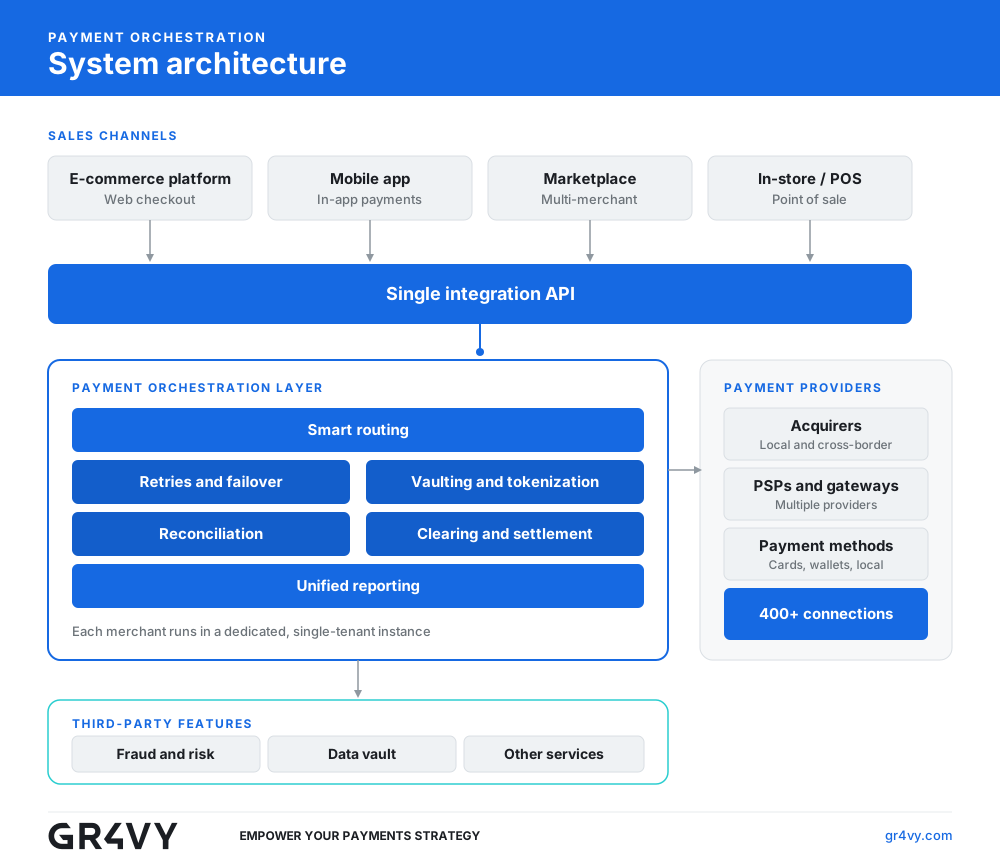
A payment orchestration layer is the technical framework performing the coordination above. It connects to every provider, holds the routing rules, applies retries and fallback, stores payment credentials in a provider-agnostic way, and unifies reporting. When people say payment orchestration platform, the layer is the engine inside it. The layer is what lets a merchant add or change a provider through configuration rather than a new engineering integration.
Benefits of payment orchestration
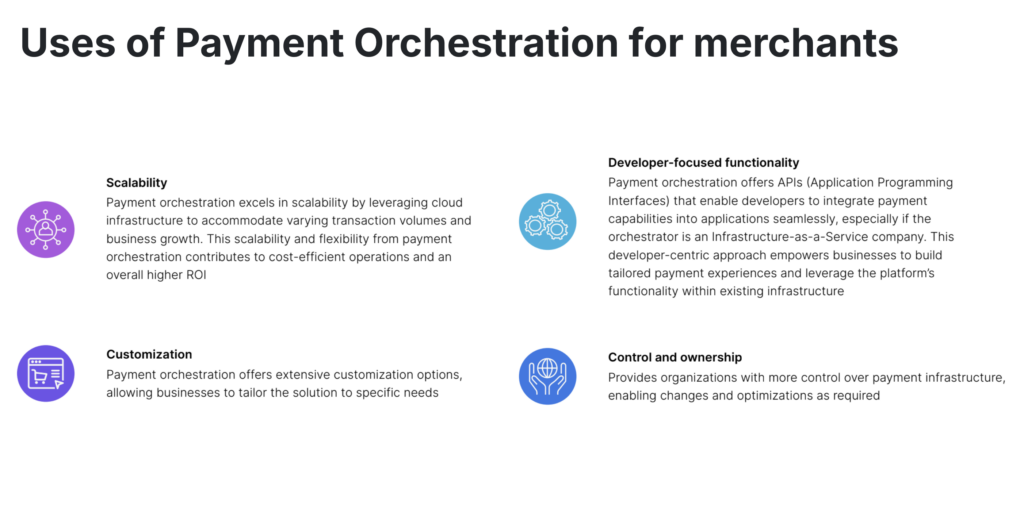
Each of these follows from the same capability: routing across many providers instead of depending on one.
Higher authorization and approval rates
Sending each transaction to the provider most likely to approve it, and retrying recoverable declines through an alternative, recovers revenue a single-provider setup loses.
Australian retailer Baby Bunting recorded a 2.8% uplift in authorization rates within four months of moving to a dual-acquirer setup with failover routing. Sports management platform PlayHQ saw a 6.9% improvement in approvals after adding Mastercard Click to Pay through an orchestration layer.
Lower processing costs
Routing introduces competition between providers and lets a merchant send each transaction along the lowest-cost path that will still get it approved, using local acquiring to avoid cross-border fees. Payment cost stops being a fixed expense and becomes something the business manages.
Mattilda, which handles tuition collection for private schools across Latin America, cut payment costs by 60% by routing across providers rather than standardising on one.
Faster access to methods and markets
The orchestration layer gives access to payment methods, currencies and local acquirers through one integration. Adding a method becomes a configuration change rather than an engineering project.
Ding, the international mobile top-up service, went from three to six weeks down to three days to add a new gateway and local payment method when launching Venmo for its US customers. Gr4vy connects merchants to more than 400 payment providers, methods and anti-fraud services through its connections library.
Resilience and no single point of failure
One provider means one point of failure. Connecting several and rerouting around any that fail keeps payments moving when a provider degrades. For a business where downtime is lost revenue, this alone can justify orchestration.
Unified data and operational control
Running providers separately fragments reporting and forces every change through engineering. Orchestration consolidates data across all providers into one view and lets payments teams build and adjust routing rules from a no-code dashboard.
Core insight: The benefits compound. Better routing lifts approvals, unified data shows where to route next, and configuration instead of code means the team can act on what it sees.
What a payment orchestration platform includes
A platform bundles the orchestration layer with the tools needed to run it. Expect:
- A single integration to many providers and methods
- A routing engine configurable without code
- Retry, failover and fallback logic
- Provider-agnostic vaulting and tokenization of payment credentials
- Support for authentication such as 3DS
- Fraud tool integration
- Unified reporting and reconciliation across every connected provider
Architecture differs between platforms and the difference has consequences. Some run all merchants together in a shared, multi-tenant environment. Others, including Gr4vy, deploy a dedicated single-tenant instance for each merchant, which isolates that merchant’s data and payment traffic and gives control over data residency. This matters most for larger merchants and regulated markets, where data isolation is a requirement rather than a preference. Gr4vy’s Infrastructure as a Service model covers how this is deployed.
What payment orchestration does not solve
Orchestration is sometimes described as though it fixes everything. It does not. These limits are worth stating plainly, because they set realistic expectations for what adopting it changes.
- It does not remove provider fees. Every PSP’s pricing still applies. Orchestration manages how those providers are used; it does not negotiate them away.
- It does not replace acquiring relationships. You still contract with acquirers and PSPs, and their pricing and approval behaviour set the ceiling on what routing can recover.
- It does not approve a transaction every provider would decline. A payment declined for genuinely insufficient funds stays declined. Dynamic retries and alternative routing recover soft declines and provider-side failures, not every failed payment.
- It does not eliminate PCI scope. Vaulting card data outside your own systems reduces the burden significantly, but obligations remain wherever card data touches your environment.
- It does not fix checkout abandonment caused by product, pricing or delivery. Only the share driven by payment friction, a missing local method or a preventable decline is addressable at this layer.
- It does not run itself. Routing rules need configuring thoughtfully and maintaining as provider performance changes. Value tracks the attention given to them.
- It adds a dependency. Putting a layer at the centre of the payment stack means that layer’s own reliability matters. Its uptime, redundancy and whether it profits from routing decisions are all worth scrutinising.
- It carries its own cost. Setup, subscription or per-transaction fees sit on top of provider costs, so the case rests on routing and resilience gains outweighing that added layer.
None of these is a reason to avoid orchestration. Each is a reason to adopt it deliberately.
Core insight: The honest test is whether orchestration solves a specific, quantifiable problem for your business, not whether it sounds like a natural next step.
Who needs payment orchestration, and who does not
Orchestration is not necessary for every business.
You need orchestration if:
- You sell across multiple countries, where local acquiring and local payment methods materially change approval rates and reach
- You use, or plan to use, more than one PSP or acquirer
- Payment downtime is costly enough that resilience justifies the investment on its own
- You run high volume, where routing on cost and recovering declines produces meaningful savings
- You run subscriptions or recurring billing, where recovering failed payments directly reduces involuntary churn
- Your approval rates vary noticeably between markets or corridors
The case is weak if:
- You operate in a single market with modest volume
- One provider already meets your needs and performs well
- You have no near-term plan to add providers or markets
- Nobody on your team would own routing logic and provider performance
- Your payment problems are really product, pricing or delivery problems
If you want to put numbers against your own situation, Gr4vy’s ROI calculator models the expected gain against your current volume and approval rates.
Core insight: Match the decision to your actual payment complexity. Multiple providers, multiple markets, meaningful volume or recurring billing are the conditions that make orchestration pay.
Payment orchestration vs a single PSP
The usual alternative to orchestration is one payment service provider bundling gateway, processing and acquiring together.
| Single PSP | Orchestration layer | |
|---|---|---|
| Integrations to maintain | One | One, covering many providers |
| Adding a provider | Not applicable | Configuration change |
| Adding a local method | New integration, often months | Configuration change |
| Approval rates | One provider’s performance | Routed to the best performer per transaction |
| Provider outage | Payments stop | Failover to an alternative |
| Negotiating position | One relationship | Comparative performance data across providers |
| Reporting | One dashboard | One dashboard across all providers |
| Card data | Held by that PSP | Held in a provider-agnostic Vault |
| Operational overhead | Lower | Routing logic to own and maintain |
| Platform cost | None beyond provider fees | Platform fee on top of provider fees |
A single PSP is simpler and can be the right answer. The tradeoff is one set of approval rates, one pricing relationship and one point of failure. For the detailed comparisons, see Gr4vy’s guides on payment orchestration vs a payment processor and payment orchestration vs payment aggregators.
How to choose a payment orchestration platform
Eight criteria, roughly in order of how often they turn out to matter.
1. Coverage depth in your priority markets
Connector counts are a weak signal. What matters is whether the platform supports the providers, methods and local acquirers in the markets you actually sell in, and whether it has a track record in your sector.
2. Whether the platform is genuinely neutral
Some orchestration providers are also payment processors. When a platform earns more from routing transactions one way than another, its routing recommendations carry a conflict. Ask directly how the platform makes money and whether its economics change based on where transactions go.
3. Sophistication of routing and recovery logic
Does routing respond to live performance or only to fixed rules? How many signals can a single rule evaluate? Can you run controlled tests between providers, version rule sets, and configure retries against issuer response codes rather than a blanket delay?
4. Data ownership and portability
Card data held inside one provider is what makes switching expensive. Ask what happens to your tokens if you leave: whether you can export as PSP token, Network Token or card push, and whether the platform has actually done it for a customer. Gr4vy covers this under data portability.
5. Security and compliance
PCI DSS Level 1 certification, data residency options, and clarity about which obligations transfer to the platform and which stay with you. Gr4vy’s guide on PCI DSS compliance and payment orchestration covers the security dimension.
6. Reliability and redundancy
The layer sits at the centre of the stack, so its own uptime matters as much as your providers’. Ask about uptime history, incident communication, and whether true resilience requires running direct provider integrations as a fallback alongside it.
7. How much your team can do without engineering
The gap between platforms is largest here. Can a payments manager add a provider, change a routing rule, or enable a new method without a release? If not, the operational independence orchestration promises does not arrive.
8. Implementation and support
Ask for a realistic timeline with references at comparable scale. FuturHealth completed its integration in 27 days. The Wikimedia Foundation moved 90% of its payment volume within a year. Both had dedicated support through the process.
Core insight: Two questions separate platforms more than any feature list: how does it make money from your routing, and what happens to your card data if you leave.
Payment orchestration and agentic commerce
AI agents that shop, compare and transact on a consumer’s behalf are a new traffic type, and existing payment stacks were not built for them. Merchants need a way to identify agent-initiated transactions, route them separately, and hold them to their own limits.
Because orchestration already sits at the control layer, it is positioned to do this. Agent transactions can be marked, routed through their own rules, sent to different providers or fraud tools, and capped, without rebuilding the payment stack. That is the broader point in miniature: an orchestration layer lets a business adopt new payment developments through configuration rather than re-engineering. Gr4vy has built an early version of exactly this, described in its guide on payment orchestration for agentic commerce.
Frequently asked questions
What is payment orchestration in simple terms?
Payment orchestration is a technology layer that connects a merchant to many payment providers through one integration and automatically routes each transaction to the provider most likely to approve it at the best cost. Instead of managing separate connections to each provider, the merchant manages one platform and one set of rules. It coordinates payments instead of replacing the providers themselves.
How does payment orchestration work?
It inserts a coordinating layer between the checkout and the payment providers. When a customer pays, the layer evaluates the transaction against the merchant’s rules and live data, routes it to the best-suited provider, applies authentication and fraud checks, and if the transaction is declined can retry it through another provider. It then consolidates the data from every provider into one unified view for reporting and reconciliation.
What is a payment orchestration layer?
A payment orchestration layer is the technical framework that connects to all of a merchant’s payment providers, holds the routing rules, applies retries and fallback, stores payment credentials in a provider-agnostic way, and unifies reporting. It is the engine inside a payment orchestration platform that does the coordination, and it is what allows a merchant to add or change a provider through configuration instead of a new engineering integration.
Is payment orchestration a single point of failure?
Used correctly, orchestration reduces single points of failure rather than creating one, because it connects multiple providers and reroutes around any that fail. The consideration is the orchestration platform’s own reliability, since it sits at the center of the payment stack. This is why the platform’s uptime and redundancy architecture are worth evaluating, and why platforms are designed so the layer itself is resilient.
How much does payment orchestration cost?
An orchestration platform carries its own fees, which may be setup, subscription, or per-transaction, and these sit on top of the underlying costs of the payment providers themselves. The case for orchestration rests on the gains (higher approval rates, lower routing costs, reduced downtime, less engineering overhead) outweighing that added layer of cost, which is why the honest way to evaluate it is to model the specific expected gain against the specific cost for the business.
Do all businesses need payment orchestration?
No. Orchestration is most valuable for businesses selling across multiple markets, using more than one provider, running high volume, or depending on recurring payments. A small, single-market business with one provider that meets its needs may find a single PSP entirely sufficient, and the added cost and complexity of orchestration would not yet pay for itself. The decision should match the business’s actual payment complexity.
What is the difference between payment orchestration and a PSP?
A payment service provider (PSP) processes payments, often bundling a gateway, processing, and acquiring. Payment orchestration is a layer that sits above multiple providers, including PSPs, and routes between them. A single PSP is simpler but means one set of approval rates and one point of failure; orchestration adds control, redundancy, and the ability to optimize across many providers. Some businesses use a PSP directly; others use orchestration to coordinate several.
Does payment orchestration replace my payment providers?
No. Orchestration is a coordinating layer rather than a processor. It sits above a merchant’s existing PSPs, acquirers, and gateways and decides which handles each transaction, so a business can adopt orchestration while keeping the payment relationships it already has. It manages how providers are used rather than replacing them.
How does payment orchestration help with international expansion?
Entering a new market requires supporting local payment methods and, ideally, local acquiring for higher approval rates. Orchestration provides access to those methods and acquirers through one integration, so adding a market becomes a configuration step instead of a separate engineering project for each country. This is one of the most common reasons cross-border businesses adopt orchestration.
Where payment orchestration is heading
Payment orchestration began as a way to manage the growing complexity of digital payments, and it has become the control layer through which many merchants run their entire payment operation. The core value has stayed constant: connect many providers through one integration, route each transaction intelligently, add resilience, and keep ownership of the data and the decisions. What changes is the range of things that control layer can do, from lifting approval rates and cutting costs today to coordinating agent-initiated transactions as commerce shifts toward AI.
For a business, the practical question is not whether orchestration is impressive in the abstract but whether its own payments are complex enough to benefit: multiple providers or markets, meaningful volume, costly downtime, or recurring billing to protect. Where those conditions hold, orchestration turns a fragmented, engineering-bound payment operation into one a team can control and optimize directly.
Gr4vy is a cloud-native payment orchestration platform that connects merchants to more than 400 payment providers and methods through a single integration, with each merchant running in its own dedicated instance for control over data and configuration. To talk through whether orchestration fits your payment operation, get in touch with our team.