GR4VY

Payment orchestration vs payment gateway vs payment processor: the definitive comparison

Most businesses use the terms payment gateway, payment processor, and payment orchestration platform as if they were interchangeable. They are not. Each plays a distinct role in moving money from a customer’s account to a merchant’s bank account, and the differences matter the moment your business grows beyond a single market or a single provider.

This guide explains what each one does, where the boundaries actually lie, and how to decide which combination is right for your business. By the end, you’ll be able to read any payment vendor’s marketing page and immediately identify which layers they cover and which ones they don’t.

Quick definitions

For readers who need the short version:

  • A payment gateway is the technology that captures payment details at checkout and sends them securely to a payment processor. It is the front door of the payment flow.
  • A payment processor is the service that moves the authorization request from the gateway to the card networks, then settles funds between the customer’s bank and the merchant’s bank. It is the engine that moves money.
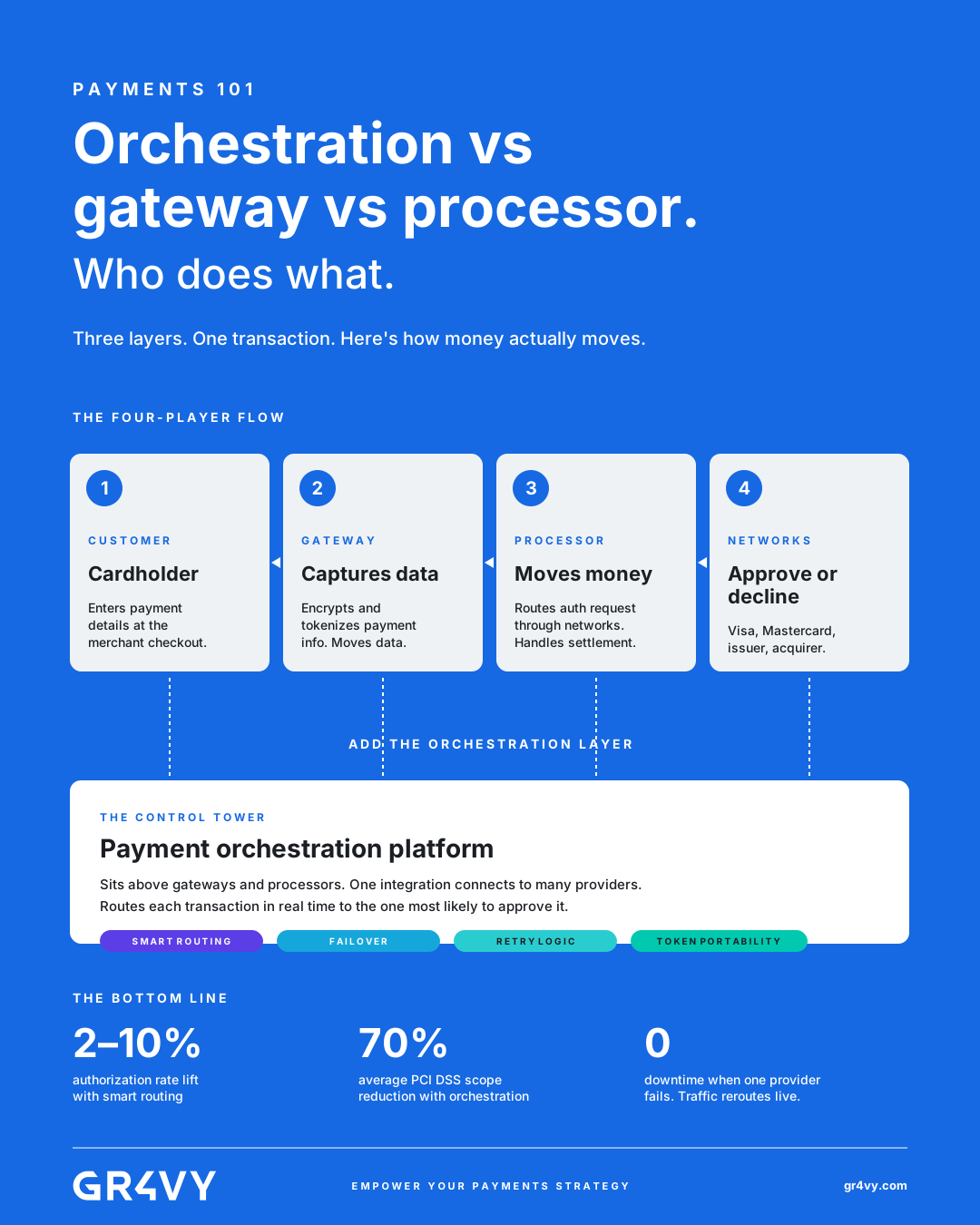
  • A payment orchestration platform is a layer above gateways and processors that connects to many of them at once, intelligently routes each transaction to the best one, and gives the merchant a single integration to manage the entire stack. It is the control tower.

The rest of this article unpacks each one in depth, shows how they interact during a real transaction, and provides a decision framework based on business stage, geography, and volume.

How a card payment actually works: the four-player model

Before comparing the three layers, it helps to understand the underlying choreography. A typical online card transaction involves four core players, with payment orchestration sitting on top as an optional fifth layer:

#PlayerRole
1Cardholder (customer)Initiates payment with card details
2Issuing bankBank that issued the customer’s card and holds the funds
3Card networkVisa, Mastercard, Amex, Discover, JCB, UnionPay, and others
4Acquiring bank (merchant bank)Bank that holds the merchant’s account and receives funds

Around these four banks and networks, three commercial layers handle the technology:

  1. The gateway captures and encrypts payment data at the merchant’s checkout
  2. The processor routes the authorization request through the card network to the issuing bank, then handles settlement back to the acquirer
  3. The orchestration platform (optional) sits above one or more gateways and processors, choosing which one to use for each transaction

When orchestration is added, the gateway and processor layers can be plural rather than singular, with the orchestration platform deciding which gateway, which processor, and which acquirer to use for each individual transaction in real time.

What is a payment gateway?

A payment gateway is the technology that connects a merchant’s website or app to the rest of the payment ecosystem. It does three core jobs: collect payment details at the point of sale, encrypt and tokenize that data, and pass it to a payment processor for authorization.

If you imagine the in-person equivalent, the gateway is the card reader on the counter. It captures the card information, secures it, and hands it off to the systems behind it. It does not move money. It moves information about a payment.

What a payment gateway actually does

A modern gateway typically provides:

  • A hosted checkout page or embeddable payment form
  • Encryption and tokenization of card details to keep raw card numbers out of the merchant’s systems
  • Basic fraud screening (CVV checks, AVS, velocity rules)
  • Transmission of the authorization request to the processor
  • Return of the approval or decline response to the merchant
  • Storage of payment credentials for repeat purchases (in many cases)

A gateway connects to one processor in most setups. Some larger gateways connect to several, but the merchant typically chooses one primary route and treats the others as backup. The gateway does not negotiate interchange fees, hold merchant funds, or settle transactions. It is purely a secure conduit.

Examples of payment gateways

Common gateways include Authorize.net, NMI, Cybersource, and Worldpay’s gateway products. Many providers brand themselves as gateways while also offering processing or acquiring services through the same parent company, which is part of why the terms get blurred in the market.

When a payment gateway alone is enough

A gateway works well when a business operates in one market, processes through a single acquirer, sells primarily to card-paying customers, and has predictable transaction volumes. For a small or mid-market merchant selling domestically, a gateway plus its associated processor often delivers everything needed.

The limits show up when the business expands into new geographies, wants to add local payment methods, needs higher authorization rates, or finds itself dependent on a single provider whose outages and pricing it cannot influence.

What is a payment processor?

A payment processor is the service that actually moves the authorization request through the payment networks and, after authorization, handles the settlement of funds. Where a gateway moves information, a processor moves money.

The processor sits between the gateway and the acquiring bank, with the card networks (Visa, Mastercard, and others) in the middle. When a customer’s card details arrive at the processor, the processor formats the authorization request for the relevant card network, transmits it through the network to the customer’s issuing bank, receives the approve-or-decline response, and returns that response back to the gateway. Later, during settlement (usually at end-of-day batch processing), the processor coordinates the actual movement of funds from the issuing bank through the card network to the acquiring bank, where the merchant’s account is held.

What a payment processor actually does

A processor’s responsibilities include:

  • Formatting and transmitting authorization requests to the correct card network
  • Receiving and relaying issuer responses (approved, declined, soft decline, fraud flag)
  • Handling end-of-day clearing and settlement files
  • Managing chargebacks and disputes
  • Reporting on transaction performance, fees, and reconciliation
  • Compliance with card scheme rules (PCI DSS, regional regulations, scheme-specific requirements)

Some processors also act as acquirers, holding the merchant account directly. Others connect to a separate acquiring bank. Stripe, Adyen, and Square are well-known examples of providers that combine processing and acquiring in a single offering, which simplifies setup at the cost of some flexibility.

Front-end and back-end processors

Within processing, there are technically two sub-roles. Front-end processors handle the live authorization request during checkout. Back-end processors handle the batch settlement at end of day. Most modern processors do both, but in enterprise stacks, these are sometimes separated for performance and reliability reasons.

When a payment processor (or gateway-plus-processor combo) is enough

A bundled gateway-plus-processor offering, such as one from Stripe, Adyen, or a traditional acquirer, covers most needs for businesses with straightforward payment requirements. The advantages are a single integration, one contract, one support relationship, and unified reporting.

The trade-off is vendor concentration. Authorization rates are limited to whatever that single processor can deliver. Outages stop payment acceptance entirely. Adding new payment methods waits on the provider’s roadmap. Cross-border transactions go through whatever acquiring relationships the provider has, even when a local acquirer would deliver higher approval rates at lower cost. These limitations are the reason payment orchestration exists.
What is a payment orchestration platform?

A payment orchestration platform sits above gateways, processors, and acquirers as a single integration layer that connects to many of them at once. The merchant integrates the orchestration platform once, and the platform handles the routing of each transaction to whichever gateway, processor, or acquirer is best suited to it.

A payment orchestration platform (POP) is a centralized payment management system that connects businesses to multiple payment service providers, acquirers, and fraud prevention tools through a single integration. Routing decisions are typically made in real time based on configurable business rules, historical performance data, cost optimization, geography, currency, and the specific payment method being used.

What a payment orchestration platform actually does

A modern orchestration platform typically provides:

  • A single API integration that abstracts away the differences between underlying providers
  • Real-time transaction routing across multiple gateways, processors, and acquirers
  • Smart retry logic for soft declines, with retries routed to alternative providers
  • Provider-agnostic tokenization and vaulting (so card data is not locked to one PSP)
  • Network token management across Visa, Mastercard, and other schemes
  • Failover and redundancy across providers to handle outages
  • Centralized reporting and analytics across the entire payment stack
  • Fraud orchestration across multiple fraud and risk providers
  • A no-code or low-code rules engine for routing logic, retry rules, and 3D Secure decisions
  • Unified compliance management (PCI DSS scope reduction, SCA orchestration, regional rules)

For a deeper view of what an orchestration platform does day to day, see Gr4vy’s guide on what a payment orchestration platform is and why your business needs one.

Examples of payment orchestration platforms

The category includes Gr4vy, Primer, Spreedly, Yuno, IXOPAY, Cellpoint Digital, and a small number of others. Some are infrastructure-as-a-service (single-tenant, deployed per merchant), while others are software-as-a-service (multi-tenant, shared infrastructure). The architectural choice affects performance, customization, data localization, and PCI scope.

When a payment orchestration platform is the right choice

Orchestration starts paying off when a business operates across multiple geographies, processes high transaction volume, needs to support multiple payment methods (cards, wallets, BNPL, local methods), has experienced or feared a payment outage with no failover, or finds its engineering team spending significant time managing PSP integrations rather than building product. The break-even point varies, but most enterprise merchants find orchestration valuable once payment volume exceeds roughly $50M annually or once they begin operating in more than two markets.

The definitive comparison table

The differences between the three layers across every dimension that matters for an enterprise decision:

DimensionPayment gatewayPayment processorPayment orchestration platform
Primary functionCapture and transmit payment dataAuthorize, clear, and settle transactionsCoordinate multiple gateways, processors, and providers
Position in flowFront of the stack (customer-facing)Middle of the stackLayer above gateways and processors
Moves money?No (moves information)YesNo (orchestrates the providers that move money)
Number of provider connectionsTypically one processorOne acquirer (sometimes more)Many gateways, processors, and acquirers
Routing intelligenceNone or basicLimited (within their own network)Advanced, rule-based, real-time
Failover supportNoneNone (single point of failure)Multi-provider redundancy
Token portabilityTokens locked to gatewayTokens locked to processorProvider-agnostic vault, network tokens
New payment method onboardingRoadmap-dependentRoadmap-dependentConfiguration-based, often days
Geographic flexibilityLimited to gateway’s coverageLimited to acquirer’s coverageCross-acquirer routing, local acquiring per market
Cost optimizationNoneLimitedRoutes by acquirer cost, declines, performance
PCI DSS scope reductionSome (depends on integration mode)Some (depends on integration mode)Significant (centralized vaulting)
ReportingSingle-provider viewSingle-processor viewUnified across all providers
Authorization rate optimizationNoneWithin own network onlyCross-provider, intelligent routing
Vendor lock-in riskHigh (data tied to gateway)High (data tied to processor)Low (designed for portability)
Integration complexityLowLow (when bundled with gateway)Higher up-front, lower long-term
Best forSingle-market, lower-volume merchantsBundled with a gateway for most merchantsMulti-market, multi-PSP, high-volume merchants

Where do PSPs and acquirers fit in?

Two more terms come up constantly in this conversation: payment service provider (PSP) and acquirer. They are not separate layers in the same sense as the three above. They are different ways of describing what a provider does.

A payment service provider is a commercial label, not a technical layer. A PSP is any company that offers payment acceptance services to merchants. In practice, a PSP usually bundles a gateway and a processor (and sometimes an acquirer) into one product. Stripe is a PSP. Adyen is a PSP. PayPal is a PSP. The category is broad and the term is used loosely.

An acquirer (or acquiring bank, merchant acquirer) is the financial institution that holds the merchant’s account and is licensed by the card networks to accept transactions on the merchant’s behalf. Acquirers are the regulated banking entity at the end of the chain. Some processors are also acquirers, some are not.

So the layers, end to end, are:

  1. Gateway captures and secures the payment data
  2. Processor moves the data through the networks and handles settlement
  3. Acquirer holds the merchant account and is licensed by the card networks
  4. (Optional) Orchestration platform sits above 1, 2, and 3, connecting to many of each

PSPs are simply commercial bundles that combine some or all of layers 1, 2, and 3 into a single offering.

How payment orchestration improves on the gateway-and-processor model

If a single gateway-and-processor combination handles the full transaction flow, what does orchestration add? Five concrete improvements, each measurable in revenue or cost.

Higher authorization rates through intelligent routing

A single processor sends every transaction down the same path. When that path performs poorly for certain card BINs, regions, or customer profiles, the merchant loses those transactions. Orchestration platforms route each transaction in real time to the gateway, processor, or acquirer most likely to approve it, based on historical performance data, the card type, the geography, and the currency.

Merchants implementing orchestration-based routing typically see authorization rate improvements of 2 to 4% immediately, with 5 to 10% gains as rules are refined over time. For cross-border transactions specifically, routing through a local acquirer can deliver up to 16% higher acceptance than the same transaction sent through a single foreign processor. For a deeper view of this layer, see intelligent payment routing.

Failover and resilience during provider outages

Every payment provider has outages. When a single-PSP merchant’s provider goes down, payment acceptance stops entirely until service is restored. Orchestration platforms automatically reroute transactions to alternative providers during outages, with no customer-facing disruption.

This is no longer a niche concern. Payment outages have been estimated to cost businesses tens of billions of dollars annually in lost sales, and that figure excludes the engineering hours spent on emergency fixes and the damage to customer trust.

Provider-agnostic tokenization and freedom from lock-in

When a merchant stores cards with a single processor, those tokens only work within that processor’s system. Switching providers means re-collecting card data from every customer, which is operationally costly and often impossible at scale.

Orchestration platforms maintain a provider-agnostic vault. Tokens can be used across any connected processor, and network tokens (issued by Visa, Mastercard, and other schemes) update automatically when underlying cards are reissued or expire. The merchant owns its payment data, not the provider.

Faster onboarding of new payment methods

Adding a new payment method through a traditional gateway or processor depends on the provider’s product roadmap. The merchant waits for the provider to support Apple Pay, then PIX, then iDEAL, then BNPL, often for months. Through orchestration, new methods can typically be added in days through configuration rather than custom development, because the orchestration platform already maintains the integrations.

A range of alternative payment methods including wallets, BNPL, and local schemes becomes available with the flip of a switch rather than a development project.

Significant PCI DSS scope reduction

Each system that stores, processes, or transmits cardholder data falls under PCI DSS audit scope. Traditional architectures with multiple gateway and processor integrations multiply this scope across every connected system. Centralizing payment data through an orchestration platform with a single vault and a single set of API controls dramatically reduces the merchant’s PCI footprint, often by 70% or more, depending on the architecture before migration. For more on this, see Gr4vy’s analysis of PCI DSS compliance and payment orchestration.

How to choose: a decision framework

The right answer depends on a small number of business characteristics. The following framework cuts through the marketing noise:

Choose a payment gateway (alone, or paired with a processor) when

  • You operate in a single country or small region
  • Card transactions account for the vast majority of your payment volume
  • Your annual payment volume is under roughly $10M
  • You do not anticipate rapid international expansion
  • You have limited engineering resources and need a fast time to market
  • Your tolerance for vendor concentration is high

Choose a bundled PSP (Stripe, Adyen, etc.) when

  • You want a single contract, single integration, and single support relationship
  • You operate in one to three markets
  • Your annual payment volume is between roughly $10M and $50M
  • Your customers primarily pay with cards and major wallets
  • You value speed of implementation over routing flexibility
  • You accept that authorization rates, costs, and capabilities will be capped by your provider

Choose a payment orchestration platform when

  • You operate in multiple geographies (especially across continents)
  • You have experienced or fear a payment outage that no failover can mitigate
  • Annual payment volume exceeds $50M and growing
  • You want to add multiple alternative and local payment methods quickly
  • Authorization rate improvements of 2 to 10% would materially affect revenue
  • You want to own your payment data and avoid PSP lock-in
  • Your engineering team is spending significant time on payment integrations
  • You need cross-provider analytics that no single provider can give you

For a closer look at the strategic case, our analysis of how to increase payment approval rates in 2026 walks through the specific levers orchestration unlocks.

Common misconceptions

A few persistent myths get in the way of clear decisions.

“My PSP already does orchestration.” Most PSPs route transactions only within their own network. True orchestration means routing across competing providers, which a single-PSP architecture cannot do. If your “orchestration” feature stops at your provider’s borders, it is not orchestration.

“Orchestration is just another middleman that adds cost.” Orchestration platforms charge a small per-transaction fee, but the authorization rate lift, cost optimization through smart routing, and operational savings typically exceed that fee by multiples. For enterprise volume, the ROI is usually visible within the first quarter of operation.

“I can build orchestration in-house.” Some merchants do, but the engineering effort is significant. A functional in-house orchestration layer requires multi-PSP integrations, a provider-agnostic vault, a rules engine, network token management, failover logic, reconciliation across providers, fraud orchestration, PCI DSS compliance for the vault, and ongoing maintenance as each underlying provider’s API evolves. Most teams that estimate the cost honestly choose to buy.

“Orchestration is only for huge merchants.” The threshold has come down significantly. Merchants in the $20M to $50M annual volume range increasingly find orchestration valuable, particularly if they sell internationally or rely on subscriptions.

Frequently asked questions

What is the difference between a payment gateway and a payment processor?

A payment gateway captures and securely transmits payment information from the customer to the processor. A payment processor moves the authorization request through the card networks to the customer’s bank, then handles the settlement of funds. The gateway moves information; the processor moves money. Most modern providers bundle the two together, which is why the terms are often used interchangeably even though they describe different functions.

What is the difference between a payment processor and a payment orchestration platform?

A payment processor handles the technical movement of a transaction through the card networks for a single provider relationship. A payment orchestration platform sits above one or more processors and routes each transaction to the best one based on real-time rules. Orchestration is not a replacement for processing; it is a coordination layer that uses multiple processors and gateways at once.

Do I need both a payment gateway and a payment processor?

You need both functions, but you do not necessarily need them from two different vendors. Most merchants buy them bundled as part of a single PSP product. The relevant question is not whether you have both, but whether your gateway and processor offer the routing flexibility, geographic coverage, and resilience your business actually needs.

Can a payment orchestration platform replace my existing PSP?

No, and that is not what orchestration is designed to do. Orchestration platforms work alongside existing PSPs, processors, and gateways. The merchant continues to maintain commercial relationships with those providers; the orchestration platform manages the routing and provides a unified integration on top.

What is the difference between a PSP and a payment orchestration platform?

A PSP (payment service provider) is a single commercial bundle that provides gateway, processing, and sometimes acquiring services. A payment orchestration platform connects to multiple PSPs at once and routes transactions across them. A PSP is one provider; orchestration is the layer that coordinates many providers.

How does payment orchestration affect PCI DSS compliance?

Orchestration platforms typically reduce a merchant’s PCI DSS scope significantly, often by 70% or more, by centralizing card data storage in a single PCI Level 1 compliant vault rather than spreading it across multiple gateway and processor integrations. This simplifies audits, reduces ongoing compliance overhead, and makes it easier to comply with newer requirements such as PCI DSS 4.0.1.

Does payment orchestration add latency to checkout?

A well-architected orchestration platform adds minimal latency, typically under 50 milliseconds per transaction. Single-tenant orchestration architectures (where the platform is deployed dedicated to one merchant) tend to perform better than multi-tenant ones because they avoid shared-infrastructure contention. The latency added is usually invisible to customers and is more than offset by the higher authorization rates orchestration enables.

How long does it take to implement payment orchestration?

Implementation timelines vary by complexity, but most merchants are live with their primary PSP routed through orchestration within four to eight weeks. Adding additional providers, optimizing routing rules, and migrating stored credentials typically continues for another one to three months. The up-front effort is greater than a single PSP integration, but it replaces many future integrations.

Is orchestration only useful for cards, or does it cover other payment methods?

Orchestration covers cards, digital wallets (Apple Pay, Google Pay, Click to Pay), buy now pay later providers (Klarna, Afterpay, Affirm), local methods (PIX, iDEAL, UPI), bank transfers, and increasingly, agentic and AI-initiated payments. The benefit of orchestration grows with each additional method, because managing them all through one integration is dramatically simpler than maintaining direct connections to each provider.

Bringing it together

The three layers are not competitors. They are complementary parts of the same payment stack, and the right architecture depends on where your business is now and where it is going.

Gateways and processors are necessary in every payment flow. Whether you buy them from one vendor or several, whether you call your provider a PSP or something else, the core functions of capturing payment data and moving money through the card networks must exist.

Payment orchestration becomes valuable the moment a single-provider architecture starts costing you more than it saves: through declined transactions you could have recovered, through outages that stop your business, through engineering time absorbed by integrations rather than product, or through the inability to expand into a market your provider does not serve well.

If you’re evaluating where your payment stack sits on this spectrum and what orchestration could unlock for your business, contact our team for a walkthrough of how Gr4vy’s cloud-native orchestration platform fits into the architecture you already have.

Checkout optimization: 13 strategies to reduce abandonment

The average online checkout loses seven out of every ten shoppers. Across all industries, the global cart abandonment rate sits at 70.19%, a figure that has remained stubbornly consistent for more than a decade despite billions invested in ecommerce platforms, marketing automation, and recovery emails. On mobile, abandonment climbs higher, reaching nearly 85% in many verticals.

The biggest opportunity for most enterprise merchants lies in keeping the traffic they already have. Every percentage point recovered at checkout flows directly to the bottom line, with no acquisition cost attached.

This guide breaks down checkout optimization into two disciplines that must work in tandem: the design principles that shape what shoppers see and feel, and the technical tactics that determine whether their payment actually goes through. Most articles focus on one or the other. The merchants who lead their categories invest in both.

Why shoppers abandon: the four root causes

Before optimizing anything, you need to know what you are optimizing against. Baymard Institute research, cited consistently across recent industry analyses, identifies four primary drivers of checkout abandonment:

Reason for abandonmentShare of abandoners
Unexpected costs (shipping, taxes, fees)48%
Forced account creation24%
Trust deficit and security concerns18%
Payment friction (limited or missing methods)13%

Each of these is a solvable problem. None of them require shoppers to “change their mind.” They require the merchant to remove a specific point of friction. The strategies below map directly onto these four root causes, with design tactics addressing the first three and technical tactics addressing the fourth and most often overlooked.

Part 1: Design principles that reduce abandonment

Make the total cost visible before checkout

Unexpected costs account for nearly half of all abandonment, and the answer is earlier transparency. Shipping, taxes, duties, and any platform fees should appear on the product page or in the cart, well before the final step of payment.

Real-time shipping calculators that update as customers enter a postcode set accurate expectations from the start. For cross-border transactions, surfacing estimated duties before checkout has become table stakes. The principle is simple: a customer who knows the total at the cart stage will not feel ambushed at the payment stage.

Offer guest checkout as the default path

Forced account creation drives 24% of abandonment, and the reason is structural. A first-time buyer has no relationship with your brand yet, so asking them to commit to one before completing a single transaction reverses the natural sequence. Account creation works better as a reward for a good experience than as a prerequisite for one.

The strongest pattern is to present guest checkout as the primary option and offer account creation after the purchase confirmation, when the customer already has a positive memory of your brand. An email address is enough to start. The relationship can grow from there.

Use a single-column, mobile-first layout

Mobile commerce now drives the majority of ecommerce traffic in most categories, yet mobile checkouts often convert at less than half the desktop rate. The gap rarely comes from device capability. It comes from design choices that work on a 27-inch monitor but fail on a 6-inch screen.

The patterns that consistently lift mobile conversion include:

  • Single-column layouts that avoid horizontal jumps and keep the form scannable
  • Sticky pay buttons anchored to the bottom of the viewport so the primary action stays visible
  • Large, thumb-friendly tap targets sized for fingers rather than cursors
  • Autofill and address lookup to reduce typing on small keyboards
  • Native biometric authentication through digital wallets where supported

For a deeper exploration of how to design specifically for smartphone shoppers, our mobile checkout best practices guide breaks down each layer of the mobile payment flow.

Minimize form fields and use real-time validation

The shortest checkout that captures the data you genuinely need will outperform the longest one every time. Audit every field and ask whether it is required for the transaction or merely useful for marketing. If the answer is the latter, move it to the post-purchase flow.

Real-time validation matters as much as field count. When a customer enters an invalid card number or a malformed postcode, the error should appear in context, immediately, with a clear correction path. The worst experience is tapping “Pay” and watching the entire form reset.

Build trust through visible security signals

Trust deficit accounts for 18% of abandonment, and most of it is preventable through design choices that cost nothing. Visible HTTPS indicators, recognizable security badges, clear privacy statements next to payment fields, and prominent display of accepted payment networks all reduce the hesitation that kills conversion at the final step.

Microcopy matters here as well. A short line such as “Your card is processed securely and never stored on our servers” placed directly above the pay button addresses the specific anxiety the customer is feeling in that moment. Customers form trust at the point of decision, where general assurances on a separate page rarely reach them.

Eliminate distractions on the checkout page

By the time a customer reaches checkout, your job is to help them finish. Upsells, cross-sells, and newsletter prompts work better elsewhere. Remove the main navigation, hide promotional banners, and let the checkout do one thing well. Every additional click target is an opportunity to lose the sale.

Part 2: Technical tactics that recover the payments shoppers want to make

Design optimization handles the first three causes of abandonment. The fourth cause, payment friction, is a technical problem with a technical solution. It is also often the largest single source of recoverable revenue, because it includes both shoppers who give up before trying to pay and shoppers whose payments fail despite their best efforts.

Offer the payment methods your shoppers actually use

Cards alone are no longer enough. Digital wallets such as Apple Pay and Google Pay deliver consistently higher acceptance rates thanks to tokenized credentials and built-in biometric authentication. Buy Now, Pay Later (BNPL) options have been shown to reduce abandonment by around 20% for orders over $100, and by nearly 30% for shoppers aged 18 to 34. Local methods such as PIX in Brazil, iDEAL in the Netherlands, and UPI in India are the default in their respective markets, and offering them is the most effective way to enter those markets without losing the majority of transactions.

The strategic implication is that your payment method mix should reflect where your customers are, rather than where your payment provider’s coverage happens to be strongest. A range of alternative payment methods including wallets, BNPL, and local schemes is now a baseline expectation for cross-border merchants.

Implement intelligent payment routing

When a customer taps “Pay,” the transaction does not have to go through a single, fixed processor. With intelligent payment routing, each transaction can be directed in real time to the acquirer or PSP most likely to approve it based on card type, BIN range, geography, currency, and historical performance data.

The impact is measurable. Merchants implementing orchestration-based routing typically see authorization rate improvements of 2 to 4% immediately, with 5 to 10% gains as rules are refined over time. For businesses operating across multiple markets, transactions routed through local acquirers can achieve up to 16% higher acceptance rates than the same transactions sent through a single foreign processor. A 5% lift on a payment volume of $100 million represents $5 million of recovered revenue that was already won at the cart and lost at the processor.

Set up smart retry logic for soft declines

Not every decline is final. Soft declines, caused by temporary issues such as insufficient funds, network timeouts, or issuer-side rate limits, represent some of the most recoverable revenue in any payment stack. The mistake is treating them with static retry schedules that fire every three or six days regardless of context.

Smart retry logic adapts to the decline reason and customer context. Insufficient-funds declines should be retried in line with typical payroll cycles. Network timeouts can often be retried within seconds through a different acquirer. Hard declines such as closed accounts or fraud flags should never be retried, because retrying them wastes processing fees and can damage your standing with issuers.

Use network tokenization to keep credentials fresh

Card-on-file transactions, subscription renewals, and one-click repeat purchases all depend on stored credentials staying valid. When a customer’s card is reissued, lost, or expires, the merchant’s stored card data goes stale, and the next transaction declines, often without the customer noticing until they wonder why their subscription stopped working.

Network tokenization replaces the stored card number with a network-issued token, provided by Visa, Mastercard, and other schemes, that automatically updates when the underlying card changes. The effect on subscription and repeat-purchase businesses is significant: declines from expired or reissued cards typically drop by around 18% after rollout, and the customer experience stays smooth throughout.

Plan for failover and multi-provider redundancy

A single payment provider creates a single point of failure. When that provider has an outage, and every provider does periodically, transactions fail until service is restored. Multi-provider redundancy, managed through a payment orchestration platform, allows transactions to automatically fail over to an alternative acquirer when the primary is degraded, with no customer-facing disruption.

This has stopped being optional infrastructure for enterprise merchants. Payment outages were estimated to cost businesses $44 billion in lost sales annually, and that figure does not include the engineering hours spent on emergency fixes or the customer relationships damaged by checkout failures during peak traffic.

Balance fraud prevention against false declines

Aggressive fraud rules feel safe, yet they often block more legitimate revenue than they save in chargebacks. False declines, where legitimate transactions are blocked by overly strict filters, are now widely understood to cost most merchants more than the fraud those filters prevent. The goal should be to maximize profitable, low-risk revenue rather than minimize fraud at any cost.

Modern fraud strategy treats risk dynamically. Trusted, returning customers move through a frictionless flow. Higher-risk transactions are routed through dedicated fraud engines or stepped up through 3D Secure only when the signal warrants it. The result is fewer false declines and lower fraud losses at the same time.

For a complete framework on improving the end-to-end payment success rate, see our guide on how to increase payment approval rates in 2026.

How design and technical tactics reinforce each other

The merchants who reduce abandonment the most are the ones who invest in both layers at once:

LayerWhat it controlsWhat it fixes
Design and UXWhat shoppers see, feel, and trustHesitation, surprise costs, friction, drop-off before payment attempt
Payment infrastructureWhat happens after “Pay” is tappedDeclined transactions, processor outages, false declines, missed retries

A beautiful checkout that routes every transaction through a single underperforming acquirer will still leak revenue. A perfectly orchestrated payment stack hidden behind a confusing eight-step form will lose the customer before authorization is even attempted. The two work in series, and a weakness in either undermines the strength of the other.

This is why payment orchestration has moved from a back-office concern to a strategic priority. By separating checkout design from payment routing logic, orchestration allows merchants to iterate on the customer experience and the technical performance independently, and to A/B test changes to each without rebuilding the other.

A practical checkout optimization checklist

Use this as a baseline audit. Each item is a known driver of abandonment or authorization loss.

Design and UX:

  • Total cost (including shipping and taxes) visible before the final step
  • Guest checkout offered as the default path
  • Single-column, mobile-first layout with a sticky pay button
  • Form fields reduced to what is genuinely required
  • Real-time field validation with clear error messaging
  • Visible security signals next to payment fields
  • No navigation, banners, or upsells inside the checkout flow

Payment infrastructure:

  • Digital wallets enabled (Apple Pay, Google Pay, Click to Pay)
  • BNPL available for relevant order values and demographics
  • Local payment methods offered in every market you sell into
  • Intelligent routing across multiple acquirers and PSPs
  • Smart retry logic configured by decline reason
  • Network tokenization in place for stored credentials
  • Failover and redundancy across providers
  • Fraud rules tuned to reduce false declines, not just block fraud
  • Unified analytics across all providers to identify decline patterns

Frequently asked questions

What is checkout optimization?

Checkout optimization is the practice of reducing friction and increasing payment success across every stage of the purchase flow, from the moment a customer reaches the cart to the moment funds are confirmed. It combines design and UX improvements that lower abandonment before payment with technical improvements that maximize authorization rates after payment is attempted.

What is the most common reason for checkout abandonment?

Unexpected costs, including shipping, taxes, duties, and other fees revealed late in the flow, account for roughly 48% of abandonment. Surfacing the total cost on the product page or in the cart, rather than at the final step, is the highest-impact design change for most merchants.

How much can payment orchestration improve authorization rates?

Merchants typically see a 2 to 4% improvement immediately after implementing orchestration-based routing, with 5 to 10% gains as rules are refined over time. For cross-border transactions, local routing can deliver up to 16% higher acceptance compared with a single foreign processor.

Is single-page checkout always better than multi-step?

Not always. The data favors consolidation for most categories, but the right structure depends on the complexity of the transaction and the volume of data captured. The principle that holds in every case is to minimize required fields and make progress visible, whether that progress sits on one page or three.

Do I need orchestration if I only use one PSP today?

Single-PSP setups work until they don’t. The risks include outages with no failover, suboptimal routing on cross-border transactions, an inability to add new payment methods without engineering work, and stored credentials that cannot be tokenized across networks. Orchestration is the layer that protects against all four without requiring you to drop your existing provider.

What checkout conversion rate should I aim for?

Industry benchmarks vary widely by vertical, average order value, and geography. As a directional reference, best-in-class merchants using modern optimization techniques achieve authorization rates above 96% and checkout completion rates well above the 30% global average. The more useful comparison is your own performance month over month, segmented by device, market, and payment method.

Does 3D Secure hurt conversion?

3D Secure adds an authentication step, which historically introduced drop-off. Modern implementations such as 3DS2 use risk-based authentication, applying friction only to transactions that genuinely require it. When deployed selectively through an orchestration layer, 3D Secure can actually improve net revenue by reducing fraud-related declines without penalizing low-risk customers.

Turn checkout into a revenue engine

A 70% abandonment rate is not inevitable. It reflects the cumulative weight of design choices that surprise the customer, infrastructure that declines transactions the customer wanted to complete, and gaps between the two that no single team owns end-to-end. Closing those gaps is some of the most profitable work in ecommerce, because every percentage point recovered is revenue that cost nothing to acquire.

Gr4vy’s cloud-native payment orchestration platform gives enterprise merchants the infrastructure to do this work without rebuilding their checkout from scratch. Through one universal integration, you can route transactions intelligently across multiple PSPs, add new payment methods without engineering effort, apply smart retry logic, and continuously test what converts, all from a no-code dashboard.

If you’re ready to reduce abandonment and recover the revenue your checkout is currently losing, contact our team to see what your authorization rate could look like with the right payment infrastructure behind it.

Architecting new revenue lines through embedded and white-label payments

For years, platforms treated payments as a necessary layer to enable transactions. Something to plug in, manage, and move on from. But as margins tighten and competition increases, that mindset is shifting. Payments are becoming a product. One that can be packaged, monetized, and differentiated. This is where embedded and white-label payments come in.

The shift from enablement to monetization 

Platforms are no longer satisfied with simply facilitating payments for their users. They want to participate in the economics of every transaction. Embedded payments make this possible. By integrating payments directly into their product experience, platforms can remove friction, improve conversion, and create a more seamless journey for their merchants or end users.

White-label payments take it a step further. Instead of exposing third-party providers, platforms can offer payments under their own brand. The experience becomes unified. The relationship stays owned. And the platform becomes central to the transaction. What was once an operational layer becomes a commercial one.

The hidden value inside the payment flow

Every transaction carries more than just payment data. It carries insight, control, and opportunity. When platforms own the payment experience, they gain access to richer data across their ecosystem. They can understand how users transact, where friction occurs, and how performance varies across regions or methods. This unlocks new possibilities. Pricing strategies can be optimized. Payment methods can be tailored to specific segments. Workflows can be customized per merchant, geography, or use case.

More importantly, platforms can introduce new monetization models. Transaction fees, value-added services, premium payment options, and financial products all become viable once payments are embedded into the core experience. The payment flow becomes a lever for growth, not just a cost center.

Why traditional models fall short

Many platforms still rely on rigid payment setups. A single provider. Limited flexibility. Little control over how transactions are processed or optimized. This creates constraints.

Merchants on the platform are forced into the same payment stack, regardless of their needs. Expansion into new markets becomes slower and more complex. Opportunities to optimize cost or performance are missed.

Most critically, the platform has limited ability to innovate. Payments remain static, while the rest of the product evolves. In a world where differentiation matters, this is a disadvantage.

Building for flexibility and scale

To unlock the full value of embedded and white-label payments, platforms need flexibility at their core. They need to support different payment methods across regions without rebuilding their stack. They need to configure workflows for different merchants without engineering effort. They need to adapt quickly as markets, regulations, and customer expectations change.

This requires an infrastructure approach. One that separates the payment experience from the underlying providers, and gives platforms control over how everything connects and operates.

With the right foundation, platforms can scale globally while still delivering localized, optimized payment experiences.

The role of orchestration

Orchestration is what makes this model work in practice. It allows platforms to connect multiple providers, define routing logic, and customize payment flows without rebuilding their integration. It enables them to offer flexibility to their merchants while maintaining centralized control.

Instead of locking into a single PSP, platforms can create tailored payment stacks for each merchant or market. They can optimize for cost, conversion, or performance based on real-time data. And they can evolve their offering without disrupting the experience. Orchestration turns embedded payments into a scalable, repeatable strategy.

The bottom line

Embedded and white-label payments are not just about improving the checkout experience. They are about creating new revenue lines, strengthening customer relationships, and turning payments into a core part of the product strategy.

Platforms that embrace this shift will move from facilitating transactions to owning them. They will unlock new value from every payment that flows through their ecosystem. Those that don’t will remain dependent on providers that capture the value instead.

With Gr4vy for Platforms, you can launch white-label payment experiences, configure workflows per merchant, and orchestrate providers globally, turning payments into a scalable revenue engine for your platform. Talk to our team today.

How much does payment processing cost?

Most merchants focus on the transaction rate. By the time interchange, scheme fees, chargebacks, and FX are added up, the number looks quite different.

That gap tends to surface as volume grows. A business starts with one PSP and a simple checkout. Later come chargeback fees, wallet routing, FX markups, failed payment recovery tools, fraud vendors, local acquiring contracts, and settlement reports that finance teams struggle to reconcile across providers.

The original processing rate is still technically in the contract. It just stops reflecting what the business is actually paying.

Costs also shift depending on what a business sells, where customers are located, how payments are routed, and which payment methods are accepted. A domestic debit card transaction behaves very differently from an international corporate card payment. Subscription businesses face a different cost structure than marketplaces. Cross-border payments add another layer entirely.

Merchants comparing processors on a single percentage rate usually walk away with an incomplete picture.

How much do payment processors charge?

Most processors advertise pricing using either flat-rate or interchange-plus models. Flat-rate pricing is common among SMB-focused providers. A processor might charge around 2.9% + 30¢ per transaction regardless of card type or issuing bank. Easy to budget against, and merchants can estimate costs without needing to understand interchange underneath. That simplicity becomes a liability as volume grows.

Every card transaction carries underlying interchange and network fees. The processor pays those first, then keeps the spread between its flat rate and the actual transaction cost. Some transactions are cheap to process. Others are significantly more expensive. A flat rate averages across all of them.

Interchange-plus pricing exposes those underlying costs directly. Instead of one blended rate, the merchant pays interchange, card network fees, and the processor markup as separate line items. Statements become harder to audit, particularly once multiple regions, currencies, and payment methods are involved. Larger merchants tend to prefer this model because it shows where costs are coming from.

Enterprise contracts are a different animal. Volume tiers, regional pricing structures, platform fees, and minimum commitments all affect what a merchant actually pays, often in ways that are hard to compare across providers. Two merchants processing similar annual volume can end up with meaningfully different effective costs.

What fees are included in payment processing?

Interchange is usually the largest component. This is the fee paid to the issuing bank when a card transaction is approved. Visa and Mastercard maintain extensive interchange tables that vary by card type, geography, authentication method, merchant category, and transaction channel.

Debit cards generally cost less than credit cards. Commercial cards tend to cost more than consumer cards. Cross-border transactions push costs higher.

Scheme fees are charged by the card networks themselves, separate from interchange.

Processors and acquirers add their own markup on top of all of this. Beyond that, account updater charges, tokenization fees, and FX spreads tend to catch merchants off guard because they don’t show up on the same line as the processing rate.

Some providers bundle all of this into a single rate. That makes the invoice cleaner but obscures where the money is actually going.

Merchants trying to calculate their effective payment cost often find the data spread across PSP dashboards, fraud platforms, finance systems, and raw settlement files. The number exists. It just takes work to find it.

What is the average credit card processing fee?

There is no universal rate. Processing costs depend heavily on transaction mix.

A business processing mostly domestic debit may run at a substantially lower blended rate than a merchant handling international ecommerce with high fraud exposure. Card-present transactions behave differently from card-not-present. Ecommerce merchants typically pay more because fraud risk is higher and authorization flows are more complex.

Industry matters too. Travel merchants, subscription platforms, gaming companies, and marketplaces often face different pricing conditions because dispute exposure and fraud patterns vary significantly by sector.

Many US-based SMBs operate somewhere near publicly advertised flat rates. Enterprise businesses with negotiated contracts often move well outside those ranges.

The more useful number to track is the effective acceptance-adjusted cost. A processor with lower fees but weaker authorization performance can still reduce net revenue. A 5% drop in auth rates can easily outweigh a 0.2% improvement in the processing fee. The same logic applies internationally: local acquiring may carry slightly higher direct costs while improving approval rates enough to generate better net revenue overall.

Why are payment processing fees so high?

A single card transaction may touch the issuing bank, acquiring bank, card network, processor, fraud systems, wallet infrastructure, and currency conversion services before funds reach the merchant. Each participant takes a fee somewhere in that chain.

The more common problem is accumulation. Payment stacks tend to expand over time without deliberate consolidation. Businesses enter new markets, add local payment methods, layer in subscriptions, connect separate fraud tools, bring on additional PSPs for redundancy. Costs creep up gradually rather than all at once.

Failed payments compound this. Subscription merchants spend heavily on retry logic, account updater services, network tokenization, and churn recovery because declined transactions directly affect retention. A 1% improvement in recovery rates on a large recurring billing base can be worth more than any fee negotiation.

Fraud management creates its own tradeoffs. Aggressive filtering reduces disputes but blocks legitimate customers. A merchant can improve chargeback ratios and still lose revenue through false positives, and that loss will not appear on the same report as the processing fee.

Fraud thresholds are never a set-and-forget decision. The cost of blocking a legitimate customer, particularly in subscription businesses where that customer represents years of revenue, can exceed the fraud loss itself. Gr4vy breaks down how to think through that tradeoff in payment fraud prevention strategies for 2026.

What hidden payment processing costs do merchants miss?

Cross-border costs are the most common blind spot, merchants selling internationally without local acquiring often absorb FX conversion costs, international interchange adjustments, and lower authorization rates without connecting those losses to checkout-level decisions.

Chargebacks create a second category of hidden expense. The dispute fee itself is manageable. The operational overhead is not. Support teams handle complaints, finance teams manage evidence submission, and merchants with physical inventory may lose the product and the transaction revenue at the same time. Subscription businesses also deal with first-party fraud, where legitimate customers dispute valid recurring charges rather than requesting refunds directly.

Then there is the cost of running too many disconnected systems. Many merchants end up with separate tools for fraud, routing, reconciliation, and retries. Each one has its own contract, its own reporting, and its own team learning curve. Over time, this adds up to more than most finance teams realize.

Subscription billing introduces its own category of payment failures that sits outside standard fraud management. Expired cards, reissued credentials, and failed retries quietly drive churn before most finance teams notice. Gr4vy covers how retry logic, network tokenization, and dunning work together in the complete guide to subscription payments.

Can payment orchestration reduce payment processing costs?

Payment orchestration addresses inefficiencies around routing, retries, failover, and provider management. When authorization rates slip in a particular market, a merchant using only one processor has little room to respond.

With orchestration, merchants can shift volume between processors, lean on local acquiring where it improves approval rates, and set up retry logic that actually recovers declined transactions rather than just re-attempting them blindly. In some markets, splitting volume across providers has improved authorization rates meaningfully. It also removes the single point of failure.

For businesses operating across multiple markets, the operational benefits often exceed the direct fee savings.

For merchants weighing whether to build a routing layer in-house or use a platform, the cost difference tends to be larger than expected. Retail Payments Global Consultancy Group modelled three merchant use cases to estimate what development actually costs. Gr4vy published the findings in how to build a payment orchestration layer in-house.

How to reduce payment processing fees

Before negotiating anything, most merchants need a clearer picture of what they are actually paying. The rate card is the starting point, not the answer.

Authorization rates, chargeback patterns, and cross-border exposure are the numbers worth pulling before any pricing conversation.

The common mistake is focusing on processor markups while ignoring approval rates or failed payment recovery. That produces the appearance of lower costs while quietly reducing captured revenue.

Local acquiring tends to have the highest impact for international merchants. Retry optimization can materially improve recurring billing performance. Enterprise merchants tend to stop chasing the lowest processing rate fairly quickly. The more pressing questions are around acceptance rates, fraud exposure, and how much operational complexity the team can actually manage.

Frequently asked questions about payment processing fees 

What is the difference between interchange and processor fees? 

Interchange goes to the issuing bank. Processor fees are the markup charged by the payment processor or acquirer on top of interchange and scheme costs.

Why do international payments cost more to process? 

Cross-border transactions typically involve additional interchange adjustments, currency conversion costs, tighter fraud controls, and lower authorization rates.

Do debit cards cost less to process than credit cards? 

Generally yes, though the exact structure depends on region and card type.

Can payment orchestration lower failed payments? 

It can help. Routing optimization, smarter retries, local acquiring, and provider redundancy all reduce the number of transactions that don’t complete.

Are payment processing fees negotiable? 

Higher-volume merchants almost always have room to negotiate. Volume, geography, industry, and risk profile all factor into where a processor is willing to move on price.

Payment costs get more complicated as a business scales. If you are seeing margin pressure or authorization rates that don’t match expectations, the answer is usually in the data, not the rate card. Contact Gr4vy to learn more about payment orchestration.

Subscription payment decline recovery: handling failed recurring charges and retry strategies that work

A subscription business with fifty thousand active subscribers will process roughly six hundred thousand recurring charges this year. About sixty thousand of those charges will fail. The cards will expire. The banks will say insufficient funds. The processors will time out. And for every failure that is not recovered, a customer loses access to your service. Some will return. Most will not.

The good news is that most failed recurring charges are recoverable. Research suggests that 60 to 70 percent of card declines are temporary issues that can be resolved with the right retry strategy. The key is knowing when to retry, how to retry, and which path to use.

Why subscription payments fail

Recurring payments fail for different reasons than one-time purchases. The time gap between the customer’s last successful charge and the next attempt creates vulnerabilities that do not exist in single transactions.

Expired or reissued cards cause roughly 10 to 15 percent of recurring payment failures. A card valid at signup may expire months later. When the bank reissues a new card with a different number and expiration date, the stored credential becomes useless unless automatically updated.

Insufficient funds affect recurring payments more than one-time purchases because customers often forget about upcoming charges. A customer who had enough balance on subscription day may not on renewal day. Timing the retry to coincide with the customer’s payday can dramatically improve success rates.

Bank declines occur when the issuing bank flags the transaction as suspicious. A charge that was approved for twelve months suddenly gets blocked because the bank’s fraud model detected an anomaly. The customer is unaware and may not notice until their service stops working.

Processor timeouts and technical failures are more common than merchants realize. A payment provider experiencing latency may fail a transaction that would have succeeded if attempted a few seconds later or through a different route.

Soft declines versus hard declines is the most important distinction. Soft declines are temporary issues that can be resolved with retries. Hard declines are permanent failures that should not be retried. Retrying a hard decline wastes time and money and can damage your relationship with the issuer.

For a deeper look at decline types, read our guide on how to increase payment approval rates.

The cost of not recovering declines

The indirect cost is harder to measure but larger. A customer whose payment fails and is not recovered has been churned. Acquiring a new customer costs five to ten times what it costs to retain an existing one. Every preventable churn event is a marketing expense you should not have to pay.

There are also operational costs. Support teams handle complaints. Finance teams reconcile failures. Engineering teams build workarounds. These costs add up across thousands of failures each month.

The worst cost is the customer relationship. A person who wanted to pay but could not may blame your business, not their bank. They may leave a negative review. They may tell others about their frustration. Recovering a failed payment is not just about revenue. It is about preserving trust.

Smart retry strategies that work

The simplest way to recover a failed recurring payment is to try again. But retrying without intelligence makes things worse. A dumb retry attempts the same card through the same processor at the same time of day. It will fail the same way every time.

A smart retry adapts based on the decline reason, the customer’s context, and the performance of your providers.

Timing is everything. For insufficient funds declines, wait two or three days. Research shows that retrying after a customer’s typical payday increases success rates significantly. For processor timeouts, retry immediately through a different route. For bank declines that indicate a temporary hold, retry after 24 hours.

Use escalating intervals. A common pattern is retry after one day, then three days, then seven days, then fourteen days. Each interval gives the customer time to resolve the issue without feeling harassed. After four attempts, consider pausing the subscription rather than canceling it outright.

Segment by decline code. Different decline codes require different responses. A decline code for “do not honor” may indicate a bank policy that will not change. A code for “insufficient funds” suggests a retry in a few days. A code for “expired card” calls for account updater or customer notification. Learning to read decline codes is essential.

For a comprehensive list of decline codes, read our article on top payment challenges for 2026.

Multi-provider retry routing

A retry through the same processor that declined the original transaction may fail for the same reason. A retry through a different processor may succeed. This is especially true for timeouts, technical errors, and some bank declines.

Multi-provider retry routing works by attempting the failed transaction through an alternative acquirer or gateway. The stored credential must be portable across providers, which requires a neutral token vault. If your tokens are locked to a single processor, this strategy is not available.

When a transaction fails with Provider A, the system automatically retries through Provider B using the same customer token. No customer action required. The second attempt succeeds where the first failed. The customer never knows anything happened.

This approach also helps with bank declines. Some issuing banks have different relationships with different acquirers. A transaction declined by Bank X when routed through Acquirer A may be approved when routed through Acquirer B. Multi-provider routing exposes these differences and exploits them.

For guidance on building multi-provider capabilities, read our article on building a multi-PSP payment strategy.

Preventive measures that reduce the need for retries

The best retry strategy is the one you never need. Preventive measures reduce the failure rate before retries become necessary.

Account updater automatically refreshes expired or reissued card details. When a customer’s card expires, the account updater requests the new information from the card network and updates the stored credential. The next recurring charge uses the new details. The failure never happens.

Network tokenization replaces raw card numbers with cryptographic tokens issued by Visa, Mastercard, and other schemes. Network tokens auto-update when cards are reissued. They also carry higher approval rates, reducing failures across all categories.

Card fingerprinting helps you identify when the same customer uses different cards. This can surface patterns that indicate fraud or simply help you link accounts for better customer communication.

Centralized token vault ensures that updates and tokens are available across all your providers. If your tokens are locked in a single processor’s vault, you cannot use them for multi-provider retries or share updates across your stack.

Dunning communication that recovers customers

Even with the best retry logic, some payments will fail. When they do, how you communicate with the customer determines whether they return or churn.

Notify immediately. As soon as a payment fails, send an email or push notification. Explain what happened in plain language. Do not say “your payment failed.” Say “we could not process your payment, which may happen if your card expired or your bank declined the transaction.”

Provide a clear path to resolution. Include a direct link to update payment details. Make the update process as simple as possible. Pre-fill any information you already have. Request only what is missing.

Escalate thoughtfully. If the customer does not respond to the first notification, send a reminder after a few days. If they still do not respond, consider a more urgent channel like SMS or phone call for high-value customers.

Graceful failure. After several unsuccessful attempts, pause the subscription rather than canceling it outright. Keep the customer’s data intact. Make it easy for them to restart with updated payment details. A paused customer is much easier to recover than a canceled one who must go through a full re-signup process.

The table below compares basic and advanced approaches to decline recovery.

Recovery tacticBasic approachAdvanced approach
Retry timingFixed intervals (every 3 days)Dynamic based on decline reason and payday patterns
Retry routingSame processor each timeMulti-provider routing with automatic failover
Card updatesCustomer must update manuallyAccount updater and network token auto-update
DunningGeneric email after multiple failuresSegmented, multi-channel communication after first failure
Token portabilityTokens locked to one processorNeutral vault with provider-agnostic tokens
Expected recovery rate20-30% of soft declines50-60% of soft declines

Using payment orchestration for decline recovery

Payment orchestration platforms provide several capabilities that make decline recovery more effective.

Centralized retry rules let you define retry logic once and apply it across all your providers. You do not need to configure retries separately in each PSP dashboard.

Real-time decline analysis helps you understand why failures are happening. Is a specific provider underperforming? Is a particular card type causing problems? Is one region seeing higher decline rates? With unified data, the answers are visible.

Automatic failover routes retries through alternative providers instantly. No manual intervention required. The customer never experiences a service interruption.

Unified dunning triggers connect payment failures to your customer communication systems. When a payment fails, the orchestration platform can fire a webhook that triggers an email or SMS. No custom integration required.

For a foundational understanding of payment orchestration, read our guide on what is a payment orchestrator.

Frequently asked questions

How many retry attempts should I make?

Most merchants attempt three to four retries over 7 to 14 days. The optimal number depends on your product, customer value, and tolerance for collection efforts. More attempts recover more revenue but may annoy customers.

Should I retry immediately or wait?

For technical failures like timeouts, retry immediately through a different provider. For insufficient funds, wait 2 to 3 days. For expired cards, use account updater first, then retry.

What is the difference between a soft decline and a hard decline?

Soft declines are temporary issues that can be resolved with retries (insufficient funds, processor timeout). Hard declines are permanent failures that should not be retried (stolen card, closed account).

How do I know if a retry will succeed?

You do not know for certain, which is why you test. Track recovery rates by decline code, provider, and retry timing. Use that data to refine your strategy.

Can I recover a payment after the subscription has been canceled?

Yes, but it is harder. Better to pause the subscription rather than cancel it. A paused subscription can be reactivated instantly when the customer updates their payment details.

The path to higher recovery rates

Subscription payment decline recovery is not about a single magic solution. It is about layering multiple strategies that each recover a portion of your failures. Smart retry timing recovers some. Multi-provider routing recovers others. Account updater and network tokens prevent failures before they happen. Dunning communication brings back the rest.

Together, these strategies can recover 50 to 60 percent of failed recurring payments. For a business with significant subscription revenue, that is not a marginal improvement. It is a transformation.

Ready to stop losing subscribers to payment failures? Book a demo today and see how payment orchestration can recover your failed subscription revenue.

Recurring payment optimization: strategies to recover failed subscription payments

A subscription business with ten thousand customers loses about one thousand of them each year to involuntary churn. The card expired. The bank declined the charge. The credentials were outdated. The customer wanted to stay, but the payment failed. This is not churn you earned through poor product experience. It is churn you inherited from broken payment infrastructure. And it is largely preventable.

Involuntary churn affects every recurring revenue business. Industry data suggests that 20 to 40 percent of subscription payment failures are recoverable with the right strategies. For a business processing $10 million in annual recurring revenue, reducing involuntary churn by half could recover hundreds of thousands of dollars that would otherwise disappear.

The problem is not that customers do not want to pay. It is that the systems designed to collect their payments are brittle. Cards expire. Banks flag legitimate transactions as suspicious. Processors experience timeouts. Each failure is a leak in your revenue bucket. 

What is involuntary churn?

Involuntary churn occurs when a customer loses access to a subscription service because their recurring payment fails, even though they intended to continue. The customer did not cancel. They did not request to stop. Their payment simply did not go through.

This is distinct from voluntary churn, where a customer actively decides to end their subscription. Voluntary churn is a product or pricing problem. Involuntary churn is a payment infrastructure problem. The two require completely different solutions.

The scale of involuntary churn is often underestimated. Studies suggest that 20 to 40 percent of all subscription payment failures are recoverable. For many businesses, that translates to 2 to 5 percent of total subscribers lost each year to preventable payment issues.

Why recurring payments fail

Recurring payments fail for different reasons than one-time transactions. The time gap between the customer’s last successful charge and the next attempt creates opportunities for failure that do not exist in single purchases.

Expired or reissued cards are the most common cause. A card valid when the customer signed up may expire months later. When the bank reissues a card with a new number and expiration date, the stored credential becomes useless unless automatically updated.

Insufficient funds affect recurring payments differently than one-time purchases. A customer who had enough balance on signup day may not on renewal day. Timing matters. Attempting a charge just after a customer’s typical payday increases success rates.

Bank declines occur when the issuing bank flags the transaction as suspicious. A charge that was approved for twelve months suddenly gets blocked because the bank’s fraud model detected an anomaly. The customer is unaware and may not notice until their service stops working.

Processor timeouts and technical failures happen more often than merchants realize. A payment provider experiencing latency may fail a transaction that would have succeeded if attempted a few seconds later or through a different route.

Network token failures occur when tokens are not properly provisioned or updated. Unlike raw card numbers, network tokens require active management. When that management fails, so do payments.

For a comprehensive look at payment challenges, read our article on top payment challenges for 2026.

Strategy one: smart retry logic

The simplest way to recover failed recurring payments is to try again. But not all retries are equal. A dumb retry that attempts the same card through the same processor at the same time of day will fail the same way every time. A smart retry adapts.

The key variables are timing, routing, and decline reason. A transaction declined for insufficient funds should be retried after a few days, ideally timed to align with the customer’s expected payday. A transaction that timed out due to processor latency should be retried immediately through a different provider. A transaction declined for suspected fraud should not be retried at all without customer intervention.

Successful retry strategies follow a few principles. Use escalating intervals, attempting a retry after one day, then three days, then seven days. Route retries through different providers, as the original processor may be the source of the problem. And stop retrying after a reasonable number of attempts to avoid customer annoyance and network penalties.

Research suggests that one in four retried transactions can be recovered when retry logic is properly configured. For a subscription business with thousands of monthly failures, that recovery rate translates directly to retained revenue.

For more on retry strategies, read our guide on how to increase payment approval rates.

Strategy two: account updater

Account updater is a service that automatically refreshes expired or reissued card details. When a customer’s card expires, the account updater requests the new card information from the card network and updates the stored credential. The next recurring charge uses the new details. The customer never knows anything changed.

The impact on involuntary churn is substantial. Between 10 and 15 percent of recurring payment failures are caused by expired or reissued cards. Account updater eliminates most of these failures. For a subscription business with one hundred thousand customers, that means saving thousands of customers who would otherwise be lost to outdated credentials.

Account updater works best when integrated into a centralized vault that can update credentials across multiple processors. If your tokens are locked in a single provider’s vault, the account updater only helps for transactions routed through that provider. A neutral vault with built-in account updater ensures that updated credentials are available to any processor you use.

For a deeper look at credential management, read our article on migrating stored card data between providers.

Strategy three: network tokenization

Network tokens are cryptographic credentials issued by Visa, Mastercard, and other card schemes. Unlike raw card numbers, network tokens are automatically updated when cards are reissued. They are also safer and carry higher approval rates.

The approval rate lift from network tokens is significant. Visa data shows that network tokenization improves authorization rates by approximately 4.7 percent while reducing e-commerce fraud by about one third. For recurring payments, the benefit is even larger because tokens auto-update, eliminating the 10 to 15 percent failure rate caused by expired cards.

Network tokens also reduce friction. Because they are bound to specific merchants and transaction contexts, issuers view them as lower risk. This often translates to fewer authentication challenges and higher approval rates.

Implementing network tokens requires integration with the card schemes and your processors. A payment orchestration platform can centralize network token provisioning and management, making the benefits available across your entire provider ecosystem.

Strategy four: dunning management

Dunning is the process of communicating with customers when their payment fails. A well-designed dunning workflow not only recovers payments but also preserves customer trust.

The first step is notification. When a payment fails, inform the customer immediately. Explain what happened in plain language. Provide a link to update their payment details. Make the process as simple as possible.

The second step is escalation. If the customer does not respond to the first notification, send a reminder. If they still do not respond, consider a more urgent message. Some businesses use SMS or phone calls for high-value customers at risk of churn.

The third step is graceful failure. After several unsuccessful attempts, pause the subscription rather than canceling it outright. Keep the customer’s data intact. Make it easy for them to restart with updated payment details. A paused customer is much easier to recover than a canceled one who must go through a full re-signup process.

Effective dunning requires integration between your payment system and your customer communication tools. Payment orchestration platforms that centralize transaction data make it easier to trigger dunning workflows based on failure events.

Strategy five: multi-provider routing for recurring payments

Most subscription businesses route all recurring charges through a single processor. This creates a single point of failure. If that processor experiences issues, every recurring payment scheduled for that day is at risk.

Multi-provider routing solves this problem. When a recurring payment fails with Provider A, the system automatically retries through Provider B. The same token works with both providers because it is stored in a neutral vault. The customer never knows that the first attempt failed.

Multi-provider routing also enables optimization. Different processors have different approval rates for different card types, regions, and issuing banks. By routing each recurring transaction to the best-performing provider, you can improve overall authorization rates by several percentage points.

For guidance on building multi-provider capabilities, read our article on building a multi-PSP payment strategy.

The cost of doing nothing

Every failed recurring payment carries direct and indirect costs. The direct cost is the lost revenue from that transaction. The indirect cost is the customer who may never return. Recovering a churned customer is expensive, often costing five to ten times what it would have cost to retain them through better payment infrastructure.

There are also operational costs. Support teams spend hours responding to customers who contact them because their subscription stopped working. Finance teams manually reconcile failed transactions. Engineering teams build workarounds for brittle payment integrations.

Frequently asked questions

What is involuntary churn?

Involuntary churn occurs when a customer loses access to a subscription because their recurring payment fails, even though they intended to continue. It is caused by expired cards, insufficient funds, bank declines, or technical failures, not by customer cancellation.

How much can optimization reduce involuntary churn?

Most businesses can recover 40 to 60 percent of failed recurring payments with proper optimization. For a business with 5 percent annual involuntary churn, that means reducing overall churn by 2 to 3 percentage points.

What is the difference between account updater and network tokenization?

Account updater refreshes expired card details using the card network’s systems. Network tokens are cryptographic credentials that auto-update and also carry higher approval rates. Both address card expiration, but network tokens offer additional security and performance benefits.

How often should I retry failed recurring payments?

A common pattern is retry after one day, then three days, then seven days. Timing should consider the decline reason. Insufficient funds may need longer intervals. Technical failures may need immediate retry through a different provider.

Do I need multiple processors for recurring payments?

Not strictly, but multi-provider routing provides redundancy and optimization that a single processor cannot offer. If your primary processor experiences an outage, a backup processor keeps your recurring revenue flowing.

The tools are available. The strategies are proven. The only question is whether you will implement them before your next batch of recurring payments fails.

Ready to stop losing customers to payment failures? Book a demo today and see how payment orchestration transforms recurring payment recovery.

Payment data portability: why owning your payment data matters and how to avoid vendor lock‑in

Most merchants think they are paying 2.9% plus $0.30 per transaction. In reality, they are paying a much bigger tax that never appears on any invoice. It is the lock‑in tax. Because payment tokens, the stored credentials that let you charge returning customers, are held inside proprietary vaults owned by Stripe, Braintree, Square, or another provider. Those tokens work only with that specific provider. Leaving means either re‑tokenizing every customer or begging your existing provider to export data they have every incentive to keep.

This lock‑in has real costs. A payment provider charging 20 basis points more than a competitor costs $20,000 annually for every million dollars processed. When merchants cannot switch, they overpay. They accept lower approval rates. They stay with providers that underperform because the perceived pain of migration outweighs the known pain of staying.

Payment data portability breaks this cycle. It means owning your payment credentials in a way that works with any provider. It means storing tokens in a neutral vault, not inside a processor‑owned silo. And it means having the freedom to switch, add, or remove providers without rebuilding your payment stack or asking customers to re‑enter their details.

This guide explains why payment data portability matters, how vendor lock‑in traps merchants, and how a centralized vault gives you back control over your most valuable payment asset: your customer credentials.

The hidden trap of processor‑owned tokens

When a customer saves their card for future purchases, your payment provider returns a token. That token is a reference to the stored card data. You use it for subsequent transactions instead of handling the raw card number. Convenient and secure.

But that token is usually owned by the provider. It is not a neutral credential. It is locked to that specific processor. If you want to send that transaction through a different acquirer, the token will not work. You would need to collect the raw card data again, which means asking the customer to re‑enter their details, a friction point that causes churn, or performing a complex and risky migration of sensitive data.

This is processor lock‑in. It happens when a merchant’s payment operations, and critically their stored card data, are tied to a single PSP or acquiring bank. The provider knows you cannot easily leave. That knowledge affects pricing, service levels, and innovation. You are not a partner. You are a captive.

The lock‑in tax appears in many forms. Higher transaction fees because you cannot route to cheaper providers. Missed revenue from declines that a different processor would have approved. Development time spent maintaining brittle integrations instead of building features. And the ultimate cost: the inability to leave a relationship that no longer serves your business.

For a deeper look at the migration challenge, read our guide on how to switch payment providers without downtime.

What payment data portability means

Data portability is the ability to move your payment data from one service provider to another without losing functionality or security. In the context of payments, it means your stored customer credentials, tokens, and payment methods can be used with any processor you choose.

True data portability requires three things. First, your tokens must be provider‑agnostic, not tied to a single PSP. Second, you must be able to import existing tokens from your current providers into a neutral vault. Third, you must be able to export tokens from that vault to any new provider you want to work with.

When these conditions are met, switching providers becomes a business decision, not a technical crisis. You can test a new processor with a small percentage of traffic. You can route transactions based on performance and cost. You can fail over to backup providers when issues arise. And you can do all of this without ever asking a customer to re‑enter their payment details.

The value of data portability extends beyond switching. It enables multi‑provider strategies where you use different processors for different transaction types. It supports regional compliance by letting you store data in specific geographies. It gives you leverage in negotiations because providers know you have options.

For more on tokenization fundamentals, read our article on tokenization vs encryption.

The cost of staying locked in

Merchants who accept vendor lock‑in pay a recurring price that compounds over time. The most obvious cost is transaction fees. A provider charging 2.9% plus $0.30 may seem reasonable until you discover a competitor offering 2.5% plus $0.20 for the same volume. On $10 million in annual processing, that difference is $40,000 per year. Over five years, it is $200,000 of pure margin leakage.

Less obvious are approval rate gaps. Different processors have different relationships with issuing banks and card networks. One provider might approve 85% of your transactions. Another might approve 88%. On the same attempted volume, that 3% gap represents $300,000 in recovered revenue that costs nothing to acquire.

There are also operational costs. Fragmented reporting forces finance teams to reconcile across multiple dashboards. Proprietary token schemes make multi‑provider routing impossible. The inability to test new providers means you never know if you could be doing better.

A proper data portability system, where you can move your payment data to a competitor with minimal friction, would save merchants significant amounts annually. One recent analysis by a Canadian competition authority suggested that similar data portability measures could save consumers billions. For merchants, the potential savings are just as large.

Failed payments due to expired, lost, or reissued cards affect 10 to 15 percent of recurring transactions annually. Without portability, each of those failures is a customer who may churn. With a portable vault that includes account updater functionality, many of those failures can be prevented entirely.

How a centralized vault eliminates lock‑in

A centralized, provider‑agnostic vault is the foundation of payment data portability. Instead of storing tokens inside each processor’s proprietary system, you store them in a neutral vault that you control. The vault is PCI DSS Level 1 certified and runs on secure cloud infrastructure with high availability.

From this vault, you can provision multiple types of tokens. Raw card data can be stored and linked to a vaulted card. Network tokens from Visa, Mastercard, and other schemes can be provisioned along with their cryptograms. PSP tokens can be created and distributed for third‑party processing. This means you can use the same underlying credential with any provider that supports those token types.

The vault also supports card forwarding, letting you use Gr4vy’s API to share stored card details with third‑party vendors when needed. And the account updater ensures that stored credentials stay current, automatically refreshing when cards are reissued or expire.

The key benefit is interoperability. You can tokenize cards independently and store multiple tokens per customer. Those tokens can be reused for recurring payments across different processors. You gain full PSP independence and can scale from one provider to many or even migrate operations without having to re‑tokenize all your vaulted cards.

Import and export: your data, your control

A portable vault is only useful if you can move data in and out freely. The vault should let you import your existing card data and PSP tokens from any provider into the vault. This means you can migrate without disrupting your payment flows.

Export is equally important. You should be able to get your data out as a PSP token, a network token, a card push, or by simply exporting your data into a new service. This flexibility ensures you are never trapped. If a provider raises prices or degrades service, you can move your credentials elsewhere and continue processing without interruption.

For subscription businesses, this capability is essential. Recurring payments depend on stored credentials. When those credentials are locked in a provider‑specific vault, switching means risking churn. When they are stored in a neutral vault, switching is seamless. The same tokens that worked with Provider A work with Provider B. Customers never know anything changed.

Network tokens and the portability advantage

Network tokens add another layer to the portability discussion. Unlike raw card numbers, network tokens are cryptographic credentials issued by the card schemes. They are safer than PANs and automatically update when cards are reissued. But they are also typically tied to a specific merchant or processor.

A neutral vault that supports network tokens changes this dynamic. You can provision network tokens and store them alongside PSP tokens and raw card data. You can then use those network tokens with any processor that supports network tokenization. The approval rate benefits of network tokens, typically a 4 to 7 percent lift, become portable across your entire provider ecosystem.

This is particularly valuable for merchants with significant recurring revenue. Network tokens reduce the 10 to 15 percent of recurring transaction failures caused by expired or reissued cards. When those tokens are portable, you can route recurring transactions to the best‑performing provider without losing the token benefits.

For a deeper look at how tokenization improves approval rates, read our guide on how to increase payment approval rates.

Compliance and scope reduction

PCI DSS compliance is expensive and time‑consuming. Every system that touches cardholder data falls under audit scope. With multiple processor‑owned vaults, each connection potentially expands your scope. Each vault must be secured, monitored, and assessed.

A centralized neutral vault reduces scope by centralizing sensitive data. Your systems interact only with tokens, which are outside PCI scope for downstream systems. Organizations regularly achieve scope reductions of 80 to 90 percent using this approach. The vault itself is PCI DSS Level 1 certified, so you inherit its compliance posture.

This scope reduction translates directly to lower compliance costs. Fewer systems to audit. Fewer controls to implement. Less risk of a breach. And the flexibility to add new providers without expanding your compliance footprint.

For more on compliance and security, read our article on payment fraud prevention strategies.

Building a multi‑provider strategy with portable data

Once you have a portable vault, the door opens to sophisticated payment strategies that were previously impossible. You can use multiple processors and route each transaction to the best provider based on real‑time conditions. You can test new providers with a small percentage of traffic, compare their performance, and scale up what works. You can maintain backup providers and fail over automatically when issues arise.

Multi‑processor environments can unlock new revenue opportunities, reduce costs, and improve customer experiences. But they require a robust, security‑first architecture with portable tokenization at the center. Without portability, multi‑provider strategies become operational nightmares. With portability, they become a competitive advantage.

For guidance on multi‑provider strategies, read our article on building a multi‑PSP payment strategy.

Frequently asked questions

What is payment data portability?

Payment data portability is the ability to move your stored customer payment credentials, tokens, and related data from one service provider to another without losing functionality or security. It means your tokens work with any provider, not just the one that issued them.

How does processor lock‑in happen?

Processor lock‑in happens when your stored payment tokens are tied to a specific provider. Those tokens cannot be used with other processors. Switching providers requires re‑tokenizing all your customers or asking them to re‑enter their payment details, a costly and risky process.

What is a neutral token vault?

A neutral token vault is a PCI‑certified system for storing payment credentials that is independent of any payment processor. It stores tokens that can be used with multiple providers, giving you portability and eliminating vendor lock‑in.

Can I import my existing tokens into a neutral vault?

Yes. A portable vault should allow you to import your existing card data and PSP tokens from any provider. This enables migration without disrupting your payment flows.

How does data portability help with recurring payments?

Recurring payments depend on stored credentials. When those credentials are locked to a specific processor, switching providers risks losing customers. With portable credentials, the same tokens work with any processor, so recurring payments continue uninterrupted.

Does a neutral vault reduce PCI scope?

Yes. Centralizing sensitive data in a certified vault removes that data from your downstream systems, significantly reducing your PCI audit scope. Organizations regularly achieve scope reductions of 80 to 90 percent using this approach.

Ready to break free from vendor lock‑in and own your payment data? Book a demo today.

Payment fraud prevention strategies: protecting revenue in 2026

A fraud prevention system that blocks ten thousand fraudulent transactions is a success. But if it also blocks five hundred legitimate customers, those five hundred will never return. Their lifetime value, lost forever, often exceeds the fraud loss by a wide margin. This is the central tension of payment fraud prevention. Tighten controls too much and you strangle revenue. Loosen them too much and fraud eats your margins.

The stakes have never been higher. Global chargeback volumes are projected to increase by 24 percent between 2025 and 2028, reaching 324 million disputes per year. Merchants face rising fraud losses, higher processing fees triggered by chargeback ratios, and the operational burden of fighting disputes. Yet the most sophisticated merchants are not winning by blocking more transactions. They are winning by blocking more fraud while approving more customers.

The fraud landscape in 2026

First-party fraud has overtaken third-party fraud as the costliest problem for many merchants. Traditional fraud tools designed to stop stolen cards are ineffective against customers who dispute legitimate charges. Refund abuse, friendly fraud, and account takeover now account for the majority of fraud losses in some verticals.

At the same time, automated fraud attacks have grown more sophisticated. Attackers use AI to simulate human browsing behavior, rotate device signatures, and test stolen credentials at scale. Static rule engines that worked five years ago are useless against these attacks.

Regulatory requirements have also tightened. Strong Customer Authentication under PSD2 and similar frameworks around the world mandate step-up verification for high-risk transactions. Merchants must authenticate customers without creating abandonment.

The table below shows the shifting composition of fraud losses from 2020 to 2026.

Fraud type2020 share2026 shareTrend
Third-party card fraud (stolen cards)55%32%Declining
First-party fraud (friendly fraud, chargeback abuse)25%42%Rising sharply
Account takeover10%15%Rising
Refund abuse10%11%Stable

For more on the evolution of fraud tactics, read our article on machine learning fraud models in payments.

Layered fraud prevention: why one tool is never enough

No single fraud detection tool catches everything. Each tool has blind spots. Each generates false positives. The solution is not finding the perfect tool but layering multiple tools that cover each other’s weaknesses.

Device fingerprinting identifies the hardware and software characteristics of the customer’s device. Fraudsters often use virtual machines, emulators, or tampered browsers. Device fingerprinting flags these anomalies before any transaction data is examined.

Behavioral analytics tracks how customers interact with your site. Mouse movements, typing speed, navigation patterns. A fraudster behaves differently from a legitimate customer, even when using stolen credentials. Behavioral analytics catches these differences.

Velocity checks monitor how many transactions originate from a single IP address, device, or account in a given time period. A sudden spike in transaction attempts often indicates card testing or credential stuffing attacks.

Network analysis maps connections between accounts, devices, and payment methods. Fraudsters often reuse phone numbers, email addresses, or shipping addresses across multiple accounts. Network analysis reveals these connections that individual transaction checks miss.

Machine learning models evaluate each transaction against historical patterns of fraud and legitimate behavior. Unlike static rules, ML models adapt as fraud patterns change. They can identify novel attack vectors that rule-based systems would miss.

Each layer on its own is insufficient. Together, they create a defense that fraudsters cannot easily bypass.

For a comprehensive approach to fraud prevention across your payment stack, read our guide on payment fraud prevention strategies.

Balancing false positives and fraud losses

The tension between blocking fraud and approving customers is captured in the trade-off between false positives and false negatives. A false positive is a legitimate transaction incorrectly flagged as fraud. A false negative is a fraudulent transaction incorrectly approved.

Most fraud systems are tuned to minimize false negatives. They block anything suspicious. This approach prevents fraud but at the cost of false positives. For high-margin businesses with low customer lifetime value, this trade-off may make sense. For subscription businesses where each customer represents years of revenue, false positives are devastating.

The optimal balance depends on your business model. Calculate the cost of a false positive: the customer’s lifetime value, plus the acquisition cost to replace them, plus the negative word of mouth. Calculate the cost of a false negative: the transaction amount, plus chargeback fees, plus potential scheme penalties. Tune your fraud thresholds to minimize the total of both.

Sophisticated merchants do not apply a single threshold to all transactions. They segment by risk. A returning customer with a history of successful transactions faces lower scrutiny than a first-time guest purchaser. A low-value digital download faces lower scrutiny than a high-value electronics purchase. Contextual fraud prevention applies appropriate scrutiny based on risk.

Dynamic 3D Secure as a fraud tool

Strong Customer Authentication requirements mandate step-up verification for many transactions. But applying 3D Secure to every transaction creates friction that drives abandonment. The solution is dynamic 3D Secure, which applies authentication only when risk warrants it.

With dynamic 3D Secure, you evaluate each transaction’s risk profile before deciding whether to challenge the customer. Low-risk transactions sail through without authentication. Medium-risk transactions may trigger a frictionless challenge that the customer never sees. High-risk transactions trigger a full authentication challenge.

The results are measurable. Merchants using dynamic 3D Secure reduce authentication rates by 50 to 70 percent while maintaining the same fraud protection. Customer friction drops. Conversion increases. And liability for fraudulent chargebacks shifts to the issuing bank when authentication is successful.

For more on balancing security and conversion, read our article on how to increase payment approval rates.

Using payment orchestration for fraud prevention

Payment orchestration platforms give merchants powerful fraud prevention capabilities that are difficult to implement with direct integrations.

Centralized fraud rules apply consistently across all your payment providers. Instead of configuring fraud settings separately in each PSP dashboard, you define rules once in the orchestration layer. The same logic applies whether the transaction routes to Provider A, Provider B, or Provider C.

Provider selection based on fraud risk allows you to route high-risk transactions to providers with stronger fraud capabilities. A transaction that triggers your fraud flags might be sent to a PSP known for rigorous fraud screening, while a low-risk transaction goes to a faster, cheaper provider.

Real-time data sharing ensures that fraud insights from one transaction inform decisions about subsequent transactions. If a device or email address is flagged as suspicious, that signal is available across your entire stack, not siloed within a single provider.

Automatic failover for fraud system outages prevents your checkout from stopping when a fraud provider experiences issues. The orchestration layer can route around the outage or apply fallback rules.

For a deeper understanding of orchestration capabilities, read our guide on what is a payment orchestrator.

First-party fraud: the growing blind spot

First-party fraud occurs when the legitimate cardholder initiates the fraudulent activity. They make a purchase, receive the goods or services, then dispute the charge with their bank. Traditional fraud tools cannot detect this because the card is valid, the customer is real, and the transaction appears normal.

Detection requires analyzing post-transaction behavior. Patterns that may indicate first-party fraud include:

  • A customer who regularly disputes charges after receiving digital goods
  • Claims of non-delivery that conflict with shipping tracking data
  • Disputes filed immediately after a free trial converts to paid
  • The same customer requesting multiple refunds across different orders

Prevention requires clear communication, robust evidence collection, and sometimes policy changes. Make refund and cancellation policies explicit at checkout. Send confirmation emails with clear terms. For digital goods, log usage data that can prove consumption. For physical goods, use signature confirmation for high-value shipments.

When a dispute does occur, having organized evidence is critical. Payment orchestration platforms that centralize transaction data make it easier to respond to disputes quickly and effectively.

Refund abuse: when customers exploit return policies

Refund abuse is a subset of first-party fraud where customers claim refunds they are not entitled to. They may return worn items, claim items never arrived despite delivery confirmation, or request refunds after fully consuming digital products.

Prevention starts with policy design. Set reasonable time limits for returns. Require proof of return shipping. For digital goods, implement usage tracking that can demonstrate consumption. For subscriptions, make cancellation easy to reduce the incentive for dispute abuse.

When abuse is detected, consider whether to block the customer, require manual review for future purchases, or accept the loss as cost of doing business. The response depends on the customer’s value and the frequency of abuse.

For more on protecting against refund abuse, read our article on refund abuse and first-party fraud.

Machine learning for fraud detection

Machine learning has transformed fraud detection. Unlike static rules that must be updated manually, ML models learn from historical data. They identify patterns that humans cannot see. They adapt as fraud tactics evolve.

But machine learning is not magic. Models require large volumes of labeled transaction data to train. They must be monitored for drift as fraud patterns change. They can amplify biases present in training data. And they are only as good as the features they are given.

Successful ML fraud implementations combine:

  • Rich feature sets including device data, behavioral signals, and network connections
  • Regular retraining to adapt to new fraud patterns
  • Human oversight to investigate edge cases and correct errors
  • Clear governance around model decisions and appeals

For merchants without the resources to build their own ML models, third-party fraud providers offer pre-trained models that can be integrated via API. Payment orchestration simplifies these integrations, allowing you to run multiple fraud providers in parallel and compare their performance.

The cost of getting it wrong

Fraud prevention failures carry direct and indirect costs. Direct costs include chargeback fees, lost merchandise, and fines from card networks when chargeback ratios exceed thresholds. Indirect costs include higher processing fees, increased scrutiny from acquirers, and damage to customer trust.

The Visa Acquirer Monitoring Program tracks merchants whose fraud or dispute activity exceeds certain levels. Merchants who trigger VAMP monitoring face fines, mandatory remediation plans, and potentially termination of their ability to accept Visa cards.

The table below shows VAMP thresholds and consequences.

MetricThresholdConsequence
Fraud-to-sales ratio1%Standard monitoring
Fraud-to-sales ratio2%Increased fines and remediation
Chargeback-to-sales ratio0.9%Standard monitoring
Chargeback-to-sales ratio1.8%Excessive chargeback program

Once you enter monitoring, exiting requires sustained improvement over many months. Prevention is far cheaper than remediation.

Building a fraud prevention strategy

An effective fraud prevention strategy has several components.

Start with clear policies. Define what constitutes acceptable behavior. Make policies visible to customers. Train support teams on enforcement.

Layer detection tools. Use device fingerprinting, behavioral analytics, velocity checks, and machine learning. No single tool is sufficient.

Segment by risk. Apply different scrutiny levels based on customer history, transaction value, product type, and region.

Optimize continuously. Monitor false positive and false negative rates. Adjust thresholds based on business impact, not just fraud loss.

Plan for disputes. Build processes for evidence collection and response. Respond to chargebacks quickly with clear documentation.

Use orchestration for flexibility. Centralize fraud rules, route transactions based on risk, and share data across providers.

Frequently asked questions

What is the most effective fraud prevention tool?

No single tool is most effective. The best approach layers device fingerprinting, behavioral analytics, velocity checks, and machine learning. Each tool covers weaknesses in the others.

How do I reduce false positives without increasing fraud?

Segment transactions by risk and apply scrutiny proportionally. Use dynamic 3D Secure to challenge only high-risk transactions. Monitor false positive rates by customer segment and adjust thresholds.

What is first-party fraud and how do I prevent it?

First-party fraud occurs when legitimate customers dispute valid charges. Prevention requires clear policies, robust evidence collection, and sometimes post-transaction monitoring of dispute patterns.

Do I need machine learning for fraud detection?

For businesses processing significant volume, machine learning outperforms static rules. For smaller businesses, rule-based systems may be sufficient, though many third-party fraud providers offer ML models as a service.

How does payment orchestration help with fraud prevention?

Orchestration centralizes fraud rules, enables risk-based routing to providers with stronger fraud capabilities, and shares fraud signals across your entire payment stack.

The path forward

Fraud prevention is not about building a wall that keeps everyone out. It is about building a system that keeps fraudsters out while letting good customers through. The merchants who succeed at this do not treat fraud as a problem to be solved once. They treat it as a continuous optimization problem, adjusting thresholds, testing new tools, and learning from every transaction.

The tools available today are more powerful than ever. Machine learning models that adapt in real time. Device fingerprinting that identifies fraudsters before they transact. Dynamic authentication that challenges only when risk warrants it. Payment orchestration that coordinates these tools across a multi-provider stack.

But tools alone are not enough. Strategy matters. The merchants who win are those who understand their customers, measure the true cost of false positives, and design fraud prevention that protects revenue as much as it prevents loss.

Ready to build a fraud prevention strategy that blocks fraudsters without blocking your best customers? Book a demo today.

Single integration, multiple payment providers: how payment orchestration simplifies complex infrastructure

A company using five different payment providers maintains five separate codebases. Five token vaults. Five reconciliation reports. Five support tickets when something goes wrong. The engineering team spends roughly two months per year just keeping these integrations alive. The finance team manually matches transactions every week. And despite all this effort, approval rates still lag behind competitors who seem to scale effortlessly.

This is not a hypothetical. It is the reality for thousands of merchants who built their payment stacks organically, adding a provider here for cross-border, another there for digital wallets, another for a specific region. Each integration made sense at the time. Together, they create a tangled mess that slows down every part of the business.

Payment orchestration solves this problem by providing a single integration point for every provider you will ever need. One API connects you to dozens of payment service providers, gateways, acquirers, and payment methods. One dashboard shows performance across your entire stack. One token vault stores credentials that work with any provider. The complexity of managing multiple providers disappears behind a unified control layer.

This guide walks through the benefits of payment orchestration, showing how a single integration transforms payment operations from a source of friction into a competitive advantage.

The hidden cost of multiple direct integrations

Every direct integration with a payment provider carries visible and invisible costs. The visible costs are developer hours, API documentation, testing, and ongoing maintenance. The invisible costs are worse. Fragmented data that hides performance trends. Token silos that prevent switching providers. Routing logic that cannot adapt because each integration stands alone.

Consider a merchant using three providers. Provider A handles North American cards. Provider B processes European payments. Provider C supports digital wallets. Each integration was built separately, by different developers, at different times. Each has its own error handling, its own webhook parsing, its own retry logic.

When approval rates drop for European Visa transactions, is the problem Provider B? Is it the card network? Is it a specific issuing bank? The merchant cannot tell because data from Provider B lives in a separate dashboard with different metrics than Provider A. Finding the answer requires logging into three systems, exporting three reports, and manually correlating data in a spreadsheet.

When the merchant wants to add a backup provider for redundancy, they face months of development work. When they want to test a new routing strategy, they cannot because rules are hardcoded into each integration. When they want to switch away from an underperforming provider, they discover that customer tokens are locked in that provider’s vault.

Payment orchestration eliminates these problems by replacing multiple direct integrations with a single, unified API.

For a deeper look at the challenges of multi-provider management, read our guide on top payment challenges for 2026.

Benefit one: faster time to market

Adding a new payment provider through direct integration typically takes weeks or months. You must read the provider’s API documentation, implement authentication, build request and response handling, parse webhooks, set up error handling, test thoroughly, and deploy. Each provider is different, so little code can be reused.

With payment orchestration, adding a provider takes minutes. You log into the orchestration dashboard, select the provider from a library of pre-built connections, enter your API credentials, and configure routing rules. The orchestration platform handles all the integration complexity. Your checkout code does not change because the orchestration API remains the same regardless of which providers sit underneath.

This speed matters. When a new payment method gains popularity in a key market, the first merchants to offer it capture the most volume. When a competitor launches a better checkout experience, the ability to test and deploy new providers quickly determines who leads and who follows.

For a practical example of fast provider switching, read our guide on how to switch payment providers without downtime.

Benefit two: unified tokenization

Tokenization is essential for security and recurring payments. But traditional tokenization ties credentials to specific providers. A token from Provider A cannot be used with Provider B. This lock-in is a feature from the provider’s perspective and a trap from the merchant’s perspective.

Payment orchestration solves this with provider-agnostic tokenization. When a customer saves their payment details, the orchestration platform generates a token that works with any provider in your stack. You are no longer locked in. You can route that customer’s future transactions to Provider A today, Provider B tomorrow, and Provider C next week. The token stays the same.

This capability transforms how merchants manage recurring payments. Subscription businesses can switch processors without asking customers to re-enter payment details. They can route each recurring charge to the provider with the best approval rate for that specific card type. They can maintain backup providers and fail over instantly when issues arise.

For more on tokenization strategies, read our article on migrating stored card data between providers.

Benefit three: intelligent routing

With direct integrations, routing decisions are static. You decide which provider handles which transactions based on rules you hardcode. Visa transactions go to Provider A. European cards go to Provider B. Digital wallets go to Provider C. These rules may have made sense when you wrote them, but they never adapt.

Payment orchestration enables dynamic, intelligent routing. The platform evaluates each transaction in real time and selects the optimal provider based on dozens of variables: the customer’s location, the card type, the issuing bank’s historical approval patterns, the current performance status of each provider, the cost structures of different routing paths.

The results are measurable. Merchants using intelligent routing typically see authorization rate improvements of 3 to 8 percentage points and processing cost reductions of 15 to 30 percent. A single integration delivers both outcomes simultaneously.

For a comprehensive look at optimization metrics, read our article on top payment performance benchmarks for 2026.

Benefit four: automatic failover

Payment providers experience issues. Scheduled maintenance. Unexpected outages. Latency spikes. Fraud system malfunctions. With direct integrations, a provider issue means your checkout stops working for any transaction routed to that provider. You wait for them to fix it.

With payment orchestration, failover is automatic. The platform monitors provider performance continuously. When a provider returns errors, times out, or exceeds latency thresholds, the orchestration layer reroutes subsequent transactions to backup providers. The customer never knows anything happened.

This resilience protects revenue during incidents that would otherwise cause downtime. For businesses processing high volumes, even a few minutes of outage can cost thousands or millions of dollars. Automatic failover turns an outage from a crisis into a non-event.

Benefit five: unified reporting and reconciliation

Finance teams hate fragmented payment data. Each provider sends settlement reports in different formats, with different field names, on different schedules. Reconciling transactions across three providers takes hours each week. Errors are common.

Payment orchestration consolidates all transaction data into a single reporting interface. Every transaction, regardless of which provider processed it, appears in the same format with the same fields. Settlement reports from different providers are normalized into a consistent structure. Reconciliation becomes a matter of checking totals, not wrestling with spreadsheets.

This unification does not just save time. It reveals insights that fragmented data hides. Which provider has the highest approval rate for European Visa transactions? Which has the lowest cost for American Express? Which settles fastest in Latin America? With unified reporting, the answers are obvious. With fragmented data, they are buried.

Benefit six: simplified compliance

PCI compliance is expensive and time-consuming. Every system that touches cardholder data falls under scope. With multiple direct integrations, each provider connection potentially expands your scope. Each token vault must be secured and audited.

Payment orchestration reduces scope by centralizing sensitive data. The orchestration platform handles tokenization and stores credentials in a certified vault. Your systems interact only with tokens, which are outside PCI scope. Instead of managing security across multiple integrations, you manage one orchestration layer.

For merchants processing significant volume, the compliance savings alone often exceed the cost of the orchestration platform.

The comparison: direct integrations versus payment orchestration

AspectDirect integrationsPayment orchestration
Integration effortPer provider, weeks eachOne integration, minutes per additional provider
TokenizationProvider-specific, non-portableProvider-agnostic, portable across stack
Routing logicStatic, hardcodedDynamic, real-time, data-driven
FailoverManual or noneAutomatic, sub-second
ReportingSeparate dashboards, inconsistent formatsUnified, consistent across all providers
PCI scopeExpands with each providerCentralized, minimized
Switching providersRe-integration requiredConfiguration change
Time to add new methodMonthsDays or hours

The numbers that matter

A business processing $50 million annually with an 85% approval rate loses $7.5 million to declines. Raising approval rates to 90% recovers $2.5 million. That is not a marginal gain. It is transformative.

The same business paying 2.5% effective processing costs spends $1.25 million annually on fees. Reducing costs to 2.0% saves $250,000 per year. Over five years, that is $1.25 million.

Payment orchestration delivers both outcomes through intelligent routing, unified tokenization, and automatic failover. The cost of the platform is a fraction of the savings.

For more on approval rate optimization, read our guide on how to increase payment approval rates.

Frequently asked questions

How many providers do I need before payment orchestration makes sense?

If you use two or more providers, orchestration simplifies management and enables intelligent routing. Even with one provider, orchestration offers benefits like centralized tokenization and future flexibility.

Does payment orchestration replace my existing PSPs?

No. Orchestration sits above your providers. You keep your current relationships while adding a unified control layer. This allows you to benefit from orchestration without disrupting your existing setup.

How long does integration take?

A typical orchestration integration takes days or weeks, not months. Your developers integrate once with the orchestration API. Adding new providers later requires no additional code.

Is payment orchestration only for large enterprises?

No. While large enterprises have the most complex needs, orchestration platforms scale down as well as up. Smaller businesses benefit from simplified management, better reporting, and the ability to add providers as they grow.

What about security and compliance?

Payment orchestration platforms maintain PCI certification and reduce your scope by centralizing tokenization. Your systems handle only tokens, not raw card data.

The shift from complexity to control

The businesses that thrive in 2026 are not those with the most payment providers. They are those with the best control over the providers they use. Control comes from visibility, flexibility, and automation. Visibility into performance across all providers. Flexibility to add, remove, or switch providers at will. Automation to route transactions intelligently and fail over instantly.

Payment orchestration delivers all three. A single integration replaces dozens. A unified dashboard replaces fragmented reporting. A provider-agnostic token vault eliminates lock-in. Intelligent routing and automatic failover optimize every transaction.

The old way of managing multiple providers through separate integrations is not just inefficient. It is a competitive disadvantage. While you struggle with fragmented data and static routing, competitors using orchestration move faster, approve more transactions, and pay lower fees.

The question is not whether you will adopt payment orchestration. It is whether you will adopt it before your competitors do.

Ready to replace multiple integrations with a single connection that gives you control over your entire payment stack? Book a demo today.

Global payment trends for 2026 and 2027: what’s changing next

If you look at payment headlines from five years ago, the dominant stories were about buy now pay later and the rise of digital wallets. Those trends have matured. They are no longer emerging. They are table stakes. The question for 2026 and 2027 is not what is new, but what is next. Which shifts will separate leaders from laggards? Which technologies will move from experimentation to essential infrastructure? Which regulatory changes will reshape the competitive landscape?

The next eighteen months will see three fundamental forces converge. Real-time payment systems will expand from domestic curiosities to global rails. Artificial intelligence will move from fraud detection to transaction routing and customer personalization. And payment orchestration will become the standard architecture for any business serious about scaling internationally.

Understanding these trends now gives you the time to prepare, adapt, and position your business ahead of the curve.

Real-time payments go global

Real-time payment systems are not new. Brazil’s Pix launched in 2020 and now processes more transactions than all card networks combined. India’s UPI handles over twenty billion transactions per month. The FedNow service in the United States continues to add participating financial institutions.

What is changing in 2026 and 2027 is connectivity. These domestic systems are beginning to talk to each other. The first cross-border real-time payment corridors are opening, allowing Pix users to send funds to UPI users and vice versa. The impact on ecommerce will be significant. Cross-border transactions that once took days will settle in seconds. Fees that once included currency conversion markups and cross-border charges will fall dramatically.

For merchants, the implication is clear. Real-time payments will become a viable alternative to cards for international transactions. Businesses that integrate these methods early will capture customers who prefer bank-based payments over credit.

For a deeper look at how local methods compare to cards, read our guide on local payment methods vs international card schemes.

Artificial intelligence moves from fraud to routing

Machine learning has been used in payments for years, primarily for fraud detection. Models analyze transaction patterns, flag anomalies, and block suspicious activity. That application is now mature. The frontier is moving to routing optimization.

In 2026 and 2027, AI models will decide which payment processor should handle each transaction. They will consider dozens of variables in real time: the customer’s location, the card type, the issuing bank’s historical approval patterns, the current performance status of each provider, the cost structures of different routing paths. The model will predict which provider is most likely to approve the transaction and route accordingly.

Early adopters are already seeing authorization rate improvements of 3 to 8 percentage points from AI-driven routing. As models train on more data and become more sophisticated, those gains will increase.

For more on how AI is transforming payments, read our article on machine learning fraud models in payments.

Payment orchestration becomes the standard architecture

For most of ecommerce history, the standard payment architecture was one merchant, one processor. That model is breaking. Merchants now work with multiple PSPs across multiple regions. They offer dozens of payment methods. They manage fraud, tokenization, and reconciliation across fragmented systems.

Payment orchestration solves the fragmentation problem. It provides a unified layer that connects to any provider, routes transactions intelligently, and centralizes data and control. In 2026 and 2027, orchestration will move from a niche solution for large enterprises to the expected architecture for any business processing significant volume.

The table below shows how the adoption of multi-provider orchestration has grown and is projected to continue.

YearMerchants using 2+ PSPsMerchants using orchestration
202225%8%
202438%16%
202652%31%
2027 (projected)58%44%

For a foundational understanding of orchestration, read our guide on what is a payment orchestrator.

Embedded finance moves from novelty to necessity

Embedded finance, the integration of financial services into non-financial platforms, has been discussed for years. In 2026 and 2027, it will become expected. Customers will no longer tolerate being redirected to separate payment pages or banking apps. They will demand that payments, lending, and banking happen within the apps and websites they already use.

For merchants, this means offering more than just a checkout button. It means providing stored credentials that work across devices, one-click purchasing for returning customers, and instant financing options at the point of sale. It means integrating with digital wallets and local payment methods so customers never have to leave your experience.

The platforms that succeed at embedded finance will be those that treat payments as a core product feature, not a back-end utility.

Regulation tightens and expands

Three major regulatory trends will shape payments in 2026 and 2027. First, Europe’s PSD3 and Payment Services Regulation will harmonize rules across member states, eliminating the fragmentation that made cross-border compliance difficult. The new framework places greater emphasis on fraud prevention, data sharing, and customer protection.

Second, stablecoin regulation is arriving. The United States GENIUS Act and similar frameworks in other major economies will create clear rules for issuing and using stablecoins. This clarity will accelerate adoption for cross-border settlement and B2B payments.

Third, open banking requirements are expanding beyond Europe. Regulators in Brazil, Australia, and other markets are mandating that banks share customer data with authorized third parties. This will enable new payment initiation services and account aggregation tools.

Biometric authentication replaces passwords and OTPs

Strong Customer Authentication has been a source of friction since its introduction. Entering one-time passcodes, approving transactions in banking apps, answering security questions, all of these steps add seconds that feel like minutes to impatient customers.

Biometric authentication is the solution. Fingerprint and facial recognition are already common for unlocking phones and authorizing digital wallet payments. In 2026 and 2027, biometrics will expand to more payment contexts. Customers will approve transactions with a glance or a touch, with no additional steps. The security is stronger than passwords, and the experience is faster than OTPs.

Merchants that support biometric authentication through digital wallets and native checkout flows will see higher conversion rates than those relying on legacy authentication methods.

The rise of agentic payments

Perhaps the most futuristic trend is also the most imminent. Agentic payments are transactions initiated and completed by artificial intelligence agents on behalf of humans. An AI travel agent might book a flight and pay for it without the traveler ever opening a banking app. A smart refrigerator might reorder groceries and pay the supplier automatically.

In March 2026, Banco Santander and Mastercard completed Europe’s first live end-to-end payment executed by an AI agent. The transaction was processed through live payments infrastructure, with the AI agent treated as a visible, governed participant in the payment flow.

For merchants, agentic payments will require new infrastructure. AI agents will not fill out checkout forms or enter card details manually. They will need API-based payment initiation, machine-readable authentication, and programmable transaction limits. Payment orchestration platforms are well-positioned to support these requirements.

For more on this emerging trend, read our article on payment orchestration and AI-driven payments.

Network tokenization becomes mandatory for card-on-file

Card networks have been promoting network tokenization for years, but adoption has been uneven. That changes in 2026 and 2027. Networks are shifting liability for card-on-file transactions. Merchants using network tokens benefit from higher authorization rates and automatic credential updates. Merchants still using raw card numbers face higher decline rates and greater fraud exposure.

For subscription businesses, the shift is particularly significant. Network tokens auto-update when cards are reissued or expire, eliminating a major source of involuntary churn. Merchants who adopt network tokenization will retain customers who would otherwise be lost to outdated credentials.

For guidance on tokenization strategies, read our article on migrating stored card data between providers.

The BNPL shakeout

Buy now pay later exploded in the early 2020s, with dozens of providers competing for merchant and consumer attention. The market has consolidated. Several players have exited or been acquired. The remaining providers have matured their underwriting and risk models.

In 2026 and 2027, BNPL will settle into its role as a permanent payment option, not a speculative growth story. Merchants should offer BNPL where it drives higher average order values, but the urgency to integrate every provider has passed. Focus on the two or three BNPL providers that matter in your markets.

Data localization reshapes global architecture

Data protection laws in Europe, Brazil, India, and other regions require that certain payment data remain within geographic borders. This conflicts with the traditional model of routing all transactions through a central processor.

In 2026 and 2027, merchants will need regional infrastructure to comply with these laws. That does not mean building separate payment stacks for each region. It means using orchestration platforms that support regional token vaults and local acquiring while maintaining centralized management.

Merchants who ignore data localization requirements face fines, operational restrictions, and loss of market access.

The trends described above share a common theme: fragmentation is increasing, and centralized control is the only effective response. More payment methods, more regions, more regulations, more fraud vectors, more authentication requirements. Each new element adds complexity.

Businesses that try to manage this complexity through direct integrations will drown. The engineering cost alone is prohibitive, and the operational burden of reconciliation, reporting, and compliance will overwhelm finance and operations teams.

Businesses that adopt payment orchestration will thrive. They will add new methods through configuration, not code. They will route transactions intelligently to optimize approval rates and costs. They will centralize tokenization to eliminate provider lock-in. They will maintain unified reporting across all providers and regions.

The gap between orchestrated and non-orchestrated merchants will widen dramatically over the next eighteen months. Those who act now will build durable competitive advantages. Those who wait will find themselves locked into architectures that cannot adapt.

Frequently asked questions

What is the single most important payment trend for 2026?

Payment orchestration moving from niche to standard architecture. It enables all other trends: multi-provider routing, network tokenization, regional compliance, and AI-driven optimization.

How will real-time payments affect card usage?

Real-time payments will capture more domestic and regional transactions, especially for lower-value purchases and peer-to-peer transfers. Cards will remain dominant for cross-border, high-value, and credit-based transactions.

Is AI in payments safe?

When properly governed, AI improves security by detecting fraud patterns humans cannot see. The risk is not the technology but poor implementation. Models must be trained on quality data, monitored for bias, and audited regularly.

Do I need to prepare for agentic payments now?

Not urgently, but awareness is wise. The infrastructure required for agentic payments, API-based checkout, programmable authentication, and tokenization, aligns with the infrastructure that benefits human-initiated payments. Build for orchestration today, and agentic payments will be an incremental addition later.

What happens if I ignore these trends?

You will fall behind. Competitors who adopt orchestration will have lower costs, higher approval rates, faster market entry, and better customer experiences. The gap will compound over time.

Your next move

The next eighteen months will separate businesses that treat payments as strategic infrastructure from those that treat them as a utility. The trends are clear. The data is available. The tools exist.

You do not need to implement every trend at once. Start with the one that addresses your biggest current pain point. High decline rates? Focus on intelligent routing. Tokenization lock-in? Centralize your vault. Regulatory fragmentation? Build for regional compliance.

But start. Every month you wait is a month your competitors gain.

Ready to see how payment orchestration prepares your business for the trends of 2026 and 2027? Book a demo today.