
Most businesses use the terms payment gateway, payment processor, and payment orchestration platform as if they were interchangeable. They are not. Each plays a distinct role in moving money from a customer’s account to a merchant’s bank account, and the differences matter the moment your business grows beyond a single market or a single provider.
This guide explains what each one does, where the boundaries actually lie, and how to decide which combination is right for your business. By the end, you’ll be able to read any payment vendor’s marketing page and immediately identify which layers they cover and which ones they don’t.
Quick definitions
For readers who need the short version:
- A payment gateway is the technology that captures payment details at checkout and sends them securely to a payment processor. It is the front door of the payment flow.
- A payment processor is the service that moves the authorization request from the gateway to the card networks, then settles funds between the customer’s bank and the merchant’s bank. It is the engine that moves money.
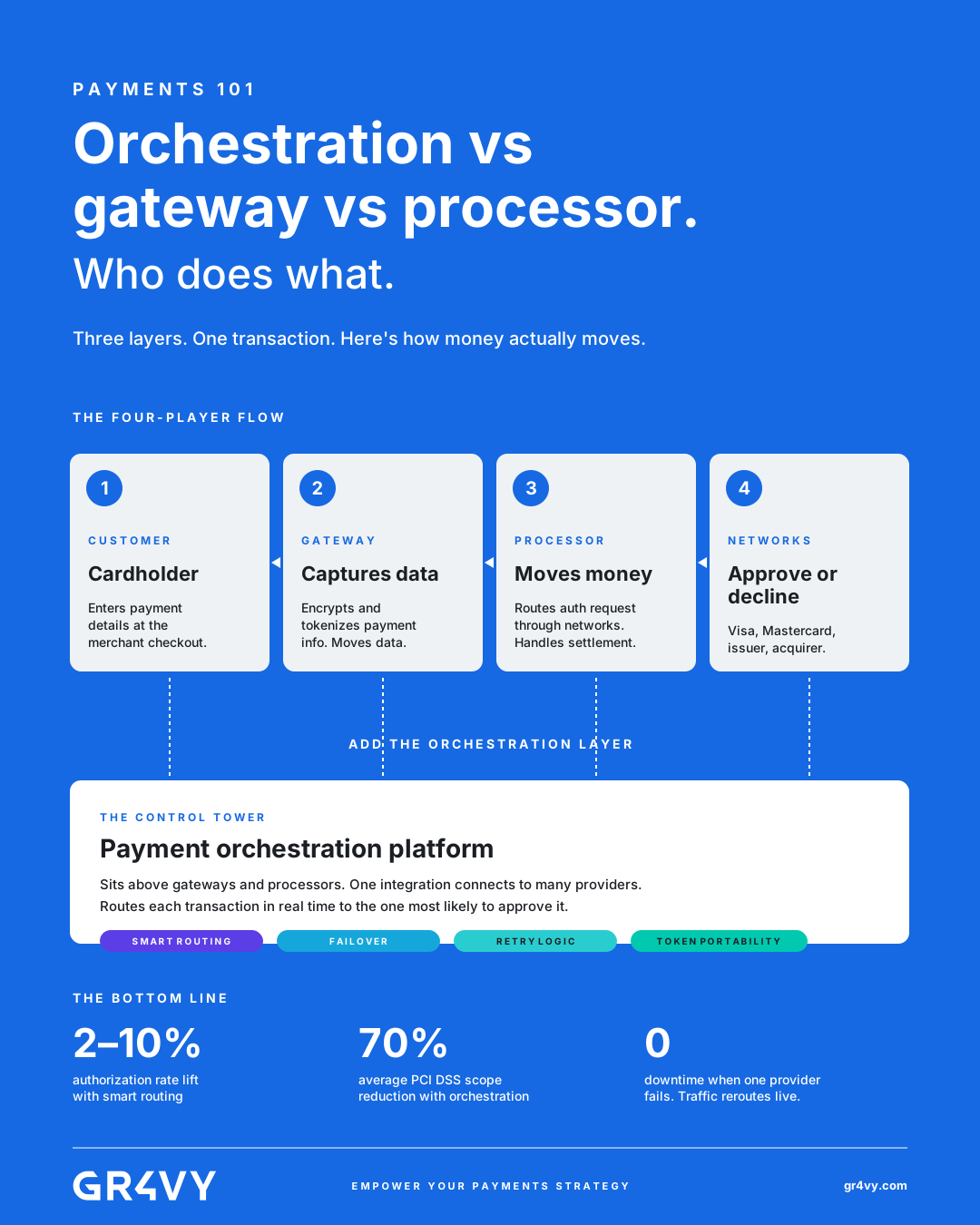
- A payment orchestration platform is a layer above gateways and processors that connects to many of them at once, intelligently routes each transaction to the best one, and gives the merchant a single integration to manage the entire stack. It is the control tower.
The rest of this article unpacks each one in depth, shows how they interact during a real transaction, and provides a decision framework based on business stage, geography, and volume.
How a card payment actually works: the four-player model
Before comparing the three layers, it helps to understand the underlying choreography. A typical online card transaction involves four core players, with payment orchestration sitting on top as an optional fifth layer:
| # | Player | Role |
|---|---|---|
| 1 | Cardholder (customer) | Initiates payment with card details |
| 2 | Issuing bank | Bank that issued the customer’s card and holds the funds |
| 3 | Card network | Visa, Mastercard, Amex, Discover, JCB, UnionPay, and others |
| 4 | Acquiring bank (merchant bank) | Bank that holds the merchant’s account and receives funds |
Around these four banks and networks, three commercial layers handle the technology:
- The gateway captures and encrypts payment data at the merchant’s checkout
- The processor routes the authorization request through the card network to the issuing bank, then handles settlement back to the acquirer
- The orchestration platform (optional) sits above one or more gateways and processors, choosing which one to use for each transaction
When orchestration is added, the gateway and processor layers can be plural rather than singular, with the orchestration platform deciding which gateway, which processor, and which acquirer to use for each individual transaction in real time.
What is a payment gateway?
A payment gateway is the technology that connects a merchant’s website or app to the rest of the payment ecosystem. It does three core jobs: collect payment details at the point of sale, encrypt and tokenize that data, and pass it to a payment processor for authorization.
If you imagine the in-person equivalent, the gateway is the card reader on the counter. It captures the card information, secures it, and hands it off to the systems behind it. It does not move money. It moves information about a payment.
What a payment gateway actually does
A modern gateway typically provides:
- A hosted checkout page or embeddable payment form
- Encryption and tokenization of card details to keep raw card numbers out of the merchant’s systems
- Basic fraud screening (CVV checks, AVS, velocity rules)
- Transmission of the authorization request to the processor
- Return of the approval or decline response to the merchant
- Storage of payment credentials for repeat purchases (in many cases)
A gateway connects to one processor in most setups. Some larger gateways connect to several, but the merchant typically chooses one primary route and treats the others as backup. The gateway does not negotiate interchange fees, hold merchant funds, or settle transactions. It is purely a secure conduit.
Examples of payment gateways
Common gateways include Authorize.net, NMI, Cybersource, and Worldpay’s gateway products. Many providers brand themselves as gateways while also offering processing or acquiring services through the same parent company, which is part of why the terms get blurred in the market.
When a payment gateway alone is enough
A gateway works well when a business operates in one market, processes through a single acquirer, sells primarily to card-paying customers, and has predictable transaction volumes. For a small or mid-market merchant selling domestically, a gateway plus its associated processor often delivers everything needed.
The limits show up when the business expands into new geographies, wants to add local payment methods, needs higher authorization rates, or finds itself dependent on a single provider whose outages and pricing it cannot influence.
What is a payment processor?
A payment processor is the service that actually moves the authorization request through the payment networks and, after authorization, handles the settlement of funds. Where a gateway moves information, a processor moves money.
The processor sits between the gateway and the acquiring bank, with the card networks (Visa, Mastercard, and others) in the middle. When a customer’s card details arrive at the processor, the processor formats the authorization request for the relevant card network, transmits it through the network to the customer’s issuing bank, receives the approve-or-decline response, and returns that response back to the gateway. Later, during settlement (usually at end-of-day batch processing), the processor coordinates the actual movement of funds from the issuing bank through the card network to the acquiring bank, where the merchant’s account is held.
What a payment processor actually does
A processor’s responsibilities include:
- Formatting and transmitting authorization requests to the correct card network
- Receiving and relaying issuer responses (approved, declined, soft decline, fraud flag)
- Handling end-of-day clearing and settlement files
- Managing chargebacks and disputes
- Reporting on transaction performance, fees, and reconciliation
- Compliance with card scheme rules (PCI DSS, regional regulations, scheme-specific requirements)
Some processors also act as acquirers, holding the merchant account directly. Others connect to a separate acquiring bank. Stripe, Adyen, and Square are well-known examples of providers that combine processing and acquiring in a single offering, which simplifies setup at the cost of some flexibility.
Front-end and back-end processors
Within processing, there are technically two sub-roles. Front-end processors handle the live authorization request during checkout. Back-end processors handle the batch settlement at end of day. Most modern processors do both, but in enterprise stacks, these are sometimes separated for performance and reliability reasons.
When a payment processor (or gateway-plus-processor combo) is enough
A bundled gateway-plus-processor offering, such as one from Stripe, Adyen, or a traditional acquirer, covers most needs for businesses with straightforward payment requirements. The advantages are a single integration, one contract, one support relationship, and unified reporting.
The trade-off is vendor concentration. Authorization rates are limited to whatever that single processor can deliver. Outages stop payment acceptance entirely. Adding new payment methods waits on the provider’s roadmap. Cross-border transactions go through whatever acquiring relationships the provider has, even when a local acquirer would deliver higher approval rates at lower cost. These limitations are the reason payment orchestration exists.
What is a payment orchestration platform?
A payment orchestration platform sits above gateways, processors, and acquirers as a single integration layer that connects to many of them at once. The merchant integrates the orchestration platform once, and the platform handles the routing of each transaction to whichever gateway, processor, or acquirer is best suited to it.
A payment orchestration platform (POP) is a centralized payment management system that connects businesses to multiple payment service providers, acquirers, and fraud prevention tools through a single integration. Routing decisions are typically made in real time based on configurable business rules, historical performance data, cost optimization, geography, currency, and the specific payment method being used.
What a payment orchestration platform actually does
A modern orchestration platform typically provides:
- A single API integration that abstracts away the differences between underlying providers
- Real-time transaction routing across multiple gateways, processors, and acquirers
- Smart retry logic for soft declines, with retries routed to alternative providers
- Provider-agnostic tokenization and vaulting (so card data is not locked to one PSP)
- Network token management across Visa, Mastercard, and other schemes
- Failover and redundancy across providers to handle outages
- Centralized reporting and analytics across the entire payment stack
- Fraud orchestration across multiple fraud and risk providers
- A no-code or low-code rules engine for routing logic, retry rules, and 3D Secure decisions
- Unified compliance management (PCI DSS scope reduction, SCA orchestration, regional rules)
For a deeper view of what an orchestration platform does day to day, see Gr4vy’s guide on what a payment orchestration platform is and why your business needs one.
Examples of payment orchestration platforms
The category includes Gr4vy, Primer, Spreedly, Yuno, IXOPAY, Cellpoint Digital, and a small number of others. Some are infrastructure-as-a-service (single-tenant, deployed per merchant), while others are software-as-a-service (multi-tenant, shared infrastructure). The architectural choice affects performance, customization, data localization, and PCI scope.
When a payment orchestration platform is the right choice
Orchestration starts paying off when a business operates across multiple geographies, processes high transaction volume, needs to support multiple payment methods (cards, wallets, BNPL, local methods), has experienced or feared a payment outage with no failover, or finds its engineering team spending significant time managing PSP integrations rather than building product. The break-even point varies, but most enterprise merchants find orchestration valuable once payment volume exceeds roughly $50M annually or once they begin operating in more than two markets.
The definitive comparison table
The differences between the three layers across every dimension that matters for an enterprise decision:
| Dimension | Payment gateway | Payment processor | Payment orchestration platform |
|---|---|---|---|
| Primary function | Capture and transmit payment data | Authorize, clear, and settle transactions | Coordinate multiple gateways, processors, and providers |
| Position in flow | Front of the stack (customer-facing) | Middle of the stack | Layer above gateways and processors |
| Moves money? | No (moves information) | Yes | No (orchestrates the providers that move money) |
| Number of provider connections | Typically one processor | One acquirer (sometimes more) | Many gateways, processors, and acquirers |
| Routing intelligence | None or basic | Limited (within their own network) | Advanced, rule-based, real-time |
| Failover support | None | None (single point of failure) | Multi-provider redundancy |
| Token portability | Tokens locked to gateway | Tokens locked to processor | Provider-agnostic vault, network tokens |
| New payment method onboarding | Roadmap-dependent | Roadmap-dependent | Configuration-based, often days |
| Geographic flexibility | Limited to gateway’s coverage | Limited to acquirer’s coverage | Cross-acquirer routing, local acquiring per market |
| Cost optimization | None | Limited | Routes by acquirer cost, declines, performance |
| PCI DSS scope reduction | Some (depends on integration mode) | Some (depends on integration mode) | Significant (centralized vaulting) |
| Reporting | Single-provider view | Single-processor view | Unified across all providers |
| Authorization rate optimization | None | Within own network only | Cross-provider, intelligent routing |
| Vendor lock-in risk | High (data tied to gateway) | High (data tied to processor) | Low (designed for portability) |
| Integration complexity | Low | Low (when bundled with gateway) | Higher up-front, lower long-term |
| Best for | Single-market, lower-volume merchants | Bundled with a gateway for most merchants | Multi-market, multi-PSP, high-volume merchants |
Where do PSPs and acquirers fit in?
Two more terms come up constantly in this conversation: payment service provider (PSP) and acquirer. They are not separate layers in the same sense as the three above. They are different ways of describing what a provider does.
A payment service provider is a commercial label, not a technical layer. A PSP is any company that offers payment acceptance services to merchants. In practice, a PSP usually bundles a gateway and a processor (and sometimes an acquirer) into one product. Stripe is a PSP. Adyen is a PSP. PayPal is a PSP. The category is broad and the term is used loosely.
An acquirer (or acquiring bank, merchant acquirer) is the financial institution that holds the merchant’s account and is licensed by the card networks to accept transactions on the merchant’s behalf. Acquirers are the regulated banking entity at the end of the chain. Some processors are also acquirers, some are not.
So the layers, end to end, are:
- Gateway captures and secures the payment data
- Processor moves the data through the networks and handles settlement
- Acquirer holds the merchant account and is licensed by the card networks
- (Optional) Orchestration platform sits above 1, 2, and 3, connecting to many of each
PSPs are simply commercial bundles that combine some or all of layers 1, 2, and 3 into a single offering.
How payment orchestration improves on the gateway-and-processor model
If a single gateway-and-processor combination handles the full transaction flow, what does orchestration add? Five concrete improvements, each measurable in revenue or cost.
Higher authorization rates through intelligent routing
A single processor sends every transaction down the same path. When that path performs poorly for certain card BINs, regions, or customer profiles, the merchant loses those transactions. Orchestration platforms route each transaction in real time to the gateway, processor, or acquirer most likely to approve it, based on historical performance data, the card type, the geography, and the currency.
Merchants implementing orchestration-based routing typically see authorization rate improvements of 2 to 4% immediately, with 5 to 10% gains as rules are refined over time. For cross-border transactions specifically, routing through a local acquirer can deliver up to 16% higher acceptance than the same transaction sent through a single foreign processor. For a deeper view of this layer, see intelligent payment routing.
Failover and resilience during provider outages
Every payment provider has outages. When a single-PSP merchant’s provider goes down, payment acceptance stops entirely until service is restored. Orchestration platforms automatically reroute transactions to alternative providers during outages, with no customer-facing disruption.
This is no longer a niche concern. Payment outages have been estimated to cost businesses tens of billions of dollars annually in lost sales, and that figure excludes the engineering hours spent on emergency fixes and the damage to customer trust.
Provider-agnostic tokenization and freedom from lock-in
When a merchant stores cards with a single processor, those tokens only work within that processor’s system. Switching providers means re-collecting card data from every customer, which is operationally costly and often impossible at scale.
Orchestration platforms maintain a provider-agnostic vault. Tokens can be used across any connected processor, and network tokens (issued by Visa, Mastercard, and other schemes) update automatically when underlying cards are reissued or expire. The merchant owns its payment data, not the provider.
Faster onboarding of new payment methods
Adding a new payment method through a traditional gateway or processor depends on the provider’s product roadmap. The merchant waits for the provider to support Apple Pay, then PIX, then iDEAL, then BNPL, often for months. Through orchestration, new methods can typically be added in days through configuration rather than custom development, because the orchestration platform already maintains the integrations.
A range of alternative payment methods including wallets, BNPL, and local schemes becomes available with the flip of a switch rather than a development project.
Significant PCI DSS scope reduction
Each system that stores, processes, or transmits cardholder data falls under PCI DSS audit scope. Traditional architectures with multiple gateway and processor integrations multiply this scope across every connected system. Centralizing payment data through an orchestration platform with a single vault and a single set of API controls dramatically reduces the merchant’s PCI footprint, often by 70% or more, depending on the architecture before migration. For more on this, see Gr4vy’s analysis of PCI DSS compliance and payment orchestration.
How to choose: a decision framework
The right answer depends on a small number of business characteristics. The following framework cuts through the marketing noise:
Choose a payment gateway (alone, or paired with a processor) when
- You operate in a single country or small region
- Card transactions account for the vast majority of your payment volume
- Your annual payment volume is under roughly $10M
- You do not anticipate rapid international expansion
- You have limited engineering resources and need a fast time to market
- Your tolerance for vendor concentration is high
Choose a bundled PSP (Stripe, Adyen, etc.) when
- You want a single contract, single integration, and single support relationship
- You operate in one to three markets
- Your annual payment volume is between roughly $10M and $50M
- Your customers primarily pay with cards and major wallets
- You value speed of implementation over routing flexibility
- You accept that authorization rates, costs, and capabilities will be capped by your provider
Choose a payment orchestration platform when
- You operate in multiple geographies (especially across continents)
- You have experienced or fear a payment outage that no failover can mitigate
- Annual payment volume exceeds $50M and growing
- You want to add multiple alternative and local payment methods quickly
- Authorization rate improvements of 2 to 10% would materially affect revenue
- You want to own your payment data and avoid PSP lock-in
- Your engineering team is spending significant time on payment integrations
- You need cross-provider analytics that no single provider can give you
For a closer look at the strategic case, our analysis of how to increase payment approval rates in 2026 walks through the specific levers orchestration unlocks.
Common misconceptions
A few persistent myths get in the way of clear decisions.
“My PSP already does orchestration.” Most PSPs route transactions only within their own network. True orchestration means routing across competing providers, which a single-PSP architecture cannot do. If your “orchestration” feature stops at your provider’s borders, it is not orchestration.
“Orchestration is just another middleman that adds cost.” Orchestration platforms charge a small per-transaction fee, but the authorization rate lift, cost optimization through smart routing, and operational savings typically exceed that fee by multiples. For enterprise volume, the ROI is usually visible within the first quarter of operation.
“I can build orchestration in-house.” Some merchants do, but the engineering effort is significant. A functional in-house orchestration layer requires multi-PSP integrations, a provider-agnostic vault, a rules engine, network token management, failover logic, reconciliation across providers, fraud orchestration, PCI DSS compliance for the vault, and ongoing maintenance as each underlying provider’s API evolves. Most teams that estimate the cost honestly choose to buy.
“Orchestration is only for huge merchants.” The threshold has come down significantly. Merchants in the $20M to $50M annual volume range increasingly find orchestration valuable, particularly if they sell internationally or rely on subscriptions.
Frequently asked questions
What is the difference between a payment gateway and a payment processor?
A payment gateway captures and securely transmits payment information from the customer to the processor. A payment processor moves the authorization request through the card networks to the customer’s bank, then handles the settlement of funds. The gateway moves information; the processor moves money. Most modern providers bundle the two together, which is why the terms are often used interchangeably even though they describe different functions.
What is the difference between a payment processor and a payment orchestration platform?
A payment processor handles the technical movement of a transaction through the card networks for a single provider relationship. A payment orchestration platform sits above one or more processors and routes each transaction to the best one based on real-time rules. Orchestration is not a replacement for processing; it is a coordination layer that uses multiple processors and gateways at once.
Do I need both a payment gateway and a payment processor?
You need both functions, but you do not necessarily need them from two different vendors. Most merchants buy them bundled as part of a single PSP product. The relevant question is not whether you have both, but whether your gateway and processor offer the routing flexibility, geographic coverage, and resilience your business actually needs.
Can a payment orchestration platform replace my existing PSP?
No, and that is not what orchestration is designed to do. Orchestration platforms work alongside existing PSPs, processors, and gateways. The merchant continues to maintain commercial relationships with those providers; the orchestration platform manages the routing and provides a unified integration on top.
What is the difference between a PSP and a payment orchestration platform?
A PSP (payment service provider) is a single commercial bundle that provides gateway, processing, and sometimes acquiring services. A payment orchestration platform connects to multiple PSPs at once and routes transactions across them. A PSP is one provider; orchestration is the layer that coordinates many providers.
How does payment orchestration affect PCI DSS compliance?
Orchestration platforms typically reduce a merchant’s PCI DSS scope significantly, often by 70% or more, by centralizing card data storage in a single PCI Level 1 compliant vault rather than spreading it across multiple gateway and processor integrations. This simplifies audits, reduces ongoing compliance overhead, and makes it easier to comply with newer requirements such as PCI DSS 4.0.1.
Does payment orchestration add latency to checkout?
A well-architected orchestration platform adds minimal latency, typically under 50 milliseconds per transaction. Single-tenant orchestration architectures (where the platform is deployed dedicated to one merchant) tend to perform better than multi-tenant ones because they avoid shared-infrastructure contention. The latency added is usually invisible to customers and is more than offset by the higher authorization rates orchestration enables.
How long does it take to implement payment orchestration?
Implementation timelines vary by complexity, but most merchants are live with their primary PSP routed through orchestration within four to eight weeks. Adding additional providers, optimizing routing rules, and migrating stored credentials typically continues for another one to three months. The up-front effort is greater than a single PSP integration, but it replaces many future integrations.
Is orchestration only useful for cards, or does it cover other payment methods?
Orchestration covers cards, digital wallets (Apple Pay, Google Pay, Click to Pay), buy now pay later providers (Klarna, Afterpay, Affirm), local methods (PIX, iDEAL, UPI), bank transfers, and increasingly, agentic and AI-initiated payments. The benefit of orchestration grows with each additional method, because managing them all through one integration is dramatically simpler than maintaining direct connections to each provider.
Bringing it together
The three layers are not competitors. They are complementary parts of the same payment stack, and the right architecture depends on where your business is now and where it is going.
Gateways and processors are necessary in every payment flow. Whether you buy them from one vendor or several, whether you call your provider a PSP or something else, the core functions of capturing payment data and moving money through the card networks must exist.
Payment orchestration becomes valuable the moment a single-provider architecture starts costing you more than it saves: through declined transactions you could have recovered, through outages that stop your business, through engineering time absorbed by integrations rather than product, or through the inability to expand into a market your provider does not serve well.
If you’re evaluating where your payment stack sits on this spectrum and what orchestration could unlock for your business, contact our team for a walkthrough of how Gr4vy’s cloud-native orchestration platform fits into the architecture you already have.