GR4VY

Gr4vy and Airwallex Partner to Expand Global Payment Control for Enterprise Merchants 

Integration gives merchants direct access to global acquiring through orchestration, with control over routing, authentication, and transaction data

San Mateo, June 16, 2026: Gr4vy, the cloud-based payment orchestration platform, today announced a new partnership with Airwallex, a leading global financial and payments platform for modern businesses, adding Airwallex as a payment connection. The integration gives enterprise merchants direct access to Airwallex’s card acquiring capabilities through Gr4vy’s orchestration platform, along with access to Optimize 360, Airwallex’s AI-powered payment optimization engine.

As merchants expand into new markets, payment infrastructure tends to become fragmented. Adding new acquirers, meeting local requirements, and maintaining performance often means stitching together multiple systems or reworking parts of the stack. This integration gives merchants a more direct way to introduce global acquiring, while also helping them improve payment performance through smarter routing, retries, authentication, and tokenization. For merchants already integrated with Gr4vy, this creates a faster path to Airwallex’s optimization capabilities without needing a separate direct integration.

“Adding Airwallex gives our merchants a strong global acquiring option, but more importantly, it gives them control,” said John Lunn, CEO of Gr4vy. “With Gr4vy, merchants decide how and when to use each provider, based on performance, cost, or region.”

That control extends to how payments are authenticated and optimized. The integration supports 3D Secure, covering both Airwallex-managed authentication and the ability to pass through external authentication data. It also gives merchants access to Airwallex Optimize 360, which applies real-time intelligence across fraud protection, network acceptance, and payment recovery to help improve approval rates, reduce friction, and manage cost more effectively.

The connection also enables the passthrough of device fingerprinting and enriched transaction data into Airwallex, giving merchants better visibility into transactions and more control over risk. Combined with Optimize 360’s ability to learn from issuer behaviour, shopper trends, and payment performance across 35+ markets, merchants can make more informed payment decisions while adapting to changing market conditions.

“Enterprise merchants shouldn’t have to choose between global reach and payment performance,” said Ivo Jenni, Payments Product General Manager, at Airwallex. “Our partnership with Gr4vy gives merchants access to Airwallex Optimize 360 through the orchestration layer they already use, helping them benefit from smarter routing, retries, authentication, and cost optimization without taking on another integration project.”

The Airwallex connector is fully integrated into Gr4vy’s infrastructure, allowing merchants to enable it directly through the Gr4vy dashboard using their Airwallex credentials. The partnership reinforces Gr4vy’s role as an orchestration layer for enterprises expanding globally, while giving merchants a simpler way to access Airwallex’s optimization capabilities and improve transaction performance across their existing payment stack.

MIT vs CIT: merchant-initiated and customer-initiated transactions explained

Every card transaction is classified by the card networks as either customer-initiated (CIT) or merchant-initiated (MIT). The distinction sounds technical, but it determines how the issuing bank treats the transaction, whether Strong Customer Authentication is required, how decline rates behave, what fees apply, and whether the merchant is exposed to chargeback liability. Misclassified transactions decline more often, trigger unnecessary authentication friction, and increase compliance risk. Correctly classified transactions process cleanly and benefit from rules designed specifically for their category.

For subscription businesses, marketplaces, and any merchant running card-on-file or recurring billing, the CIT-MIT framework is the single most important set of rules to get right. It governs everything from when 3D Secure is required to how the new Mastercard Transaction Link Identifier propagates across renewals.

This guide explains what CITs and MITs are, the eight MIT use cases the card networks formally recognize, the indicators that must accompany each one, how SCA exemptions work, and what merchants need to do to keep their transactions correctly classified across multiple PSPs and acquirers.

A clear definition: CIT and MIT in one sentence each

A customer-initiated transaction (CIT) is a payment where the cardholder is actively present and participating in the transaction at the moment it happens, providing card details, authorizing the charge, or completing authentication in real time.

A merchant-initiated transaction (MIT) is a payment that the merchant triggers without the customer’s active involvement at the moment of the charge, based on a prior agreement with the cardholder that authorized the merchant to do so.

The distinction comes down to who initiates the authorization at the moment it occurs, regardless of who benefits from the transaction. Both transaction types flow through the same card networks, but the networks apply different rules to each.

How CITs and MITs differ across every dimension

DimensionCustomer-Initiated Transaction (CIT)Merchant-Initiated Transaction (MIT)
Customer presence at authorizationYes, actively involvedNo, processed without participation
Strong Customer Authentication requiredYes (in SCA-regulated regions)No, exempt when properly flagged
3D SecureApplied at the time of transactionPerformed once on initial CIT, then carried forward
Decision authorityCustomer authorizes each transactionCustomer authorized in advance
Common examplesOnline checkout, one-click repeat purchase, manual recurring confirmationSubscription renewal, installment payment, account top-up, no-show fee
Risk profileHigher fraud risk per transactionLower risk, governed by prior consent
Chargeback liabilityStandard rules applySpecific MIT chargeback codes
Authorization ratesVariable, dependent on 3DS, fraud, AVSOften higher when properly classified
Required indicatorsStandard CIT flagMIT type indicator plus original transaction reference
Network transaction ID propagationGenerated at CITMust be passed forward from CIT

The defining mechanic across all these differences is the same: a CIT establishes the consent and the credential relationship, and every subsequent MIT references that original CIT to inherit its authorization context. Get the link right and the chain works. Get it wrong and the chain breaks, with every MIT in the broken chain treated as a fresh, suspicious, fully-authenticatable transaction.

The eight MIT use cases recognized by the card networks

Visa formalized the modern MIT framework in 2017. Mastercard updated theirs in late 2021 to include eight specific use cases, broadly aligned with Visa’s framework. Every MIT must be classified as one of these eight types, and the classification affects how the transaction is processed:

1. Recurring payments

Scheduled, fixed-frequency payments of a fixed or variable amount, agreed to in advance. The classic example is a monthly subscription. Visa’s indicator for recurring CIT storage is R (credential stored for subsequent recurring MITs).

2. Installment payments

Scheduled payments of a known total amount, split into a defined number of installments. Common in BNPL and large-purchase financing. Visa’s indicator is I (credential stored for subsequent installment MITs).

3. Unscheduled credential-on-file (UCOF)

Payments triggered by an event rather than a schedule, against a stored credential. Examples include account top-ups, automatic refills, and one-tap repeat purchases initiated by the merchant based on a stored agreement. Visa’s indicator is C (credential stored for unscheduled subsequent MITs or for subsequent CITs).

4. Resubmission

A merchant-initiated retry of a transaction that previously declined for specific reasons (typically insufficient funds), submitted under the original authorization context. Must reference the original CIT’s network transaction ID.

5. Delayed charge

A charge submitted after the original CIT, typically for incremental services or additional costs that were authorized as part of the original agreement. Common in hospitality (minibar charges added after checkout) and rental services (additional usage fees).

6. No-show

A charge applied when a customer fails to honor a reservation, with prior authorization from the original booking CIT. Standard in hotels, restaurants, car rentals, and any reservation-based business.

7. Reauthorization

A new authorization request for a transaction whose original authorization has expired or whose amount needs adjustment, against the same stored agreement. Common in travel and hospitality for extended stays.

8. Incremental authorization

An additional authorization on top of an existing one, to increase the authorized amount as services accumulate. Common in fuel pumps, hotels (incidentals), and any transaction with growing or uncertain final amounts.

Each of these eight types has a specific transaction indicator that must be sent with the authorization request. Sending the wrong indicator (or no indicator) can cause the issuer to decline the transaction, treat it as a fresh CIT requiring authentication, or flag it for fraud review.

Every MIT depends on a prior CIT that established the consent and the credential storage. The chain works in three phases:

The customer reaches the merchant’s checkout, enters card details, and explicitly agrees to terms that authorize the merchant to use the stored credential for future transactions. In SCA-regulated regions, the merchant must perform Strong Customer Authentication on this CIT (typically through 3D Secure 2 with a challenge if the issuer requires it).

The merchant must:

  • Capture explicit consent (separate from general terms and conditions)
  • Identify the type of stored credential the consent covers (recurring, installment, unscheduled, or general CIT storage)
  • Submit the appropriate Credential-on-File (COF) indicator in the authorization request
  • Receive and store the network transaction ID (sometimes called network transaction reference or NTID) returned in the authorization response
  • For Mastercard, also capture and store the Transaction Link Identifier (TLID)

Phase 2: Credential storage

The card is stored in a secure vault, typically with network tokenization layered on top to handle automatic credential lifecycle updates. The stored credential is linked to:

  • The customer’s account
  • The original CIT’s network transaction ID
  • The Mastercard TLID (where applicable)
  • The COF indicator showing what type of future transactions are authorized

This metadata is what makes future MITs work. Without it, every renewal looks like a fresh, suspicious card-not-present transaction.

Phase 3: Subsequent MITs

When the merchant initiates a future charge (subscription renewal, installment, top-up, etc.), the authorization request includes:

  • The stored credential (often a network token)
  • The MIT type indicator (one of the eight use cases above)
  • The original CIT’s network transaction ID (or a previous MIT’s network transaction ID, depending on the scheme)
  • For Mastercard, the TLID retained from the original CIT

The issuer sees the chain: “this MIT is part of an installment plan authorized in CIT X, processed Y days ago, with this customer.” The issuer treats it as a low-risk transaction governed by prior consent and approves it without requiring fresh authentication.

If any link in this chain breaks (missing network transaction ID, wrong MIT indicator, lost TLID), the issuer loses the context. The transaction looks like a fresh card-not-present charge with no consent history, and gets treated accordingly: higher decline rates, fraud flags, and in SCA regions, demands for re-authentication that cannot be satisfied because the customer is not present.

For more on Mastercard’s TLID specifically and how it propagates across the chain, see Gr4vy’s guide on the Mastercard Transaction Link Identifier mandate.

SCA exemptions: why MIT classification matters in Europe

Under PSD2 in Europe (and similar regulations in the UK, Japan, and a growing list of jurisdictions), most electronic payments require Strong Customer Authentication. The MIT framework provides a critical exemption: properly classified MITs are out of scope for SCA, because the authentication happens once on the original CIT and is carried forward through the MIT framework.

For an MIT to qualify for SCA exemption, two conditions must be met:

  1. The original CIT must have undergone SCA authentication, typically via 3D Secure 2 with the challenge mandated flag set
  2. Every subsequent MIT must include the correct COF indicator identifying the transaction type and referencing the original CIT

If either condition fails, the MIT loses its exemption status and the issuer is entitled to decline it or demand re-authentication.

This is why correct MIT classification is not optional for European subscription businesses. A misclassified MIT in an SCA-regulated market is a transaction that will decline more often, trigger 3DS challenges that cannot complete (the customer is not present), and create chargeback exposure that the merchant cannot defend.

The same logic applies to Japan’s SCA mandate, the upcoming PSD3/PSR rules in Europe, and the gradual rollout of SCA-equivalent requirements in other markets. Markets that do not have explicit SCA mandates still benefit from correct MIT classification because issuers in those markets use the same indicators to inform their risk decisioning.

The network transaction ID and why it is the most critical field

Across both Visa and Mastercard, the network transaction ID (Visa Transaction ID, Mastercard scheme transaction ID) is the single most important field in the MIT chain. It is the value the issuer uses to confirm that the current MIT belongs to a previously-established stored credential relationship.

A few important properties:

  • Generated by the network during the original CIT authorization. The merchant does not create it; the merchant receives it in the authorization response and stores it.
  • Required on every subsequent MIT. For Visa, the value from any prior MIT in the chain can be used. For other schemes, the value from the original CIT (or the relationship-establishment transaction) is required.
  • Persistent across the lifetime of the stored credential. Even years after the original CIT, the same network transaction ID is referenced on the latest subscription renewal.
  • Not the same as the merchant’s own transaction reference. Internal transaction IDs are useful for merchant operations but have no role in network-level CIT/MIT linkage.

For Mastercard transactions, the Transaction Link Identifier (TLID) introduced in 2024-2026 supplements the existing scheme transaction ID with a stronger, network-generated linkage value. From October 23, 2026, merchants must include the stored TLID in every economically-related MIT. The TLID does not replace the network transaction ID; both are required during the transition period.

How to flag a transaction correctly: the indicators

Correct MIT classification requires the merchant’s authorization request to include the right combination of indicators. The exact field names vary by PSP, but the underlying network requirements are the same:

FieldWhat it indicates
InitiatorCustomer (CIT) or Merchant (MIT)
Stored Credential indicatorFirst storage, subsequent use, or no stored credential involved
Credential TypeRecurring, installment, unscheduled COF, or general subsequent CIT
MIT use caseOne of the eight recognized types (recurring, installment, UCOF, resubmission, delayed charge, no-show, reauthorization, incremental)
Network Transaction IDThe value from the original CIT or prior MIT in the chain
Mastercard TLID(Mastercard transactions) The Transaction Link Identifier from the original CIT
POS Entry ModeIndicates the transaction was processed using stored credentials

For most modern PSPs and orchestration platforms, these indicators are handled at the integration layer rather than being passed explicitly by the merchant’s application. The merchant configures the transaction type once (subscription, installment, etc.) and the platform translates the configuration into the correct combination of network indicators for each authorization request.

For a deeper view of how the tokenization layer interacts with MIT classification, see Gr4vy’s guide on PSP tokens vs network tokens.

The multi-PSP problem: how MIT chains break when providers switch

For single-PSP merchants, MIT classification is operationally straightforward. The PSP captures the original CIT, returns the network transaction ID, stores it alongside the merchant’s customer reference, and submits it on every subsequent MIT.

For multi-PSP merchants, the chain becomes fragile. If an original CIT is processed through Acquirer A and a subsequent renewal is routed through Acquirer B, the network transaction ID and TLID need to be portable across the boundary. Three failure modes are common:

Failure 1: Acquirer-locked transaction ID storage. If the network transaction ID is stored inside Acquirer A’s records rather than at the merchant or orchestration layer, Acquirer B cannot reference it on the renewal. The MIT loses its CIT linkage and is treated as a fresh card-not-present transaction.

Failure 2: Inconsistent indicator application. Different PSPs implement MIT indicators slightly differently. The same logical transaction (a subscription renewal) might be flagged correctly through one PSP and incorrectly through another. The issuer sees inconsistent signals and decisions vary.

Failure 3: Lost chain during PSP migration. When a merchant migrates from one PSP to another, the stored credential relationships and their associated network transaction IDs need to migrate with them. Without explicit migration, the renewal volume on the new PSP starts as if every customer were a brand new acquisition with no consent history.

The solution to all three failure modes is to maintain the network transaction ID, TLID, COF indicator, and MIT classification at the orchestration or merchant layer rather than inside any single PSP’s records. The orchestration platform captures the metadata from whichever PSP processes the original CIT and propagates it to whichever PSP processes the subsequent MITs.

The MIT framework was designed by Visa and Mastercard with the assumption that the merchant would maintain the chain metadata, but most early implementations defaulted to letting the acquirer handle it. As multi-PSP setups have become standard for enterprise merchants, the architectural correction has become important.

Agentic commerce: a new category in the MIT framework

The rise of agentic commerce introduces a new question into the CIT/MIT framework. When an AI agent like ChatGPT or Gemini initiates a purchase on behalf of a customer, who initiated the transaction?

The card networks have not yet published comprehensive guidance on this question, but the operational consensus is forming around two principles:

Initial agent setup is a CIT. When the customer first authorizes an AI agent to make purchases on their behalf, providing consent and going through Strong Customer Authentication, that transaction is a CIT in the classical sense. The customer is present, providing credentials, and authorizing future activity.

Subsequent agent-initiated purchases are typically classified as MITs, with the agent’s instructions treated as part of the merchant-initiated chain. The specific MIT type depends on the use case: a scheduled agent purchase resembles a recurring MIT, while an on-demand agent purchase resembles an unscheduled COF.

The protocols emerging from Mastercard, Visa, OpenAI, Stripe, and others (including the Agentic Commerce Protocol and Universal Commerce Protocol) are formalizing this classification with new transaction indicators specific to agent-initiated flows. Merchants accepting agentic commerce should plan to support agent-specific MIT indicators alongside the existing eight use cases.

For a deeper view, see Gr4vy’s guide on making your checkout AI-agent-ready.

Common misclassification mistakes and how to avoid them

A handful of patterns consistently produce misclassified transactions and the avoidable declines they cause:

Treating a customer-initiated repeat purchase as an MIT. A returning customer logging in and clicking “buy again” is a CIT, even though the card was stored. The transaction is initiated by the customer at the moment it happens. Flagging it as an MIT can cause the issuer to apply different rules than it should, with unpredictable approval outcomes.

Treating a delayed merchant-initiated capture as an MIT. A customer who completes a CIT at checkout but whose charge is captured the next day is still a CIT. The latter capture happens against the original authorization, which was customer-initiated. The capture timing does not change the classification.

Missing the COF indicator on the original CIT. If the original CIT does not declare that credentials are being stored for future MITs, the chain cannot be established. Every subsequent MIT will lack the proper consent reference. This is one of the most common implementation mistakes.

Sending the wrong MIT type indicator. A recurring monthly subscription submitted with an installment indicator (or vice versa) creates inconsistency between what the issuer expects and what arrives. Decline rates rise even though the customer would have approved the transaction if it had been classified correctly.

Reusing one MIT indicator across all subsequent transactions regardless of purpose. Some merchants default all MITs to “recurring” because it covers the largest share of their volume. A no-show fee classified as recurring confuses the issuer’s risk model. Each MIT should carry the indicator that matches its specific purpose.

Losing the network transaction ID during PSP migration or routing changes. The chain breaks silently. Renewal authorization rates drop, but the cause is hidden in the indicator metadata rather than in any visible error. Audit migrations specifically to confirm the chain remains intact.

Skipping SCA on the initial CIT in regulated markets. Without SCA on the CIT, subsequent MITs do not qualify for SCA exemption. Every renewal becomes subject to authentication requirements that cannot be satisfied without the customer present. The result is a slow accumulation of declines on what should be a frictionless renewal flow.

Implementation checklist: making MIT classification work

Setting up correct MIT classification requires consistent handling across the entire payment stack. A practical checklist:

1. Identify every transaction in your stack as CIT or MIT. Map every flow that creates an authorization request and document which classification applies. Renewals, top-ups, no-show fees, delayed captures, and reauthorizations all need explicit classification.

2. For each MIT, identify the specific use case (recurring, installment, UCOF, resubmission, delayed charge, no-show, reauthorization, or incremental). The classification drives the indicator that must be sent.

3. Update CIT authorization requests to declare stored credential intent. Use the appropriate COF indicator (R, I, C, or other depending on the scheme) to tell the issuer the credential is being stored.

4. Capture and store the network transaction ID from every CIT response. This is the value that links subsequent MITs back to the original consent. Store it alongside the customer’s credential reference.

5. For Mastercard transactions, also capture and store the TLID in preparation for the October 23, 2026 mandate.

6. Include the network transaction ID (and TLID for Mastercard) in every subsequent MIT. The exact field names vary by PSP, but the values are required.

7. Ensure SCA is properly applied to CITs in regulated markets. Without authentication on the CIT, MIT exemptions do not apply.

8. Validate the chain across all your PSPs and acquirers. If you operate multi-PSP, verify that the network transaction ID, TLID, and indicators flow correctly across provider boundaries.

9. Monitor authorization rates and decline reasons by transaction type. A drop in MIT approval rates often points to misclassification or a broken chain rather than fundamental issues with the underlying credentials.

10. Document the classification rules in your operations runbook. New transaction types, edge cases, and integration changes should all be reviewed against the framework.

Frequently asked questions

What is the difference between a CIT and an MIT?

A customer-initiated transaction (CIT) is a payment where the cardholder is actively involved at the moment of the charge, providing card details or authenticating in real time. A merchant-initiated transaction (MIT) is a payment that the merchant triggers without the cardholder’s active involvement, based on a prior agreement established during an earlier CIT. The distinction determines authentication requirements, decline behavior, chargeback handling, and SCA exemption status.

Why does CIT vs MIT classification matter?

Card networks apply different rules to each category. CITs require Strong Customer Authentication in SCA-regulated regions; MITs are exempt when properly flagged. Issuers use the classification to inform their risk decisioning, which affects authorization rates. Misclassified transactions decline more often, can trigger unnecessary authentication requests, and may create chargeback liability that the merchant cannot defend.

What are the eight types of MITs?

The card networks recognize eight MIT use cases: recurring payments, installment payments, unscheduled credential-on-file (UCOF), resubmission, delayed charge, no-show, reauthorization, and incremental authorization. Each use case has a specific transaction indicator that must accompany the authorization request to properly classify the transaction.

Do MITs require Strong Customer Authentication?

No, MITs are exempt from SCA when properly flagged, provided the original CIT that established the stored-credential relationship underwent SCA authentication. This is one of the primary reasons subscription businesses in Europe rely on the MIT framework: it allows recurring transactions to proceed without re-authenticating the customer for every renewal.

Is a subscription renewal a CIT or an MIT?

A subscription renewal is an MIT when the merchant triggers the renewal automatically based on the subscription schedule. The original sign-up (where the customer entered card details and agreed to terms) was the CIT. Every subsequent automatic renewal is a recurring MIT that references back to that original CIT.

What is the difference between MIT and Credential-on-File (COF)?

Credential-on-File refers to the stored card data, which is a prerequisite for MITs but is not itself a transaction classification. A stored credential can be used for both subsequent CITs (when the customer returns and clicks “use my saved card”) and MITs (when the merchant triggers a transaction against the stored credential). The COF indicator at the original CIT declares what types of future transactions the stored credential authorizes.

How does the Mastercard TLID relate to MIT classification?

The Mastercard Transaction Link Identifier (TLID) is a scheme-generated identifier that links the original CIT to all subsequent MITs at the network level. It supplements the existing network transaction ID with a stronger, more consistent linkage value. From October 23, 2026, merchants must include the stored TLID on every economically-related MIT authorization request.

Can I use the same network transaction ID across multiple MITs?

For Visa, you can use the network transaction ID from any prior MIT in the chain when submitting a new MIT. For other schemes, you typically need to reference the ID from the original CIT or the relationship-establishment transaction. Most modern PSPs and orchestration platforms handle this automatically based on the configured transaction type.

What happens if I misclassify a transaction?

Misclassified transactions can decline at higher rates because the issuer’s risk model receives inconsistent signals. In SCA-regulated regions, a misclassified MIT can lose its authentication exemption and be subject to challenge requests that cannot be satisfied without the customer present. Chargeback liability can also shift because MIT-specific dispute codes do not apply to misclassified transactions.

Do CIT and MIT rules apply to all card networks?

Yes, all major card networks (Visa, Mastercard, American Express, Discover) recognize the CIT-MIT distinction, though the specific indicators, use case definitions, and technical requirements vary slightly by scheme. Visa formalized the modern framework in 2017; Mastercard updated theirs in late 2021. American Express and Discover apply similar logic through their closed-loop systems.

How does CIT vs MIT work for agentic commerce?

When an AI agent like ChatGPT initiates a purchase on behalf of a customer, the initial setup (where the customer authorizes the agent and authenticates) is treated as a CIT. Subsequent agent-initiated purchases are typically classified as MITs, with the specific MIT type depending on the use case. The agentic commerce protocols emerging from Mastercard, Visa, and major AI platforms are formalizing this classification with new indicators specific to agent-initiated flows.

How do I store the data needed for MIT classification?

Store the original CIT’s network transaction ID (and Mastercard TLID where applicable), the COF indicator declaring what types of future transactions are authorized, the credential reference (typically a network token), and the customer’s consent record. This metadata should live at the merchant or orchestration layer rather than inside any single PSP’s records, particularly for multi-PSP setups where MITs may be routed through a different acquirer than the original CIT.

What is the network transaction ID?

The network transaction ID (sometimes called Visa Transaction ID, Mastercard scheme transaction ID, or NTID) is a value generated by the card network at the time of authorization and included in the response. It serves as the reference that links subsequent MITs back to the original CIT. The merchant does not create it; the merchant receives it and stores it for use on future transactions.

What to do next

Correct MIT classification is the foundation of every successful card-on-file and subscription business. Get it right, and authorization rates on renewals stay high, SCA exemptions apply cleanly, and chargeback defenses hold up. Get it wrong, and the symptoms appear gradually: declining renewal approval rates, mysterious authentication challenges on transactions that should be exempt, and chargeback losses on transactions that should have been defensible.

For most merchants, the work falls into two categories. The classification logic and indicator application can usually be handled at the PSP or orchestration layer, which is where it belongs architecturally. The harder problem is making sure the chain metadata (network transaction IDs, TLIDs, COF indicators, consent records) is stored at the merchant or orchestration layer rather than inside any single PSP’s records, so that it remains portable across PSP boundaries.

Gr4vy’s cloud-native payment orchestration platform handles MIT classification, network transaction ID propagation, and TLID management automatically across more than 400 connected PSPs and payment methods. The chain stays intact across routing decisions, PSP migrations, and multi-acquirer setups, with no merchant-side application code required to maintain it.

If you’re evaluating your current MIT classification setup or want to understand how chain metadata could be unified across your existing PSP relationships, contact our team for a stack review and integration plan tailored to your current architecture.

Mastercard Transaction Link Identifier (TLID): what it is and what merchants need to do

Mastercard is changing how transactions are tracked across the payment lifecycle. The Transaction Link Identifier (TLID) is a new, scheme-generated reference that links every authorization, capture, refund, chargeback, and subsequent merchant-initiated transaction back to its originating cardholder-initiated payment. From October 23, 2026, merchants must include the stored TLID in every economically-related transaction (recurring billing, subscription renewals, installments, unscheduled credential-on-file charges). Non-compliance fees begin in January 2027.

The change is operationally simple to implement, but it carries real consequences for subscription businesses, marketplaces, and any merchant running multi-PSP setups where stored credentials need to remain portable. This guide explains what TLID is, the exact technical specification, the dates that matter, how it differs from the Trace ID it replaces, and what enterprise merchants need to do now to stay ahead of the deadline.

The Mastercard Transaction Link Identifier is a unique, scheme-generated 22-character alphanumeric identifier that Mastercard assigns to every card authorization and includes in the authorization response. The identifier persists across every related message in the transaction lifecycle (captures, refunds, voids, chargebacks) and across every economically-related transaction (subscription renewals, installments, unscheduled MITs) under the same stored-credential agreement.

In simpler terms: when a cardholder makes their first payment with a merchant and authorizes that merchant to store the card, Mastercard generates a TLID. That same TLID is then carried forward into every subsequent transaction linked to that stored credential. The merchant stores it once, and reuses it on every related charge.

A few important characteristics:

  • Scheme-generated by Mastercard. The TLID comes from Mastercard directly, included in the authorization response. Merchants do not create it; they receive it and store it.
  • 22 characters, alphanumeric, case-sensitive, may include hyphens and underscores. (Some industry articles have reported a 36-character length, which appears to be confusion with the canonical UUID format. The Mastercard specification, as reflected in Stripe, Adyen, and Worldpay documentation, is 22 characters.)
  • Globally unique. TLIDs are unique across all of Mastercard’s infrastructure, eliminating the duplication risk that affected the older Trace ID.
  • Consistent across all Mastercard acceptance brands, including Maestro.
  • Not PCI-sensitive. TLIDs can be stored in standard databases alongside customer payment profiles, without requiring a PCI-compliant vault.

Why Mastercard is introducing TLID

Until now, Mastercard transactions have been tracked across the lifecycle using the Trace ID (also known as the scheme transaction ID or previous_payment_id), which is generated by the acquirer rather than by Mastercard itself. The Trace ID has worked, but it carries a structural weakness: because each acquirer generates its own values, duplicates can occur across different acquiring relationships, and the same transaction can carry different Trace IDs in different parts of the chain.

The TLID solves this at the network level. Because Mastercard itself generates the identifier and propagates it across every message in the lifecycle, there is no risk of duplication, no acquirer-to-acquirer translation problem, and no ambiguity about whether two transactions are related.

The benefits Mastercard cites for the change:

  • Consistent transaction identification across all Mastercard platforms and acceptance brands
  • Matching and linking of all messages across the full transaction lifecycle
  • Improved fraud detection by making it harder to obscure related transactions
  • Reduction in authorization-related chargebacks through clearer traceability
  • Better support for merchant-initiated transactions, including subscriptions and installments
  • Operational efficiency gains for issuers, acquirers, and merchants doing investigative work

For merchants, the practical benefits show up in three areas: faster dispute resolution (TLID makes it trivial to link a chargebacked MIT to the original CIT where the cardholder consented), cleaner reconciliation (every transaction in a lifecycle shares the same TLID), and better authorization rates on MITs (issuers see the chain of consent more clearly).

The four key dates merchants need to track

The Mastercard rollout happens in four phases. Missing any of them creates either compliance risk or operational disruption.

DatePhaseWhat changes
October 17, 2025Lifecycle phaseMastercard requires acquirers and merchants to pass the TLID from the original authorization response into all subsequent lifecycle messages (captures, refunds, reversals, chargebacks)
June 2, 2026Retention phaseMastercard begins generating TLIDs for economically-related transactions (MITs, BNPL, installments). Acquirers must ensure merchants retain the TLID from card-not-present CITs and Account Status Inquiry (ASI) requests where credentials are stored
October 23, 2026Active population phaseMerchants must include the stored TLID in every economically-related MIT authorization request so Mastercard can link it back to the original CIT
January 31, 2027Compliance assessmentMastercard begins assessing fees for non-compliance with TLID data mandates. Formal compliance is required by December 1, 2026

The window that matters most for most merchants is between June 2 and October 23, 2026: that is when the TLID actually starts arriving on new transactions, and when merchants need to have their storage and integration ready. Merchants who wait until October 2026 to start the work face real risk of missing the deadline, because integration testing, schema changes, and conformance work do not happen overnight.

The TLID applies to two distinct categories of transactions, and the rules differ slightly for each.

Lifecycle transactions

A lifecycle transaction is any message that is part of the same authorization event: the capture that follows the original authorization, the partial or full refund issued against it, a void or reversal, and any chargeback messages.

For lifecycle transactions, the TLID generated at the original authorization is automatically propagated across all related messages by the acquirer or PSP. The merchant typically does not need to do additional work, because the integration handles it transparently. The October 17, 2025 mandate covers this category.

An economically-related transaction is a separate authorization that is logically tied to an earlier one through a stored-credential agreement. The classic example is a subscription: the customer’s first payment is a CIT where they authorize the merchant to charge the card on a recurring schedule. Every subsequent renewal is a separate MIT authorization, but it is economically related to that initial CIT.

For these transactions, the merchant has to do the work of storing the TLID from the original CIT and submitting it with every subsequent MIT. This is the integration burden the October 23, 2026 mandate creates.

The same pattern applies to:

  • Installment payments following an initial purchase
  • Buy Now, Pay Later (BNPL) schedule charges following the authorization
  • Unscheduled credential-on-file payments (top-ups, on-demand purchases against a stored card)
  • Free-to-paid conversions where a free trial becomes a paid subscription
  • Variable recurring payments where the amount or timing differs each cycle

In every case, the TLID retained from the original CIT travels with every subsequent MIT, creating a verifiable chain at the network level.

The four main use cases for TLID

The strategic value of TLID becomes visible in four specific use cases that affect day-to-day merchant operations.

1. Faster, cleaner dispute resolution

When a cardholder raises a dispute on a subscription renewal claiming they did not authorize the recurring charge, the merchant traditionally has to assemble evidence linking that MIT to the original CIT where consent was given. This typically involves PAN matching, timestamp correlation, system trace IDs, and sometimes manual investigation across multiple systems.

With TLID, the chain is verifiable at the network level. The TLID on the disputed MIT traces directly back to the TLID on the original CIT, providing scheme-generated proof of the stored-credential relationship. Disputes that previously required hours of investigation can be resolved in minutes, and the success rate on representment typically improves because the evidence is cleaner and more defensible.

2. Cleaner reconciliation and transaction tracking

Every lifecycle event for a transaction shares the same TLID. The original authorization, the capture, any partial refunds, and any chargebacks all carry the same identifier. This makes reconciliation between authorization and clearing records significantly faster, and makes it trivial to assemble a complete transaction timeline for any specific charge.

For finance teams doing month-end close, the time savings are meaningful. For customer support teams investigating duplicate-charge complaints or refund timing questions, the lookup becomes a single-query operation rather than a multi-system investigation.

3. Linking authentication to subsequent payments

When the original CIT was submitted with Strong Customer Authentication (SCA) data, which is common for European transactions under PSD2 and similar regulations in Japan and other jurisdictions, that authentication context can carry forward to subsequent MITs through the TLID. Issuers see the chain of consent and authentication, which typically improves authorization rates on the renewals.

This matters most for subscription businesses operating in SCA-regulated markets, where MIT authorization rates can be 5-10 percentage points higher when the chain to the authenticated CIT is visible.

4. Multi-PSP credential portability

For merchants using multiple PSPs, the TLID enables a critical capability: an MIT can be processed through one PSP while referencing a CIT that was processed through a different PSP. Because the TLID is scheme-generated rather than acquirer-generated, it remains valid across acquirer boundaries.

This is the angle most coverage of TLID misses, and it matters specifically for enterprise merchants running orchestration-based architectures. Routing a subscription renewal through whichever acquirer is currently performing best, even if the original authorization went through a different one, requires the underlying chain-of-consent reference to be portable. The Trace ID was not. The TLID is.

For a deeper view of how multi-PSP routing benefits subscription and card-on-file businesses, see Gr4vy’s guide on intelligent payment routing.

What merchants need to do: the implementation checklist

The good news is that TLID implementation is operationally simple. Most merchants can complete the work in a week or two of engineering effort. The checklist:

1. Confirm your acquirer is passing TLID. All major acquirers (Stripe, Adyen, Worldpay, Checkout.com, Braintree, and others) have published their TLID handling specifications. Verify with your account manager that TLIDs are appearing in authorization responses for your Mastercard transactions.

2. Update your database schema. Add a field to your customer payment profile records that can store a 22-character alphanumeric string. The field can be a standard VARCHAR column; no encryption or PCI-compliant storage is required.

3. Capture TLID on every CIT authorization response. When you process the initial Customer-Initiated Transaction (typically the first payment with a new stored credential), parse the TLID from the authorization response and store it alongside the customer’s token or card reference.

4. Submit TLID with every economically-related MIT. When processing subscription renewals, installments, BNPL charges, or any other MIT against a stored credential, include the previously-stored TLID in the authorization request.

5. Plan for older stored credentials. Cards stored before your integration captured TLIDs will not have one. For these, the standard approach is to submit a new MIT, receive the TLID back from Mastercard via your acquirer in the authorization response, store it, and use it for all future transactions. Mastercard recommends using an undisputed MIT from at least three months prior as the basis for the new TLID lineage.

6. Continue passing Trace ID in parallel. Mastercard has not yet sunset the Trace ID, and merchants should plan to store and pass both Trace ID and TLID for the foreseeable future. The Trace ID sunset is expected eventually but no date has been announced.

7. Test conformance with your acquirer. Most major acquirers offer test environments where merchants can validate their TLID handling before going live. Run end-to-end tests covering CIT capture, MIT submission with TLID, and dispute flows before the October 2026 deadline.

Acquirers that include orchestration platforms typically handle most of this transparently. For merchants using Gr4vy, the TLID capture, storage, and propagation across all connected PSPs and acquirers is handled automatically through the platform.

The multi-PSP angle: why orchestration matters here

For single-PSP merchants, TLID implementation is straightforward: the PSP returns the TLID, the merchant stores it, the merchant passes it back on MITs. The flow lives inside one provider relationship.

For multi-PSP merchants, the picture is more complex. A TLID generated through Acquirer A on the original CIT needs to be available to Acquirer B if a subsequent MIT is routed through it. The TLID itself is scheme-generated and globally valid, but the merchant’s integration has to make it available across all the PSP connections that might handle related transactions.

Three implementation patterns exist for this:

Pattern 1: Single-PSP-per-customer. The merchant routes every transaction for a given customer through the same PSP. The TLID lives inside that PSP’s records and is reused on MITs. This works but defeats the purpose of multi-PSP routing, because the merchant cannot dynamically route a renewal through whichever PSP is currently performing best.

Pattern 2: Merchant-managed TLID storage. The merchant stores the TLID in their own database, separate from any single PSP. When routing an MIT through any PSP, the merchant includes the stored TLID in the request. This works but requires the merchant to build the storage and propagation logic themselves, and to ensure every PSP integration handles the field correctly.

Pattern 3: Orchestration-managed TLID. The orchestration platform captures the TLID from whichever PSP processes the original CIT, stores it in a provider-agnostic vault, and automatically includes it in subsequent MITs regardless of which PSP routes them. The merchant’s application code does not need to handle TLID directly; the orchestration platform manages the full lifecycle.

The third pattern is the cleanest architectural fit for multi-PSP merchants and is the model Gr4vy’s platform implements. The TLID is captured at the orchestration layer when the original CIT is processed, stored alongside the merchant token, and automatically propagated to subsequent MITs across any connected PSP. The merchant does not need to manage TLID storage in their own database or update their application code to handle the field.

This becomes especially important for merchants planning migrations between PSPs or adding additional providers, because the TLID needs to remain valid across the migration. Acquirer-managed TLIDs that live inside a single PSP’s records create the same portability problem as PSP-locked tokens. Orchestration-managed TLIDs do not.

How TLID relates to network tokens

A common question is how TLID relates to network tokenization (Visa Token Service, Mastercard Digital Enablement Service). The short answer: they are complementary technologies that solve different problems.

Network tokens replace the stored PAN with a network-issued credential. They handle credential security and lifecycle (automatic updates when cards are reissued). They do not, by themselves, provide a way to link related transactions across the payment lifecycle.

TLIDs provide the lifecycle linkage. They identify which transactions are related to which, and which MITs flow from which CITs. They do not change how credentials are stored.

For a card-on-file or subscription transaction processed through Mastercard, the modern best-practice stack uses both: a network token to represent the credential, and a TLID to identify the relationship between transactions. For more on tokenization patterns, see Gr4vy’s guide on network tokenization vs PSP tokenization.

Common implementation mistakes to avoid

A handful of patterns separate smooth TLID rollouts from troubled ones:

Underestimating the schema work. While the TLID itself is just a 22-character string, the work of updating customer payment profile records, propagating the field through application code, and updating analytics and reporting systems can extend across multiple teams. The integration is technically simple but organizationally non-trivial.

Treating TLID as PCI-sensitive. Some teams default to storing any payment-related field in their PCI vault. TLIDs are not PCI-sensitive and storing them in the vault adds operational overhead without any compliance benefit. Standard database storage alongside customer profiles is the correct approach.

Skipping the back-migration plan for legacy credentials. Cards stored before TLID capture went live will not have one, and merchants need a plan for generating TLIDs for these credentials. The standard approach (issue a new MIT, capture the returned TLID, use it going forward) works but should be scheduled before the October 2026 deadline rather than reactively after.

Locking TLID storage to a single PSP. Storing the TLID inside one PSP’s records rather than at the orchestration or merchant layer creates exactly the portability problem TLID was designed to solve. Multi-PSP merchants should store TLIDs in their own database or in an orchestration platform that propagates them across all connected PSPs.

Confusing the 22-character spec with 36-character UUID. Several published articles on TLID report a 36-character length, likely confusing the TLID with standard UUID formatting. The Mastercard specification is 22 characters. Building database schemas around the wrong length creates avoidable rework.

Waiting until October 2026 to start. The integration is straightforward but it is not zero-effort. Schema changes, application updates, conformance testing with acquirers, and back-migration of legacy credentials all take time. Most merchants who start in the second half of 2026 will be cutting it close to the October 23 deadline.

Frequently asked questions

The TLID is a 22-character alphanumeric identifier that Mastercard automatically generates for every card authorization. It links the original cardholder-initiated transaction (CIT) to all related lifecycle messages (captures, refunds, chargebacks) and all economically-related merchant-initiated transactions (subscription renewals, installments, unscheduled MITs) under the same stored-credential agreement.

When does the TLID mandate take effect?

The rollout happens in four phases: October 17, 2025 covered lifecycle transactions and is already in effect. June 2, 2026 begins TLID generation for economically-related transactions and requires acquirers to ensure merchants retain TLIDs from CITs. October 23, 2026 requires merchants to actively include the stored TLID in every MIT authorization request. January 31, 2027 begins formal compliance assessments and non-compliance fees.

How is TLID different from the Trace ID?

The Trace ID (also called scheme transaction ID) is generated by the acquirer and can be duplicated across acquirer boundaries. The TLID is generated by Mastercard at the network level and is globally unique. TLID is intended to eventually replace Trace ID, but Mastercard has not yet announced a sunset date for the Trace ID, and merchants should plan to store and pass both for the foreseeable future.

Is TLID a UUID?

The TLID functions like a unique identifier but uses a 22-character alphanumeric format (including hyphens and underscores) rather than the canonical 36-character hyphenated UUID format. Several published articles have reported a 36-character length, which appears to be a confusion with standard UUID formatting. The official specification, as reflected in major PSP documentation, is 22 characters.

Where do I store the TLID?

The TLID is not PCI-sensitive and can be stored alongside customer payment profiles in standard database tables. Most implementations add a VARCHAR(22) field to the table that holds customer card references. No encryption or vault-grade storage is required.

What happens if I do not include the TLID on MITs after October 2026?

In the near term, Mastercard is not declining transactions for missing TLID. However, Mastercard has signaled it may flag data integrity issues, and non-compliance fees begin in January 2027. Issuers may eventually decline MITs that do not carry the expected TLID. The safest interpretation of the mandate is that TLID submission becomes operationally required, with both compliance fees and downstream authorization rate risks for merchants who skip it.

Does TLID apply to non-Mastercard transactions?

No. TLID is a Mastercard-specific identifier and applies to all Mastercard acceptance brands including Maestro. Visa, American Express, and Discover have not announced similar identifiers as of mid-2026. Each network maintains its own transaction reference scheme.

Will I need to manage TLID separately for each PSP?

If you operate with a single PSP, that PSP typically handles TLID storage and propagation transparently. If you operate with multiple PSPs, you have two practical options: store TLIDs in your own database and pass them through each PSP integration, or use an orchestration platform that captures and propagates TLIDs across all connected PSPs automatically.

What happens to TLIDs for cards stored before the mandate?

For credentials stored before your integration started capturing TLIDs, the standard approach is to submit a new merchant-initiated transaction against the stored credential, receive the TLID back from Mastercard via your acquirer, store it, and use it on all subsequent transactions. Mastercard recommends using an undisputed MIT from at least three months prior as the basis for the new TLID lineage.

Does TLID replace network tokens?

No. TLID and network tokens serve different purposes. Network tokens (from Visa Token Service, Mastercard Digital Enablement Service, and equivalents) replace the stored PAN with a network-issued credential that handles security and automatic lifecycle updates. TLID is a separate identifier that links related transactions across the lifecycle. The modern stack uses both: network tokens for credential representation and TLIDs for transaction linkage.

Can I use TLID for refunds and chargebacks?

Yes. The TLID generated at the original authorization is included in all lifecycle messages, including captures, refunds, voids, and chargebacks. Merchants do not need to take additional action for these, because the TLID propagation happens automatically in the lifecycle phase that became active in October 2025. For refund authorizations specifically, Mastercard requires the TLID to be provided in the authorization response in clearing.

How long does TLID implementation take?

For most merchants, the engineering work takes a week or less. The bigger time investments are in cross-team coordination (database schema changes, application updates, analytics updates), conformance testing with acquirers, and the back-migration plan for legacy stored credentials. Most enterprise merchants should plan for 4-8 weeks of total project time from kickoff to production-ready.

How does Gr4vy handle TLID?

Gr4vy captures the TLID from the original CIT authorization response automatically, stores it in the provider-agnostic vault alongside the merchant token, and propagates it to subsequent MITs across any connected PSP. Merchants using Gr4vy do not need to update their application code, database schemas, or PSP integrations individually to handle TLID, because the orchestration platform manages the full lifecycle. This is especially valuable for multi-PSP merchants whose MITs may be routed through a different acquirer than the original CIT.

What to do next

The TLID mandate is one of the cleaner scheme changes in recent memory: low integration complexity, real operational benefits, and a meaningful improvement in how subscription and card-on-file transactions are tracked across the network. The work is straightforward, but the timeline matters. Merchants starting in mid-2026 will be comfortable; merchants starting in October 2026 will be at risk of missing the deadline.

For merchants with single-PSP setups, the practical first step is confirming with your account manager that TLID handling is configured in your acquirer’s integration and updating your customer profile schema to store the field. For merchants with multi-PSP setups, the question is whether to build TLID propagation across each PSP integration individually or to let an orchestration platform handle it centrally.

Gr4vy’s cloud-native payment orchestration platform manages TLID capture, storage, and propagation automatically across more than 400 PSPs and payment methods. The TLID flows from the original CIT through every subsequent MIT regardless of which acquirer processes the renewal, preserving the chain of consent that Mastercard’s mandate is designed to enforce.

If you’re evaluating how to handle the TLID mandate across your existing PSP relationships or want a walkthrough of how Gr4vy implements TLID propagation in a multi-PSP setup, contact our team for a stack review and integration plan tailored to your current architecture.

What is Payment Orchestration? A 2026 guide for payments leaders

Last updated May 21st 2026

Around half of online merchants now use more than one payment provider. That shift, more than any other in the last five years, is what created the category called payment orchestration and the technology layer at the center of it. The term is still used loosely. People confuse payment orchestration with a gateway, ask whether it replaces a PSP, and want to know what actually changes inside a business the day a payment orchestrator goes live. Below, the answers in the order a payments leader asks them.

TL;DR

  • Payment orchestration is a technology layer that connects multiple PSPs, acquirers, and payment methods through a single integration, routing every transaction to the provider best suited to handle it.
  • It typically lifts authorization rates by 2 to 3 percentage points, reduces processing costs, and removes months of engineering work when adding new payment methods or markets.
  • The case for payment orchestration sharpens once a business is processing roughly $1M per month, selling into two or more countries, or using two or more PSPs.
  • Gr4vy is the only payment orchestration platform built on dedicated single-tenant cloud instances with edge localization capabilities. Unlike shared SaaS environments, every merchant operates on its own isolated infrastructure, deployed in-region to support performance, resiliency, and regulatory requirements. This Infrastructure-as-a-Service model enables data localization for markets where payment data cannot leave the country, helping enterprises meet strict sovereignty and compliance mandates without sacrificing flexibility or scale.

What is payment orchestration?

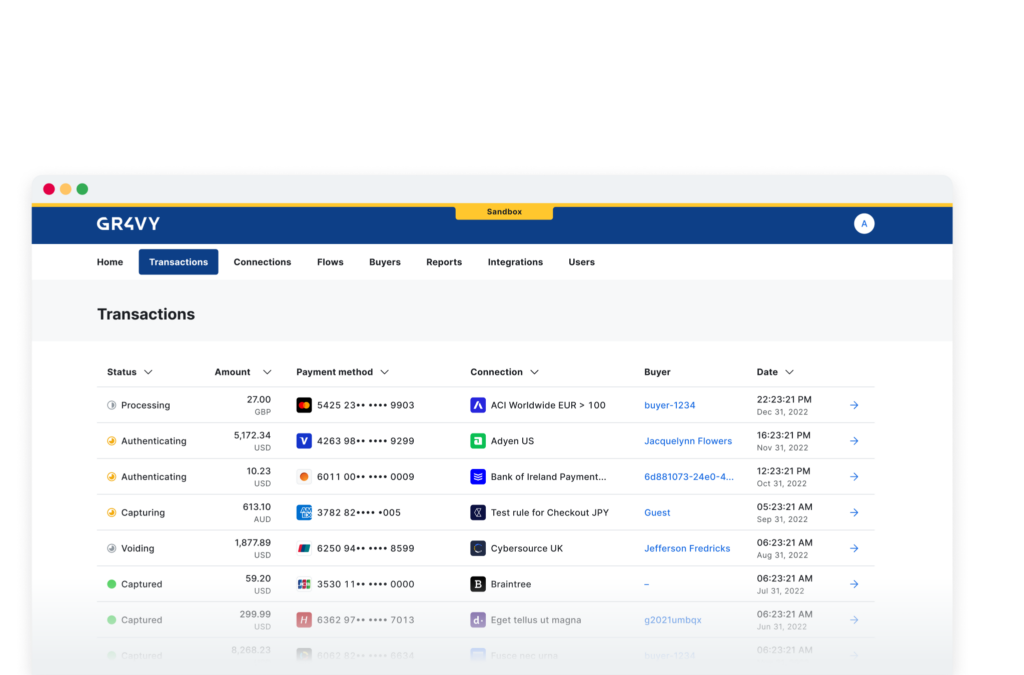
A payment orchestrator is the software layer that sits between your checkout and every payment provider you use, process each transaction, decides which provider should handle it, sends it on, and brings the result back. The customer sees a single checkout. Your team sees one dashboard. The complexity of multiple PSPs, acquirers, payment methods, and fraud tools is absorbed inside the orchestration layer.

A payment orchestrator does not authorize payments, move money, or own a merchant account. Its role is to coordinate the providers that do, deciding which one is best suited to each individual payment based on rules you set and conditions it sees in real time.

That distinction matters commercially. A PSP earns more when more transactions flow through its own pipes. Payment orchestration earns nothing from routing one provider over another, which is why a well-designed orchestrator can route transactions away from underperforming providers without any conflict of interest. The neutrality is the product.

The five jobs of a payment orchestration platform

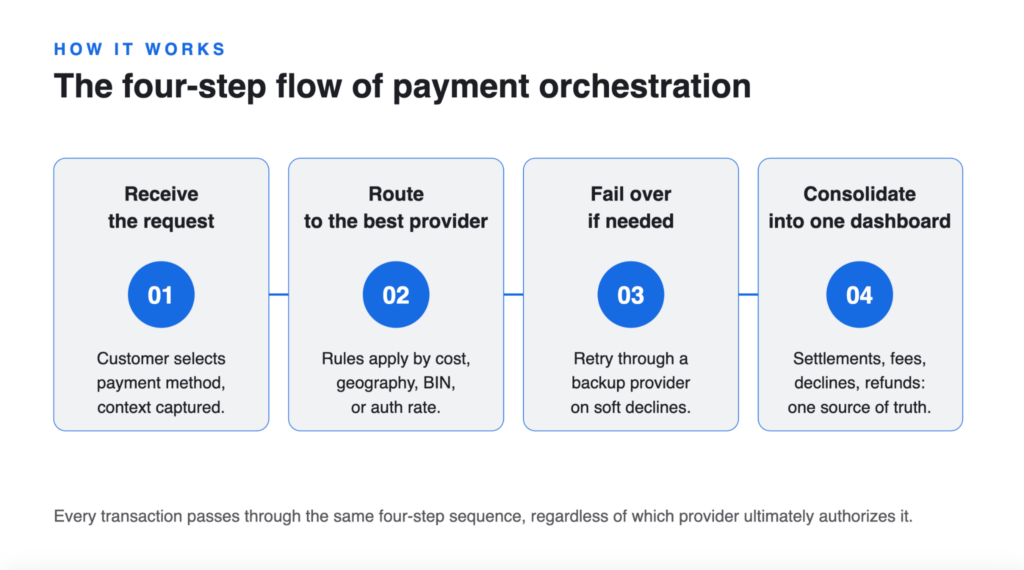
Payment orchestration handles five jobs across every transaction.

It processes  the transaction request from your checkout and applies any pre-routing logic you have configured (3D Secure, fraud screening, business rules).

It routes the transaction to the optimal provider based on cost, expected approval rate, geography, card BIN, provider uptime, or any combination of criteria your team specifies.

It handles failover when a provider returns a soft decline or times out, attempting the transaction through a backup provider before the customer sees a failure.

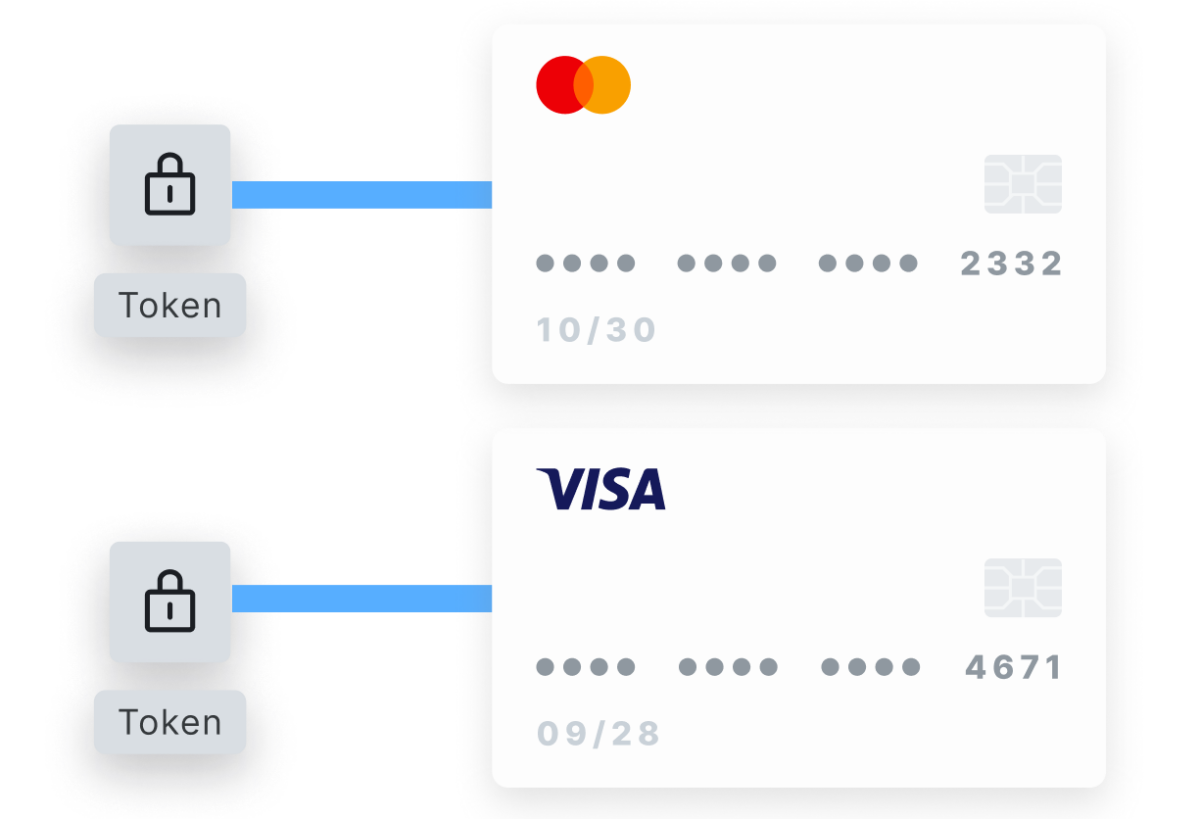
It stores payment credentials in a provider-agnostic Vault, so tokens work across every connected PSP and customers do not have to re-enter details when you switch or add providers.

It consolidates reporting across every provider into a single dashboard: settlements, fees, decline reasons, chargebacks, refunds, all attributable to provider, market, payment method, or card type.

Each capability is useful on its own. They become substantially more useful as a coherent system, which is the point of choosing a serious platform rather than assembling the equivalent yourself.

How does payment orchestration work?

Walk through what happens between a customer clicking “pay” and a settlement appearing in your finance dashboard.

The customer reaches checkout and selects a payment method. The payment orchestration layer receives that selection along with contextual information: country, currency, basket value, card BIN if relevant. Before deciding anything else, the merchant decides which payment methods to show the customer in the first place, because the right methods depend on the customer’s market. A shopper in São Paulo expects Pix. A shopper in Amsterdam expects iDEAL. Showing the wrong set of methods is itself a leading cause of checkout abandonment.

Once the method is selected, the payment orchestration platform applies your pre-routing logic. This usually includes 3D Secure rules, fraud screening, and any business-level constraints. The platform then evaluates which provider should handle the transaction as per the merchant setup, sends it there, and waits for the response.

If the transaction succeeds, authorization and settlement proceed through the chosen provider in the normal way. If it fails, payment orchestration can attempt the transaction through an alternative provider before returning a decline. This failover mechanism is the single capability most directly responsible for recovered revenue.

All transaction data, regardless of which provider ultimately handled the payment, flows back to the orchestration dashboard. Your finance team sees a single source of truth.

payment orchestration infographic 2026

Payment orchestrator vs payment gateway vs PSP

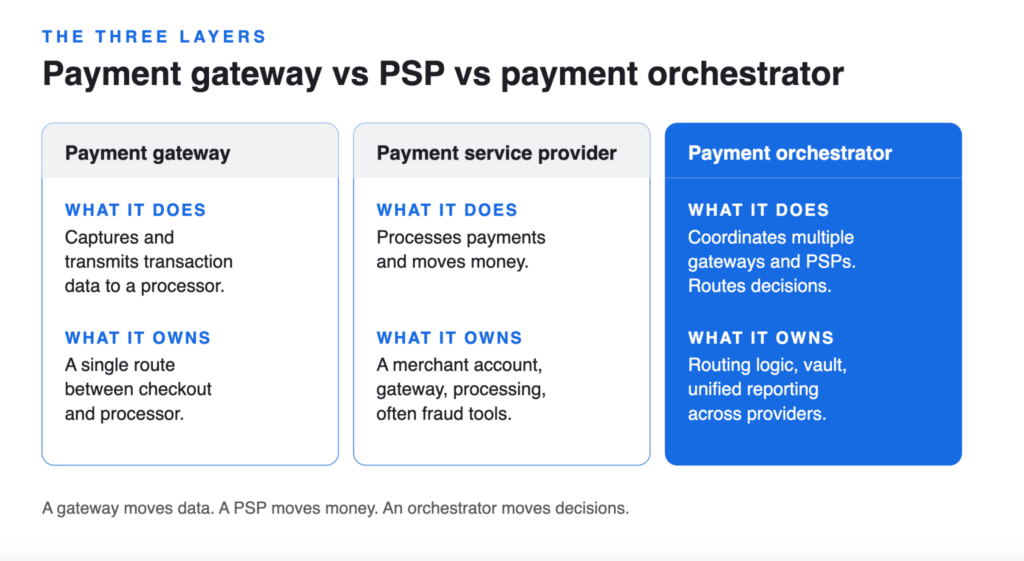
The three layers are often confused. The cleanest mental model is this: a gateway moves data, a PSP moves money, an orchestrator moves decisions.

CapabilityPayment gatewayPSPPayment orchestrator
Connects to multiple providersYesNoYes
Single API integrationPer providerSingle providerYes, across all providers
Intelligent routing across providersNoLimited to internal optionsYes
Automatic failoverYesNoYes
Centralized reporting across providersNoNoYes
Provider-agnostic tokenizationNoNoYes
Switch providers without re-integrationNoNoYes
Owns merchant accountNoYesNo
Processes payments directlyNoYesNo

A payment gateway captures payment information from the checkout, encrypts it, and transmits it to a processor or acquirer for authorization. It does not decide which provider to use. It follows a predetermined path.

A payment service provider (PSP) is a bundled solution combining gateway functionality, a merchant account, payment processing, and often fraud protection and reporting. You get an integrated stack from a single vendor, and you cannot optimize across providers because you only have one.

A payment orchestrator sits above gateways and PSPs and coordinates between them. It connects to multiple providers through a single API and routes each transaction to the optimal destination based on the rules you set. For a deeper breakdown, see payment orchestration vs payment gateway vs payment processor.

The three conditions that break a single-PSP setup

A single-PSP setup is the right answer for many businesses. It only stops working when one of three things happens.

Geographic expansion. A PSP that performs well in one market may have weaker acquiring relationships, slower decline recovery, or no native support for local payment methods elsewhere. Merchants entering Brazil, India, or the Nordics quickly find that the provider that served them well at home is not the right answer in those markets.

Scale. As volume grows, the gap between a good authorization rate and a great one converts into seven-figure numbers. A merchant processing $200 million a year cannot afford to ignore a two-point approval-rate gap between providers, even if both are technically functional.

Operational drag from multiple providers. Many merchants reach a multi-PSP setup organically, adding a second provider for redundancy or a third for a new market. Each integration was a reasonable choice in isolation. Taken together, they create fragmentation: different APIs, different reconciliation timelines, different reporting formats, different ways of representing a chargeback. Finance teams stitch together exports at month-end. Engineering teams maintain integrations whose original authors have left the company.

This is the situation payment orchestration resolves. Everything runs on the same rules and shows up in the same dashboard.

payment orchestration vs payment gateway infographic 2026

Payment orchestration: new sources of revenue

The business case for payment orchestration is more than productivity. 

Higher authorization rates. Routing each transaction to the provider most likely to approve it lifts authorization rates by two to three percentage points in most deployments, with more fragmented multi-PSP estates seeing larger gains. Within four months of moving to a dual-acquirer setup, Australian retailer Baby Bunting measured a 2.8% authorization uplift that contributed to record online sales above $120 million. On $100 million of annual volume, a single percentage point of recovered approvals is roughly $1M of revenue, recovered without any change in customer acquisition spend. On $500 million it is $5M. At enterprise scale, two or three points of authorization uplift is a strategic line item.

Lower processing costs. Smart routing sends each transaction to the lowest-cost provider that can authorize it, which compounds across millions of transactions. Local acquirers in each market reduce cross-border fees and FX leakage. Mattilda, a Latin American education payments platform, posted a 60% reduction in payment costs after consolidating collections across multiple acquirers this way. For platform businesses, the cost reduction story is often as significant as the revenue uplift.

Faster speed to market. Adding a new payment method or a new market used to mean months of engineering. With a coordinating layer above the providers, both become configuration changes in a dashboard. A platform with hundreds of pre-built provider connections can enable a new local payment method in days.

Reduced engineering overhead. Engineering capacity that used to maintain three or four PSP integrations gets returned to product work. This is consistently the orchestration benefit engineering leaders rate highest when asked retrospectively, partly because it shows up as work that no longer happens.

Recovered revenue from failed payments. Failover, dynamic retries, Network Tokens, and Account Updater each recover transactions that single-PSP setups would lose. Industry research puts the recoverable share of failed-payment revenue as high as 14%, depending on the merchant’s profile.

Unified reporting. Two thirds of multi-PSP merchants lack a unified view across providers. Roughly 30% of payment failures go unresolved because of the resulting visibility gap. Reconciliation, fee analysis, and provider benchmarking all become possible the moment data from every provider runs through one platform.

When do you need payment orchestration?

The answer comes from the setup, not from the size. A subscription business doing modest monthly volume across five countries faces the same fragmentation, the same provider-specific approval-rate variance, and the same reconciliation overhead as a much larger single-market merchant. The smaller business often needs orchestration sooner, because the complexity is already there.

The case sharpens whenever any of three conditions appears: a second market, a second PSP, or a meaningful approval-rate gap between regions. Larger volume amplifies the return on every percentage point of recovered approvals, but it does not gate access to the underlying benefits. Smaller merchants with the right setup capture them too.

Beyond volume, the conditions that consistently signal a payment orchestration-shaped problem are these. Multiple providers already in the stack, particularly across regions. Cross-border operations where approval rates vary noticeably by market. Subscription or recurring billing exposing the business to involuntary churn. Concerns about vendor lock-in, particularly where switching PSPs is a multi-quarter migration.

There are conditions where payment orchestration is not the right move yet. A single PSP, single market, single payment method, and modest volume. No one to own payments operations. A platform replatforming that needs to finish first.

The threshold is not a fixed number. The right question is whether multiple providers, multiple markets, or multiple payment methods are already creating operational drag, or will within twelve months.

What payment orchestration does not solve

The vendor pitch for payment orchestration tends to be uniformly positive. The reality is more mixed, and most failed implementations come from underestimating four things.

It does not negotiate your PSP contracts for you. Routing transactions across multiple providers gives you leverage, but the leverage only converts into better rates if someone uses it. Merchants who add an orchestration layer without then renegotiating PSP terms typically leave the largest portion of available savings on the table. The orchestrator hands you the data and the optionality. Acting on both is still a job.

It does not eliminate the need for someone to own payments. A payment orchestration platform replaces engineering work with configuration work, which is much faster but not zero. Routing rules need to be defined, tested, and revisited. Provider performance needs to be reviewed. New payment methods need to be activated and monitored. Businesses that bought into orchestration expecting it to run itself usually end up with a powerful platform that nobody is steering.

It does not fix a checkout that has other problems. If the checkout itself has friction unrelated to payment routing, broken mobile flows, missing local payment methods that exist in the orchestrator but were never enabled, or a confusing form layout, the orchestration layer will not solve those problems. A 30% checkout abandonment rate driven by UX issues will not move because the underlying transactions started routing more intelligently.

It does not remove all risk of a payments incident. A well-architected orchestrator reduces single-points-of-failure dramatically, but it introduces one new dependency. If the orchestration platform itself goes down, every connected provider becomes inaccessible at once. The mitigation is at the architecture level, and it is one of the reasons the multi-tenant versus dedicated instance question matters. A platform built on dedicated cloud instances per customer has a much smaller blast radius than a multi-tenant platform where one incident affects every customer simultaneously.

The trade-offs are real, but they are also manageable. Merchants who implement payment orchestration with clear-eyed expectations about what it does and does not do consistently capture more of the available upside than merchants who treat it as a one-time fix.

Multi-tenant vs dedicated instance: the architecture trade-off most buyers miss

Two payment orchestration platforms can offer the same features and run on very different infrastructure. The distinction matters in 2026, particularly for merchants in regulated industries or markets with strict data residency requirements.

Multi-tenant payment orchestration runs on shared infrastructure across the platform’s customers. One set of servers, databases, and APIs serves all merchants. The benefits are speed and cost. The trade-off appears under specific conditions: traffic spikes from one merchant can affect performance for others, data sovereignty cannot be fully guaranteed, and the platform’s blast radius covers every customer at once.

Dedicated instance payment orchestration runs each customer on its own isolated cloud environment. Gr4vy is the only  payment orchestration platform built this way. Each merchant’s orchestration layer, Vault, dashboard, and routing logic runs on infrastructure that nobody else shares. Data residency can be guaranteed by region. Performance does not depend on other tenants. The blast radius shrinks dramatically.

For enterprises in financial services, healthcare, regulated sectors, or any business where data sovereignty is a board-level concern, dedicated instance is often the requirement that disqualifies multi-tenant platforms outright.

How much does payment orchestration cost?

Pricing varies by platform and is typically based on processed volume, with custom enterprise pricing above certain thresholds. Most payment orchestration platforms add a per-transaction or platform fee on top of existing PSP fees.

At Gr4vy, pricing is tied to infrastructure rather than transaction volume alone, reflecting our Infrastructure-as-a-Service and single-tenant architecture. Every merchant operates on its own dedicated orchestration instance, with isolated infrastructure designed for greater control, resiliency, security, and regulatory flexibility. This model aligns our platform with the operational realities of enterprise payments, where infrastructure ownership, performance, and compliance are critical business requirements rather than shared SaaS resources.

At scale, the fee is offset by authorization-rate uplift, processing cost reductions, and reduced engineering overhead. The total cost of ownership of payment orchestration tends to fall, not rise, once it is in place. The Gr4vy ROI calculator gives a per-business estimate based on processed volume, current approval rates, and provider mix.

Is payment orchestration PCI compliant?

Yes, when the platform is properly certified. Look for PCI DSS Level 1, SOC 2 Type II, and ISO 27001. One of the secondary benefits of payment orchestration is that the merchant’s own PCI scope is reduced, because sensitive card data lives inside the platform’s tokenization Vault rather than across multiple systems.

Where payment orchestration is heading next

Payment orchestration began as a way to coordinate multiple integrations through a single API. The capabilities have grown well beyond that. Machine learning now optimizes routing decisions based on issuer response patterns the platform can detect across millions of transactions. Network Tokenization has moved from a card-network capability to a feature most payment orchestration platforms expose natively.

The most significant shift in the next two years is agentic commerce. AI agents are starting to initiate and complete purchases on behalf of consumers, often inside conversational interfaces like ChatGPT. The payments infrastructure required for agent-driven transactions differs from the infrastructure required for human checkouts. Gr4vy is the first payment orchestration platform to launch a dedicated Agentic Development Kit for this purpose, enabling its merchants to process agentic commerce payments.

Frequently asked questions

Is a payment orchestrator the same as a payment gateway?

No. A gateway transmits transaction data between the checkout and a processor. A payment orchestrator sits above gateways, PSPs, and acquirers, coordinating across all of them and providing a unified view of payment performance.

Is a payment orchestrator the same as a PSP?

No. A PSP processes payments and owns the merchant account. A payment orchestrator does not process payments. It decides which PSP should handle each transaction and can use multiple PSPs in parallel.

Do I need to replace my existing PSPs to use payment orchestration?

No. Payment orchestration sits on top of existing providers. PSP relationships, contracts, and merchant accounts stay in place. The platform coordinates how transactions flow across them.

How many providers do I need before payment orchestration makes sense?

Two or more is the practical threshold. The case for payment orchestration sharpens quickly as more providers are added.

Can payment orchestration help with recurring payments and subscriptions?

Yes. Centralized tokenization keeps recurring payments active when a merchant switches providers. Network Tokens, Account Updater, and dynamic retries recover the failed recurring charges that single-PSP setups lose to involuntary churn.

What is the difference between multi-tenant and dedicated instance payment orchestration?

Multi-tenant payment orchestration runs on shared infrastructure across all customers. Dedicated instance payment orchestration runs in a private cloud environment per customer. The trade-off is cost and time to deploy versus data sovereignty, blast-radius isolation, and configuration depth.

Payments have moved from a back-office cost line to one of the most consequential systems an online business operates. The merchants pulling away from their competition in 2026 are the ones treating it that way: measuring authorization rates the way they measure conversion, treating provider relationships as negotiable, and building the infrastructure to route transactions intelligently across multiple paths instead of accepting whatever a single PSP produces. Payment orchestration is the layer that makes that posture practical.

Gr4vy was built specifically for businesses ready to take that step. Talk to our team about your stack.

Hosted checkout vs API checkout: which payment integration is right for your business?

The choice between hosted checkout and API checkout shapes how a payment stack handles every transaction. It determines PCI compliance burden, conversion potential, branding flexibility, mobile experience, how quickly new payment methods can be added, and whether the merchant can route across multiple PSPs without rebuilding. For enterprise merchants, the decision is also rarely binary, with most production payment stacks ending up using a combination of integration methods for different surfaces and transaction types.

Learn the five practical integration patterns merchants choose between in 2026 (hosted checkout, hosted fields, full API, mobile SDK, and payment links), compare them across every dimension that matters, to make a decision framework based on merchant profile, technical capacity, and business priorities. The framing throughout assumes a multi-PSP, orchestration-aware payment stack rather than a single-provider integration, because that is increasingly the architecture that most enterprise merchants operate under.

The five integration patterns at a glance

Before the deeper analysis, the short version of each option:

  • Hosted checkout redirects the customer to a payment page hosted by the PSP or orchestration platform. Customers leave the merchant’s site for the payment step. Fastest to deploy, lowest PCI scope, lowest branding control.
  • Hosted fields embeds secure payment input fields inside the merchant’s own checkout page. Customers stay on the merchant’s site, but card data is captured inside iframes served by the PSP or vault provider. Best balance of control and compliance.
  • Full API integration uses REST APIs and SDKs to handle every aspect of the payment flow. Maximum control and branding flexibility, highest PCI compliance burden.
  • Mobile SDK provides native iOS and Android components that handle in-app payment collection. Optimized for mobile-first experiences with biometric authentication and digital wallets.
  • Payment links generate shareable URLs that route to a pre-configured payment page. Used for invoicing, social commerce, B2B billing, agentic flows, and any scenario where the buyer is not present at a traditional checkout.

The choice is not strictly between “hosted” and “API.” Modern payment stacks combine these patterns based on which surface the transaction is happening on, which PSP will process it, and what the business priorities are at that touchpoint.

What is hosted checkout?

A hosted checkout solution sends the customer to a payment page hosted on the PSP’s or orchestration platform’s infrastructure. The merchant’s site redirects to the hosted page, the customer completes payment there, and the customer returns to the merchant’s site after the transaction is finished or canceled.

The merchant never sees or stores card data. The PCI compliance burden is mostly absorbed by the PSP or platform, which means the merchant typically qualifies for a simpler PCI Self-Assessment Questionnaire (SAQ A) rather than a full PCI DSS audit. Setup time is hours to days for most platforms, and the integration is usually configuration-driven rather than code-heavy.

Where hosted checkout works well:

  • Merchants with limited engineering bandwidth or compressed time-to-launch requirements
  • Subscription businesses where checkout happens infrequently and the brand impact of a redirect is acceptable
  • Smaller merchants whose volume does not justify investment in custom payment UX
  • B2B sales flows where the buyer expects to leave the marketing site to complete a purchase
  • Markets where the PSP’s hosted page already supports a strong selection of local payment methods

The limitations of hosted checkout:

  • Customers experience a domain change during the payment step, which can introduce trust friction. Approximately 70% of checkout abandonment stems from trust concerns during transitions, according to industry research, making the redirect a measurable conversion cost in some segments.
  • Branding control is limited to whatever customization the PSP allows (typically logo, colors, and some copy adjustments)
  • Conversion rate optimization is harder because the merchant does not control the entire checkout funnel
  • Complex payment flows (split payments, escrow, conditional captures) often cannot be expressed inside a hosted page
  • Multi-PSP routing requires the hosted page itself to be PSP-agnostic, which is only true for orchestration platforms

For a deeper view of how to optimize the checkout experience regardless of integration model, see Gr4vy’s guide on checkout optimization strategies.

What is API checkout?

A full API integration uses REST APIs, server SDKs, and client-side JavaScript to build the entire payment flow inside the merchant’s environment. The customer never leaves the merchant’s site, no redirect happens, and every pixel of the payment experience is under the merchant’s control.

The trade-off is responsibility. With full API integration, card data flows through the merchant’s infrastructure, which means the merchant typically operates under PCI DSS SAQ D requirements (the most comprehensive Self-Assessment Questionnaire) and must maintain a PCI Level 1 compliant environment if transaction volumes exceed scheme thresholds. The compliance overhead is significant, with annual costs that can run from $100,000 to several hundred thousand dollars for enterprise merchants.

Where API checkout works well:

  • Enterprise merchants with established payments engineering teams and budget for PCI compliance
  • Marketplaces and platforms with complex payment flows that hosted pages cannot accommodate
  • Brands where checkout is a meaningful part of the customer experience and the conversion impact of full UX control justifies the engineering investment
  • Subscription, usage-based, and recurring businesses where billing logic is tightly coupled to product logic
  • Mobile-heavy businesses where native integration through SDKs is essential

The limitations of full API checkout:

  • The engineering investment is substantial, with implementation timelines typically running 3-6 months for a comprehensive integration
  • PCI DSS audit scope is significantly broader, with all associated cost and operational overhead
  • The merchant takes on responsibility for fraud screening, 3D Secure orchestration, error handling, and security patching of the payment surfaces
  • Adding new payment methods requires development work for each one, slowing time-to-market for international expansion
  • Ongoing maintenance burden is meaningful, since payment APIs evolve and the merchant’s integration has to evolve with them

Hosted fields: the underserved middle option

Most articles compare hosted checkout to full API integration as if those were the only two choices. There is a third option that combines most of the advantages of each: hosted fields.

A hosted fields integration embeds secure iframes inside the merchant’s own checkout page, with each iframe controlled by the PSP or vault provider. The customer sees what appears to be the merchant’s checkout page, but the actual card-number, expiration, and CVV inputs are running inside iframes hosted on the PSP’s domain. Card data flows directly from the customer’s browser to the PSP, never touching the merchant’s servers.

The result is PCI scope reduction similar to a hosted page (SAQ A in most implementations) combined with branding control similar to a full API integration. The customer never sees a domain change. The merchant designs the checkout page exactly as they want it. The card-input fields look and feel native to the merchant’s brand, with only the PSP-controlled inputs being technically separate.

Where hosted fields work well:

  • Enterprise merchants who want to minimize PCI scope while preserving full UX control
  • Brands where checkout is a measurable conversion driver and even a redirect would be costly
  • Multi-PSP setups where the hosted fields can be swapped dynamically based on routing decisions
  • International expansion scenarios where compliance overhead in new markets needs to be contained

The trade-offs:

  • Implementation complexity sits between hosted checkout and full API, with timelines typically 1-3 months
  • Browser compatibility and iframe handling require more QA than a redirect-based hosted page
  • Some PSPs implement hosted fields differently, which means switching providers can require front-end work
  • The PCI scope reduction depends on correct implementation; misconfigured iframes can pull additional pages into PCI scope

For merchants in the middle of the size and complexity spectrum, hosted fields is often the strongest answer and is increasingly the default pattern enterprise orchestration platforms recommend.

Mobile SDKs: the in-app integration path

A separate but related question is how to handle payments inside native mobile apps. Three options exist: redirect to a hosted page via a web view, embed hosted fields via a web view, or use a native mobile SDK provided by the PSP or orchestration platform.

Mobile SDKs are designed specifically for in-app payment collection. They provide native iOS and Android components that match platform design conventions, integrate with biometric authentication (Touch ID, Face ID, fingerprint), handle Apple Pay and Google Pay natively, and avoid the web-view friction that hosted pages create on mobile.

Where mobile SDKs are essential:

  • Apps with significant transaction volume where the in-app experience materially affects conversion
  • Subscription apps where biometric reauthorization is a meaningful retention signal
  • Apps targeting markets where digital wallets are dominant (Apple Pay in the US, Google Pay across Android markets, regional wallets globally)
  • Any app where Apple Pay or Google Pay needs to be a primary payment method

The compliance posture of mobile SDKs varies by implementation. Most modern mobile SDKs from major orchestration platforms keep card data inside the SDK’s secure context, avoiding direct exposure to the merchant’s app code, which maintains a reduced PCI scope similar to hosted fields.

For a deeper look at mobile-specific patterns, see Gr4vy’s guide on mobile checkout best practices.

The fifth integration pattern is payment links, which are shareable URLs that route to a pre-configured payment page. The merchant generates a link through an API or dashboard, sends it via email, SMS, chat, or any other channel, and the recipient completes payment when they choose.

Payment links work alongside hosted checkout and API integration rather than replacing them, handling the cases where a traditional checkout flow does not fit:

  • Invoicing and B2B billing: send the link in the invoice email, the buyer pays when ready
  • Social commerce: share the link in Instagram DMs, WhatsApp, or social posts
  • Voice and phone commerce: read the link to a customer over the phone or send via SMS
  • Agentic flows: the AI agent generates a payment link for the buyer to authorize asynchronously
  • Pop-up and event commerce: sales surfaces where embedding a checkout is impractical

Industry data suggests payment links can unlock 7% or more additional revenue for merchants who add them to their stack, by serving transaction scenarios that traditional checkout patterns cannot address. They are also the simplest integration path: a single API call generates a fully functional payment page.

The definitive comparison

The five integration patterns across every dimension that matters for a merchant evaluation:

DimensionHosted checkoutHosted fieldsFull APIMobile SDKPayment links
Customer experienceRedirect to PSP pageStays on merchant site, fields in iframesFully native to merchant siteNative in-appRecipient-driven, asynchronous
PCI scopeSAQ A (minimal)SAQ A (minimal)SAQ D (full)SAQ A typicallySAQ A (minimal)
Branding controlLimitedHighFullNative to platformConfigurable, PSP-hosted
Time to deployHours to days1-3 months3-6 months1-3 monthsHours
Engineering effortLowMediumHighMedium-HighVery low
Conversion potentialLower (redirect friction)HighHighestVery high in-appHigh for fit use cases
Multi-PSP routingRequires orchestrationYes, via orchestrationYes, requires routing layerYes, via orchestrationYes, via orchestration
Mobile experienceAcceptableGood (with mobile-optimized fields)GoodBestExcellent (recipient device-native)
Apple Pay / Google PayLimited customizationYesYesNativeYes
Custom payment flowsLimitedPossibleFull flexibilityFull flexibilityLimited to single transactions
3D Secure handlingManaged by PSPManaged by PSPMerchant-implementedManaged by SDKManaged by PSP
Best forFast launch, low-volume, simple flowsMost enterprise checkoutsComplex platforms, marketplacesMobile-first businessesInvoicing, B2B, async commerce

The pattern that emerges from the table: hosted fields is the strongest default for most enterprise merchants, with mobile SDK for native app surfaces, payment links for asynchronous use cases, and full API only where the complexity genuinely justifies the overhead.

When to choose hosted checkout

Choose hosted checkout when one or more of these apply:

  • You are launching quickly. The hours-to-days deployment time is unmatched, and getting payments live is more important than optimizing them.
  • You have limited engineering bandwidth. Hosted checkout requires the least ongoing maintenance and shifts most of the operational burden to the PSP or orchestration platform.
  • Your PCI compliance posture is the priority. SAQ A is significantly less expensive and less operationally demanding than SAQ D, and hosted pages achieve this cleanly.
  • Your transactions are infrequent or one-off. Subscription renewals, donation flows, ticket sales, and similar use cases where the checkout is not the brand experience.
  • The PSP’s hosted page already supports your needed payment methods. International expansion is significantly faster when local methods are included in the hosted page by default.
  • You operate in regulated industries where reducing data handling responsibility is a strategic priority. Healthcare, financial services, and government often default to hosted patterns specifically to limit PCI scope.

When to choose full API

Choose full API integration when one or more of these apply:

  • Checkout is a meaningful part of the brand experience. Luxury retail, premium subscription services, and DTC brands where even a domain change is a measurable conversion cost.
  • You operate a marketplace or platform with complex payment flows. Split payments, escrow, conditional captures, marketplace payouts, and other patterns that hosted pages cannot express.
  • You have an established payments engineering team and budget for PCI compliance. SAQ D is workable but expensive, and the team has to be set up to maintain it.
  • You need granular control over the payment UX at every step. Custom fraud screening, conditional 3D Secure, dynamic field validation, and similar capabilities that require code-level access.
  • You are building agentic commerce flows where the agent needs deep API access. Protocol-level integrations with ChatGPT, Gemini, and other agent platforms typically require full API access. For details, see Gr4vy’s guide on how to make your checkout AI-agent-ready.

When to choose hosted fields (the most common enterprise answer)

For most enterprise merchants, hosted fields is the right default. Choose this pattern when:

  • You want PCI scope reduction without sacrificing UX control. Hosted fields achieve SAQ A while keeping customers on the merchant’s site
  • Your annual card volume is between $20M and several billion. This range benefits most from the balance hosted fields strike
  • You operate across multiple PSPs. Hosted fields can be swapped dynamically based on routing decisions, which is the orchestration pattern most enterprise stacks use
  • You want to A/B test checkout designs without backend redeploys. Hosted fields integrate cleanly with experimentation platforms
  • You are migrating from a hosted checkout to gain branding control without taking on full PCI scope. This is the most common evolution path from hosted to full API

How orchestration changes the integration decision

The choice between hosted, hosted fields, and full API is often presented as a one-time decision tied to a specific PSP. With payment orchestration, the framing changes meaningfully.

An orchestration layer sits between the merchant’s checkout (whatever its integration model) and the underlying PSPs. The merchant can implement hosted fields once through the orchestration platform, and the platform routes the resulting transactions across multiple PSPs based on configurable rules. The integration model becomes a property of the merchant’s checkout, decoupled from the PSP relationships sitting underneath.

This is meaningful in three ways:

1. Integration choice is no longer locked to PSP choice. A merchant can use hosted fields with Stripe and Adyen simultaneously, with the orchestration platform deciding which PSP processes each transaction. Switching providers does not require rebuilding the checkout.

2. Different integration models can coexist. The web checkout might use hosted fields, the mobile app might use a mobile SDK, and the B2B invoicing might use payment links. All three run on the same underlying PSP relationships and the same routing rules.

3. Migration paths become smoother. A merchant that starts with hosted checkout can migrate to hosted fields without changing their PSP relationships. A merchant on hosted fields can selectively migrate to full API for specific transaction types without rebuilding everything.

This is the architecture Gr4vy’s Checkout product was built around. Hosted checkout, hosted fields, REST APIs, mobile SDKs, plugins, and payment links all sit on top of the same orchestration platform, with routing logic that connects to more than 400 PSPs and payment methods through a single integration.

PCI compliance implications

The PCI compliance burden differs significantly across integration patterns, and the differences directly affect operational cost and audit complexity.

SAQ A is the simplest Self-Assessment Questionnaire. It applies when the merchant fully outsources cardholder data handling to a PCI DSS-validated third party, with the merchant’s own systems never seeing, processing, or transmitting card data. Hosted checkout, well-implemented hosted fields, payment links, and most mobile SDKs qualify for SAQ A. The annual compliance overhead is typically a few thousand dollars and a couple of weeks of internal work.

SAQ A-EP applies when the merchant’s website or mobile app affects the security of the payment page, even though the merchant does not directly handle card data. Some hosted fields implementations fall into this category if the integration code is not isolated from sensitive elements. The compliance burden is higher than SAQ A but still significantly less than SAQ D.

SAQ D is the most comprehensive Self-Assessment Questionnaire, applicable when the merchant directly handles, processes, or transmits cardholder data. Full API integrations almost always fall into SAQ D. The annual compliance cost is meaningful, typically $100,000 to several hundred thousand dollars for enterprise merchants, plus the operational overhead of maintaining a PCI Level 1 compliant environment.

PCI DSS 4.0.1 (the current standard) tightened several requirements around stored card data, third-party script integrity, and authentication. Merchants who operated under SAQ D in 2024 should reassess whether their current architecture still represents the most efficient PCI posture, because the gap between SAQ A and SAQ D has widened. For a deeper view, see Gr4vy’s analysis of PCI DSS compliance and payment orchestration.

Migration paths: how integrations evolve

Most merchants do not stay on the integration they started with. The typical evolution looks like:

Stage 1: Hosted checkout (years 0-2). Fast launch, simple needs, limited engineering capacity. Most merchants begin here.

Stage 2: Hosted fields (years 2-5). As volume grows, the branding limitations and conversion impact of redirect become measurable. Migrating to hosted fields preserves PCI scope reduction while recovering UX control.

Stage 3: Hosted fields plus mobile SDK (years 3-7). Mobile share of revenue grows, and the in-app experience becomes a meaningful conversion driver. Adding a mobile SDK alongside the web hosted fields integration becomes standard.

Stage 4: Hosted fields plus mobile SDK plus payment links (years 4+). B2B, social, voice, and agentic use cases emerge. Payment links handle the asynchronous and non-traditional checkout scenarios that the rest of the stack cannot address.

Stage 5: Selective full API (years 5+, only where justified). Complex payment flows that hosted fields cannot express get migrated to full API. This is rarely a wholesale migration; instead, specific transaction types move to API while the bulk of the volume remains on hosted fields.

The merchants who manage this evolution best are the ones who started with an orchestration platform from the beginning, because the platform decouples the integration model from the PSP relationships and makes each migration step a configuration change rather than a rebuild.

Common integration mistakes to avoid

A handful of patterns separate well-implemented payment stacks from troubled ones:

Choosing full API integration too early. The PCI compliance overhead is significant, and the engineering team that ships the integration is often not the team that has to maintain it long-term. Most merchants under $20M in annual card volume do not yet need the level of control that full API provides, and the operational drag becomes a problem before the strategic value materializes.

Locking the integration model to a single PSP. A hosted page implementation tied to one PSP becomes a multi-month rebuild when the merchant wants to add or switch providers. Implementing through an orchestration platform from the start preserves the flexibility to add PSPs without rebuilding the integration.

Treating mobile as a secondary surface. In most B2C categories, mobile is the majority of revenue. Implementing a web-only integration first and adding mobile later typically produces a worse mobile experience than building mobile-native from the start. The order of priority should reflect where revenue actually comes from.

Skipping hosted fields and going straight from hosted to full API. Many merchants overshoot. The full API integration produces more flexibility than they need, with more PCI scope and engineering overhead. Hosted fields is the right destination for most enterprise checkouts, and the migration from hosted page to hosted fields is significantly faster than the migration from hosted page to full API.

Underestimating the ongoing maintenance burden. Payment integrations are not one-time projects. APIs evolve, security requirements tighten, new payment methods emerge, and the integration has to evolve with them. The team needs to be sized for ongoing maintenance over the long term, with initial implementation being only the first phase of a continuous commitment.

A practical decision matrix

Combining merchant profile with integration choice produces the following starting recommendations:

Merchant profileRecommended integrationWhy
Small or new business (under $1M annual card volume)Hosted checkoutFast launch, lowest overhead, focus engineering on product
Growing mid-market merchant ($1-20M)Hosted checkout, planning migration to hosted fieldsCapture volume now, plan UX investment when conversion impact becomes measurable
Enterprise ecommerce ($20M-$1B)Hosted fields plus mobile SDKBest balance of UX, PCI, and flexibility
Mobile-first enterpriseMobile SDK plus hosted fields for webMatch the surface where revenue concentrates
Marketplace or platformFull API where complexity demands it, hosted fields elsewhereComplex payment flows require code-level control
B2B with invoicingHosted fields plus payment linksMatch the buying patterns of B2B customers
Subscription businessHosted fields plus mobile SDK plus payment linksCover web, app, and recovery flows
Agentic commerce participantFull API for agent surfaces, hosted fields for human surfacesProtocol-level integration requires direct API access

These are starting points to guide further evaluation. The actual decision depends on the specific business priorities, the team’s capabilities, and the existing payment infrastructure. Many enterprise merchants operate combinations of these patterns simultaneously, with each transaction routed through whichever integration best fits the customer surface and the merchant’s priorities at that touchpoint.

Frequently asked questions

What is the difference between hosted checkout and API checkout?

Hosted checkout redirects the customer to a payment page hosted on the PSP’s or orchestration platform’s infrastructure, with the merchant never touching card data. API checkout uses REST APIs and SDKs to handle the entire payment flow inside the merchant’s environment, with the merchant taking on full responsibility for the payment UX and PCI compliance. Hosted checkout is faster to deploy and has lower PCI scope; API checkout offers maximum control and branding flexibility.

Which has higher conversion: hosted checkout or API checkout?

API checkout typically achieves higher conversion because customers stay on the merchant’s site throughout the payment process, avoiding the trust friction that a domain change introduces. Industry research suggests approximately 70% of checkout abandonment stems from trust concerns during transitions, making the redirect in hosted checkout a measurable conversion cost. However, well-implemented hosted fields (a hybrid pattern) achieve conversion close to full API while keeping PCI scope similar to hosted checkout.

Are hosted checkout and hosted payment page the same thing?

Yes, the terms are used interchangeably. Both refer to a payment page hosted on the PSP’s or orchestration platform’s infrastructure, with the customer redirected from the merchant’s site to complete the transaction.

What is the PCI compliance difference between hosted and API checkout?

Hosted checkout typically allows merchants to qualify for PCI DSS SAQ A, the simplest Self-Assessment Questionnaire, because card data never touches the merchant’s systems. API checkout almost always requires SAQ D, the most comprehensive Questionnaire, because the merchant directly handles cardholder data. The annual compliance overhead can differ by an order of magnitude, with SAQ A typically costing a few thousand dollars and SAQ D often costing $100,000 or more for enterprise merchants.

What are hosted fields?

Hosted fields are secure iframes embedded inside the merchant’s own checkout page, with each iframe controlled by the PSP or vault provider. Customers see what appears to be the merchant’s checkout, but the actual card-input fields are technically hosted on the PSP’s domain. The pattern combines PCI scope reduction similar to a hosted page with branding control similar to full API integration, which is why it is increasingly the default for enterprise checkouts.

Can I switch from hosted checkout to API checkout later?

Yes, and most merchants do. The typical evolution is from hosted checkout to hosted fields to selective full API, with mobile SDKs and payment links added along the way. The migration is significantly easier if the merchant started with an orchestration platform, because the underlying PSP relationships do not need to change when the integration model evolves.

Does API checkout support more payment methods than hosted checkout?

Not necessarily. Both patterns can support the same payment methods; the difference is how the merchant configures them. Hosted checkout often includes a pre-built selection of methods that the PSP supports, making international expansion faster. API checkout requires the merchant to integrate each method individually, which produces more flexibility but slower time-to-market for new methods.

How long does it take to integrate hosted checkout vs API checkout?

Hosted checkout typically deploys in hours to days. Hosted fields integrations take 1-3 months. Full API integrations take 3-6 months for a comprehensive implementation. Mobile SDK integrations take 1-3 months. Payment links can be live in hours.

Is hosted checkout less secure than API checkout?

No, the two are equally secure when properly implemented. Both rely on tokenization, encryption, and the underlying PSP’s security infrastructure. The PCI scope is different (hosted checkout reduces the merchant’s compliance burden) but the actual security posture of a well-implemented integration in either model is comparable.

Can I use multiple integration types at once?

Yes, and this is the most common pattern for enterprise merchants. Web checkout might use hosted fields, the mobile app might use a mobile SDK, B2B invoicing might use payment links, and complex marketplace transactions might use full API. An orchestration platform makes this practical because the underlying PSP relationships and routing rules are shared across all the integration surfaces.

What about iframes specifically: are they the same as hosted fields?

Hosted fields are a specific implementation of iframes for payment-input collection. The terms are sometimes used interchangeably, but “hosted fields” usually refers specifically to the pattern where individual card-input fields are isolated in iframes inside an otherwise merchant-controlled checkout page. Other iframe patterns exist (full-page iframe checkouts, redirect iframes) and have different trade-offs.

Does mobile SDK count as hosted or API?

Neither, exactly. Mobile SDKs are a separate integration pattern designed for in-app collection. Most modern mobile SDKs keep card data inside the SDK’s secure context (avoiding direct exposure to the merchant’s app code), which preserves PCI scope similar to hosted fields, while providing the native in-app experience that web-view-based hosted pages cannot match.

No, they work as a complementary capability. Payment links handle asynchronous and non-traditional payment scenarios (invoicing, social commerce, voice, agentic flows) that traditional checkout patterns cannot serve. Most merchants who add payment links use them alongside their primary checkout to extend reach into new transaction types.

What to do next

The hosted vs API choice is less binary than most articles present it. The realistic question for most enterprise merchants is which combination of integration patterns best serves which transaction surface, with hosted fields as the default for most web checkouts, mobile SDK for native apps, payment links for asynchronous and B2B scenarios, and full API reserved for the specific cases where complex payment flows justify the overhead.

The architectural decision that matters most is whether all of these integration surfaces share the same underlying PSP relationships and routing rules. Merchants who run each integration on its own dedicated PSP integration multiply their operational complexity, fragment their analytics, and lock themselves into multiple parallel vendor relationships. Merchants who run their integrations on top of an orchestration platform share PSP relationships, share routing logic, and share analytics across every customer surface.

If you’re evaluating which integration pattern fits your current stack or thinking about evolving from hosted checkout to hosted fields, mobile SDK, or any other surface, contact our team for a walkthrough of how Gr4vy’s Checkout product supports all five integration patterns through a single orchestration platform.

What are payment workflows? A complete merchant guide for 2026

A payment workflow is a configurable set of rules that controls how each transaction is processed: which provider it routes to, when and how it retries on failure, what payment methods appear at checkout, which fraud screening applies, and what happens at every decision point in between. Instead of hardcoding these decisions into the merchant’s payments service, modern payment workflows live in a rules engine, where they can be inspected, tested, and adjusted without engineering work.

Most merchants already run payment workflows of some kind. The question is whether those workflows live in code (where every change is a release cycle) or in a configuration layer (where every change is a few minutes of work). For enterprise merchants, the answer to that question shapes how quickly they can respond to provider outages, optimize authorization rates, add new payment methods, and adapt to changing customer behavior across markets.

This guide explains what payment workflows actually are, how they differ from generic business automation, the six core workflow patterns every merchant should understand, how to design and govern them, and how to evaluate whether your current setup is built for the pace your business needs to move at.

Payment workflows in one sentence

A payment workflow is a configurable, rule-based path that determines how a payment transaction is processed at every step, from the moment a customer reaches checkout to the moment funds are confirmed.

Three elements define a payment workflow:

Triggers: the event that activates the workflow. Common triggers include a customer reaching checkout, a transaction being declined, a card being added to a stored vault, a fraud signal firing, or a scheduled subscription renewal coming due.

Conditions: the criteria the workflow evaluates to decide what to do next. Conditions can include transaction amount, currency, customer geography, card BIN range, payment method, cart contents, customer history, time of day, or any custom metadata the merchant chooses to pass through.

Actions: what the workflow actually does when the conditions match. Actions include routing the transaction to a specific PSP, retrying with different parameters, applying or bypassing 3D Secure, displaying specific payment methods, calling a fraud provider, or escalating to dunning.

Together, these three elements describe a complete decision tree for any transaction. A workflow engine evaluates triggers, conditions, and actions in real time, producing different outcomes for different transactions based on the rules the merchant has configured.

How payment workflows differ from business workflows

The term “workflow” gets used loosely. A great deal of content in the workflow automation category refers to accounts receivable, invoice approvals, purchase orders, employee onboarding, or general business process automation. These are useful capabilities, but they are not payment workflows in the sense most merchants need.

Payment workflows are specifically the rules that govern how a transaction moves through a payment infrastructure. They differ from general business workflows in four ways:

They operate at transaction speed. A business workflow approving an invoice might take hours or days. A payment workflow has to evaluate, decide, and act in the few hundred milliseconds between a customer tapping “pay” and the issuer returning an authorization response. The performance constraints are completely different.

They span multiple providers. A payment workflow can route to one of several PSPs, fall over to a backup acquirer, query an external fraud provider, refresh a network token, and capture analytics tags, all in a single transaction. Business workflows tend to operate inside a single application; payment workflows operate across the merchant’s entire payment stack.

They are deeply rule-bound by external parties. Card networks (Visa, Mastercard, Amex, Discover), regulators (PCI DSS, PSD2/SCA, GDPR), and individual issuers all set rules that payment workflows must respect. A retry workflow that violates Visa’s Acquirer Monitoring Program can trigger penalties; a checkout workflow that mishandles Strong Customer Authentication can fail audits.

They directly affect revenue. Every payment workflow decision (which PSP, which retry timing, which fraud rule) has a measurable impact on authorization rates, conversion, and recovered revenue. Business workflows generally improve efficiency; payment workflows improve top-line performance.

The distinction matters because the tools and platforms that handle business workflows are usually not well-suited to payment workflows, and vice versa. Most enterprise merchants run them on different infrastructure for this reason.

How payment workflows work end-to-end

The mechanics of a payment workflow are best understood by walking through a single transaction.

When a customer reaches checkout, the merchant’s frontend calls the workflow engine with the transaction context: the cart, the customer’s location, the currency, the customer’s stored credentials if any, and any metadata the merchant attaches. The workflow engine evaluates the relevant trigger (“checkout reached”) against its rules. Based on the conditions (geography, cart value, customer history), it decides which payment methods to display, in which order, with which terms.

The customer chooses a payment method and enters their details (or the agent passes a delegated token, or the customer authorizes a stored credential). The merchant’s payment infrastructure passes the transaction to the workflow engine again, this time with the trigger “transaction initiated.”

The engine evaluates the routing rules. Based on the card’s BIN range, the transaction’s geography, the amount, the time of day, and the historical performance of relevant acquirers, the engine selects a PSP and submits the authorization request. If the transaction succeeds, the workflow records the result and the flow completes.

If the transaction fails, the engine evaluates retry rules. Soft declines may trigger an immediate retry through an alternate PSP, a scheduled retry for the next pay cycle, or a refresh of the underlying network token. Hard declines bypass retries entirely and may trigger customer outreach instead.

If the transaction looks fraud-suspicious, the engine may step up to 3D Secure, route to a specialized fraud provider, or escalate to manual review. Each of these decisions happens inside the same workflow engine, evaluated in real time against the merchant’s configured rules.

The same workflow engine handles subscription renewals, agent-initiated transactions, refund flows, and any other event that touches the payment stack. The workflow becomes the single layer where merchants control how payments behave, regardless of which PSP, which channel, or which transaction type is involved.

The six core payment workflow patterns

Most merchants’ payment workflows are combinations of six patterns. Each one solves a specific problem and is most powerful when combined with the others.

1. Intelligent routing workflows

Routing workflows decide which PSP, acquirer, or payment method handles each transaction. The decisions are based on card type, BIN range, geography, currency, transaction amount, historical performance, and cost. A typical rule set might route US Visa Signature transactions through Acquirer A, European Visa transactions through Acquirer B, and high-value cross-border transactions through whichever local acquirer has the strongest authorization rate for the customer’s country.

The revenue impact is meaningful: merchants implementing intelligent routing typically see 2-10% improvements in authorization rates, with cross-border transactions sometimes achieving 16% gains when routed through local acquirers. For a deeper look, see Gr4vy’s guide on intelligent payment routing.

2. Retry workflows

Retry workflows decide what happens when a transaction fails. They classify the decline (soft vs hard, by reason code), determine whether and when to retry, and choose the retry path (same PSP, alternate PSP, network token refresh, account updater). Different decline reasons get different timing and routing.

A well-designed retry workflow recovers 50-65% of failed payments, compared to 30% or less from static retry schedules. For the full framework on designing these, see Gr4vy’s deep-dive on payment retry logic.

3. Failover workflows

Failover workflows handle the case when a primary PSP or acquirer is degraded or offline. The workflow detects the failure (through health checks, error rate spikes, or response time monitoring), routes incoming transactions to a backup provider, and reverts when the primary recovers. The customer never sees the outage.

This pattern is increasingly considered essential infrastructure rather than optional resilience. Payment outages have been estimated to cost businesses tens of billions of dollars annually in lost sales, and a single-PSP setup with no failover offers no protection against any of it.

4. Fraud and risk workflows

Fraud workflows apply different risk treatments to different transactions. Low-risk traffic (returning customers, low values, trusted geographies) moves through a frictionless flow. Higher-risk transactions are routed to a dedicated fraud provider, stepped up through 3D Secure, or escalated to manual review. The workflow tunes the friction level transaction by transaction rather than applying a single rule to all of them.

The trade-off most merchants navigate is between blocking fraud and minimizing false declines. A well-designed fraud workflow reduces both at the same time, by applying friction only where the signal warrants it.

5. Dynamic checkout workflows

Dynamic checkout workflows personalize the payment experience based on the customer’s context. Different countries see different local payment methods. High-value carts see Buy Now Pay Later options. Specific merchant categories see digital wallets prioritized. The same checkout displays differently to different customers, with the rules evaluated in real time from cart and session data.

Dynamic checkout improves conversion by surfacing the most relevant payment options for each customer, reducing the cognitive load of choice and the friction of switching methods. Static checkouts that show the same options to everyone consistently underperform dynamic ones in head-to-head tests.

6. Authentication and 3DS workflows

Authentication workflows decide when and how to apply Strong Customer Authentication (SCA) or 3D Secure. The decisions are based on transaction amount, customer behavior, issuer requirements, regional regulations (PSD2 in Europe, others elsewhere), and risk signals. Frictionless 3DS handles most authenticated transactions invisibly; challenge flows kick in only when the signal warrants the friction.

A well-designed 3DS workflow protects fraud-prone transactions while letting the rest of the volume through without the conversion impact that blanket 3DS application causes.

These six patterns rarely live in isolation. A complete payment workflow stack combines all of them: routing for the initial attempt, retry rules for failures, failover for provider outages, fraud rules for risk transactions, dynamic checkout for personalization, and 3DS workflows for authentication. They interact, often within a single transaction.

Workflow examples: what rules actually look like

The abstract definitions matter less than how workflows actually get configured. Here are five concrete rule examples that illustrate the pattern in practice.

Routing rule. “If card BIN starts with 4 (Visa), transaction amount is over $500, and customer geography is France, route to Acquirer A. Otherwise, route to Acquirer B.” This kind of rule lives at the top of most routing workflows and is adjusted as merchants learn which acquirers perform best for which segments of their volume.

Retry rule. “If decline reason code is 51 (insufficient funds), retry after 3 days through the same PSP. If first retry fails, retry after 7 days through an alternate PSP with the network token. If second retry fails, trigger dunning email.” The timing-by-reason approach is what separates smart retries from static ones.

Failover rule. “If Acquirer A response time exceeds 5 seconds for three consecutive transactions, automatically route the next 1,000 transactions to Acquirer B. Check Acquirer A every 60 seconds. Resume primary routing when response times normalize.”

Dynamic checkout rule. “If customer geography is Brazil and cart value is under R$500, display PIX as the primary payment method, with cards as secondary. If cart value is over R$500, display PIX and Boleto as primary, with installments offered on cards.”

Fraud rule. “If transaction amount exceeds $1,000, customer’s IP geography does not match billing address country, and the customer has no transaction history, route to fraud provider X for additional screening. If transaction matches all three criteria but customer has more than 5 successful past transactions, bypass additional screening.”

A typical enterprise merchant runs dozens to hundreds of rules like these, organized into named workflows that handle specific transaction types or scenarios. The visual rules engine of a modern workflow platform lets payments teams build, test, and adjust these without engineering tickets.

No-code vs hardcoded workflows: the architectural choice

The single biggest architectural decision in payment workflows is whether the rules live in code or in configuration.

Hardcoded workflows are implemented inside the merchant’s payments service. Each rule is part of the application code, deployed through the normal release cycle. Changing the rule requires a developer to write the change, a code review, a deployment, and any associated testing. A simple routing adjustment can take days; a meaningful rule overhaul can take weeks.

No-code workflows live in a configuration layer outside the application code. The rules are stored as data, evaluated by a workflow engine, and managed through a visual interface. Changes are deployed in minutes. Payments teams configure rules directly; engineering involvement is limited to the integration layer and special-case logic that genuinely requires custom code.

The performance difference is significant. Merchants who move from hardcoded to no-code workflows typically see deployment timelines compress from weeks to hours, and A/B testing of payment rules becomes routine instead of exceptional. The strategic case is that payment optimization is a continuous activity, and the architecture has to support continuous iteration through frequent small adjustments instead of infrequent batched releases.

Some specific capabilities only become practical with no-code workflows:

  • Testing a new PSP without rebuilding the entire payment integration
  • Adjusting routing rules in response to a partner’s outage within minutes
  • A/B testing retry timing across customer segments
  • Localizing the checkout for new markets without engineering work
  • Tagging and routing agent-initiated transactions separately from human ones, then refining the rules as performance data accumulates

This is the architectural pattern Gr4vy’s Workflows product was built around. Rules sit in a no-code engine, all six workflow patterns are supported, and changes deploy instantly. Engineering effort is reserved for the underlying integrations rather than the day-to-day optimization work.

Designing payment workflows: a practical framework

Most workflow design problems can be approached with six questions. Document the answers before implementing any rules, and revisit them quarterly.

1. What outcomes are we optimizing for? Authorization rate, cost per transaction, conversion at checkout, fraud loss, customer experience, or some combination. Different outcomes lead to different rules, and being explicit about the priority order prevents conflicting workflows.

2. What signals do we have access to? Card data (BIN, type, network), transaction data (amount, currency, geography, time), customer data (history, segment, account age), session data (device, IP, cart contents), and external data (fraud scores, risk signals). The richer the signal set, the more granular the rules can be.

3. What providers and partners are in play? PSPs, acquirers, fraud providers, vault services, network tokenization, and any other components the workflow may need to coordinate. A workflow design that assumes one PSP is different from one that needs to choose between several.

4. What is the testing and rollout strategy? New rules should be validated in shadow mode before going live, A/B tested across customer segments where possible, and monitored for unexpected behavior in the first 24-48 hours after activation. Workflows that go live without staged rollout produce more incidents than they recover revenue.

5. Who has authority to change which rules? Routing changes might sit with payments engineering, fraud rules with security, dynamic checkout with marketing, and retry rules with finance. Governance has to be explicit before the workflow engine becomes a source of disputes.

6. What is the rollback plan? Every rule change should have a clear path back. Most workflow platforms support versioning and instant revert; even with that capability, the team should know how to use it before the first incident.

These six questions cut through most of the implementation noise. The merchants who answer them upfront produce workflow architectures that scale; the merchants who do not tend to end up with rule sprawl, conflicting logic, and unclear ownership.

Common payment workflow patterns by industry

Different industries lean on different workflow combinations. A few representative examples:

Subscription businesses. Heavy emphasis on retry workflows and dunning. Network tokens and account updater services are usually in scope. Routing tends to be simpler (subscription billing volumes are predictable) but retry rules are detailed, with decline-reason-specific timing being the differentiator. Failover matters because a multi-day outage during billing cycles can wipe out a quarter’s net retention.

Marketplaces and platforms. Complex routing across sub-merchants, with each sub-merchant potentially needing different PSP relationships, fee structures, and payout flows. Dynamic checkout rules are often per-sub-merchant. Fraud workflows have to account for both the platform’s risk and the sub-merchant’s risk independently.

Travel and hospitality. High average order values, heavy cross-border traffic, and complex authorization patterns (pre-authorizations, captures, partial refunds). 3DS and authentication workflows are especially important. Failover is critical because outages during high-volume booking windows are exceptionally expensive.

Digital goods and SaaS. Strong emphasis on dynamic checkout for global reach, network tokens for retention, and retry workflows for recurring billing. Fraud workflows tend to be permissive on first-time small transactions and tighten as account value grows.

Physical retail and ecommerce. Routing optimization across acquirers is usually the highest-impact workflow. Dynamic checkout matters in markets with diverse local payment preferences. Retry workflows are less critical than in subscription but still meaningful.

Agentic commerce. A new category where the workflow has to identify agent-initiated transactions separately from human ones, apply different fraud rules, route through different fraud providers, and tag the transaction for separate analytics. For a deeper look, see Gr4vy’s guide on how to make your checkout AI-agent-ready.

The specific rule sets vary by industry, but the six core patterns apply to all of them.

Measuring workflow performance

A workflow engine without measurement is a configuration system without feedback. The metrics that matter most:

Authorization rate by workflow path. If routing workflows are sending different transactions to different paths, each path’s authorization rate should be measurable independently. The merchants who optimize routing well are the ones who can see which paths are winning.

Recovery rate by retry workflow. Soft decline categories should each have a measurable recovery rate. Tracking only the aggregate retry recovery hides the optimization opportunities specific to each decline reason.

False decline rate. Fraud workflows should be measured on false declines (legitimate transactions blocked) as much as on fraud blocked. Reducing one at the expense of the other does not improve net revenue.

Conversion at checkout. Dynamic checkout workflows should be measured on conversion rates by segment, so the impact of personalization decisions is visible.

Provider performance during failover events. Backup providers’ performance during failover is its own metric and should be monitored independently from primary provider performance.

Time-to-deploy for workflow changes. This is a meta-metric, but a useful one. Teams operating on workflow engines should be deploying changes in hours; teams operating on hardcoded workflows often see weeks. The gap is one of the strongest indicators of which architecture a team is actually running.

Common workflow mistakes and how to avoid them

Several patterns separate well-implemented workflow systems from troubled ones:

Rule sprawl. Over time, workflow rules tend to accumulate. New rules get added without retiring old ones, and the engine ends up evaluating hundreds of conditions that may conflict or duplicate. Periodic audits to consolidate, retire, and rationalize rules are essential.

Lack of staged rollout. Activating new rules directly in production, especially routing changes, is how teams cause outages. Shadow mode (evaluate the rule but do not act on it) and A/B testing should be standard practice.

Hardcoded rules masquerading as workflows. Some merchants run a “workflow engine” that is actually a thin wrapper over hardcoded logic. The test is whether non-engineering team members can change rules in minutes through a visual interface. If they cannot, the workflow engine is not delivering its core value.

Insufficient observability. Workflows that cannot be measured cannot be optimized. The metrics above belong on standard dashboards, with custom reports reserved for one-off investigations.

Treating workflows as set-and-forget. Card networks update interchange tables, issuers change risk thresholds, customer behavior shifts, and providers gain or lose capabilities. Workflow rules that worked last year may be suboptimal this year. Continuous review is part of the operating model.

Conflicting workflow logic. When multiple workflows operate on the same transaction (a routing rule, a fraud rule, and a retry rule all firing), the order of evaluation and conflict resolution has to be explicit. Implicit ordering produces unpredictable behavior.

Frequently asked questions

What are payment workflows?

Payment workflows are configurable, rule-based paths that determine how each transaction is processed. They control routing decisions (which PSP handles the transaction), retry logic (how failures are recovered), failover behavior (what happens when a provider is degraded), fraud screening (what risk treatment applies), dynamic checkout (which payment methods appear to which customers), and authentication flows (when 3D Secure is invoked). Modern payment workflows live in a rules engine outside application code, so they can be adjusted without engineering involvement.

How are payment workflows different from business workflows?

Business workflows automate processes like invoice approvals, employee onboarding, and accounts receivable. Payment workflows specifically govern transaction processing inside a payment stack. They operate at much higher speed (sub-second decisions rather than hours), span multiple providers (PSPs, acquirers, fraud tools), are constrained by external rules (card networks, regulators), and directly affect revenue (authorization rates, conversion, recovery). The infrastructure and platforms suited to business workflows are typically different from those that handle payment workflows.

What is a no-code payment workflow?

A no-code payment workflow is one configured through a visual interface rather than written in application code. Payments teams can build and modify rules through a dashboard, with changes deploying in minutes. The alternative is hardcoded workflows, where each rule is part of the application code and changes require an engineering release cycle. No-code workflows let merchants iterate on payment performance continuously rather than in occasional batched releases.

What types of payment workflows are most common?

Six patterns cover most enterprise use cases: intelligent routing (which PSP handles each transaction), retry logic (how failures are recovered), failover (what happens during provider outages), fraud and risk screening (which transactions need additional checks), dynamic checkout (which payment methods appear to which customers), and authentication workflows (when 3DS or SCA applies). Most merchants run combinations of all six.

How do payment workflows improve authorization rates?

Workflow-driven routing sends each transaction to the PSP and acquirer most likely to approve it, based on card BIN, geography, currency, and historical performance data. Workflow-driven retries recover failed transactions through alternate paths, refreshed network tokens, and decline-reason-specific timing. Together, these typically lift authorization rates by 2-10%, with cross-border transactions sometimes seeing gains of up to 16% when routed through local acquirers rather than foreign processors.

Can payment workflows handle multiple PSPs?

Yes, and this is one of the strongest reasons to use a workflow engine. Routing workflows can direct different transactions to different PSPs based on configurable rules. Failover workflows can switch between PSPs during outages. Retry workflows can attempt a failed transaction through an alternate PSP. None of this is practical inside a single-PSP integration, which is one of the reasons workflow capability is closely tied to payment orchestration.

Do payment workflows require an orchestration platform?

The two are closely related but distinct. A payment orchestration platform connects to multiple PSPs and providers; workflows are the rules that decide how transactions move through those connections. Workflow capabilities can exist inside a single-PSP setup, but they tend to be limited by the underlying provider’s roadmap. Workflows running on top of an orchestration platform have access to the full set of patterns described above.

How long does it take to implement payment workflows?

For merchants using a payment orchestration platform with workflow capability built in, implementing the initial set of rules typically takes days to weeks rather than months. The deeper work is the ongoing optimization, which is continuous. For merchants building workflow capability from scratch inside their payments service, the initial implementation is usually 3-6 months and the ongoing optimization is bottlenecked by engineering throughput.

What is dynamic checkout in the context of workflows?

Dynamic checkout is a workflow pattern that personalizes the payment options shown to each customer based on real-time data. Country, currency, cart value, customer history, and custom metadata can all be used as signals. A Brazilian customer might see PIX as the primary option; a French customer might see Cartes Bancaires; a high-value cart in either market might add installment plans. The same checkout displays differently to different customers, with the rules adjusted continuously rather than coded in static templates.

How do payment workflows handle fraud?

Fraud workflows apply different risk treatments to different transactions. Low-risk traffic moves through a frictionless flow; higher-risk transactions are routed to specialized fraud providers, stepped up through 3D Secure, or escalated to manual review. The workflow tunes the friction transaction by transaction rather than applying a uniform rule to all of them. This approach typically reduces both fraud losses and false declines at the same time, which is the only combination worth pursuing.

Can payment workflows be A/B tested?

Yes, and this is one of the main advantages of workflow-based payment infrastructure. Different rule variants can be applied to different customer segments, with the results measured against authorization rate, conversion, fraud, or any other configured metric. A/B testing of payment logic was historically rare because the engineering cost of running each test was high; with no-code workflows, it becomes routine.

What governance is needed for payment workflows?

At minimum, three governance elements are essential: clear ownership of which team can change which rules (routing typically sits with payments, fraud with security, dynamic checkout with growth), staged rollout for any rule change (shadow mode, A/B test, full deployment), and audit logging of who changed what when. Workflow platforms that lack these governance features tend to accumulate rule sprawl and ownership disputes within their first year of use.

Are payment workflows compliant with PCI DSS?

The workflows themselves are not in PCI scope, because they operate on transaction metadata and decisions rather than on cardholder data. The infrastructure that runs the workflows must be PCI compliant if it stores, processes, or transmits cardholder data, which is why most modern workflow engines operate inside PCI DSS Level 1 certified environments. Centralizing payment logic in a single PCI Level 1 workflow engine typically reduces overall PCI scope compared to scattered hardcoded logic across multiple PSP integrations.

What to do next

Payment workflows work as an architecture for the entire payment stack. Merchants who run their payment logic as configurable rules in a no-code engine consistently move faster, recover more revenue, and adapt better to provider and market changes than those who hardcode the same logic into their payment services. The architectural choice has compounding effects, because every optimization opportunity gets easier with the right foundation in place.

For merchants beginning to evaluate workflow capability, the practical first step is auditing where payment logic currently lives. If routing rules, retry schedules, fraud thresholds, and checkout personalization are spread across application code, PSP-specific configurations, and ad-hoc scripts, the engineering cost of any optimization is high enough that most optimizations do not happen. Centralizing this logic in a workflow engine is the foundation that makes everything else possible.

Gr4vy’s cloud-native payment orchestration platform was built around exactly this architecture. The Workflows engine handles routing, retries, failover, fraud, dynamic checkout, and authentication through a single no-code interface, with changes deploying in minutes and integration to more than 400 PSPs and payment methods through one API.

If you’re evaluating where your current payment logic sits or want to understand what workflow capability could unlock for your business, contact our team for a walkthrough of how Gr4vy handles each of the six core workflow patterns in production.


Payment retry logic explained: smart retries for failed transactions in 2026

Between 70% and 90% of all failed card-not-present payments are soft declines, which means the card itself is fine but something temporary went wrong: a network timeout, insufficient funds at the moment of the charge, an issuer-side velocity limit, a fraud rule that fired conservatively. The transaction will likely succeed on a second attempt, if the second attempt is made at the right time, in the right way, through the right path. The merchants who get this right recover meaningful revenue. The merchants who get it wrong trigger fraud flags, annoy customers, accumulate card network penalties, and convince their own analytics teams that retries do not work.

This guide explains what payment retry logic actually is, the difference between static and smart retries, the six retry patterns every merchant should know, how card network rules constrain what is allowed, and how to implement retry logic as a workflow rather than a hardcoded loop. The framework applies to one-time card-not-present transactions, card-on-file billing, subscriptions, and agent-initiated payments. For a focused look at recovering recurring subscription declines specifically, see Gr4vy’s guide on subscription payment decline recovery.

What is payment retry logic?

Payment retry logic is the set of rules that determines when, how, and through which provider a merchant attempts to charge a card again after an initial transaction fails. The logic decides whether to retry at all (some declines should never be retried), when to retry (timing affects success rates by an order of magnitude), what to change between attempts (same PSP or different one, same authentication or stepped up, same card or updated credentials), and when to stop (network rules cap the number of attempts).

A well-designed retry strategy recovers a meaningful share of failed transactions silently, without the customer ever knowing a retry happened. A poorly designed strategy retries the wrong declines on the wrong schedule and produces worse outcomes than not retrying at all.

The cost of getting this wrong is significant. Subscription businesses lose approximately 9% of their revenue to failed payments. Up to 70% of involuntary churn stems from failed transactions, with subscription companies projected to lose $129 billion to failures in 2025 alone. Even non-subscription merchants leak meaningful revenue from cart abandonments and dropped one-time transactions that better retry logic could have recovered.

Soft declines vs hard declines: the distinction that matters most

Before any retry logic can work, the system has to know which failures are worth retrying. Card declines fall into two categories, and treating them the same is the single most common mistake in retry implementations.

Soft declines are temporary failures where the card is still valid but something specific to that moment caused the transaction to fail. Common soft decline reasons include insufficient funds, processor timeouts, issuer-side velocity limits, “do not honor” responses, generic risk flags, and bank-side authentication issues. Soft declines account for 70-90% of all CNP payment failures and represent the bulk of recoverable revenue.

Hard declines are permanent failures where the card cannot be used and retrying will not change the outcome. Common hard decline reasons include stolen card, lost card, closed account, expired card, restricted card, fraud-block, and pickup-card responses. Retrying a hard decline wastes processing fees, triggers card network penalties, and damages the merchant’s standing with the issuing bank.

The challenge is that decline codes are imperfect signals. There are roughly 160 distinct decline reasons across the major card networks, and the mapping between codes and the soft/hard distinction is not always clean. American Express, for example, returns a single decline code for approximately 85% of its declines, hiding the underlying reason. Visa’s “do not honor” (code 05) is technically a soft decline but sometimes masks permanent issues.

The practical implication is that retry logic should be configured around decline-reason categories rather than a strict soft-versus-hard binary. Ambiguous codes (such as do not honor) are typically treated as soft with a longer retry window, then escalated to customer outreach if retries fail. For a comprehensive reference, see Gr4vy’s updated list of credit card decline codes and how to fix them.

Static retries vs smart retries

Most merchants start with static retry logic. Some never move beyond it. The performance difference between static and smart retries is significant enough that the upgrade is usually one of the highest-impact payments improvements a business can make.

Static retries

A static retry schedule attempts the failed payment at fixed intervals regardless of the decline reason or context. A common pattern is to retry after 1 day, then 3 days, then 7 days, then 14 days. The schedule is the same for every failure, every customer, and every card.

Static retries are simple to implement. They are also leaving meaningful revenue on the table, because the timing of a retry is one of the largest determinants of whether it succeeds. A retry attempted at 2 AM on a Tuesday performs differently than one attempted at 9 AM on the day after payday. Insufficient-funds declines need different timing than network timeouts. The same schedule cannot be optimal for all of them.

Smart retries

A smart retry strategy adapts to the specific decline reason, the customer context, and the historical performance of similar transactions. Implementations vary, but the common building blocks are:

  • Decline-reason-specific timing: insufficient-funds declines are retried in line with typical payroll cycles; network timeouts are retried within seconds; issuer velocity limits are retried after the velocity window resets
  • Customer-context awareness: a customer whose card recently succeeded has a different retry profile than one whose card has failed three months running
  • Cross-PSP routing: retries can be sent to a different acquirer than the original attempt, which often resolves declines that were caused by an issuer-acquirer combination rather than the card itself
  • Network token refresh: if a card was reissued, retrying with a network token can succeed where the original attempt failed
  • Statistical optimization: machine learning models trained on historical retry outcomes can predict the highest-probability time and path for each retry

The performance gap between static and smart retries is significant. Paddle data shows that adding three extra retries within the standard dunning window lifted failed payment recoveries by 20.2%. Retrying 24 hours after the initial failure rather than 2 hours improved recovery by 6.5%. Some retail merchants have lifted monthly authorization rates from 88% to 95% through smart retry implementation, with no increase in fraud.

The six retry patterns every merchant should know

A complete retry strategy uses several different patterns, each suited to a specific failure mode. The merchants who recover the most failed transactions combine all six, with the workflow engine deciding which pattern applies to each specific decline.

1. Immediate same-PSP retry

A retry attempted within seconds of the initial failure, through the same PSP and acquirer. This pattern is appropriate for network timeouts, transient connection errors, and processor-side hiccups. Most modern PSPs handle this internally without merchant configuration, but the boundary between “internal retry” and “merchant-initiated retry” varies by provider and is worth understanding for any audit of recovery performance.

2. Scheduled time-based retry

A retry attempted hours or days after the initial failure, following a fixed or smart schedule. This is the standard pattern for insufficient-funds declines, where waiting until after a typical pay cycle materially improves success rates. Schedule design matters: aligning retries with customer paydays produces higher recovery than arbitrary day-counts.

3. Alternate-PSP retry

A retry routed to a different PSP or acquirer than the original attempt. This pattern is especially powerful for cross-border transactions and for issuer-specific decline patterns. A transaction that declined through a foreign acquirer may succeed when routed through a local one. A card that one issuer-acquirer pairing rejects may be accepted by a different one. This is one of the strongest cases for intelligent payment routing and is only possible inside a multi-PSP setup.

4. Network token retry

A retry attempted with a network token rather than the original PAN, or with an updated network token if the underlying card has changed. Because network tokens automatically reflect card reissue and update events at the network level, a retry against the network token will succeed in cases where the original credential has gone stale. This pattern is especially effective for card-on-file and subscription billing, and for merchants who experience high involuntary churn from expired or reissued cards.

5. Account updater retry

A retry attempted after an account updater service has refreshed the underlying card data. Visa Account Updater and Mastercard’s Automatic Billing Updater both provide programmatic ways to refresh stored card details when the underlying account has changed. The merchant queries the updater service, receives any updated credentials, then retries the transaction with the new data. This is most useful for periodic batch retries on dormant credentials.

6. Dunning-driven retry with customer contact

A retry combined with proactive customer outreach. For ambiguous decline reasons or repeated failures, this pattern emails or messages the customer to update their payment method or take other action, then retries the transaction with the updated credentials. Dunning is the last line of defense before treating the customer as lost.

The strongest retry strategies use all six patterns together. A workflow engine decides which pattern applies to each decline, often combining several (for example, an immediate same-PSP retry followed by a scheduled alternate-PSP retry with a network token, with dunning kicking in if all of the above fail).

What card network rules actually allow

Retry logic operates inside constraints set by the card networks. Violating those constraints can produce penalties, increased processing fees, or merchant program reviews. The rules are worth understanding before designing any retry strategy.

Visa rules cap merchant-initiated retries at 15 attempts within a 120-day period for the same transaction. Visa also requires merchants to honor decline reason codes: certain codes (such as 04 “pick up card” or 41 “lost card”) prohibit retries entirely. Excessive retry attempts can trigger Visa’s Acquirer Monitoring Program.

Mastercard rules are similar, with slightly different specific thresholds. Mastercard’s Excessive Decline Rate program monitors merchants whose decline rates exceed defined thresholds, and excessive retries on hard declines are a primary trigger.

American Express and Discover operate their own retry rules through their closed-loop systems. Both are stricter on certain decline categories than Visa or Mastercard, particularly for fraud-flagged transactions.

For most merchants, the practical implications are:

  • Do not retry hard declines under any circumstances
  • Limit retries to 3-5 attempts in most cases (the network maximum is rarely the optimal number)
  • Space retries appropriately (immediate retries on the same path often produce worse outcomes than waiting)
  • Stop retrying when the decline reason explicitly forbids it (this requires decline-code-aware logic, not blanket schedules)

The merchants who consistently exceed network retry thresholds end up paying for it, sometimes through higher fees, sometimes through merchant program intervention, and sometimes through the gradual erosion of their reputation with issuers.

How to design your retry rules: a framework

A practical retry strategy can be designed using six decisions. Document each one before implementation, and revisit them quarterly as performance data accumulates.

Decision 1: Which decline reasons are retry-eligible? Build a mapping of decline codes to retry policies. Most modern retry implementations group codes into categories (retry-now, retry-scheduled, retry-with-updater, dunning-required, do-not-retry) rather than handling each code individually.

Decision 2: What is the timing schedule for each retry-eligible category? Different decline reasons benefit from different timing. Insufficient funds responds to payday-aligned timing. Velocity limits respond to short waiting periods. Network timeouts respond to immediate retries through alternate paths.

Decision 3: How many attempts are allowed before escalation? Most enterprise merchants land on 3-5 retries within a 10-14 day window. Beyond this, marginal recovery drops sharply and network penalty risk rises.

Decision 4: Will retries go through the same PSP, an alternate one, or a configurable mix? Multi-PSP retry routing requires an orchestration layer but typically produces 2-5 percentage points of additional recovery. Single-PSP retries are simpler but capped in performance.

Decision 5: Are network tokens enabled, and is the account updater running? Both are prerequisites for the highest-performance retry patterns. The decline reduction from network tokens specifically can be 15-25% on card-on-file portfolios.

Decision 6: When does dunning kick in? Customer-facing communication should typically wait until silent retries have exhausted (or are about to exhaust) their attempts. Premature dunning frustrates customers; late dunning loses recovery opportunity.

These six decisions can be encoded in a workflow engine and adjusted without code changes, which is the operational pattern most modern payment teams now use.

Implementing retry logic as a workflow rather than hardcoded logic

Traditional retry implementations hardcode the schedule, decline mapping, and routing logic into the merchant’s payments service. Changing any of it requires engineering effort, redeployment, and the usual release cycle overhead. For a function as performance-sensitive as retry logic, this is the wrong architecture.

A workflow-based approach treats retry logic as configuration. The rules engine handles decline code classification, routing decisions, retry timing, and escalation policies through a visual interface. Changes are deployed in minutes rather than weeks. A/B tests on retry strategies become routine. Payment teams can iterate without filing engineering tickets.

This is the model Gr4vy’s Workflows product was built around. Retry rules sit alongside routing rules, fraud rules, and dynamic checkout rules in a single no-code engine. A typical merchant configuration might encode:

  • Soft declines route to immediate same-PSP retry
  • Insufficient funds route to a 3-day scheduled retry, then a 7-day retry through an alternate acquirer
  • Velocity limits route to a 24-hour delayed retry through the same PSP
  • Network timeouts retry immediately through an alternate acquirer
  • Hard declines bypass retry entirely and trigger dunning
  • After three failed retries, the workflow triggers an email to the customer and a final retry 48 hours later
  • After five total failures, the customer is moved to an inactive state and the subscription is paused

The same configuration that took six weeks to implement in a hardcoded retry service typically takes a few hours in a workflow engine, and updates that previously required engineering sprints become same-day adjustments.

Common retry mistakes that cost merchants revenue

A handful of patterns consistently separate merchants who recover failed transactions from those who do not:

Treating all declines as binary. Configuring a single retry schedule for “any failure” wastes both opportunities (different declines respond to different timing) and risk capacity (hard declines get retried and trigger network penalties).

Retrying too frequently in the early window. Multiple retries in the first hour after a failure rarely succeed and often look fraud-suspicious to issuers. The standard guidance is to wait at least 24 hours between attempts on the same path, with shorter windows reserved for retries through alternate paths.

Skipping the alternate-PSP path. Single-PSP retry setups cap the achievable recovery at whatever the original acquirer can produce. Adding alternate-PSP routing for retries typically lifts recovery by 2-5 percentage points and is one of the strongest cases for orchestration.

Not using network tokens for card-on-file retries. Merchants who run subscription billing without network tokens are leaving the largest single retry-improvement on the table. The 15-25% reduction in card-reissue declines from network tokens shows up directly in retry success rates.

Ignoring decline-reason-specific timing. A 1-day, 3-day, 7-day schedule applied to every decline category produces strictly worse outcomes than reason-specific timing. The engineering effort to implement reason-aware timing is modest; the recovery improvement is meaningful.

Hardcoding retry logic. Retry strategies are exactly the kind of logic that benefits most from rapid iteration. Hardcoding it produces strategies that lag the data by months because every adjustment requires an engineering sprint. Configuration-based retry logic in a workflow engine lets payment teams iterate weekly.

Missing the dunning handoff. A retry strategy that never escalates to customer outreach loses the opportunity to recover hard-decline customers who would gladly update their payment method. Silent recovery has limits; dunning closes the gap.

A worked ROI example

For a subscription business processing $50M in annual recurring card volume, with a baseline failed-payment rate of 8% and current static retry recovery of 30%:

Current state. Failed payments total $4M annually (8% of $50M). Static retries recover 30%, or $1.2M. Net loss from failures: $2.8M annually.

With smart retry logic (decline-reason-aware timing, alternate-PSP routing, network tokens, multi-pattern strategy). Industry data suggests this typically lifts recovery from 30% to 50-65%. Taking the conservative midpoint of 55%, recovery rises to $2.2M annually. Net loss falls from $2.8M to $1.8M.

Annual revenue impact: approximately $1M of additional recovered subscription revenue, with no change to acquisition spend or product. For a subscription business, the recovery also avoids the lifetime value loss from involuntary churn, which typically adds another 30-50% to the headline number when measured across customer lifecycles.

The math is even stronger for larger merchants, because retry infrastructure costs are largely fixed while the recovery scales linearly with volume.

Frequently asked questions

What is payment retry logic?

Payment retry logic is the set of rules a merchant uses to attempt a failed transaction again, including when to retry, how often, through which payment provider, and when to stop. Effective retry logic distinguishes between soft declines that benefit from retries and hard declines that should not be retried, applies decline-reason-specific timing, and operates within card network rules that cap the number and frequency of attempts.

What is the difference between soft declines and hard declines?

Soft declines are temporary failures where the card is still valid and a retry has a meaningful chance of success. Common reasons include insufficient funds, network timeouts, and issuer velocity limits. Hard declines are permanent failures where retrying will not succeed and may trigger penalties. Common reasons include stolen card, closed account, and fraud blocks. Soft declines account for 70-90% of all card-not-present payment failures, which is why retry strategy focuses on them.

How many times should I retry a failed payment?

Three to five attempts spread over 10-14 days is the optimal range for most merchants. Card networks allow up to 15 attempts within 120 days, but recovery diminishes sharply after the first few attempts and excessive retries can trigger network penalties. The specific schedule should vary by decline reason rather than apply uniformly.

What is the difference between static retries and smart retries?

Static retries apply the same fixed schedule to every failure regardless of decline reason or context. Smart retries adapt the timing, routing, and approach based on the specific decline code, the customer’s history, and the predicted success probability of each retry path. Smart retries typically recover 20-50% more revenue than static retries on the same failure volume.

Can I retry payments through a different PSP than the original?

Yes, if your payment infrastructure supports it. Multi-PSP retry routing means a failed transaction can be retried through an alternate acquirer or processor that may have a stronger relationship with the issuing bank, a stronger local presence in the customer’s geography, or a better historical performance for that specific card type. Cross-PSP retries typically add 2-5 percentage points of recovery beyond same-PSP retries alone.

What is network token retry?

A network token retry uses a network-issued token (from Visa Token Service, Mastercard MDES, American Express Token Service, or Discover’s tokenization service) in place of the original card number. Because network tokens automatically reflect card reissue and expiration updates at the network level, a retry against the network token succeeds in cases where the original credential has gone stale. This pattern is especially effective for card-on-file and subscription retries.

Should I retry payments immediately or wait?

It depends on the decline reason. Network timeouts and transient processor errors often resolve within seconds and benefit from immediate retries through alternate paths. Insufficient funds declines benefit from waiting hours or days, ideally aligned with the customer’s payday cycle. Issuer velocity limits require waiting until the velocity window resets. The single worst pattern is retrying the same path repeatedly within minutes, which both fails to recover and looks suspicious to fraud systems.

Do retries count against my chargeback rate or fraud metrics?

Retries themselves do not count as chargebacks, but excessive retries on hard declines or fraud-flagged transactions can trigger card network monitoring programs. Visa’s Acquirer Monitoring Program and Mastercard’s Excessive Decline Rate program both track merchants whose retry patterns suggest noncompliance with network rules. The practical guidance is to never retry hard declines and to limit retry frequency on ambiguous decline codes.

How does dunning relate to retry logic?

Dunning is the customer-facing component of retry strategy. After silent retries have exhausted or are about to exhaust, dunning emails or messages the customer to update their payment method or take other action. The most effective retry strategies use silent retries first (no customer involvement, no friction) and escalate to dunning only when silent recovery has failed. Premature dunning frustrates customers; late dunning misses recovery opportunity.

What is involuntary churn and how do retries reduce it?

Involuntary churn is when a customer’s subscription ends because of a failed payment they did not intend. It typically accounts for 20-40% of all subscription churn. Smart retry logic, especially when combined with network tokens and account updater services, recovers 50-70% of the payments that would otherwise cause involuntary churn. For most subscription businesses, retry logic is the single most effective churn-reduction tool available.

Can retry logic be configured without engineering work?

Yes, when retry logic is implemented as a workflow rather than hardcoded into the payments service. A workflow engine lets payment teams configure decline-code mapping, timing schedules, routing decisions, and escalation rules through a visual interface, with changes deploying in minutes rather than weeks. This is the architectural pattern most modern payment teams now use, and it is the core function of platforms like Gr4vy’s Workflows product.

How long does it take to implement smart retry logic?

For merchants with an existing orchestration platform or workflow engine, smart retry configuration typically takes days to weeks. For merchants building retry logic from scratch inside their payments service, the timeline is usually 8-16 weeks including testing and rollout. The biggest variable is the data engineering work required to map decline codes accurately to retry policies, which most modern platforms handle out of the box.

What metrics should I track for retry performance?

Five metrics matter most: overall recovery rate (percentage of failed transactions eventually collected), recovery rate by decline reason (to identify which categories perform well or poorly), time-to-recovery (how long it takes from initial failure to successful charge), retry-attempt distribution (how many retries each successful recovery required), and customer experience metrics (complaints, support tickets, churn following failed transactions). Tracking only the overall recovery rate hides significant optimization opportunities.

Payment retry logic is one of the most impactful optimizations available to any merchant with meaningful card-not-present volume. The merchants who treat retries as a workflow problem (configurable, decline-reason-aware, multi-pattern, multi-PSP) consistently recover meaningfully more revenue than those who treat it as a fixed cron job that runs the same schedule for every failure.

The infrastructure pattern that makes this work is the same one that makes payment orchestration valuable generally: rules separated from code, routing separated from a single PSP, tokens separated from a single vault. Retry logic running on top of that infrastructure becomes a continuous optimization rather than a one-time engineering project.

If you’re evaluating where your current retry strategy sits or want to understand what the recovery improvement could look like with smart, multi-pattern retry logic running on top of your existing PSPs, contact our team for a walkthrough of how Gr4vy’s Workflows engine handles retries across acquirers, networks, and decline categories through a single configuration layer.

How to migrate from PSP tokens to network tokens: a complete merchant guide for 2026

Most enterprise merchants start their tokenization journey with PSP tokens, because that is the default option every payment service provider offers out of the box. The integration is fast, the vault is managed by the provider, and the immediate security and PCI scope benefits are real. The trade-off is vendor lock-in. Once millions of stored credentials sit inside one PSP’s vault, switching providers, adding a second one, or capturing the 2-7% authorization rate lift from network tokens becomes operationally complex and easy to defer.

This guide is for merchants who have decided to migrate. It covers what to audit before starting, the five stages of a typical PSP-to-network-token migration, how to handle the operationally sensitive credential migration step, common pitfalls, expected timelines and resource requirements, and how to measure ROI as the migration proceeds.

For a foundational understanding of how PSP tokens and network tokens differ before reading this guide, our overview of PSP tokens vs network tokens covers the basics.

Why merchants migrate: the six business triggers

Token migration is significant engineering work. Merchants typically commit to it when one or more of the following business pressures becomes acute:

1. Adding a second PSP. The single most common trigger. The moment a merchant decides to operate with more than one PSP (for redundancy, regional coverage, cost optimization, or specific payment method support), PSP-locked tokens become a structural problem. Cards stored with the existing PSP cannot be charged through the new one without either re-collecting from customers or migrating the underlying credentials.

2. Subscription decline rates climbing. PSP tokens do not auto-update when underlying cards are reissued. Subscription businesses typically see 5-8% involuntary churn from expired or reissued cards, with most of that loss preventable through network tokenization. Network tokens automatically refresh at the network level, removing this source of churn entirely.

3. Cross-border expansion. Merchants expanding into new geographies often discover their current PSP’s coverage is weakest in exactly the markets they need most. Local acquirers typically deliver 10-16% higher authorization rates than foreign processors for in-market cards, but unlocking those acquirers requires moving stored credentials out of the PSP-locked vault.

4. Acquisition or merger integration. Post-acquisition integration almost always surfaces incompatible PSP token stores. The acquiring company runs Stripe, the acquired company runs Adyen, and unifying the customer book requires either dual-running both stacks indefinitely or migrating one set of tokens to a common provider-agnostic layer.

5. Pricing renegotiation power. Merchants with PSP-locked tokens negotiate from a position of weakness. The PSP knows the cost of switching is high, and pricing conversations reflect this. Merchants with portable tokens negotiate from parity, which typically translates to meaningfully better pricing terms within the first negotiation cycle.

6. PCI DSS 4.0.1 audit pressure. The current PCI DSS standard tightens requirements around stored cardholder data. Some merchants find that consolidating onto network tokens through a single PCI Level 1 vault simplifies their audit posture substantially compared to maintaining cardholder data across multiple PSP integrations.

If any two of these apply to your business, the migration math typically works in the first year. If three or more apply, deferring the migration becomes the more expensive option.

The pre-migration audit: ten questions to answer first

Before any technical work begins, the migration project needs answers to ten questions. The answers determine timeline, complexity, and which providers need to be involved.

  1. How many stored credentials does the migration cover? Total count, plus the split between active customers (last transaction within 12 months) and dormant ones.
  2. Which PSPs hold those credentials today? Single-PSP migrations are simpler than multi-PSP consolidations.
  3. What proportion is card-on-file or subscription versus one-time? Card-on-file volume is where the migration ROI concentrates.
  4. What is the current authorization rate, segmented by card type and geography? This becomes the baseline against which the post-migration lift is measured.
  5. What is the current involuntary churn rate on subscription customers? Card-reissue declines are the largest single category, and network tokens address them directly.
  6. What is the contractual relationship with the current PSP? Specifically, the data export provisions and any contractual limits on credential portability.
  7. Where will the migrated tokens live? Merchant-controlled vault, third-party PCI Level 1 vault, or orchestration platform.
  8. Which network tokens will be provisioned? Visa Token Service (VTS), Mastercard Digital Enablement Service (MDES), American Express Token Service, Discover’s tokenization service, or a combination.
  9. What is the rollback plan if something goes wrong? Dual-write architectures during transition are the standard answer.
  10. Who owns the migration internally? Payments engineering, infrastructure, security, and finance all need to be aligned before stage 1 begins.

The audit typically takes 1-2 weeks for a mid-market merchant and 3-4 weeks for an enterprise with multiple PSPs. It is time well spent, because every downstream stage assumes these answers.

The five-stage migration framework

A typical PSP-to-network-token migration runs through five stages. The stages are sequential, but several can be partially overlapped to compress the timeline.

Stage 1: Stand up the vault layer

The first technical step is implementing the destination vault. This is the PCI DSS Level 1 certified environment that will hold the underlying PAN data after migration. There are three common approaches:

Approach A: Use a third-party vault provider. Provider-agnostic vaults from Basis Theory, VGS, or Gr4vy’s Cloud Vault handle the certification, infrastructure, and ongoing PCI scope. Most enterprise merchants choose this path because the build-versus-buy math rarely favors building.

Approach B: Use an orchestration platform with vaulting built in. This is the option that simplifies the entire architecture, because the vault and the routing layer share a single integration. The orchestration platform handles vault storage, network token provisioning, and PSP routing through one API.

Approach C: Build an in-house vault. Some very large merchants with specialized requirements run their own PCI Level 1 vault. This is significant engineering work (typically 9-18 months and multi-million-dollar investment) and ongoing compliance burden, but provides maximum control.

Whichever path is chosen, the vault must be operational, certified, and integrated with the merchant’s checkout before stage 2 begins.

Stage 2: Dual-write architecture for new transactions

Once the vault is live, the merchant’s checkout starts writing every new card to both the existing PSP vault (for backward compatibility) and the new vault (for forward compatibility). The PSP token continues to be used for transactions during this stage; the new vault is populated in parallel but not yet active.

This dual-write phase is the single most important risk-mitigation step in the entire migration. It allows the merchant to validate that the new vault is capturing data correctly, that the integration is stable, and that the operations team is comfortable with the new system before any production transactions depend on it.

Dual-write typically runs for 2-4 weeks. During this period, the merchant’s payments analytics should be checking that every new card written to the PSP also gets a corresponding entry in the new vault, with no data loss or mismatch.

Stage 3: Migrate stored credentials

This is the operationally sensitive step. The stored cards that live inside the current PSP’s vault need to be moved into the new vault. There are three primary methods, each with different trade-offs:

Method 1: PSP-supported export. Most major PSPs support credential export procedures for departing merchants. Stripe’s Data Migration program, Adyen’s tokenization export, and similar processes at Braintree and Worldpay all exist, though the specific terms vary by contract. The export typically takes 4-12 weeks of coordinated work between the merchant, the current PSP, and the destination vault.

Method 2: Network token re-provisioning. Visa, Mastercard, and American Express can provision network tokens directly against the underlying PAN without requiring the PAN to leave the PSP’s vault, in some implementation patterns. This approach works particularly well when both the current PSP and the destination vault are integrated with the same network tokenization services. The migration becomes a metadata operation rather than a full credential transfer.

Method 3: Card-on-file re-authorization. For active customers, a hybrid approach involves issuing a $0 or $1 authorization request to refresh the credential, capturing the response, and storing it in the new vault. This works for active customers but does nothing for dormant accounts.

The right method depends on the PSP, the merchant’s contract, and the network tokenization partners involved. Most enterprise migrations use a combination: PSP-supported export for the bulk of the credentials, network re-provisioning where it is faster, and re-authorization for any remaining edge cases.

This stage is also where data loss or corruption risk is highest. The most defensible approach is to migrate in batches (typically 10% of the credential book per week), with reconciliation checks after each batch confirming that every credential migrated successfully and the resulting tokens authorize correctly.

Stage 4: Provision network tokens

Once cards live in the merchant-controlled vault, network tokens can be provisioned against them. The provisioning typically happens through the vault provider or orchestration platform, not directly by the merchant. The technical work involves:

  • Connecting the vault to Visa Token Service, Mastercard MDES, American Express Token Service, and Discover’s tokenization service (or whichever subset is in scope)
  • Submitting the underlying PANs for token provisioning
  • Storing the returned network tokens alongside the existing PAN reference
  • Configuring cryptogram generation for each authorization request

For most enterprise vaults, this provisioning runs as a back-end batch process and takes 1-3 weeks depending on the volume of credentials. The credentials being provisioned can already be in active use through merchant tokens during this stage; network tokens are provisioned underneath without disrupting transactions.

A useful detail: not every card is eligible for network tokenization. Issuer participation varies, and certain card types (some commercial cards, certain co-branded cards) may not be tokenized at the network level. Plan for roughly 80-90% of the credential book to be eligible for network tokenization, with the remainder continuing as merchant tokens.

Stage 5: Route through orchestration

The final stage activates the new infrastructure. The orchestration layer (or routing logic, if no orchestration platform is being used) is configured to:

  • Use network tokens for eligible card-on-file and CNP transactions
  • Fall back to merchant tokens for cards not yet network-tokenized
  • Route each transaction to the PSP and acquirer most likely to approve it for that specific token, card, and geography
  • Handle cryptogram management and lifecycle updates automatically

Once routing is active, the merchant can begin running A/B comparisons between transactions routed through network tokens and the legacy PSP-token-only flow. The authorization rate lift typically becomes visible within the first month, and the full revenue impact compounds across subsequent billing cycles for subscription businesses.

The credential migration step in detail

The migration of stored credentials (stage 3) is where most migration projects encounter unexpected issues. A closer look at what actually happens at this stage helps anticipate them.

What “migrating credentials” really means

The merchant’s current PSP holds the underlying PAN for every stored customer. The merchant typically does not have direct access to those PANs (they live inside the PSP’s PCI environment). To migrate, the PAN data needs to move from the source PSP’s vault to the destination vault, in a way that is PCI compliant at every step.

In practice, this means the source PSP exports the PANs into an encrypted file that is transmitted directly to the destination vault provider through a secure channel. Both parties verify the file integrity, the destination vault ingests the data and generates new tokens, and the merchant updates their customer records to reference the new tokens.

The merchant never sees the raw PAN data during this process. Both PSPs are responsible for maintaining PCI compliance at their respective ends.

What can go wrong

Three failure modes account for most migration incidents:

Data integrity issues. Encrypted file transfers can drop, corrupt, or duplicate records. Reconciliation procedures need to verify that every credential in the source set appears exactly once in the destination set, with the correct customer mapping. Batching the migration helps catch issues early.

Customer record mismatches. If the merchant’s database uses different customer IDs than the PSP’s vault, or if there are duplicate customer accounts in the source system, the migration can produce orphan tokens (no customer to associate them with) or duplicate associations (one customer linked to two tokens). Pre-migration data cleanup prevents this.

Authentication failures during the transition. During the dual-write phase and the credential migration window, some customers may transact, update their card, or churn. The migration plan needs to handle these mid-flight changes without losing data or double-charging.

Reconciliation: the step nobody talks about

After every batch of credentials moves, reconciliation has to confirm three things:

  1. Every credential in the source batch produced a corresponding token in the destination vault
  2. The new tokens, when used in a $0 authorization, return success responses from the issuer
  3. The customer records in the merchant’s database point correctly to the new tokens

Reconciliation typically runs the day after each batch. Any discrepancies are investigated and corrected before the next batch begins. Skipping reconciliation is how migrations produce silent data loss that only becomes visible months later when subscription renewals start failing.

Common pitfalls and how to avoid them

A handful of patterns separate successful migrations from troubled ones:

Migrating active and dormant credentials with the same plan. Active customers (last transaction within 12 months) have valid cards that can be reauthorized as part of the migration. Dormant customers may have expired or replaced cards that will only become visible as failures. Plan separately for the two populations. For dormant customers, accept that some credentials will not migrate cleanly and that the next transaction (whenever it happens) may decline.

Underestimating the PSP cooperation requirement. The current PSP has to participate in the migration. They are not always eager to help a departing customer. Build the migration contract terms before any technical work begins, and make sure the PSP’s data export commitments are written into the agreement.

Skipping the dual-write phase. Some teams want to move fast and migrate directly from PSP tokens to network tokens without a dual-write period. The savings in calendar time are real, but the risk of an undetected failure mode taking down live transactions is also real. The conservative approach (dual-write for 2-4 weeks) catches issues before they reach production.

Failing to plan for cards that cannot be network-tokenized. Roughly 10-20% of cards in a typical book will not be eligible for network tokenization on day one. The migration plan needs to handle these gracefully, either by keeping them as merchant tokens in the new vault or by gradually re-attempting network tokenization as issuer participation expands.

Not measuring the right metrics. The migration’s success is measured in authorization rate lift, decline reduction on card-on-file transactions, and reduction in involuntary churn. Some teams measure migration success in operational metrics (credentials migrated, percent complete) and miss whether the migration is actually delivering the business outcomes. Both sets of metrics matter.

Treating it as a one-time event rather than a capability. Once the vault and orchestration layer are in place, adding new PSPs, switching primary processors, or running A/B tests across providers becomes routine. The migration is the hard part. The flexibility it unlocks is the lasting benefit.

Migration ROI: a worked example

For an enterprise merchant processing $100M in annual card volume, with 70% card-not-present and 30% card-on-file or subscription billing, the typical migration delivers:

Authorization rate lift on CNP volume. A 4.6% lift on $70M in CNP volume translates to roughly $3.22M in additional approved transactions per year that would have declined without network tokens.

Subscription churn reduction. On $30M in card-on-file volume with a baseline 5-8% involuntary churn rate, a 20% reduction in card-reissue declines recovers $300K-$480K per year.

Fraud reduction. A 30% reduction in fraud on a baseline 0.5% chargeback rate saves approximately $150K in chargebacks and associated fees.

Visa interchange incentive. The 0.10% incentive on eligible tokenized CNP transactions delivers an additional $50K-$70K per year.

Total annual recovery: $3.5M to $4M of recovered revenue.

Against this, the migration costs typically include vault provider fees, orchestration platform fees if applicable, internal engineering time (typically 2-4 engineering quarters), and any PSP transition fees. For most enterprise merchants, the migration recovers its costs within the first 6-9 months and compounds in every subsequent year.

The ROI math becomes more favorable as merchant volume increases, because the per-transaction costs are largely fixed while the per-transaction lift scales linearly with volume.

Timeline expectations and resource requirements

A typical PSP-to-network-token migration for an enterprise merchant runs 12-20 weeks from kickoff to live network token routing:

PhaseDurationKey deliverable
Pre-migration audit2-4 weeksInventory, contracts reviewed, plan approved
Stage 1 (vault setup)3-6 weeksVault live, certified, integrated with checkout
Stage 2 (dual-write)2-4 weeksNew cards writing to both vaults reliably
Stage 3 (credential migration)4-12 weeksExisting credentials transferred and reconciled
Stage 4 (network token provisioning)1-3 weeksEligible cards have active network tokens
Stage 5 (routing activation)1-2 weeksLive transactions routing through new infrastructure

The phases can be partially parallelized. Stage 2 and the early parts of Stage 3 typically overlap, as do Stage 4 and Stage 5. The bottleneck for most projects is Stage 3, where PSP cooperation and reconciliation requirements set the pace.

Resource requirements for a mid-market enterprise:

  • Payments engineering: 2-3 engineers for the duration, plus architectural review at key checkpoints
  • Security and compliance: review and approval at each stage gate
  • Finance and procurement: contract review with the current PSP, vault provider, and orchestration platform
  • Operations: monitoring, alerting, and on-call coverage during cutover windows
  • Customer support: trained for any customer-facing edge cases during migration

For larger enterprises with multiple PSP relationships and tens of millions of credentials, double the timeline and resource estimates as a starting point.

How orchestration simplifies the migration

A payment orchestration platform with built-in vaulting and network token support compresses several of the stages significantly. Instead of integrating separately with a vault provider, a network tokenization service, and a routing layer, the merchant integrates once with the orchestration platform and the underlying components are configured rather than built.

The practical impact:

  • Stage 1 (vault setup) collapses from 3-6 weeks to days of configuration, because the orchestration platform’s vault is already PCI Level 1 certified and integrated
  • Stage 4 (network token provisioning) becomes a configuration toggle rather than an integration project, because the orchestration platform already maintains relationships with Visa Token Service, Mastercard MDES, and other network tokenization services
  • Stage 5 (routing activation) is built-in, because routing is the orchestration platform’s core capability

Stages 2 and 3 (dual-write and credential migration) still require operational coordination with the current PSP, but the technical work happens through the orchestration platform’s existing connectors.

For a deeper view of how this works end-to-end, our overview of what a payment orchestration platform is covers the architecture, and Gr4vy’s collaboration with Mastercard details how Mastercard Merchant Cloud (network tokenization, Click to Pay, gateway services) is available directly through the orchestration platform.

Frequently asked questions

How long does a PSP-to-network-token migration take?

For an enterprise merchant with a single existing PSP and a moderate credential book, a typical migration runs 12-20 weeks end-to-end. Merchants with multiple PSPs, tens of millions of stored credentials, or complex compliance requirements should plan for 6-9 months. Merchants using an orchestration platform that has the vault and network tokenization built in can typically compress the timeline by 30-40%.

Will my customers notice the migration?

If the migration is executed properly, customers should notice nothing at all. Their stored cards continue to work, their subscriptions continue to renew, and their checkout experience is unchanged. The only customer-visible impact should be the gradual improvement in transaction success rates as network tokens reduce expired-card declines and improve authorization rates.

Can I migrate without my current PSP’s cooperation?

Partially, but not completely. For the underlying PAN data to leave the PSP’s vault, the PSP has to participate in the export process. Most major PSPs have established procedures for this, though the specific terms vary by contract. Where PSP cooperation is limited, alternative approaches (network token re-provisioning where the network can identify the underlying card, or $0 reauthorization of active customers) can recover a meaningful portion of the credential book without full PSP support.

What happens to credentials that cannot be migrated?

For dormant customers with expired or invalid cards, those credentials will fail to migrate cleanly. The standard practice is to remove them from active billing flows and treat the next customer engagement as a fresh card collection. For active customers whose cards cannot be migrated for any reason, the merchant typically prompts a card update during the next customer interaction.

Do I need to switch PSPs to migrate?

No. The migration is from PSP-locked tokens to provider-agnostic tokens, not from one PSP to another. After migration, the merchant can continue using the same PSP, add additional PSPs without re-collecting card data, or switch primary processors based on performance. The point of the migration is to gain the option, not to force a specific PSP change.

How much does a migration typically cost?

Migration costs vary significantly by merchant size and complexity. For a typical enterprise migration, the major cost components are vault and orchestration platform fees (typically priced as a percentage of transaction volume or a tiered subscription), internal engineering time (2-4 quarters of engineering capacity), and any PSP transition fees. For most enterprise merchants processing $50M+ in annual card volume, the migration recovers its costs within 6-9 months from authorization rate lift alone.

What is the rollback plan if something goes wrong?

The dual-write architecture is the rollback plan. During and immediately after the migration, the current PSP’s vault and the new vault both hold copies of the customer credentials. If a critical issue is detected, transactions can be routed back to the PSP tokens while the issue is resolved. Once the migration has been live and stable for 30-60 days, the dual-write can be wound down and the PSP-side vault becomes a true backup.

Do I need to migrate all credentials at once?

No, and most merchants do not. Batch migration (typically 10% of the credential book per week, with reconciliation between batches) is the standard pattern. This allows issues to be caught and corrected early without affecting the entire credential book. The full migration typically completes in 6-12 weeks of active credential movement.

What happens to my PCI DSS scope during migration?

PCI scope is typically reduced once the migration completes, sometimes significantly. The merchant’s environment no longer needs to be configured to handle cardholder data flowing to multiple PSP integrations; instead, cardholder data is centralized in a single PCI Level 1 vault, and the merchant interacts with tokens. During the migration itself, both the source and destination environments need to maintain PCI compliance, which is why working with a Level 1 certified destination vault is essential.

Will the migration affect my existing card-on-file authorization rates during the transition?

The migration itself should not change authorization rates during the transition, because transactions continue to flow through the existing PSP tokens until routing is activated in Stage 5. Once network tokens are live, authorization rates on tokenized CNP transactions typically lift by 2-7%, with the full benefit visible within the first 30-60 days.

Can I migrate from one PSP’s tokens to another PSP’s tokens without using network tokens?

Yes, but the migration unlocks less value. Moving from one PSP’s vault to another’s is technically possible if both PSPs cooperate, but the result is still a PSP-locked credential book, just in a different PSP. The strategic value of migration comes from moving to a provider-agnostic vault with network tokens layered on top, which is what unlocks the flexibility, authorization rate lift, and lifecycle resilience.

What if my business is too small for this migration to be worth it?

The migration ROI scales with volume. For merchants processing under $10M annually with no card-on-file or subscription billing, the return may not justify the engineering investment. The break-even point typically sits around $20-30M in annual card volume for merchants with meaningful CoF or subscription mix, and the math gets steadily more favorable above that threshold.

What to do next

The merchants who have completed PSP-to-network-token migrations consistently report that the engineering work, while substantial, was the easy part. The harder part is committing to the project in the first place, because the costs are visible upfront and the benefits compound over time.

For merchants beginning to plan this work, the practical first step is the pre-migration audit. Answer the ten questions in the section above. The answers will tell you whether the migration is worth pursuing now, what your specific timeline looks like, and where your risks concentrate.

Gr4vy’s cloud-native payment orchestration platform was designed to compress the technical phases of this migration. Through a single integration, merchants get a PCI Level 1 vault, automatic network token provisioning across Visa, Mastercard, American Express, and Discover, and routing across more than 400 PSPs and payment methods. The migration becomes a configuration project rather than a multi-vendor integration project.

If you’re evaluating whether and when to migrate, or want a walkthrough of what your specific migration would look like, contact our team for a stack audit and migration plan tailored to your current setup.

Visa vs Mastercard vs American Express vs Discover: a merchant’s guide to the four credit card networks

The four major credit card networks process more than $27.7 trillion in consumer transactions worldwide every year. For merchants, they are not interchangeable. Each network operates a distinct business model, charges different fees, achieves different authorization rates, and carries different acceptance footprints across the geographies a business sells into.

Most existing content on this topic is written for cardholders deciding which card to carry. This guide is written for the other side of the transaction. It covers what each network actually is, how they differ in ways that matter for cost and acceptance, what the 2025-2026 shifts (including Capital One’s acquisition of Discover) mean for merchants, and how a modern payment stack should route across all four.

The four networks at a glance

Before the deeper analysis, the short version:

  • Visa is the largest network by purchase volume and the most widely accepted card brand globally. It operates an open-loop model and does not issue cards directly.
  • Mastercard is the second-largest network, also open-loop, with the broadest international reach by country count and growing share in tokenization and digital identity.
  • American Express is a closed-loop network that issues most of its own cards, charges higher merchant fees, and concentrates on premium and corporate segments.
  • Discover is a closed-loop network historically focused on the US market, now part of Capital One following the February 2025 acquisition. Its international acceptance comes through alliances with Diners Club, UnionPay, JCB, and others.

The structural difference between open-loop (Visa, Mastercard) and closed-loop (Amex, Discover) is the single most important distinction merchants need to internalize. It shapes fees, dispute handling, acceptance dynamics, and routing options across the entire payment stack.

How card networks fit into the payment flow

A credit card transaction involves more parties than most merchants realize. The card network sits at the center of the flow, but it is one of several distinct roles. To understand how the four networks differ, it helps to map them against the broader payment orchestration vs gateway vs processor model first.

The participants in a card transaction are:

  1. Cardholder: the buyer making the purchase
  2. Issuing bank: the bank that issued the card to the cardholder and holds the line of credit
  3. Card network: Visa, Mastercard, Amex, Discover (or others like UnionPay, JCB, Cartes Bancaires)
  4. Acquiring bank: the bank that holds the merchant’s account and is licensed by the networks
  5. Payment processor: the technology that moves the authorization request through the network
  6. Payment gateway: the front-end interface that captures payment data at checkout
  7. Merchant: the business accepting the payment

The card network’s job is to authorize the transaction, route the authorization between the issuing bank and the acquiring bank, set the scheme rules, and define the interchange and assessment fees that flow between participants.

In open-loop networks (Visa, Mastercard), all seven roles are filled by different parties. In closed-loop networks (Amex, Discover), the network combines the issuing bank, card network, and acquiring functions into a single entity, which is why Amex and Discover can charge merchants directly without an external acquirer.

Open-loop vs closed-loop: the structural difference

This is the framing every merchant should understand because it determines how fees, disputes, and acceptance work for each network.

Open-loop networks (Visa, Mastercard)

Visa and Mastercard do not issue cards. They do not lend money. They operate the network that connects thousands of issuing banks on one side with thousands of acquiring banks on the other, and they earn revenue from scheme fees on every transaction that flows across that network.

The advantage of open-loop is scale. Because any bank can issue Visa or Mastercard cards and any acquirer can process them, both networks have achieved global ubiquity. The trade-off is that interchange (the largest single fee on most card transactions) flows to the issuing bank, not the network itself. The network earns smaller scheme fees, but on enormous volume.

Closed-loop networks (American Express, Discover)

American Express and Discover both issue their own cards, hold the credit relationship with the cardholder, and process the merchant side of the transaction themselves. This single-entity model means the closed-loop network captures all the economics from a transaction rather than splitting them across an issuer-network-acquirer chain.

The advantage of closed-loop is margin. Amex and Discover can charge merchants higher fees because there is no separate issuer to compensate, and they retain control of the entire customer relationship on both sides. The trade-off is acceptance. Because closed-loop networks have to recruit merchants directly rather than relying on the open-loop network effect, they have historically achieved lower acceptance, particularly outside their home markets.

Understanding which network is which determines what merchants can expect when they accept a card. Visa and Mastercard transactions flow through the merchant’s chosen acquirer. Amex and Discover transactions flow through the closed-loop network directly, often with a separate merchant agreement.

Visa: the global volume leader

Visa is the largest card network in the world by every measurable metric.

Scale and reach. Visa processed roughly 257.5 billion transactions globally in 2024, a 10% year-over-year increase. The network holds approximately 52.2% of the global credit card market and around 60% of the US card network market by purchase volume. There are more than 4.48 billion Visa cards active worldwide.

Business model. Pure open-loop. Visa does not issue cards, does not extend credit, and does not hold consumer or merchant accounts. The company’s revenue comes from data processing fees, service fees, and international transaction fees charged to the issuing and acquiring banks on its network.

Merchant economics. Visa’s interchange typically ranges from 1.43% to 2.4% depending on card type, transaction channel, merchant category, and geography. Premium and rewards cards carry higher interchange than standard consumer cards. Card-present transactions incur lower interchange than card-not-present transactions due to the lower risk profile. Cross-border transactions add interchange adjustments and currency conversion costs on top of base rates.

Where merchants see Visa most. Effectively everywhere. Visa is the default network for retail, hospitality, ecommerce, and most other categories in most geographies. For a merchant operating internationally, Visa volume is almost always the largest share of card transactions.

Recent developments. Visa has invested heavily in Click to Pay, network tokenization, and Visa Direct (its real-time payments platform). These investments are repositioning the network from a card-only authorization layer to a broader payments infrastructure provider.

Mastercard: the international challenger

Mastercard is the second-largest network and the one closing the gap on Visa fastest in several dimensions.

Scale and reach. Mastercard processed around 160 billion transactions in 2024 with approximately $2.997 trillion in card volume reaching 500 million consumers worldwide. The network has 3.158 billion active cards. Mastercard is accepted in more countries and territories than any other network globally (210+).

Business model. Open-loop, identical to Visa in structure. Banks issue Mastercard-branded cards; Mastercard operates the network connecting them.

Merchant economics. Mastercard interchange typically ranges from 1.55% to 2.6%. Slightly higher on average than Visa but the ranges overlap substantially. Mastercard’s scheme fee structure is broadly comparable to Visa’s, with similar adjustments for card type, channel, and geography.

Where merchants see Mastercard most. Strong global coverage with particular strength in Europe and emerging markets. In the US, Mastercard is roughly half Visa’s volume but accepted nearly universally wherever Visa is.

Strategic positioning. Mastercard has been more aggressive than Visa in commercial cards, fintech partnerships, and tokenization infrastructure. The Mastercard Merchant Cloud product launched in 2024 bundles network tokenization, Click to Pay, and gateway services as a single offering. Gr4vy’s October 2025 partnership with Mastercard integrates Mastercard Merchant Cloud directly into the orchestration platform, allowing merchants to enable network tokenization and Click to Pay through a single integration without additional development work.

American Express: the premium closed-loop network

American Express occupies a distinctive position as the largest closed-loop network and the network with the highest average transaction value.

Scale and reach. Amex has approximately 127.6 million basic cards in force worldwide, with around 67 million active cardholders in the US in 2025. The average Amex transaction value sits at $155, the highest of any major network and a direct reflection of its premium and corporate card concentration.

Business model. Primarily closed-loop, but with hybrid arrangements. Most Amex cards are issued by American Express itself. A smaller segment is issued by partner banks under Amex’s network rules. Either way, transactions flow through Amex’s own processing infrastructure rather than through external acquirers.

Merchant economics. Amex charges merchants the highest discount rates of the four major networks, typically 2.5% to 3.5% per transaction, sometimes higher for small merchants without volume-based negotiations. This is the primary reason Amex acceptance is narrower than Visa or Mastercard: the higher fee creates a real cost question for low-margin merchants.

Where merchants see Amex most. Travel, hospitality, restaurants, B2B procurement, and premium retail. Amex’s customer base skews higher-income and higher-AOV, which is why merchants in those categories generally accept it despite the higher fees. In the US, roughly 99% of retailers that accept credit cards now accept Amex, but international acceptance remains 30-40% behind Visa and Mastercard.

Dispute handling. Amex’s closed-loop model means disputes are handled internally rather than through the merchant-acquirer-network-issuer chain that governs Visa and Mastercard chargebacks. This can simplify some processes but also gives Amex more unilateral authority in dispute outcomes than open-loop networks typically have.

Discover: the closed-loop network reshaping in 2025

Discover is the smallest of the four major US networks but the one undergoing the most structural change. Capital One’s acquisition of Discover closed in February 2025, fundamentally altering the network’s strategic position.

Scale and reach. Discover holds approximately 5.9% of US credit card purchase volume, with around 71.5 million Discover credit cards in circulation. The Discover Global Network processed approximately $500 billion in worldwide transaction value in 2025, a 7% increase year over year. International acceptance flows through alliance partnerships with Diners Club, UnionPay, JCB, RuPay, BC Card, and Elo, which together cover 185 countries and territories.

Business model. Closed-loop. Discover issues its own cards, processes its own transactions, and historically focused on the US domestic market. The network’s growth strategy has leaned on alliance partnerships for international acceptance rather than direct expansion.

Merchant economics. Discover’s discount rate typically ranges from 1.56% to 2.3%, broadly comparable to Visa and Mastercard rather than to Amex despite its closed-loop structure. This pricing strategy reflects Discover’s effort to maintain merchant acceptance in the US market.

The Capital One acquisition and what it means. Capital One’s $35.3 billion acquisition of Discover, completed in February 2025, gives Capital One control of a major card network for the first time. The strategic implication is that Capital One can potentially route its own card transactions through Discover’s network rather than Visa or Mastercard, capturing more of the transaction economics internally. For merchants, this means the Discover-branded transactions they accept may grow as Capital One migrates its issuer portfolio onto the network, and the competitive pressure on Visa and Mastercard interchange may increase over the medium term.

Where merchants see Discover most. Predominantly US-based transactions. Cashback rewards programs, particularly among middle-market consumer segments. Through alliance partners, Discover-branded transactions also appear in cross-border flows from China (UnionPay), Japan (JCB), and several other markets.

The other networks merchants encounter

For merchants operating internationally, the four major networks above are not the only ones that matter. Four secondary networks come up frequently:

UnionPay. China’s domestic and increasingly international network. UnionPay handles more transactions globally than any other network by volume, though most are within China. Merchants targeting Chinese cross-border ecommerce or inbound travel from China benefit significantly from UnionPay acceptance, which is now widely available through Discover Global Network and direct integrations.

JCB. Japan’s primary domestic network, with extensive Asia-Pacific reach and partnership-based US acceptance through Discover.

Cartes Bancaires. France’s domestic network, which co-brands with Visa and Mastercard. Routing transactions through CB rather than the international networks can reduce costs and improve authorization rates for merchants with French customer bases.

Elo. Brazil’s domestic credit card network, important for merchants selling in Latin America’s largest ecommerce market.

For merchants with cross-border operations, supporting these secondary networks through local acquiring relationships is often the difference between strong and weak authorization rates in those markets. Our analysis of how to increase payment approval rates in 2026 covers the routing logic in more detail.

The definitive comparison

The four major networks across every dimension that matters for a merchant evaluation:

DimensionVisaMastercardAmerican ExpressDiscover
Network modelOpen-loopOpen-loopClosed-loopClosed-loop
Issues cards directly?NoNoYesYes
Global market share~52.2%~24%~10%~6%
Active cards worldwide4.48B3.16B127.6M71.5M
Annual transactions (2024)257.5B160B~9B~2.5B
Acceptance (countries)200+210+100+185 (via alliances)
Typical merchant fee1.43% – 2.4%1.55% – 2.6%2.5% – 3.5%1.56% – 2.3%
Average transaction value$93~$95$155~$80
BIN prefix (primary)451-55, 2221-272034, 376011, 622126-622925, 644-649, 65
Card number length13, 16, or 19 digits16 digits15 digits16 digits
Strongest inAll geographies, all channelsEurope, emerging markets, B2BPremium, travel, US corporateUS domestic, cashback
Recent developmentClick to Pay rollout, Visa DirectMastercard Merchant Cloud launchPremium repositioningCapital One acquisition (Feb 2025)

How fees actually differ across the four networks

The “Visa is cheaper than Amex” framing common in consumer-finance content oversimplifies what merchants actually experience. The real picture has more dimensions:

Interchange varies more by card type than by network. A premium rewards card on any network costs more than a standard consumer card on any network. The interchange tables maintained by Visa and Mastercard are extensive, with hundreds of categories. A Visa Signature card may cost more than a basic Mastercard, even though Mastercard’s typical range is slightly higher.

Closed-loop networks have flatter pricing. Amex and Discover do not split interchange and scheme fees between issuer and network because they are both. Their merchant pricing is typically a single discount rate, which is simpler to model but can be higher in absolute terms.

Geographic mix matters more than network mix. A merchant processing 60% of volume in Europe through CB or domestic networks will have a different effective rate than one processing through Visa internationally, regardless of which network logos appear on the cards.

Card-not-present always costs more. Ecommerce interchange is consistently higher than card-present across all four networks, sometimes by 30-50 basis points. The risk premium is built into the rate.

Volume matters. Enterprise merchants negotiate. The published ranges above reflect typical small and mid-market pricing. High-volume merchants achieve materially lower effective rates across all four networks through volume-tier negotiations with their acquirers and direct deals with Amex.

For more detail on the fee structure across networks, see Gr4vy’s guide to credit card processing fees.

Authorization rates: where networks really differ

Beyond fees, the metric that has the biggest revenue impact for merchants is the percentage of attempted transactions that get approved. Authorization rates differ meaningfully across networks for reasons that merchants should understand:

Network-level differences are smaller than acquirer-level differences. A Visa transaction routed through a strong local acquirer can outperform a Visa transaction routed through a weak foreign acquirer by 10-15 percentage points. The network is the same; the routing makes the difference.

Closed-loop networks have unified visibility. Because Amex and Discover handle both the issuer and acquirer sides, they can sometimes achieve more consistent authorization decisions than open-loop networks where issuers and acquirers operate independently.

Tokenization affects networks differently. Network tokenization (Visa Token Service, Mastercard Digital Enablement Service, and their equivalents) typically improves authorization rates by 2-7 percentage points compared to raw PAN transactions. The lift is meaningful and reasonably consistent across networks, but the implementation maturity varies.

Cross-border patterns differ. International transactions face additional decline pressure regardless of network, but the specific reasons differ. Visa transactions decline more often for AVS mismatches; Mastercard transactions decline more often for issuer-level velocity rules; Amex transactions decline more often for closed-loop fraud screening; Discover transactions face higher decline rates simply because issuers see them less frequently and may flag them as anomalous.

For merchants accepting all four networks, routing each transaction to the acquirer best positioned for that specific network in that specific geography typically improves overall authorization rates by 2-10 percentage points, with cross-border gains often higher. Intelligent payment routing is the mechanism that delivers this lift in practice.

What network mix tells you about your customer base

The distribution of which networks your customers use is genuinely informative about who they are and how they shop.

Heavy Visa and Mastercard with low Amex/Discover share typically signals a broad mass-market customer base, often international, often price-sensitive. Most ecommerce merchants outside the premium category see this pattern.

Elevated Amex share correlates with premium positioning, B2B customers, travel-related categories, and US corporate buyers. If Amex is 15%+ of your volume, you are likely serving a higher-income segment regardless of how your brand positions itself.

Elevated Discover share typically indicates a US domestic customer base in middle-market consumer categories. Discover users skew toward cashback-conscious shoppers in retail, restaurants, and services.

Significant cross-border network presence (CB, JCB, UnionPay) indicates real international reach. Most merchants underestimate how much of their cross-border revenue depends on supporting these networks at the local acquirer level.

The strategic implication is that the network mix should inform routing strategy. A merchant with 20% Amex volume needs an acquirer relationship that performs well on Amex. A merchant with significant UnionPay volume needs a routing path that handles UnionPay efficiently. A single-acquirer setup that performs well on Visa but poorly on Amex is leaving real revenue on the table.

How payment orchestration handles routing across networks

For merchants operating across all four networks, the architectural question becomes how to ensure each network’s transactions reach the acquirer most likely to approve them. This is the problem payment orchestration was designed to solve.

A modern orchestration setup routes transactions based on multiple variables in real time:

  • Network and BIN range determine which acquirers support the card and which have historically performed well for that issuer
  • Geography and currency determine whether local acquiring will achieve higher acceptance than international routing
  • Card type (consumer, premium, commercial) determines which acquirers have favorable interchange agreements for that specific category
  • Historical authorization performance determines which paths have worked recently for similar transactions
  • Cost optimization routes lower-margin transactions to lower-cost acquirers when authorization probability is comparable

The merchant maintains relationships with multiple acquirers and the orchestration layer chooses the best path for each transaction. This is materially different from the single-PSP model in which every Visa transaction, every Mastercard transaction, every Amex transaction goes through the same processor regardless of fit.

For merchants with annual payment volume above $50M and multi-network mix, the typical authorization rate improvement from this kind of routing is in the 2-10% range. Combined with network tokenization, which protects card-on-file payments from expired-card declines, the cumulative revenue impact is often the largest single optimization a payments team can deliver.

Regulatory pressure: the Credit Card Competition Act

For US merchants specifically, a regulatory development worth tracking is the Credit Card Competition Act (CCCA). If enacted, the legislation would require large banks to offer merchants alternative payment networks beyond Visa and Mastercard for credit card transactions, broadly mirroring the routing competition that already exists for debit cards under the Durbin Amendment.

The CCCA was not included in the GENIUS Act that passed in 2025, but the underlying interchange-reform pressure has not gone away. If enacted, the legislation could meaningfully reduce interchange revenue and create new routing options for merchants. The merchants best positioned to benefit are those whose payment stacks can already route flexibly across multiple acquirers and networks, which is exactly the architecture that orchestration enables.

Frequently asked questions

What is the difference between Visa, Mastercard, American Express, and Discover?

Visa and Mastercard are open-loop networks that do not issue their own cards; they operate the network connecting issuing banks and acquirers. American Express and Discover are closed-loop networks that issue their own cards and process their own transactions, capturing more of the transaction economics. The structural difference shapes merchant fees, dispute handling, and acceptance dynamics.

Which credit card network is the largest?

Visa is the largest by every measurable metric. It processes around 257.5 billion transactions per year, holds approximately 52.2% of the global credit card market, and has more than 4.48 billion active cards worldwide.

Which credit card network charges merchants the most?

American Express typically charges the highest merchant discount rates, ranging from 2.5% to 3.5% per transaction. The other three networks (Visa, Mastercard, Discover) all sit in the 1.43% to 2.6% range for typical transactions, with overlap between them.

Why does American Express charge merchants more?

Because Amex operates a closed-loop model, it captures all the transaction economics directly rather than splitting them between an issuer and a separate acquirer. Its premium card portfolio also justifies higher merchant fees in exchange for higher average transaction values (Amex’s average transaction is $155, well above the other networks).

What does open-loop vs closed-loop mean?

In an open-loop network (Visa, Mastercard), the issuing bank, the network, and the acquiring bank are three separate entities. In a closed-loop network (American Express, Discover), all three functions are performed by the same company. Open-loop networks achieve broader acceptance through their network effects; closed-loop networks capture higher per-transaction economics.

How do BIN ranges identify each network?

The first digit of a card number identifies the network: Visa starts with 4, Mastercard starts with 51-55 or 2221-2720, American Express starts with 34 or 37, and Discover starts with 6011, 622126-622925, 644-649, or 65. Visa card numbers are 13, 16, or 19 digits; Mastercard and Discover are 16; American Express is 15.

Does Capital One’s acquisition of Discover affect merchants?

Yes, in the medium term. Capital One closed its $35.3 billion acquisition of Discover in February 2025. Capital One can now route its own card transactions through the Discover network, capturing more transaction economics internally. For merchants, this is likely to increase the share of Discover-branded transactions over time and may apply competitive pressure on Visa and Mastercard interchange rates.

Should my business accept all four networks?

For most merchants in most categories, yes. Restricting accepted networks to avoid fees usually loses more revenue from declined customers than it saves in interchange. The exception is small merchants serving demographics with very low Amex or Discover usage, where the cost-benefit analysis can favor selective acceptance. Enterprise merchants almost always accept all four because their customer mix is broad enough that any restriction creates measurable revenue loss.

How do authorization rates differ across networks?

The differences are real but smaller than most merchants assume. Network-level authorization rate variation is typically within a few percentage points, but how a transaction is routed (to a local acquirer vs a foreign one, with or without network tokenization, through a strong or weak processor for that specific BIN range) makes much more difference than the network itself. Intelligent routing across multiple acquirers per network typically improves authorization rates by 2-10%.

What is network tokenization and how does it relate to the networks?

Each major network operates its own tokenization service: Visa Token Service, Mastercard Digital Enablement Service, Amex Token Service, and Discover’s tokenization through ProtectBuy. Network tokens replace stored card numbers with network-issued tokens that automatically update when underlying cards are reissued or expire. The result is fewer declined transactions on stored credentials and improved security. Network tokenization typically delivers a 2-7 percentage point authorization rate improvement on card-on-file transactions across all networks.

Are there other credit card networks merchants should know about?

Yes. UnionPay (China) handles more transactions globally than any other network by volume. JCB (Japan) has strong Asia-Pacific presence. Cartes Bancaires (France) co-brands with Visa and Mastercard and routing through CB can reduce costs in the French market. Elo (Brazil) is essential for Brazilian ecommerce. For merchants with international customer bases, supporting these networks through local acquiring relationships is often the difference between strong and weak authorization rates in those geographies.

How does payment orchestration help with network routing?

A payment orchestration platform connects to multiple acquirers and processors at once, then routes each individual transaction to the path most likely to approve it based on the card’s network, BIN range, geography, currency, and historical performance. For merchants accepting all four major networks plus regional ones, this delivers 2-10% authorization rate improvements and meaningful cost optimization without requiring the merchant to switch any of their existing providers.

The four credit card networks are not interchangeable, and the differences matter for merchant economics, acceptance, and authorization rates. Visa and Mastercard offer the broadest acceptance and the most predictable economics. American Express commands premium fees in exchange for premium transaction values. Discover is reshaping under Capital One’s ownership in ways that may benefit merchants over time.

The architectural implication for enterprise merchants is that the network mix in your transaction volume should inform your acquiring strategy. Single-acquirer setups that perform well on one network often underperform on others. The merchants who extract the most value from their card acceptance are the ones who route each transaction to the acquirer best positioned for its specific network, geography, and card type.

If you’re evaluating how your current setup performs across the four networks, or want to understand where intelligent routing could improve your authorization rates and acceptance costs, contact our team for a walkthrough of how Gr4vy’s orchestration platform routes across acquirers, networks, and geographies through a single integration.

PlayHQ partners with Gr4vy to power payments across global markets

Integration brings a consistent payments infrastructure across registrations, memberships, and competitions as PlayHQ expands internationally.

San Mateo, May 26, 2026Gr4vy, the cloud-based payment orchestration platform, today announced a partnership with PlayHQ, the unified sports management platform, to deliver scalable payments infrastructure across PlayHQ’s international operations.

PlayHQ connects national governing bodies, associations, clubs, and participants on a single platform, managing registrations, competition scheduling, payments, and participant engagement at scale. To date, it has supported more than 11 million registrations, over 100,000 administrators and volunteers, and more than 3 million scheduled games across Australia, New Zealand, the UK, and Canada.

PlayHQ is running sport at scale across multiple markets, and that puts real demands on payments infrastructure,” said John Lunn, Founder and CEO of Gr4vy. “Our focus is on keeping registrations and competitions running, with payments that are reliable and flexible.”

As PlayHQ expands internationally, Gr4vy enables the platform to support payments across regions without adding operational complexity or engineering overhead. Through Gr4vy’s orchestration layer, PlayHQ can connect to multiple payment providers, introduce new payment methods, and maintain consistent payment performance across markets, including during peak registration periods. 

Payments are a critical part of how sports organizations operate,” said Tim MacKinnon, CEO of PlayHQ. “Gr4vy gives us the infrastructure to deliver reliable, flexible payments as we expand into new markets—so organizations can focus on growing participation, not managing payment failures.”

The integration is already live across multiple markets, supporting payments for Basketball England, Cricket Scotland, and Rugby Canada.

As participation grows and digital engagement becomes more central to sport operations, organizations need infrastructure that can scale with them. By combining PlayHQ’s platform with Gr4vy’s payments infrastructure, organizations can scale registrations and payments without needing to rebuild systems as they grow, while continuing to support sport at a local level.