GR4VY

Payment settlement: A complete guide to how it works and optimization

At the churn point of the digital world, payment settlement is not just a technical matter, but the very thing that ensures the transaction is “closed. Whether you’re a global enterprise or a small business, ensuring smooth and timely payment settlement is essential for maintaining cash flow, building customer trust, and achieving operational efficiency.

As settlement mechanisms are growing up to keep up with the level of interconnession of transactions, enterprises are faced with a portfolio of problems related to settlement latency, regulatory compliance, and high price. This guide explores the intricacies of payment settlement, offering actionable insights into its processes, challenges, and optimization strategies, with a focus on how modern tools like payment orchestration can revolutionize your approach.

What is payment settlement?

Authorization (transaction check) and clearing (preparation of and modification of transactional data).

For example, at the moment of online purchase of a product from a customer with a credit card, the issuing bank (customer’s bank) and the acquiring bank (merchant’s bank) work together in transferring funds. Settlement guarantees that the merchant gets the money they are entitled to for the transaction completed, marking the end of the transaction loop. Review our optimizing payment workflow guide to explore how businesses can benefit from the cycle workflow.

The phases of payment settlement

Authorization

Authorization is the initial step, in which the customer’s bank ensures that the transaction data is verified and that a sufficient amount of money is available in the customer’s account to cover the transaction. The authorization workflow is not restricted to transaction acceptance/rejection but also to temporarily suspend the value of the transaction on the customer account.

Key points: Provides real-time approval or rejection. Creates a temporary hold on the transaction amount.

Clearing

During the clearing process, transaction data is checked between the issuing and acquiring banks. During this cycle, the data to be used for the value of operation and the counterparty to be credited are validated for validity and completeness before being forwarded to settlement.

Key points: Reconciles transaction data between banks. Prepares the transaction for final settlement.

Settlement

Transaction are settled by crediting the amount due to the merchant account of the customer’s account. The number of hours needed to finish the process varies between hours or less and a few days, according to the payment used. Yet, these real-time payments

ecosysems are rapidly contracting, and this can have a useful effect on the operational efficiency of the stores involved.

Key points: Moves funds to the merchant’s account.

Settlement times are also dependent on the payment mode and geographic region. Learn about real-time payment applications and their implication in our article on real-time payments.

How long does payment settlement take?

The settlement timeframe depends on a variety of variables depending on the payment method, location and the financial intermediaries that are involved in the payment. Below are typical timeframes:

Credit and debit card transactions: 1–3 business days.

ACH transfers: 2–5 business days.

Real-time payments (RTP): Almost instant.

Cross-border payments: No later than 7 working days in time as a result of further screening and exchange functionality.

These timelines are quite critical for businesses, to properly manage the cash flow. There are instruments, like Gr4vy Pulse, that provide, on the spot, to merchants that best fit the analytics for the merchants to help them pinpoint and solve bottlenecks, which in turn accelerate settlements.

Why do settlement delays occur?

Settlement delays can disrupt business operations and customer satisfaction. Common causes include:

  • Banking cut-off times: RTs issued after the above periods of service are treated the next business day.
  • Data errors: Incomplete or mismatched account details can delay processing.
  • Compliance checks: Cross-border payments often face regulatory scrutiny.
  • Technical issues: Network downtimes or PSP outages can stall settlement.

By leveraging the payment orchestration, they can prevent these risks through dynamic routing and failover provisions that can effectively handle a transaction being routed to another location in the event of a failure. Next, let’s discuss the advantages of orchestration, as presented in our article on the advantages of payment orchestration, for example.

The cost of inefficient payment settlement

Stoppages in the settlement process can set off a domino effect for your business: 

  • Cash flow constraints: Delays make it harder to manage operational expenses.
  • Customer dissatisfaction: Refund delays and failed payments erode trust.
  • Administrative burden: Manual reconciliation processes increase labor costs and time expenditure.

How to optimize your payment settlement process

Optimizing the payment settlement process is one of the cornerstones to operational excellence. 

Here are actionable strategies:

Implement payment orchestration: Orchestration platforms take several PSPs and put them together in one architecture, allowing a smooth exchange at high speed and instantaneous settlement.

Adopt intelligent routing: Dynamic routing guarantees the most efficient cost and delivery paths of transactions.

Automate reconciliation: Automation tools are automatically settled payments and settlements, thus reducing errors and work in people.

Strengthen security: Executive-level fraud detection systems provide the customer’s account with a high level of security and thereby, decrease the amount of disagreements.

Explore further in terms of how orchestration can support efficiencies as our ultimate guide dives into payment efficiency optimization.

The role of payment orchestration in modern settlement

Payment orchestrator platforms have altered the business model of how companies approach settlements by offering the following: 

Streamlined processes: Maintenance of multiple PSPs and financial application through single integration point is simple.

Enhanced analytics: Real-time” information about transactional streams enables businesses to spot evolving patterns and challenges/bottlenecks.

Dynamic failover: Orchestration platforms can automatically reroute transactions when PSPs become unavailable, thereby delivering business continuity.

Fee optimization: The processing cost can be considerably minimized by utilizing computationwise transaction routing.

FAQs

What is payment settlement in banking?

Payment settlement is the process of transferring funds from the consumer bank account to the retailer bank account, which is the last step during a retail transaction.

Why does payment settlement take time?

Delays are the result of the banking cutoff times, regulatory holds, and errors in transaction data, and so on.

How can merchants speed up settlement times?

Merchants are able to use Gr4vy tools to track and manage those settlement processes in order to prevent the inception of delays or interruption of operation.

What are the differences between clearing and settlement?

Data verification during transactions is done at Clearing and settlement of funds is at the transfer of funds to the merchant’s account.s account.

How does Gr4vy improve payment settlement?

Gr4vy offers intelligent routing capabilities, on-the-fly capabilities, and a one-stop index API integration toolkit to automatically enable efficient and effective settlement process automation.

What role does real-time payments play in settlement?

Real-time settlement has the effect of providing same-day settlement and no overhangs, so cash flow for merchants is enhanced.

Payment settlement is the cornerstone of the continuity of doing business and effective movement of money subsequent and ultimately contributes by the foundation of customer trust. Delays and inefficiencies can affect cash availability and customer retention but solutions, e.g., payment orchestration, can lead to a paradigm shift. By combining payment flows, workflow automation and real-time analytics it is possible to get to a level of business efficacy and consistency previously unattainable.

Take control of your payment processes with Gr4vy’s cutting-edge payment orchestration platform. Contact us today to discover how we can help optimize your payment settlement process for success in 2025.


Understanding transaction costs and how to optimize them

Transaction costs are an inevitable part of doing business in the digital age. They encompass the fees incurred when processing payments, from payment gateway charges to cross-border fees. For merchants, these costs directly impact profitability and scalability, making it crucial to understand and optimize them.

This guide explores transaction costs in-depth, their components, and strategies for managing them effectively. We’ll also discuss how payment orchestration platforms like Gr4vy can help reduce transaction costs and improve operational efficiency.

What are transaction costs?

Transaction costs refer to the fees and charges associated with processing payments. Every time a customer makes a payment—whether by credit card, debit card, digital wallet, or another method—a percentage of the transaction value and additional fixed fees are deducted by various parties in the payment chain.

Components of transaction costs

  1. Payment processor fees: Charged by payment service providers (PSPs) for handling transactions. These typically include a percentage of the transaction amount plus a flat fee, e.g., 2.9% + $0.30.
  2. Interchange fees: Paid to the card-issuing bank for each transaction. These fees are set by card networks like Visa and Mastercard.
  3. Assessment fees: Charged by card networks for maintaining the payment infrastructure.
  4. Currency conversion fees: Additional charges for converting one currency into another during cross-border transactions.
  5. Fraud prevention costs: Expenses incurred for using fraud detection tools to secure transactions and avoid chargebacks.

Why do transaction costs matter?

High transaction costs can erode profit margins, particularly for businesses with high sales volumes or those operating in international markets. Understanding and managing these costs is essential for:

  • Improving profitability: Lower transaction costs mean higher revenue retention per sale.
  • Enhancing customer experience: Offering diverse payment options without overcharging customers can build trust and loyalty.
  • Facilitating growth: Reduced costs allow businesses to reinvest in expansion opportunities, such as entering new markets.

Factors influencing transaction costs

Several factors contribute to the total transaction costs a business incurs:

1. Payment methods

Different payment methods have varying costs. For instance, credit cards often come with higher interchange and assessment fees than ACH transfers or direct bank payments. Alternative payment methods like Buy Now Pay Later (BNPL) or e-wallets may also have unique pricing structures. Explore the rise of alternative payment methods in global commerce.

2. Cross-border payments

Processing international transactions typically incurs additional fees for currency conversion and cross-border processing. Businesses expanding globally must account for these costs.

3. Transaction volume

High-volume businesses may qualify for lower rates or volume-based discounts. However, smaller merchants may face higher fees per transaction due to limited bargaining power.

4. Fraud prevention measures

Investing in robust fraud detection tools is essential but adds to transaction costs. These systems protect businesses from chargebacks and reputational damage. Learn about advanced fraud prevention solutions.

How payment orchestration can reduce transaction costs

A payment orchestration platform like Gr4vy centralizes and optimizes payment operations, enabling businesses to reduce transaction costs while maintaining a seamless customer experience.

1. Dynamic payment routing

Gr4vy’s payment orchestration capabilities include dynamic routing, which ensures transactions are directed to the most cost-effective payment provider. For example, a business can route high-value transactions to providers with lower fees or leverage local acquirers for cross-border payments.

2. Multiple PSP integrations

By connecting to multiple payment service providers, Gr4vy allows businesses to negotiate better terms, avoid vendor lock-in, and choose providers that align with their cost and performance goals.

3. Streamlined compliance

Compliance with global regulations such as PCI DSS can be costly and complex. Gr4vy simplifies compliance by consolidating data security measures into a single platform, reducing the need for costly, standalone solutions.

4. Fraud prevention and security

Gr4vy integrates with leading fraud detection tools, enabling businesses to minimize chargebacks and fraudulent transactions. These savings directly impact the overall transaction cost. Discover how Gr4vy optimizes revenue and reduces transaction costs.

Strategies for managing transaction costs

Optimizing transaction costs requires a proactive approach. Here are actionable strategies to reduce fees and enhance efficiency:

1. Negotiate with payment providers

Work with PSPs to secure lower rates, especially if you have high transaction volumes. Businesses that demonstrate consistent growth can often negotiate better terms.

2. Leverage payment orchestration

Adopting a payment orchestration platform allows businesses to route transactions intelligently, minimize costs, and consolidate payment operations.

3. Offer low-cost payment methods

Encourage customers to use payment methods with lower processing fees, such as ACH transfers or digital wallets.

4. Regularly review payment data

Analyze transaction data to identify costly patterns, such as high cross-border fees or frequent declines, and adjust strategies accordingly.

Learn how to optimize approval rates and reduce declines.

Real-world example: Reducing transaction costs with Gr4vy

A multinational eCommerce retailer faced escalating transaction costs due to cross-border payments and high chargeback rates. By implementing Gr4vy’s payment orchestration platform, the business achieved:

  • A 20% reduction in payment processing fees through dynamic routing.
  • Increased approval rates, boosting monthly revenue by $50,000.
  • Streamlined operations with a single integration for multiple PSPs.

This example highlights how payment orchestration transforms payment systems to maximize profitability.

FAQs about transaction costs

What are transaction costs in payments?
Transaction costs include fees charged by payment providers, card networks, and banks for processing payments.

How can businesses reduce transaction costs?
Businesses can reduce transaction costs by adopting payment orchestration, negotiating provider fees, and using cost-effective payment methods.

What is the difference between interchange and assessment fees?
Interchange fees are paid to the card-issuing bank, while assessment fees are charged by card networks like Visa or Mastercard.

Why are cross-border payments more expensive?
Cross-border payments incur additional fees for currency conversion and international processing, which increase total transaction costs.

How does Gr4vy help reduce transaction costs?
Gr4vy reduces transaction costs by optimizing routing, integrating multiple PSPs, and supporting cost-effective payment methods.

Understanding and managing transaction costs is essential for any business aiming to optimize profitability. By adopting strategies like payment orchestration, leveraging dynamic routing, and integrating fraud prevention tools, businesses can reduce fees and enhance operational efficiency.Ready to take control of your transaction costs? Contact Gr4vy today to explore how our payment orchestration solutions can streamline your payment operations and boost revenue.

ROI in payments: meaning, formulas, and how to improve it

Efficient payment systems are at the heart of any successful business, ensuring smooth transactions while managing costs. But how can you measure whether your payment infrastructure is truly delivering value? That’s where ROI in payments comes in—a key metric that helps businesses quantify the impact of their payment operations on overall profitability.

From processing fees to approval rates, understanding ROI provides clarity on what works and what doesn’t in your payment strategy. This article delves into how ROI applies to payments, practical ways to calculate it, and how innovative tools like payment orchestration can transform your bottom line by enhancing efficiency and reducing costs.

What does ROI mean in payments?

ROI (return on investment) is a performance metric used to determine the efficiency and profitability of an investment. In payments, ROI measures whether the income generated from payment operations justifies the associated costs, such as provider fees, fraud prevention tools, and maintenance expenses.

Key components of ROI in payments

  1. Transaction revenue: Income from successful transactions and sales.
  2. Payment costs: Fees for payment processing, fraud management, compliance, and platform maintenance.
  3. Operational efficiency: Factors like approval rates, transaction success rates, and customer satisfaction, all of which indirectly impact revenue.

By analyzing ROI, businesses can identify inefficiencies, refine their payment strategies, and achieve sustainable growth.

Why is ROI important in payments?

Tracking ROI in payments is essential for businesses looking to balance operational costs with revenue generation. Here’s why it matters:

1. Evaluating payment provider performance

ROI enables businesses to compare the value provided by payment service providers (PSPs) based on approval rates, fees, and customer satisfaction. Choosing the right PSP can significantly boost profitability.

2. Enhancing customer experience

A seamless payment process improves customer retention and reduces cart abandonment rates, ultimately increasing revenue and ROI.

3. Identifying cost-saving opportunities

ROI analysis highlights inefficiencies, such as high processing fees or low transaction approval rates, allowing businesses to address these issues proactively.

Learn more about optimizing payment success rates.

The historical evolution of ROI in payments

The concept of ROI in payments has evolved alongside technological advancements in the payment ecosystem. Here’s a brief timeline:

  • Pre-digital era: Businesses measured ROI based on manual payment processes and cash flow efficiency.
  • Emergence of electronic payments: The introduction of credit cards and electronic payments added new variables to ROI, such as processing fees and transaction speed.
  • Advent of payment gateways: ROI expanded to include considerations like fraud prevention and customer experience.
  • Current era of payment orchestration: Modern platforms optimize every aspect of payment systems, from routing to compliance, offering businesses unprecedented opportunities to enhance ROI.

How to calculate ROI in payments

The basic ROI formula

The formula for ROI is: ROI (%) = [(Net Profit – Investment Costs) ÷ Investment Costs] × 100

Adapting ROI for payments

When applied to payment operations, the formula becomes: ROI (%) = [(Transaction Revenue – Payment Costs) ÷ Payment Costs] × 100

Where:

  • Transaction revenue: Total income from successful transactions.
  • Payment costs: Expenses for payment providers, fraud tools, compliance measures, and related services.

Practical example

A business generates $500,000 in monthly revenue but spends $20,000 on payment-related expenses. Its ROI is calculated as: ROI = [($500,000 – $20,000) ÷ $20,000] × 100 = 2,400%

This result indicates a highly profitable payment system.

Real-world examples of ROI improvement

Scenario 1: Reducing transaction fees

A business processes $2 million monthly with $80,000 in payment costs. By implementing dynamic routing, it reduces fees by 15%, saving $12,000: ROI = [($2,000,000 – $68,000) ÷ $68,000] × 100 = 2,841%

Scenario 2: Increasing authorization rates

Through payment orchestration, a company boosts approval rates by 5%, adding $50,000 in monthly revenue: ROI = [($2,050,000 – $80,000) ÷ $80,000] × 100 = 2,462%

These examples show how small changes in payment strategy can have a significant impact on profitability.

Enhancing ROI with payment orchestration

What is payment orchestration?

Payment orchestration is a centralized platform that integrates all payment methods, service providers, and tools into a single system. It optimizes payment processes, reduces costs, and improves efficiency.

Learn more about payment orchestration.

Benefits of payment orchestration for ROI

  1. Cost savings through dynamic routing Intelligent routing sends transactions to the most cost-effective provider, lowering processing fees.
  2. Higher approval rates Multiple PSP integrations ensure failed transactions are retried with alternate providers, increasing revenue.
  3. Enhanced fraud prevention Integrated fraud tools reduce chargebacks and unauthorized transactions, saving costs and improving trust.
  4. Global scalability Payment orchestration supports diverse payment methods and currencies, enabling seamless global expansion.
  5. Simplified compliance Platforms ensure adherence to PCI DSS and other regulations, minimizing legal risks and compliance costs.

Explore Gr4vy’s integrations for fraud prevention and more.

Using Gr4vy’s ROI calculator

roi in payments

Gr4vy’s ROI calculator simplifies the process of assessing payment profitability. Here’s how it works:

  • Enter your transaction volumes, current costs, and approval rates.
  • Compare your existing system’s ROI with potential gains from payment orchestration.
  • Visualize long-term savings and revenue increases.

This tool provides actionable insights for businesses seeking to enhance their payment strategies.

Challenges impacting ROI in payments

1. High processing fees

Payment providers charge varying fees, which can significantly impact ROI. Businesses must evaluate their provider agreements and negotiate better terms.

2. Failed transactions

Failures due to insufficient funds, fraud checks, or network issues reduce revenue. Payment orchestration mitigates these problems with retry logic and backup providers.

Discover tips for reducing failed payments.

3. Limited payment options

Without diverse payment methods, businesses risk losing customers who prefer alternative payment methods like BNPL or digital wallets.

4. Compliance complexity

Ensuring compliance with global regulations adds costs and operational challenges. Orchestration platforms simplify compliance management.

Advanced strategies for maximizing ROI in payments

  1. Regular performance analysis Use data analytics to monitor metrics like approval rates, processing fees, and transaction success rates.
  2. Experiment with workflows Test different routing configurations to identify the most cost-effective solutions.
  3. Invest in customer experience Prioritize seamless checkout processes and preferred payment options to boost conversions.
  4. Stay updated on trends Keep an eye on emerging technologies and payment methods to maintain a competitive edge.

FAQs about ROI in payments

What does ROI mean in payments?
ROI measures how effectively payment systems contribute to profitability by comparing revenue to operational costs.

How is ROI calculated for payments?
The formula is:
ROI (%) = [(Transaction Revenue – Payment Costs) ÷ Payment Costs] × 100

Why is ROI important for merchants?
ROI highlights inefficiencies, helps optimize costs, and ensures payment systems align with business objectives.

How does payment orchestration improve ROI?
Payment orchestration reduces costs, increases approval rates, and enhances customer satisfaction, all of which improve ROI.

What factors negatively impact ROI in payments?
High fees, failed transactions, and insufficient payment options are common challenges.

Understanding ROI in payments is essential for evaluating the profitability of your payment systems. By optimizing transaction routing, enhancing approval rates, and leveraging payment orchestration platforms like Gr4vy, businesses can significantly improve ROI and streamline operations.

Ready to maximize your ROI? Contact Gr4vy today to discover how our payment orchestration platform can drive profitability and efficiency.

What is an Open Banking API and how does it work?

With financial technology advancing rapidly, open banking APIs have become essential to modern banking, enabling secure, third-party access to bank data for personalized financial services. This guide covers the meaning, applications, benefits, and challenges of open banking APIs, along with practical examples and security considerations.

What is an API in Open Banking?

An API (Application Programming Interface) in open banking securely connects banks with third-party applications, providing authorized access to customer data. APIs make it possible for customers to manage all their finances across multiple banks in one app, simplifying transactions and financial planning.

The role of PSD2 API in Open Banking

The PSD2 API (Payment Services Directive 2) plays a foundational role in the EU’s open banking framework. PSD2 requires banks to provide secure, standardized APIs that third parties can access with customer consent. This regulation encourages competition, innovation, and enhanced security in the financial industry. It has inspired other markets globally to implement similar standards, helping to build a competitive, customer-centered financial landscape.

To gain a deeper understanding of the global impact of PSD2 and similar regulations, check out Gr4vy’s comprehensive guide to open banking.

Benefits of Open Banking APIs for consumers and businesses

Open banking APIs create a transparent and efficient financial ecosystem that benefits both consumers and businesses.

For consumers

  1. Financial Transparency: APIs offer consolidated views of multiple accounts, helping consumers manage their money more effectively.
  2. Customized Financial Solutions: By analyzing transaction data, third-party providers can create personalized tools, such as budgeting apps or tailored credit offers.
  3. Seamless Payment Experience: Open banking APIs facilitate quick, secure payments directly from bank accounts, reducing reliance on cards.

For businesses

  1. In-depth Customer Insights: Businesses gain insights into consumer spending patterns, enabling targeted product development.
  2. Enhanced Collaboration Opportunities: Open banking APIs allow traditional banks to partner with fintechs, broadening their reach and services.
  3. Accelerated Innovation: APIs fuel new financial services, like real-time payments and payment orchestration, improving engagement and retention.

For more insights on the ways open banking can drive business growth, explore Gr4vy’s articles on innovative payment trends.

How does an Open Banking API work?

Open banking APIs facilitate secure data sharing between banks and third-party providers, standardizing data access and protecting privacy.

  1. Customer Authorization: Customers must approve access to their banking data.
  2. Data Exchange: APIs transfer specific data from the bank to the third party, ensuring privacy and security.
  3. Service Delivery: The third party uses this data to provide enhanced services, such as spending insights or credit assessments.

Open Banking API examples in action

Here are a few examples of API in banking that highlight the versatility and potential of open banking:

  • Personal Budgeting Apps: Apps like Mint and Yolt access data from multiple accounts, enabling users to manage their finances and track spending in real time.
  • Credit Scoring Tools: By analyzing transaction data, credit scoring apps can offer alternative assessments, benefiting users with non-traditional credit histories.
  • Direct Payments for E-commerce: Open banking APIs support card-free payments, allowing users to pay directly from their bank accounts.

These applications demonstrate the diverse possibilities of open banking APIs, providing customer-centric solutions that improve financial management and accessibility.

Security and compliance in Open Banking APIs: Is it safe?

Security is critical in open banking, as APIs handle sensitive financial data. Open banking APIs incorporate strong security measures to protect customers’ privacy and integrity.

  1. Data Encryption: APIs use encryption to secure data during transfer, ensuring confidentiality.
  2. Two-Factor Authentication (2FA): APIs enforce 2FA to verify users’ identities and protect against unauthorized access.
  3. Regulatory Compliance: Open banking APIs must adhere to major standards, such as PCI DSS and GDPR, ensuring compliance and protecting customer data.

Is open banking API safe? When implemented with industry standards and regulatory oversight, open banking APIs provide secure, regulated access to financial data, fostering customer trust.

Challenges and downsides of Open Banking

While open banking APIs bring many benefits, they also present challenges for businesses and users.

  1. Privacy Concerns: Even with security protocols, some users are wary of sharing financial data.
  2. Technology Reliance: Open banking services depend on technology, meaning service disruptions can impact availability.
  3. Implementation Costs: Establishing and maintaining API infrastructure requires ongoing investment in technology, compliance, and support.

Understanding these challenges is crucial for companies looking to leverage open banking and minimize risks to both businesses and customers.

Which banks use Open Banking?

Open banking adoption varies by region, but many prominent banks worldwide now offer open banking services. In the EU and UK, PSD2 mandates open banking, while in the U.S. and Australia, adoption is growing.

Examples of banks using open banking include major players such as HSBC, Barclays, and BBVA. These institutions offer open banking APIs, enabling customers to access a wide range of financial applications and manage their finances seamlessly.

For a more comprehensive list of banks and payment platforms offering open banking, explore Gr4vy’s integration solutions.

Open Banking API documentation and resources

Banks and fintechs offer detailed open banking API documentation to guide developers on integration, including setup instructions, endpoint references, and security protocols. For instance, the PSD2 API documentation from European banks provides developers with technical specs on secure data sharing, regulatory requirements, and multi-factor authentication methods. Similarly, HSBC and Barclays provide comprehensive API guidelines supporting features for real-time payments, account access, and payment initiation (HSBC Developer Hub and Barclays API Exchange).

For developers and businesses, reviewing API documentation ensures a deep understanding of each API’s functionalities, security protocols, and compliance requirements, which helps avoid implementation issues. Some banks and open banking platforms also offer sandbox environments for testing, providing a secure space for developers to explore API capabilities without risk. This combination of documentation and testing environments helps businesses fully leverage data-driven solutions while maintaining security and compliance.

Free and personal use of Open Banking APIs

Certain open banking APIs are available for free, often targeted at non-commercial projects, testing, or prototype development. For example, Plaid offers a free tier for limited usage, ideal for testing in personal projects (Plaid API), while Nordigen provides free open banking APIs in Europe, allowing users to access bank data without cost for personal projects (Nordigen Free API).

For commercial needs, businesses typically select paid API plans, which provide enhanced security features, data capacity, and compliance standards—critical for larger customer bases.

Key use cases of Open Banking APIs

Open banking APIs have applications across numerous sectors, transforming financial services through data-driven innovation.

Budgeting and financial planning

Open banking APIs allow personal finance apps to access users’ financial data, helping them track expenses, set goals, and improve their financial health.

Credit scoring and lending

With open banking APIs, lenders can analyze transaction histories to assess creditworthiness, providing credit access for those lacking traditional credit scores.

Direct bank payments and e-commerce

For e-commerce, direct bank payments enable customers to pay without card details, offering an alternative that enhances security and streamlines transactions.

Fraud prevention and security

APIs can help prevent fraud by monitoring transaction data and detecting unusual patterns. This helps banks and fintechs protect accounts and secure transactions.

For an in-depth look at fraud prevention in digital transactions, consider reading Gr4vy’s guide on reducing fraud in ecommerce.

The future of open banking APIs is promising, with new trends shaping the sector’s growth and potential.

Expansion of Open Banking regulations

As more countries adopt PSD2-like frameworks, the number of banks offering open banking APIs is set to rise. This regulatory expansion fosters innovation and inclusivity in financial services.

Integration of AI and machine learning

With AI and machine learning incorporated into open banking APIs, banks can better understand customer behaviors, personalize offerings, and enhance fraud detection capabilities.

Demand for alternative payment methods

As digital payments rise, APIs are adapting to accommodate new methods, like digital wallets and BNPL. Real-time payments, for instance, surged 42.2% YoY in 2023, showing a significant shift in how people prefer to transact.

For more insights on alternative payments and future payment trends, see Gr4vy’s latest trends report.

FAQs about Open Banking APIs

What is an example of an API in banking?

The PSD2 API allows third-party access to account information and payments, fostering financial transparency and competition.

What is PSD2 API?

PSD2 API is a regulated interface in the EU that permits authorized providers access to customer accounts, driving open banking innovation.

Is open banking API safe?

Yes, open banking APIs use encryption, two-factor authentication, and adhere to privacy regulations like GDPR and PCI DSS to protect data.

What are the downsides of open banking?

Challenges include privacy concerns, dependency on technology, and implementation costs for institutions.

Which banks use open banking?

Major banks like HSBC, Barclays, and BBVA support open banking, providing APIs for secure data sharing and enhanced customer services.

Open banking APIs are transforming the financial industry by creating a secure, connected ecosystem where data-sharing fosters innovation and personalization. As adoption grows, these APIs will continue to fuel a range of financial services, from personalized budgeting tools to seamless direct payments. Interested in exploring payment orchestration with open banking integration? Contact Gr4vy today to discover how we can help streamline your payment processes with secure, scalable solutions.

Payment compliance and regulations: what every business needs to know

Every payment made, whether online or in-store, involves a chain of rules and safeguards designed to protect consumers, businesses, and financial systems. These rules—known as payment compliance and regulations—ensure that transactions remain secure, ethical, and transparent.

For businesses, compliance is more than a requirement; it’s an opportunity to build a reputation for reliability and safety. With payment systems evolving rapidly and global markets becoming increasingly interconnected, navigating these regulations has become an essential part of managing payments. This article explores the challenges businesses face, and how adopting the right strategies can simplify operations while maintaining security.

What is compliance in payments?

Payment compliance refers to the adherence to laws, regulations, and standards governing financial transactions. Businesses handling payments must meet these requirements to ensure legal operation and protect sensitive customer data.

Why is payment compliance important?

  1. Preventing legal penalties: Non-compliance can lead to fines, sanctions, and reputational damage.
  2. Enhancing customer trust: Consumers prefer businesses that prioritize secure and compliant payment processes.
  3. Supporting global operations: Cross-border payments require compliance with local regulations in each region.

Key regulations governing payment systems

1. PCI DSS (Payment Card Industry Data Security Standard)

PCI DSS sets the global security standards for businesses that handle credit card information. Compliance with PCI DSS ensures the secure processing, storage, and transmission of payment card data.

2. PSD2 (Payment Services Directive 2)

A European regulation, PSD2 enhances security and transparency in online payments. It mandates Strong Customer Authentication (SCA) to protect transactions and enable open banking initiatives.

3. GDPR (General Data Protection Regulation)

Although not specific to payments, GDPR governs the handling of customer data in the EU. Payment processes involving personal data must comply with GDPR to ensure privacy and security. Learn more about compliance and its role in secure payments.

What is meant by regulatory compliance in banking?

Regulatory compliance in banking refers to the adherence to laws and standards governing financial institutions. For payments, this includes following guidelines for anti-money laundering (AML), data protection, and fraud prevention.

Challenges businesses face in payment compliance

Navigating payment regulations can be daunting, especially for businesses operating internationally. Here are some common challenges:

1. Complexity of regulations

Payment regulations vary widely across regions, requiring businesses to keep track of country-specific rules such as GDPR in Europe or CCPA in the US.

2. Evolving regulatory landscape

With new technologies like cryptocurrency and open banking, regulations are constantly evolving. Staying updated is a major challenge for businesses.

3. Cost of compliance

Implementing compliance measures, such as PCI DSS certification or AML protocols, can be resource-intensive for businesses.

4. Integration with existing systems

Ensuring compliance across all payment channels and systems requires seamless integration and regular updates. Explore how payment orchestration supports compliance and scalability.

Payment compliance: how payment orchestration simplifies management

Payment orchestration platforms like Gr4vy are designed to streamline compliance by integrating all payment processes and ensuring adherence to global standards.

Key features of payment orchestration for compliance:

  1. PCI Level 1 compliance
    Gr4vy ensures the highest level of security for card data, eliminating the burden of direct compliance management for merchants.
  2. Dynamic routing with compliance checks
    Transactions are automatically routed through providers that meet specific regulatory requirements, reducing the risk of non-compliance.
  3. Centralized data management
    Gr4vy provides a unified dashboard for monitoring all payment activity, ensuring visibility and compliance across regions.
  4. Fraud prevention integration
    By integrating with fraud prevention tools, Gr4vy helps businesses adhere to AML and KYC (Know Your Customer) regulations.
  5. Support for regional compliance
    Whether dealing with PSD2 in Europe or local regulations in APAC, Gr4vy simplifies compliance by accommodating regional requirements.

Learn how Gr4vy’s orchestration platform ensures compliance with ease.

Benefits of compliance in payments

Adhering to payment regulations offers significant benefits beyond legal obligations:

  1. Reduced risk of fraud: Compliant businesses are less likely to fall victim to fraud or data breaches.
  2. Enhanced reputation: Customers are more likely to trust businesses with robust compliance measures.
  3. Global growth: Meeting international standards enables seamless cross-border transactions.
  4. Cost savings: Avoiding fines and penalties reduces unnecessary expenses.

FAQs about payment compliance and regulations

What is compliance in payments?
Compliance in payments refers to adhering to laws, regulations, and standards governing payment processing to ensure security and legality.

What is the regulation of payment systems?
Payment system regulations establish guidelines for secure and transparent transactions, protecting consumers and ensuring market stability.

What is compliance in finance?
Compliance in finance involves following rules and standards to prevent fraud, ensure transparency, and safeguard sensitive information.

What is regulatory compliance in banking?
It’s the adherence to laws governing financial transactions, such as AML protocols, PCI DSS standards, and open banking regulations.

What are the challenges of payment compliance?
Businesses face challenges like the complexity of regulations, evolving standards, high compliance costs, and integration difficulties.

Navigating the complex world of compliance and regulations is essential for businesses operating in the digital payment ecosystem. By adopting a payment orchestration platform like Gr4vy, businesses can simplify compliance, protect sensitive data, and expand operations with confidence.Ready to enhance your payment compliance? Contact Gr4vy to discover how our platform ensures regulatory compliance while optimizing your payment processes.

Popular payment methods in Europe: Localized payment solutions

For any business looking to make headway in Europe, understanding how people prefer to pay is more than just a smart move—it’s essential. Across Europe, payment habits vary widely, shaped by culture, technology, and regional trends. What’s popular in one country might be less so in another, making it critical for companies to cater to these preferences to build trust and drive sales.

In this guide, we’ll dive into the most popular payment methods across Europe, explore the distinct trends in different regions, and share practical tips to help businesses offer a seamless payment experience. Whether you’re looking to expand into new European markets or simply want to refine your existing strategy, this overview will help you meet the needs of European customers and stay competitive in an ever-evolving market.

Why understanding European payment preferences Matters

In Europe, payment preferences aren’t one-size-fits-all. For businesses targeting this market, aligning with local payment preferences is crucial. Failing to do so may result in lower conversion rates, higher cart abandonment, and, ultimately, lost revenue. Customers in Europe value convenience, security, and familiarity, making it vital for companies to offer the right payment mix that appeals to each demographic.

Providing local payment methods also builds trust. European customers are accustomed to options like iDEAL in the Netherlands and Giropay in Germany. When businesses offer these familiar choices, customers are more likely to complete their purchases, knowing they can rely on trusted, secure payment methods.

Key Payment Methods Across Europe

Let’s examine the dominant payment methods and their regional variations, as well as trends and considerations when choosing the right mix for European consumers.

Credit and Debit Cards

Credit and debit cards are widely used across Europe, but adoption and usage patterns vary by country. In places like the UK and France, credit cards (Visa, Mastercard) are standard, while Germany and the Netherlands have a strong preference for debit cards over credit.

For businesses, offering both credit and debit card options is essential. However, businesses should also consider contactless payment options associated with these cards, as the COVID-19 pandemic accelerated demand for contactless solutions, especially for in-store purchases. In many cases, adding options like Visa and Mastercard with contactless support can enhance convenience and appeal to a broader audience.

Bank Transfers

Bank transfers are a preferred payment method in Europe, particularly in countries like Germany, the Netherlands, and Sweden. The SEPA (Single Euro Payments Area) initiative allows for cross-border bank transfers, making it a seamless option for businesses operating within the EU. The SEPA Direct Debit system is another popular choice for recurring payments, like subscriptions and memberships.

Bank transfer solutions vary by country:

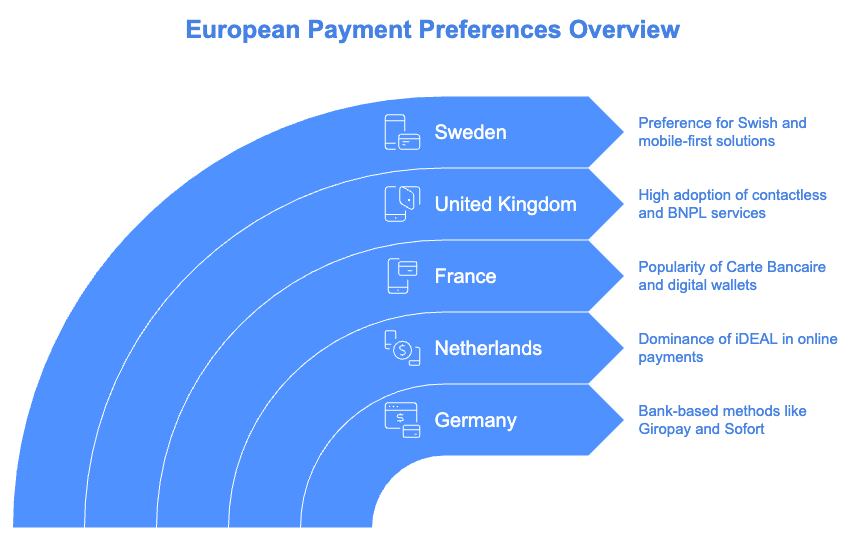
  • Germany: Consumers often prefer methods like Giropay and Sofort, which allow real-time bank transfers.
  • Netherlands: iDEAL is the dominant online payment method, highly trusted and widely used.
  • Sweden: Swish is popular for bank-to-bank transfers, especially for mobile transactions.

Digital Wallets

The popularity of digital wallets is growing rapidly across Europe, with younger generations leading this shift. Wallets such as Apple Pay, Google Pay, and PayPal are prevalent, enabling customers to make secure, fast payments online and in-store. Mobile payment adoption rates are particularly high in the UK, France, and Nordic countries, where contactless payment technology is well-integrated.

For businesses, supporting digital wallets can be a competitive advantage, particularly in regions where mobile commerce is booming. Consumers increasingly expect to be able to use their smartphones for transactions, and digital wallets meet this demand effectively.

Country-specific payment methods in Europe

To succeed in Europe, businesses must cater to country-specific payment preferences. Here’s a closer look at the most popular methods in key markets:

Germany

German consumers favor bank-based payment methods. Credit card use is less common than in other countries, with many opting for direct debit options and local solutions like Giropay and Sofort. These methods are bank-linked, offering secure, real-time transactions that appeal to security-conscious German shoppers. Cash usage, while decreasing, is still notable in in-person transactions.

Netherlands

The Netherlands is highly digital in terms of payment, with iDEAL dominating online transactions. Nearly all Dutch banks support iDEAL, making it the top choice for e-commerce. For businesses targeting this market, integrating iDEAL is essential for reaching Dutch consumers, as it accounts for a large share of online purchases.

France

In France, Carte Bancaire (CB) is the most widely used payment card, while Visa and Mastercard are also common. Credit and debit cards remain popular, and digital wallet adoption is growing, with Apple Pay and Google Pay leading in mobile payments. In recent years, there’s been a shift towards mobile and contactless solutions, particularly among younger consumers.

United Kingdom

The UK is a leader in digital payments, with high adoption of contactless cards and digital wallets like Apple Pay and Google Pay. Buy Now, Pay Later (BNPL) services, such as Klarna and Clearpay, have also gained popularity, especially among millennials. Businesses aiming to succeed in the UK should consider offering a wide variety of digital and alternative payment methods.

Sweden

Sweden’s payment landscape is one of the most advanced, with Swish being a popular mobile payment method. Cash usage is nearly obsolete, and digital wallets, alongside debit cards, are preferred for both in-store and online transactions. The Swedes are tech-savvy, and businesses targeting Sweden benefit from focusing on mobile-first payment solutions.

Europe can be divided into regions where payment habits vary:

Western Europe

Western Europe has high rates of credit card and digital wallet usage, especially in countries like the UK, France, and Belgium. Contactless payments have become standard in these countries, driven by mobile and wearable technology adoption.

Eastern Europe

Eastern Europe is still catching up in terms of digital payment adoption. Many consumers continue to prefer cash, though digital wallet use is rising as smartphone penetration increases. Poland and the Czech Republic have strong bank transfer systems, and mobile payment solutions are becoming more popular among urban populations.

Northern Europe (Nordics)

The Nordics are highly digital, with a strong preference for mobile and digital wallet payments. Countries like Sweden and Denmark lead in cashless transactions, and bank transfers through mobile solutions like Swish are common.

Southern Europe

In Southern Europe, credit cards and bank transfers are commonly used, but cash is still prevalent in countries like Italy and Spain. Digital wallets are gaining traction, but adoption is slower compared to Northern Europe.

RegionPopular Payment MethodsNotes
Western Europe– Credit and Debit Cards (Visa, Mastercard)Contactless payments are widely adopted.
– Digital Wallets (Apple Pay, Google Pay, PayPal)France, UK, and Belgium lead in mobile wallet adoption.
– Bank Transfers (SEPA Direct Debit)Common for recurring payments and high-value transactions.
Eastern Europe– CashStill widely used in certain areas, particularly in rural regions.
– Bank Transfers (SEPA)Popular in Poland and the Czech Republic.
– Digital Wallets (PayPal, Apple Pay)Growing adoption, especially in urban areas and among younger populations.
Northern Europe– Digital Wallets (Swish in Sweden, MobilePay in Denmark)High mobile payment adoption, low cash usage.
– Credit and Debit CardsContactless and mobile payments are common.
– Bank Transfers (SEPA)SEPA transfers are widely used and trusted.
Southern Europe– Credit and Debit Cards (Visa, Mastercard)Credit cards are standard, but digital wallets are gradually gaining traction.
– CashCash remains common, especially in countries like Italy and Spain.
– Digital Wallets (Apple Pay, Google Pay)Slowly increasing in popularity with younger consumers.

Key trends in european payment methods

European payment trends are continuously evolving. Some key trends include:

Growth of Contactless Payments

Contactless payments saw significant growth during the COVID-19 pandemic. In many countries, consumers have come to expect contactless options for in-store purchases, whether through contactless-enabled cards or digital wallets.

Buy Now, Pay Later (BNPL) Options

BNPL options like Klarna, Clearpay, and Afterpay are rapidly expanding in Europe. They’re particularly popular with younger consumers who prefer flexible payment options. Businesses can benefit from integrating BNPL solutions, especially for e-commerce transactions.

Digital Wallet Adoption

Digital wallets are becoming standard payment methods, with rapid adoption across the continent. Apple Pay, Google Pay, and Samsung Pay are widely accepted, and local solutions like Swish (Sweden) and MobilePay (Denmark) are expanding.

Decrease in Cash Usage

Cash is declining across Europe, with many countries aiming to become cashless. Sweden is at the forefront, with plans to phase out cash entirely, while other countries see digital payments replacing cash, especially in urban areas.

Practical tips for businesses: Choosing the right payment methods

For businesses, the diversity of payment preferences in Europe can be challenging. Here are some actionable tips for selecting the right payment methods:

  1. Offer Multiple Payment Options: Give customers a variety of choices, including credit cards, bank transfers, and digital wallets. This inclusivity increases the likelihood of conversion.
  2. Consider Country-Specific Solutions: Integrate local payment solutions like iDEAL in the Netherlands and Giropay in Germany to meet regional expectations.
  3. Optimize for Mobile: Ensure that payment interfaces are mobile-friendly, as mobile commerce is significant in Europe. A smooth mobile checkout process is essential.
  4. Prioritize Security: European consumers are increasingly concerned about data privacy. Use secure payment solutions and communicate your commitment to data protection to build customer trust.
  5. Utilize a Payment Orchestration Platform: Solutions like Gr4vy’s orchestration platform allow businesses to integrate multiple payment providers effortlessly, customizing payment options based on country-specific needs.

Frequently Asked Questions (FAQs)

What is the most common payment method in Europe?

Credit and debit cards remain the most common payment methods, with digital wallets and bank transfers also popular depending on the country.

PayPal leads digital wallet usage across Europe, with Apple Pay and Google Pay also gaining significant traction, especially in Western Europe.

What are the alternative payment methods in Europe?

Alternative payment methods include buy now, pay later (BNPL) options like Klarna, direct bank transfers, and local methods like Giropay in Germany and iDEAL in the Netherlands. Learn more about Alternative payment methods in this article. 

What is the biggest payment provider in Europe?

Major players include Visa, Mastercard, and PayPal, along with region-specific providers like SEPA for bank transfers within the EU.

What is the most common international payment method?

Credit cards and digital wallets are widely accepted across borders, while SEPA bank transfers facilitate cross-border payments within the EU.

Gr4vy’s role in supporting payment methods in Europe

For businesses expanding in Europe, Gr4vy’s payment orchestration platform offers an efficient way to manage and integrate multiple payment options. With support for credit cards, digital wallets, and local payment methods, Gr4vy helps businesses deliver seamless payment experiences tailored to each country’s needs.

How does Gr4vy help businesses with payment methods in Europe?

Gr4vy enables businesses to manage multiple payment providers across Europe, ensuring seamless transactions tailored to each country’s payment preferences.

Can Gr4vy support local payment methods?

Yes, Gr4vy supports a variety of local methods, helping businesses cater to country-specific needs and improve their payment conversion rates. Check out Gr4vy’s integrations. 

Does Gr4vy support digital wallets in Europe?

Absolutely, Gr4vy integrates with digital wallets like Apple Pay, Google Pay, and PayPal to meet the rising demand for mobile and contactless payments across Europe.

Understanding Europe’s diverse payment preferences is crucial for any business aiming to succeed in this market. By offering a tailored mix of payment options that resonate with local customers, companies can create a smoother purchasing experience, build trust, and ultimately increase sales. With trends like digital wallets and contactless payments gaining ground, staying agile and responsive to these shifts can be a true competitive advantage.

For businesses looking to simplify payment management, Gr4vy’s payment orchestration platform offers the flexibility to integrate and optimize payment methods across different countries. Ready to streamline your payment strategy? Contact Gr4vy to learn how their platform can support your expansion and help you connect with customers across Europe.

Why do online payments fail: an updated guide for 2025

For businesses and consumers alike, online payments are essential for smooth transactions, whether it’s shopping online, subscribing to services, or booking travel. However, payment failures can disrupt this flow, leading to frustration and potentially lost revenue for merchants. Understanding why online payments fail is crucial to minimizing these disruptions and maintaining a reliable experience for customers.

Payment failures can occur for various reasons, from network issues to insufficient verification steps or security protocols blocking certain transactions. This guide unpacks the most common reasons for online payment failures and offers actionable strategies for businesses to prevent them, enhancing the overall customer experience and maximizing transaction success.

Common reasons for failed online payments

Online payments can fail for a variety of reasons, from insufficient funds to technical glitches. Below are the primary causes of payment failures and how each impacts the transaction process.

1. Insufficient funds

One of the most common reasons a transaction fails is due to insufficient funds in the user’s account. When a customer’s balance doesn’t cover the transaction amount, the bank or card issuer will automatically decline the payment. This situation is particularly common with debit cards.

2. Incorrect payment details

Entering incorrect payment details, such as the card number, expiration date, or CVV code, is another frequent cause of payment failure. Security protocols in most payment gateways and banks decline transactions when details don’t match to prevent unauthorized access.

3. Card expiration

Using an expired card results in an automatic transaction decline. This is a frequent issue with recurring payments, where customers may forget to update their stored card information.

4. Network and connectivity issues

Stable internet and network connections are essential for successful online payments. Any interruption in connectivity between the user, bank, and payment gateway can disrupt the transaction, resulting in a failure. This is particularly common during high-traffic periods or events, where network latency can cause timeouts.

5. Fraud detection protocols

Banks and payment gateways use fraud detection measures to prevent unauthorized payments. If a transaction appears suspicious, such as being initiated from an unfamiliar location, the bank may block it. These security measures are essential but can sometimes result in false positives, where legitimate payments are blocked by mistake.

For more information on optimizing transaction approvals, check out our guide on payment fraud prevention.

6. Payment gateway issues

Payment gateways may experience technical issues or downtimes, especially during peak periods. Even when all other transaction factors are in order, issues with the gateway itself can prevent payments from processing successfully.

7. Exceeding daily card limits

Many debit and credit cards have daily spending limits. If a customer tries to make a payment that exceeds this limit, the transaction may be declined. While some banks allow users to adjust these limits through mobile banking, payments exceeding these thresholds are typically unsuccessful.

8. Insufficient account verification

Banks may require additional verification, such as 3D Secure or OTP codes, to authorize online transactions. If the customer fails to complete this verification, the transaction won’t go through.

Learn more about optimizing payment approval rates to enhance your customer experience.

Why online payments fail due to technical issues

Technology plays a central role in online payments, but it’s also a common source of transaction failure. Here are some ways technical issues can disrupt payments:

Network and connectivity interruptions

Successful online transactions rely on smooth data exchange between the customer, payment gateway, and bank. If connectivity is lost at any point, the payment may not complete, leading to timeouts or failures.

Incompatible payment gateways

Not all banks or cards work with every payment gateway. Some banks only support domestic transactions, while others have limitations on certain payment types. This can lead to failed transactions when a card or bank isn’t compatible with the merchant’s gateway.

System maintenance

Banks and payment gateways periodically undergo maintenance, which can disrupt the payment process. Scheduled downtimes typically result in temporary unavailability, affecting payment success rates.

Outdated browser or app

Using an outdated browser or app can also impact payment processing. Compatibility issues with older versions may prevent payments from going through, especially if the platform doesn’t support current security protocols.

Check out how payment orchestration can improve transaction success rates by addressing common technical issues.

Why certain transactions fail due to bank policies

Banks have policies to protect customer accounts and ensure safe transactions, but these policies sometimes result in failed payments. Here are a few ways bank policies can affect online transactions:

Fraud detection protocols

Banks use fraud detection algorithms to monitor unusual spending patterns. If a transaction triggers one of these protocols, the bank may block it. Unusual spending, foreign transactions, or high-value purchases are common reasons for flagged transactions.

Card type restrictions

Certain businesses only accept specific card types, such as Visa or Mastercard, causing payments to fail if the customer’s card type isn’t supported. Customers may need to use an alternative payment method to complete the purchase.

International transaction restrictions

Some banks automatically block international payments for security reasons. In these cases, customers may need to authorize international transactions through online banking or contact their bank to lift the restriction.

Spending limits on debit and credit cards

Most banks impose daily spending limits on debit and credit cards. If a customer’s transaction exceeds this limit, the payment will be declined. Customers should check their bank’s policies on spending limits to prevent disruptions.

Why online payments fail due to insufficient user verification

Security verification steps are essential for protecting online transactions, but they can also cause payment failures when users are unable to complete the necessary steps. Here’s how verification issues impact payments:

One-time password (OTP) requirements

For high-value purchases or foreign transactions, banks often send OTPs to confirm the payment. If the user doesn’t complete the OTP verification, the transaction will fail. This is a common issue in ecommerce and online bookings.

3D Secure requirements

3D Secure adds a layer of protection by requiring cardholders to authenticate transactions through their bank. However, if the user fails this step, the transaction will be declined.

Inactive or unverified account

Some online services require users to verify their account details or activate specific security features before making payments. If an account is inactive or unverified, payments may fail.

How payment orchestration can reduce failed transactions

Payment orchestration platforms help minimize payment failures by offering flexible routing options, managing multiple gateways, and enhancing security measures. Here’s how payment orchestration supports transaction success:

Smart routing for increased approval rates

Payment orchestration platforms use smart routing to direct each transaction to the provider with the highest approval rates based on transaction type, location, and payment method. This ensures that payments are more likely to succeed, minimizing disruptions.

Multi-gateway support

Orchestration platforms connect with multiple payment gateways, reducing the risk of downtime. If one gateway is experiencing issues, the platform can reroute the transaction through an alternative provider, ensuring continuity.

Fraud prevention and security measures

By integrating advanced fraud detection and verification protocols, payment orchestration platforms reduce the likelihood of false declines. This prevents genuine transactions from being blocked due to security triggers.

For more on minimizing payment failures with orchestration, explore Gr4vy’s guide to payment orchestration.

Improved customer experience

Payment orchestration platforms create a seamless customer experience by supporting multiple payment methods, reducing the likelihood of failed payments, and enhancing approval rates. This makes the checkout process smoother and reduces cart abandonment.

See how Gr4vy’s platform supports a seamless payment experience for businesses worldwide.

FAQ about failed online payments

Why would a transaction fail?
A transaction can fail for various reasons, including insufficient funds, incorrect details, network issues, or fraud detection protocols.

Why would a payment be unsuccessful?
Unsuccessful payments can result from card expiration, network errors, incompatible payment gateways, or security policies from the bank.

Why is my payment failing with my debit card?
Debit card transactions may fail if the card has international restrictions, spending limits, or additional security verification requirements.

Why would a payment not go through?
Payments may not go through due to temporary bank holds, system maintenance, or limitations set by the payment gateway or bank.

Why are my online transactions failing?
Online transactions can fail due to expired cards, outdated payment information, or blocked international transactions.

How does Gr4vy help reduce payment failures?
Gr4vy’s platform minimizes payment failures through smart routing, multi-gateway support, and integrated fraud detection, ensuring a smooth checkout experience.

Understanding the reasons behind online payment failures helps both customers and businesses address and prevent these disruptions. Whether caused by technical issues, insufficient funds, or verification requirements, failed payments are a challenge that can be minimized through strategic solutions. Payment orchestration platforms, like Gr4vy, enable businesses to improve transaction success rates by offering routing flexibility, fraud protection, and backup options across multiple gateways.

Ready to optimize your payment success rates? Contact Gr4vy today to learn how our payment orchestration platform can support seamless transactions and enhance your customer experience.

Payment routing: All you need to know for 2025

Managing payments efficiently is a priority for businesses handling diverse transactions and high-volume sales. Payment routing—a method of directing transactions to specific providers based on factors like cost, location, or approval likelihood—plays a pivotal role in meeting these needs. It enables companies to deliver a fast and dependable checkout experience while minimizing expenses.

For merchants expanding into new markets or handling cross-border payments, strategic payment routing optimizes approval rates and customizes the payment flow, making it an indispensable tool for growth and customer satisfaction.

What is payment routing?

Payment routing is the process of directing payment transactions to the most suitable payment provider based on criteria like cost, currency, or location. By setting these rules, businesses can improve transaction success rates, reduce transaction fees, and ensure a smoother experience for customers.

The importance of payment routing in Ecommerce

In an increasingly global market, payment routing allows businesses to navigate complex payment networks, enhance their approval rates, and control costs across multiple payment providers and regions. For example, routing to a local provider for Australian customers or using a high-approval-rate provider for large transactions can make a substantial difference in both user experience and operational cost.

To learn more about optimizing payment flows, check out our comprehensive guide on payment orchestration.

How does payment routing work?

Payment routing operates based on rules that assess transaction data in real-time to select the most efficient path for each payment. These rules may consider factors like transaction size, card type, and currency. This process typically involves the following steps:

  1. Transaction Initiation: A customer initiates a payment on the merchant’s platform.
  2. Criteria Evaluation: The payment platform assesses transaction factors, such as customer location or currency.
  3. Route Selection: Based on set rules, the platform selects the optimal payment provider.
  4. Transaction Completion: The selected provider processes the transaction, resulting in approval or denial.

Real-Life Example of Payment Routing in Action

Consider an online retail platform with customers worldwide. When a customer from Europe makes a purchase, the system may route the transaction to a European payment provider with lower fees, enhancing approval rates and reducing cross-border charges.

Types of Payment Routing

Various routing types are available, each suited to specific business needs. Understanding these options can help merchants design effective payment flows.

1. Static Payment Routing

Static routing employs fixed rules for all transactions, directing payments through a specific path regardless of changing factors. This method can be suitable for smaller businesses or straightforward payment processes but lacks flexibility in response to dynamic conditions.

Benefits of Static Routing

  • Predictable: Offers consistent and reliable routing without fluctuations.
  • Simple Setup: Easy to configure, particularly for merchants with limited routing requirements.

2. Dynamic Payment Routing

Dynamic routing adjusts to real-time transaction conditions, selecting the best route for each transaction based on factors like location, card type, or provider performance.

Benefits of Dynamic Routing

  • Optimized Costs: Minimizes transaction costs by routing through providers with the best rates.
  • Higher Approval Rates: Adapts routes to maximize transaction approvals, reducing decline rates.

Explore dynamic routing in payment orchestration and how it benefits merchants.

3. Smart Payment Routing

Smart routing leverages machine learning to make data-informed routing decisions based on historical transaction data. Over time, this method becomes increasingly effective as it learns from each transaction.

Benefits of Smart Routing

  • Advanced Optimization: Uses data to refine routing paths continually.
  • Enhanced Fraud Prevention: Routes high-risk transactions to providers with strong fraud detection capabilities.

For merchants seeking to manage fraud while improving efficiency, learn about Gr4vy’s integrations for fraud prevention.

The key benefits of payment routing for merchants

Payment routing offers substantial benefits, making it a valuable tool for businesses aiming to improve transaction management.

1. Reduced Processing Costs

Routing transactions to the provider with the most competitive fees reduces the overall cost of transactions. For high-volume businesses, these cost savings can significantly impact the bottom line.

2. Higher Approval Rates

Payment routing improves approval rates by directing transactions to providers with favorable approval histories, ensuring that more transactions succeed and fewer are declined.

3. Enhanced Customer Experience

Customers experience quicker approvals, minimal payment failures, and a seamless checkout process, which enhances satisfaction and encourages repeat business.

4. Simplified Cross-Border Transactions

For businesses with international customers, routing transactions through local providers minimizes cross-border fees and reduces the risk of transaction declines.

Implementing payment routing: Step-by-Step guide

Implementing effective payment routing involves several key steps. Here’s a step-by-step guide for businesses:

Step 1: Define Business Objectives

Clearly identify your routing goals. Are you looking to reduce fees, increase approval rates, or expand into new markets? Defining these objectives will shape the routing rules you establish.

Step 2: Choose a Payment Orchestration Platform

Select a payment orchestration platform that offers comprehensive routing capabilities. Platforms like Gr4vy enable flexible routing configurations and simplify the management of multiple providers.

Learn more about payment orchestration platforms and how they help merchants.

Step 3: Set Up Routing Rules

Based on your objectives, configure rules that determine routing criteria. For instance, routing transactions based on geographic regions, currency types, or high-risk profiles can be effective.

Step 4: Monitor and Optimize

Regularly monitor your routing performance and adjust rules as needed. Data analysis can help you fine-tune your routing strategies to enhance transaction outcomes.

Step 5: Implement Fraud Prevention Measures

Incorporate fraud detection tools in your payment routing strategy. Routing high-risk transactions to providers with robust fraud protection can help minimize losses and safeguard customer data.

Staying updated with emerging trends can help businesses refine their payment routing strategies. Here are a few key trends in 2025:

  1. AI-Powered Routing: AI and machine learning enhance routing by predicting the most efficient paths for each transaction, making routing smarter and more adaptable.
  2. Focus on Cross-Border Payment Efficiency: As global ecommerce grows, efficient cross-border routing has become a priority, with platforms adding more local providers to streamline international payments.
  3. Increased Focus on Fraud Detection: Integrating fraud detection into routing is a growing trend, with platforms like Gr4vy providing robust fraud prevention tools.

For more on enhancing approval rates and managing fraud, check out our guide on approval rates.

Frequently asked questions (FAQs)

What is payment routing information?

Payment routing information includes data points like transaction type, currency, and location, used to determine the optimal route for each payment.

What is smart payment routing?

Smart routing uses machine learning to analyze transaction data and choose the most efficient route, often improving approval rates and reducing fees.

What is the routing number on a payment method?

In banking, this refers to a bank identifier, but in payment routing, it relates to the decision path for each transaction based on set criteria.

What is merchant routing?

Merchant routing is the practice where businesses set specific rules to direct transactions, often to optimize costs or increase approval rates.

How does smart routing work?

Smart routing applies algorithms to analyze transaction data in real time, choosing routes that improve approval rates and minimize transaction costs.

Does Gr4vy support payment routing?

Yes, Gr4vy’s platform offers customizable payment routing, allowing merchants to optimize their transaction flows across multiple providers.

How does Gr4vy’s payment routing benefit my business?

With Gr4vy, you gain flexibility to manage routing rules, reduce processing fees, and maximize approval rates, especially useful for global and high-volume businesses.

Can Gr4vy help with fraud detection in payment routing?

Absolutely. Gr4vy integrates advanced fraud detection tools, allowing merchants to route high-risk transactions to providers with strong security features.

How can I set up payment routing with Gr4vy?

To start, explore Gr4vy’s integration options, define routing rules in the platform, and customize the system to align with your business needs.

Payment routing is a powerful tool that allows merchants to manage payment processes with precision, ensuring smoother transactions, cost efficiency, and better approval rates. By understanding the different types of routing—static, dynamic, and smart—businesses can choose a strategy that aligns with their goals. Implementing payment routing through a capable orchestration platform, such as Gr4vy, simplifies complex transactions and provides the flexibility needed for growth.

Want to optimize your payment routing? Contact Gr4vy today to learn how our platform can help you integrate, manage, and streamline your payment processes for success.

Popular payment methods in Australia: A complete guide for 2025

Australia has rapidly transitioned to a cashless society, driven by the convenience and security of digital payment methods. As the ecommerce landscape grows, Australian consumers are opting for contactless, digital-first transactions over traditional cash payments. For businesses, understanding the most popular payment methods in Australia is essential for providing seamless and efficient customer experiences. This guide offers a comprehensive overview of the payment methods Australians prefer and how merchants can leverage these trends for growth.

Australia’s payment landscape is dominated by digital wallets, credit cards, Buy Now, Pay Later (BNPL), and BPAY. Below is a detailed breakdown of each method:

  1. Digital Wallets
    Digital wallets, including Apple Pay, Google Pay, and Samsung Pay, have seen significant growth, particularly for contactless payments. These wallets allow consumers to store their payment information securely on their mobile devices, providing speed and convenience at checkout. In 2021, monthly digital wallet transactions increased by 90%, illustrating their dominance.
  2. Credit and Debit Cards
    Despite the rise of alternative payment methods, credit and debit cards remain widely used, with Visa and Mastercard continuing to lead the market. Most merchants accept these cards both online and in-store, benefiting from the security protocols like 3-D Secure.
  3. Buy Now, Pay Later (BNPL)
    BNPL services like Afterpay, Zip, and Klarna are rapidly gaining traction, especially among younger consumers. This flexible payment option allows customers to make purchases immediately and pay off the balance in installments, without interest, boosting consumer purchasing power. BNPL is expected to grow by 20% annually through 2028 in Australia. Dive deeper into payment trends in Australia.
  4. BPAY
    A trusted method for bill payments, BPAY allows consumers to use their banking apps to pay bills. It is popular due to its simplicity, security, and integration with nearly all major financial institutions in Australia.
  5. Cryptocurrency Payments
    While still niche, cryptocurrency is gaining interest among Australians, particularly among tech-savvy users. Some merchants have begun accepting Bitcoin and Ethereum as payment options, although their mainstream use is still limited compared to traditional payment methods.

What is the most used payment method in Australia?

The most used payment method in Australia is digital wallets. Consumers favor Apple Pay, Google Pay, and Samsung Pay for contactless transactions. This trend is driven by their convenience, security features, and widespread merchant acceptance. Additionally, the COVID-19 pandemic accelerated the adoption of contactless payments, making digital wallets the go-to option for millions of Australians.

What do people use to pay in Australia?

Australians predominantly use digital wallets, credit cards, and Buy Now, Pay Later services for payments. In-store, contactless payments through digital wallets and cards are standard, while BNPL has become a favored option for online purchases. Additionally, BPAY is commonly used for bill payments, and cryptocurrency is slowly making its way into the payment ecosystem.

For more details on emerging payment trends, visit our comprehensive guide.

What payment app does Australia use?

Australia widely uses Apple Pay, Google Pay, and Samsung Pay for contactless payments. These mobile wallets are widely accepted by most retailers and are integrated into the everyday purchasing experience. Additionally, PayPal remains a popular option for online transactions, offering secure payments for both ecommerce and peer-to-peer transfers.

If you’re interested in understanding more about payment approval rates, check out how to optimize approval rates in ecommerce transactions.

Does Australia use Cash App or PayPal?

While Cash App is not widely used in Australia, PayPal is a leading platform for both online shopping and money transfers. PayPal’s secure and user-friendly interface makes it a popular choice for both consumers and businesses. Additionally, Venmo, owned by PayPal, is also starting to gain traction for peer-to-peer payments.

Australia is experiencing several key trends that are shaping its payment landscape:

  1. Contactless Payments: The rise of digital wallets has transformed the way consumers make in-person payments. By 2024, contactless payments are expected to dominate the retail space, with digital wallets leading the charge.
  2. BNPL Growth: Buy Now, Pay Later (BNPL) is one of the fastest-growing payment trends in Australia, particularly in ecommerce. It offers flexibility for consumers and drives conversion rates for merchants.
  3. Increased Payment Security: As digital payments grow, so does the emphasis on fraud prevention. Merchants are investing in advanced fraud detection and prevention tools, including tokenization and 3-D Secure, to safeguard transactions. Learn more about how to prevent ecommerce fraud.
  4. Cryptocurrency Adoption: While still a niche payment method, cryptocurrencies like Bitcoin and Ethereum are gaining ground as alternative payment options in Australia. Though mainstream adoption is limited, some merchants now offer cryptocurrency payment options to cater to tech-savvy consumers.

Additional payment methods used in Australia

Australia’s payment ecosystem extends beyond digital wallets and BNPL services. Here are some additional payment methods used across the country:

  • Direct Debit: For subscriptions and recurring payments, direct debit from bank accounts remains a popular option.
  • POLi Payments: An online payment method allowing consumers to pay directly from their bank account without needing a credit or debit card.
  • EFTPOS: Widely used for in-person debit transactions, EFTPOS is a secure and instant payment method, connecting directly to the customer’s bank account.

For merchants looking to integrate these payment methods, explore Gr4vy’s payment orchestration integrations in the APAC region.

FAQs about payment methods in Australia

What is the most used payment method in Australia?
Digital wallets, particularly Apple Pay and Google Pay, are the most used payment methods, especially for contactless payments.

What do people use to pay in Australia?
Australians use digital wallets, credit/debit cards, Buy Now, Pay Later services, and BPAY for payments, depending on the context.

What payment app does Australia use?
Australia’s top payment apps are Apple Pay, Google Pay, and Samsung Pay. PayPal is widely used for online transactions.

Does Australia use Cash App or PayPal?
While Cash App is not common in Australia, PayPal is widely used for both online shopping and peer-to-peer money transfers.

What are the payment trends in Australia?
Key trends include the rise of contactless payments, BNPL, enhanced payment security, and increasing cryptocurrency adoption.

Australia’s payment landscape is rapidly evolving, with digital wallets, BNPL, and contactless payments shaping the future of transactions. To stay competitive, merchants must adapt by integrating these popular payment methods. By offering a variety of payment options and staying informed about the latest trends, businesses can enhance customer satisfaction and drive growth.

Ready to optimize your payment methods for the Australian market? Contact Gr4vy today to learn how our payment orchestration platform can streamline your payment processes and integrate seamlessly with your business.

Fraud prevention for ecommerce: Best practices for merchants

As ecommerce grows, so does the threat of online fraud. For merchants, safeguarding their businesses from fraud is critical to maintaining customer trust, minimizing financial losses, and preserving brand reputation. Effective fraud prevention strategies are essential for running a secure ecommerce operation.

This article provides an in-depth look at the best practices for ecommerce fraud prevention and explores how merchants can benefit from the anti-fraud tools integrated into Gr4vy’s payment orchestration platform. From multi-layered security measures to advanced fraud detection solutions, Gr4vy partners with industry-leading anti-fraud providers to ensure merchants can focus on growth while staying protected.

What are the ways to prevent ecommerce fraud?

Preventing ecommerce fraud requires a proactive and multi-layered approach. Here are some of the most effective ways to protect your online store:

  1. 3-D Secure Authentication: This additional verification step requires customers to authenticate themselves (usually with a one-time password) before completing a transaction. By using 3-D Secure, fraudsters are prevented from making unauthorized purchases with stolen card details. Gr4vy’s platform allows seamless integration with 3-D Secure, providing extra security without compromising user experience.
  2. Address Verification System (AVS): AVS ensures that the billing address entered by the customer matches the one on file with the issuing bank. This simple method can help detect fraud, particularly in card-not-present (CNP) transactions.
  3. Tokenization: Protect sensitive cardholder data by using tokenization to replace sensitive information with encrypted tokens. Gr4vy’s payment orchestration platform offers tokenization services, ensuring that customer card details remain protected even during breaches. Learn more about tokenization and its role in fraud prevention.
  4. Real-Time Fraud Detection: Leverage real-time monitoring tools to detect suspicious activities as they happen. Gr4vy integrates leading anti-fraud providers like Accertify, CyberSource Decision Manager, Forter, and more, all designed to continuously monitor transactions and flag potential fraud based on advanced machine learning algorithms and data analytics.
  5. Multi-Factor Authentication (MFA): MFA provides an additional layer of security by requiring more than just login credentials to access accounts or make purchases. Combining this with Gr4vy’s orchestration solutions further safeguards against unauthorized transactions.

What is fraud detection in e-commerce?

Fraud detection in ecommerce is the process of identifying suspicious activities that may indicate fraudulent transactions. It involves analyzing various data points, such as transaction amounts, IP addresses, geolocation, and purchasing patterns, to detect and block fraud attempts before they occur.

Gr4vy integrates with powerful fraud prevention tools like Forter and Sift, which use machine learning and artificial intelligence to assess transactions in real time. These tools can flag unusual behaviors, such as multiple transactions from the same IP address or mismatched billing and shipping addresses. By using machine learning, the fraud detection systems get smarter over time, adapting to new types of fraud that may emerge.

What is the most common type of ecommerce fraud?

The most common type of ecommerce fraud is card-not-present (CNP) fraud, where fraudsters use stolen credit card information to make online purchases without physically possessing the card. Since merchants cannot physically verify the customer’s identity, CNP fraud poses a higher risk to ecommerce businesses.

Other types of common ecommerce fraud include:

  • Chargeback fraud: Customers dispute legitimate transactions, often claiming they did not authorize the purchase, in order to receive a refund.
  • Account takeover fraud: Fraudsters gain access to customer accounts using stolen login credentials and make unauthorized purchases.
  • Phishing attacks: Fraudsters trick customers into providing sensitive information through fraudulent websites or emails, which they then use to make purchases.

To mitigate these types of fraud, Gr4vy’s anti-fraud integrations with Accertify and CyberSource Decision Manager help merchants monitor transactions and automatically flag potential fraud. These solutions prevent fraud from affecting the business while maintaining a smooth checkout experience for legitimate customers.

How can you prevent fraud when selling online?

When selling online, merchants need to take extra precautions to prevent fraud. Below are actionable steps to reduce the risk of fraud in your ecommerce store:

  1. Enable 3-D Secure Authentication: By using 3-D Secure, you can require customers to complete an extra verification step (such as entering a one-time password) before the transaction is processed. This adds a layer of security to prevent CNP fraud.
  2. Leverage machine learning-based fraud detection: Fraud detection tools that use machine learning can analyze thousands of data points to identify fraud patterns in real time. Gr4vy integrates with fraud detection leaders like Sift and Riskified, which dynamically prevent fraud by analyzing data from their vast networks of ecommerce transactions. These tools learn from past transactions, becoming smarter and more accurate over time.
  3. Tokenize payment data: Use tokenization to replace sensitive card details with encrypted tokens, reducing the likelihood of data breaches and fraud. Tokenization is critical for storing customer information for recurring transactions or subscriptions.
  4. Monitor IP addresses and geolocation: Look for patterns in transaction locations to detect unusual behavior, such as multiple orders from different IP addresses within a short time. Gr4vy’s integration with Forter provides detailed insights into customer behaviors to help detect and prevent fraud.

For more tips on how to improve payment security and reduce fraud, visit our guide on online payment security.

How do you secure e-commerce?

Securing your ecommerce store is about more than preventing fraud—it’s about creating a safe environment for both your customers and your business. Here are essential steps for securing your platform:

  • PCI Compliance: Ensuring that your business follows PCI DSS guidelines is vital for protecting cardholder data. Compliance minimizes the risk of data breaches and helps avoid costly fines.
  • SSL Certificates: SSL certificates encrypt the data shared between customers and your website, ensuring that sensitive payment information is securely transmitted.
  • Secure Payment Gateways: Gr4vy’s payment orchestration platform integrates with multiple payment gateways, offering a secure checkout experience while protecting transactions with tools like 3-D Secure, tokenization, and fraud detection.
  • Regular Security Audits: Regularly audit your ecommerce platform’s security settings to identify and close any potential vulnerabilities.

For more information on securing your ecommerce platform, read our guide on how to ensure online payment security.

Fraud prevention tools for e-commerce

Ecommerce merchants can significantly reduce fraud risk by using the right tools. Gr4vy integrates with several industry-leading fraud prevention providers to give businesses access to advanced fraud detection solutions.

Here are some of the most powerful fraud prevention tools available through Gr4vy’s integrations:

  1. Accertify: Accertify prevents fraud by using AI and machine learning to analyze transactions and detect anomalies. With over 7.6 billion ecommerce transactions analyzed last year, Accertify’s platform offers powerful insights to help businesses prevent fraud while enabling growth.
  2. CyberSource Decision Manager: Cybersource’s Decision Manager combats fraud using one of the world’s largest fraud detection databases, allowing merchants to maximize revenue while reducing operational costs.
  3. Forter: Forter provides real-time fraud prevention by assessing digital interactions at every touchpoint. Forter’s network includes data from major global retailers, giving it the ability to prevent account takeovers, promo fraud, and chargebacks.
  4. Kount: Kount offers fraud prevention from the first customer interaction, verifying identities and detecting synthetic IDs throughout the customer journey. This protects merchants from account takeovers and chargebacks.
  5. Sift: Sift dynamically prevents fraud and abuse using machine learning algorithms. Sift specializes in preventing account takeovers, promo abuse, and payment fraud, particularly in APAC, EMEA, LATAM, and NA regions.

With these powerful fraud prevention tools integrated into Gr4vy’s platform, merchants can feel confident that their transactions are secure while maintaining an optimal customer experience. Explore all of Gr4vy’s fraud prevention tools.

FAQs about ecommerce fraud prevention

What is the most common type of ecommerce fraud?


The most common type of ecommerce fraud is card-not-present (CNP) fraud, where fraudsters use stolen credit card information for online transactions without having the physical card.

How can merchants prevent fraud when selling online?


Merchants can prevent fraud by enabling multi-factor authentication, using tokenization to protect sensitive card data, and leveraging machine learning-based fraud detection tools like Accertify, Forter, and Sift, which are available through Gr4vy’s integrations.

What tools can prevent ecommerce fraud?


Gr4vy integrates with fraud prevention tools such as CyberSource Decision Manager, Forter, Kount, and Riskified to help merchants detect and prevent fraud in real time, protecting against chargebacks, promo abuse, and account takeovers.

How do I secure payments in my ecommerce store?


To secure payments, use SSL certificates, comply with PCI DSS standards, integrate fraud detection tools like Sift, and use tokenization to protect sensitive customer data.

Fraud prevention is crucial for ecommerce businesses, but with the right tools and strategies, merchants can significantly reduce their risk. By leveraging the powerful anti-fraud tools integrated into Gr4vy’s payment orchestration platform, merchants can prevent fraud, protect their customers, and focus on growing their businesses.

Want to protect your business from online fraud? Contact Gr4vy today to learn how our platform can integrate industry-leading fraud prevention tools and secure your ecommerce transactions.