GR4VY

The ultimate PCI compliance checklist: protect your payment data

Every time a customer enters their card details, they expect their data to be handled securely. Yet, cardholder information remains a prime target for fraudsters, and failing to comply with PCI compliance can lead to financial penalties, reputational damage, and even loss of payment processing capabilities.

Unlike other compliance frameworks that may only apply to specific industries, PCI DSS affects anyone processing, storing, or transmitting payment card data—from small e-commerce businesses to global enterprises. The challenge? Compliance isn’t a one-time task. It requires ongoing effort, regular assessments, and adaptation to evolving security threats.

This checklist provides a structured breakdown of PCI DSS compliance, ensuring businesses meet security requirements while streamlining payment operations. Whether you’re new to PCI compliance or looking to refine your security strategy, this guide covers everything you need to know.

The 12 requirements of PCI DSS compliance

PCI DSS is built on twelve core security requirements, each addressing different aspects of payment security. These requirements serve as a framework for businesses to protect cardholder data and minimize the risk of breaches.

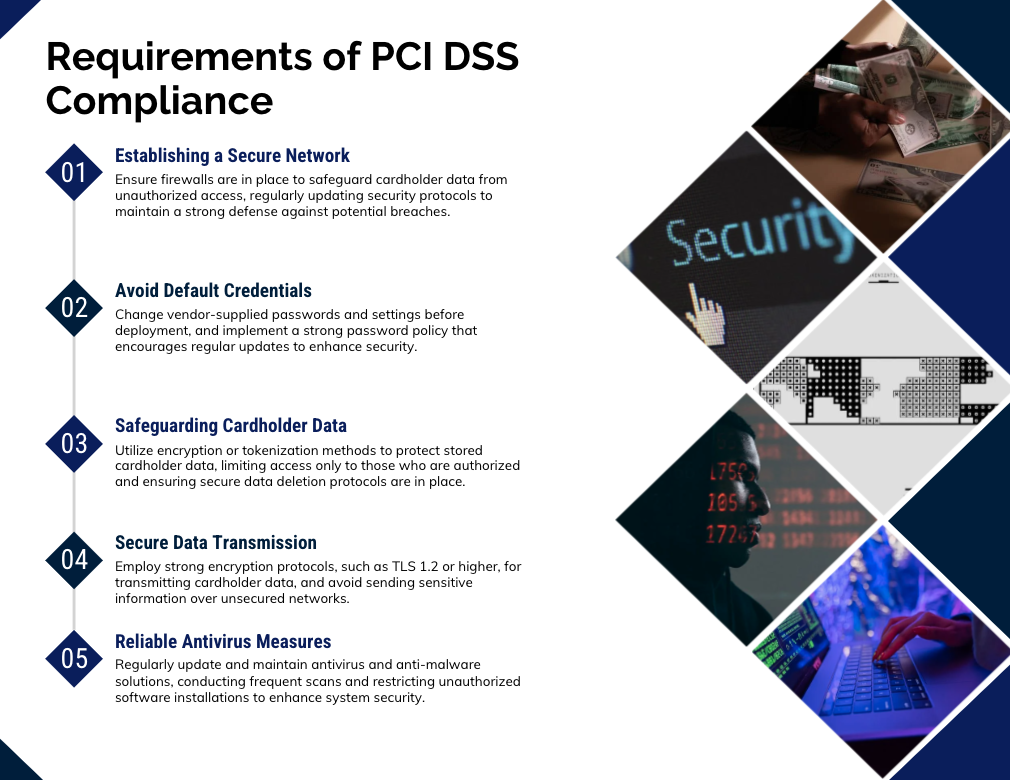
Install and maintain a secure network

Firewalls and network security controls are the first line of defense against unauthorized access. Businesses must:

  • Configure firewalls to protect cardholder data
  • Prevent public access to payment systems
  • Regularly update security configurations

Do not use vendor-supplied defaults for passwords and security settings

Cybercriminals often exploit default credentials left unchanged in payment systems. To reduce risk:

  • Change all default passwords and settings before deploying payment systems
  • Enforce strong password policies across all accounts
  • Regularly review and update authentication methods

Protect stored cardholder data

Businesses must store cardholder data securely, or better yet, avoid storing it at all. Best practices include:

  • Using encryption or tokenization to protect stored payment information
  • Restricting access to stored cardholder data to authorized personnel only
  • Implementing secure deletion methods when data is no longer needed

For more information on secure card data storage, visit how to store card data safely.

Encrypt transmission of cardholder data across open networks

Whenever cardholder data is transmitted, it must be encrypted to prevent interception. Businesses should:

  • Use strong encryption protocols (e.g., TLS 1.2 or higher)
  • Ensure payment data is never sent over unsecured communication channels
  • Regularly review encryption configurations

Use and regularly update antivirus and anti-malware software

Payment systems must be protected from viruses and malicious software. This requires:

  • Installing and maintaining updated antivirus software on all payment processing devices
  • Conducting regular system scans and monitoring suspicious activity
  • Restricting software installations to authorized personnel only

Develop and maintain secure systems and applications

Software vulnerabilities can provide hackers with entry points into payment systems. Businesses must:

  • Regularly apply security patches to operating systems and applications
  • Conduct vulnerability assessments and penetration testing
  • Implement secure coding practices for in-house software development

Restrict access to cardholder data based on business need

Not all employees require access to payment data. Businesses must:

  • Enforce role-based access control (RBAC)
  • Limit access to only those who require it for job functions
  • Regularly review and update access permissions

Assign unique IDs to each person with computer access

Shared login credentials create security risks. PCI DSS requires:

  • Assigning unique credentials to each employee or system user
  • Implementing multi-factor authentication (MFA) for remote access
  • Monitoring login attempts and failed authentication attempts

Restrict physical access to cardholder data

Data security extends beyond digital threats. Businesses handling cardholder data must:

  • Securely store physical payment records
  • Restrict access to payment data storage areas
  • Use surveillance and access logs to monitor data handling

Track and monitor all access to network resources and cardholder data

Real-time monitoring helps detect security incidents before they escalate. Businesses should:

  • Maintain detailed logs of all system access and payment transactions
  • Use automated monitoring tools to detect suspicious activity
  • Store logs securely and review them regularly

Regularly test security systems and processes

A proactive security approach requires continuous testing. Businesses must:

  • Conduct periodic security audits and penetration testing
  • Implement automated vulnerability scanning
  • Test disaster recovery and incident response plans

Maintain a policy that addresses information security

A strong security culture ensures ongoing PCI DSS compliance. Businesses should:

  • Establish formal security policies covering payment data handling
  • Conduct employee training on PCI DSS requirements
  • Regularly update security policies to reflect industry changes

By implementing these twelve requirements, businesses significantly reduce the likelihood of payment data breaches. However, compliance doesn’t end here—maintaining PCI DSS compliance is an ongoing effort that requires continuous monitoring and adaptation.

PCI compliance requierements

Common challenges in achieving PCI compliance

Many businesses struggle with PCI DSS compliance due to complex security requirements, evolving threats, and operational constraints. Some common challenges include:

  • Managing third-party vendors – Businesses often rely on payment processors, cloud services, and third-party integrations, each of which must also meet PCI DSS standards.
  • Balancing security and user experience – Implementing strong security measures without disrupting the checkout experience is key.
  • Keeping up with regulatory updates – PCI DSS standards evolve to address new risks, requiring businesses to update their security practices accordingly.
  • Handling multi-channel payment environments – Ensuring compliance across in-store, online, and mobile transactions adds another layer of complexity.

To better understand how businesses navigate these challenges, check out how payment orchestration simplifies compliance.

Best practices for sustaining PCI compliance

Achieving PCI compliance is one thing—maintaining it is another. Businesses must take proactive measures to ensure ongoing compliance and adapt to emerging threats. The following best practices help sustain PCI DSS compliance long-term.

Conduct regular compliance audits

PCI DSS compliance is not a one-time achievement but an ongoing process. Businesses should:

  • Schedule routine internal security audits
  • Work with Qualified Security Assessors (QSAs) to evaluate compliance
  • Perform annual PCI DSS self-assessments to identify gaps

Train employees on security protocols

Human error is one of the most significant risks to data security. Regular training helps employees recognize threats and follow security best practices.

  • Conduct mandatory security training sessions for all employees handling cardholder data
  • Provide phishing awareness training to prevent social engineering attacks
  • Establish clear policies on handling sensitive payment information

Implement real-time monitoring and logging

A proactive approach to security includes tracking all access to cardholder data. Businesses should:

  • Use Security Information and Event Management (SIEM) tools to detect suspicious activities
  • Monitor failed login attempts and unusual transaction patterns
  • Store log files securely and review them regularly for anomalies

Partner with PCI-compliant payment providers

Working with a PCI DSS-compliant payment processor helps businesses maintain security standards while reducing compliance burdens.

  • Select providers with robust security features and encryption protocols
  • Ensure vendors comply with PCI DSS requirements before integrating them into your payment system
  • Regularly review vendor security policies and contracts

For businesses looking to streamline compliance, payment orchestration platforms provide an efficient way to integrate multiple PCI DSS-compliant payment service providers while reducing security risks.

The role of payment orchestration in PCI compliance

Payment orchestration platforms simplify the complexities of PCI DSS compliance by offering secure, compliant, and scalable payment solutions. Here’s how they help businesses stay PCI-compliant:

Reducing PCI scope

By outsourcing payment data handling to a payment orchestration platform, businesses can minimize their exposure to sensitive cardholder information, reducing PCI scope and compliance costs.

Enhancing fraud prevention

Modern orchestration platforms include advanced fraud detection tools, helping merchants mitigate security threats before they become an issue.

  • Implement AI-driven fraud detection systems
  • Enable multi-factor authentication (MFA) for transactions
  • Use tokenization to replace card details with secure tokens

Optimizing payment routing

Payment orchestration platforms intelligently route transactions through multiple payment providers, improving authorization rates while ensuring compliance with PCI DSS security standards.

Learn more about how payment orchestration benefits businesses.

Preparing for PCI DSS updates and future compliance requirements

PCI DSS standards evolve over time to address new security threats. Businesses must stay ahead of these changes by:

  • Keeping up to date with the latest PCI DSS versions and updates
  • Attending industry events and training sessions on data security
  • Working with security consultants to adapt compliance strategies

By proactively preparing for future compliance requirements, businesses can reduce the risk of non-compliance while maintaining a secure payment ecosystem.

Frequently asked questions about PCI compliance

What is a PCI DSS compliance checklist?

A PCI DSS compliance checklist is a structured guide that helps businesses ensure they meet the Payment Card Industry Data Security Standard (PCI DSS) requirements. It includes key security measures such as encrypting data, maintaining secure networks, and conducting regular security audits.

What does PCI mean in payment processing?

PCI (Payment Card Industry) refers to the security standards set to protect cardholder data in payment transactions. Businesses that process, store, or transmit payment card information must comply with PCI DSS to prevent fraud and data breaches.

What is considered PCI payment card data?

PCI payment card data includes sensitive customer payment details such as:

  • Primary Account Number (PAN)
  • Cardholder name
  • Expiration date
  • Security codes (CVV, CVC, CID)

What is included in the scope of PCI DSS standards?

The scope of PCI DSS compliance includes:

  1. Payment processing systems – All devices and software that handle cardholder data.
  2. Network infrastructure – Firewalls, routers, and security protocols that protect card transactions.
  3. Third-party service providers – Vendors and partners that access or process payment information.

What are the different types of PCI transactions?

PCI transactions can be classified into:

  • Card-present transactions – In-store purchases where the card is physically swiped, dipped, or tapped.
  • Card-not-present transactions – Online, phone, or mail orders where card details are manually entered.
  • Recurring payments – Automated charges for subscriptions or memberships.
  • Mobile transactions – Payments made via digital wallets and mobile apps.

How can businesses determine their PCI compliance scope?

To determine PCI scope, businesses should:

  • Identify all systems that store, process, or transmit cardholder data.
  • Assess third-party service providers for compliance.
  • Conduct a network segmentation review to isolate payment systems from non-compliant areas.
  • Perform a PCI DSS self-assessment to define compliance requirements.

Maintaining PCI DSS compliance is an essential responsibility for businesses handling payment transactions. By following best practices, leveraging payment orchestration, and preparing for future updates, merchants can ensure their payment infrastructure remains secure and compliant.

To explore how payment orchestration can simplify your compliance strategy, contact Gr4vy and speak with a payment expert today.

What is CVV/CVC in debit card? Understanding card security codes

When making an online or card-not-present transaction, one key piece of security information required is the CVV (Card Verification Value) or CVC (Card Verification Code). These three- or four-digit numbers play a crucial role in preventing fraud and ensuring the security of card transactions.

For merchants, understanding what is CVV/CVC in debit card payments is essential for securing transactions, reducing fraud risks, and maintaining compliance with payment security standards. Businesses that use payment orchestration can ensure better transaction routing and fraud protection while streamlining the process of handling CVV/CVC codes.

This article explores what is CVV CVC in Visa debit card and how businesses and consumers can use it to enhance payment security.

What is CVV/CVC in debit card transactions?

A CVV (Card Verification Value) or CVC (Card Verification Code) is a security feature used in debit and credit card transactions. This number is typically found on the back of a debit card and acts as an additional layer of authentication for online and card-not-present payments.

The primary function of the CVV CVC number in debit card transactions is to confirm that the person making the transaction has physical possession of the card. Since CVVs are not stored in merchant databases, they add an extra security layer against fraud.

What is the CVV CVC code on a debit card?

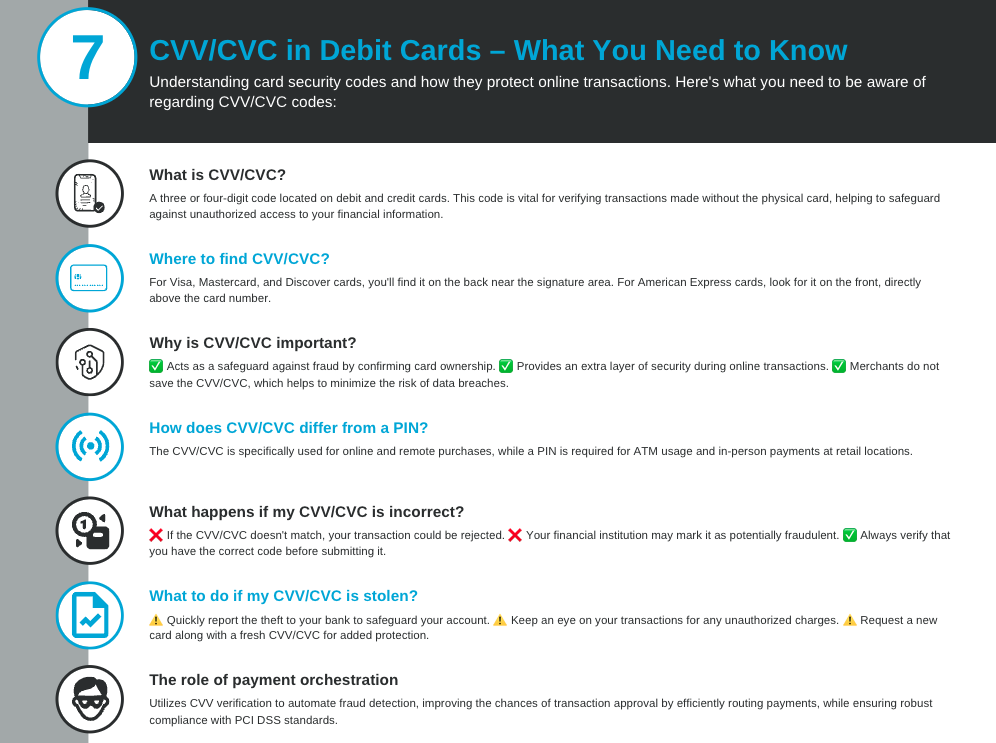
The CVV/CVC code on a debit card is typically a three-digit number printed on the signature strip on the back of Visa, Mastercard, and Discover cards. American Express cards display a four-digit CVC on a credit card printed on the front.

This code is necessary for:

  • Online transactions – Used to verify cardholder authenticity during checkout.
  • Card-not-present transactions – Required for phone and digital purchases.
  • Fraud prevention – Protects against unauthorized use in digital payments.

What is the CVV CVC on a credit card?

The CVV CVC on a credit card works similarly to debit cards but is used for credit-based transactions. Whether a card is Visa, Mastercard, or Amex, this security code helps prevent fraudulent use when the card is not physically present.

CVC in credit card means: How does it work?

CVC in credit card means a code that is dynamically generated and unique to each card. Unlike card numbers, expiration dates, or PINs, CVC in card transactions cannot be stored by merchants, making it harder for fraudsters to exploit stolen card details.

Since what does CVC on a credit card mean varies slightly by card network, different brands label this code differently:

  • Visa/Mastercard: CVV (Card Verification Value)
  • American Express: CID (Card Identification Number)
  • Discover: CVC (Card Verification Code)

To understand how CVVs fit into broader credit card schemes, read how credit card schemes work.

CVV CVC in debit card infographic

What is CVV CVC number in debit card security?

CVV/CVC security measures are essential for businesses processing payments. As a merchant, ensuring compliance with PCI DSS (Payment Card Industry Data Security Standard) is necessary to prevent fraud. Payment orchestration platforms help businesses manage these security measures while optimizing checkout flows.

To enhance security:

  • Never store CVV CVC numbers in databases.
  • Require CVV/CVC verification for all online transactions.
  • Use fraud prevention tools that detect unusual transactions.
  • Implement AI-driven fraud detection to monitor transaction patterns.
  • Utilize multi-factor authentication (MFA) where possible for additional security.

For more details on secure card storage, check how to store card data safely.

Why is CVV/CVC important in payment orchestration?

In a payment orchestration system, merchants work with multiple payment providers to increase transaction approval rates while minimizing fraud risks. CVV/CVC validation ensures that only legitimate transactions are processed, reducing chargebacks and declined transactions.

Key benefits include:

  • Improved fraud detection – Helps block unauthorized transactions.
  • Higher authorization rates – Some banks decline transactions without CVV CVC verification.
  • Compliance with PCI DSS – Ensures that sensitive data is handled correctly.
  • Seamless integration with alternative payment methods – Ensures security even when processing wallets and BNPL payments.
  • Better checkout experience – By automating security checks, businesses can reduce friction for legitimate transactions.

Can CVV/CVC codes be declined?

Yes, transactions can be declined if:

  • The CVV/CVC number is entered incorrectly.
  • The card issuer detects suspicious activity.
  • The card is expired or blocked.
  • The transaction is flagged due to potential fraud detection systems.
  • The payment gateway has incorrect settings for processing CVVs.

If you experience repeated declines, check credit card decline codes and how to fix them.

CVV vs PIN: What’s the difference?

While CVV CVC codes and PINs both enhance security, they serve different functions:

  • CVV/CVC codes are used for card-not-present transactions (online, phone payments).
  • PINs are used for card-present transactions (ATM withdrawals, in-store purchases).
  • CVVs are not stored, while PINs may be entered into merchant systems for processing.

Future of CVV/CVC security in digital payments

With the rise of digital wallets, biometric authentication, and AI-driven fraud detection, CVV/CVC codes may evolve into more dynamic security measures. Tokenization and cryptographic security are already reducing reliance on static CVV numbers, allowing for safer digital transactions.

Frequently asked questions about CVV/CVC in debit cards

What is CVV/CVC in a debit card?

The CVV (Card Verification Value) or CVC (Card Verification Code) is a three- or four-digit security code printed on debit cards. It helps verify the authenticity of a transaction when the card is used online or in a card-not-present environment.

Where can I find the CVV/CVC code on my debit card?

For most debit cards, including Visa, Mastercard, and Discover, the CVV/CVC code is located on the back, near the signature strip. For American Express cards, the CVC on a credit card appears on the front.

Why do I need a CVV/CVC code for online transactions?

CVV/CVC codes act as an additional security layer to prevent unauthorized transactions. Since the CVC in card is not stored by merchants, it ensures that only someone with physical possession of the card can complete an online purchase.

Is it safe to share my CVV/CVC number?

No, never share your CVV/CVC code with anyone. Merchants are not allowed to store CVV codes, and legitimate companies will never ask for it outside of a secure transaction process.

What happens if my CVV/CVC code is incorrect?

If the CVV/CVC code is entered incorrectly, the transaction will likely be declined by the card issuer. This is a fraud prevention measure to ensure the correct security details are provided. If repeated declines occur, check credit card decline codes and how to fix them.

Understanding what is CVV/CVC in debit card transactions is crucial for secure online payments. Whether using a debit card or credit card, this security code plays a vital role in preventing fraud and verifying transactions.

For businesses, leveraging payment orchestration platforms can help streamline CVV validation, reduce fraud risks, and improve transaction success rates. To learn more about optimizing payments, contact Gr4vy and explore how payment orchestration can enhance your security strategy.

Test credit card numbers: what they are and how to use them

Businesses and developers often need to test payment systems before going live for online transactions. This is where test credit card numbers come into play. These are specially generated numbers that mimic real credit cards but do not hold any financial value. They allow businesses to simulate transactions, check for errors, and ensure their payment gateway works correctly.

For merchants, understanding credit card test card numbers is crucial to preventing fraud, optimizing checkout experiences, and complying with security regulations. Payment orchestration platforms make this process more efficient by streamlining the integration and testing of various payment methods.

This guide will cover everything you need to know about credit card test numbers, including how they work, how to generate them, and how scammers might misuse them.

What are test credit card numbers?

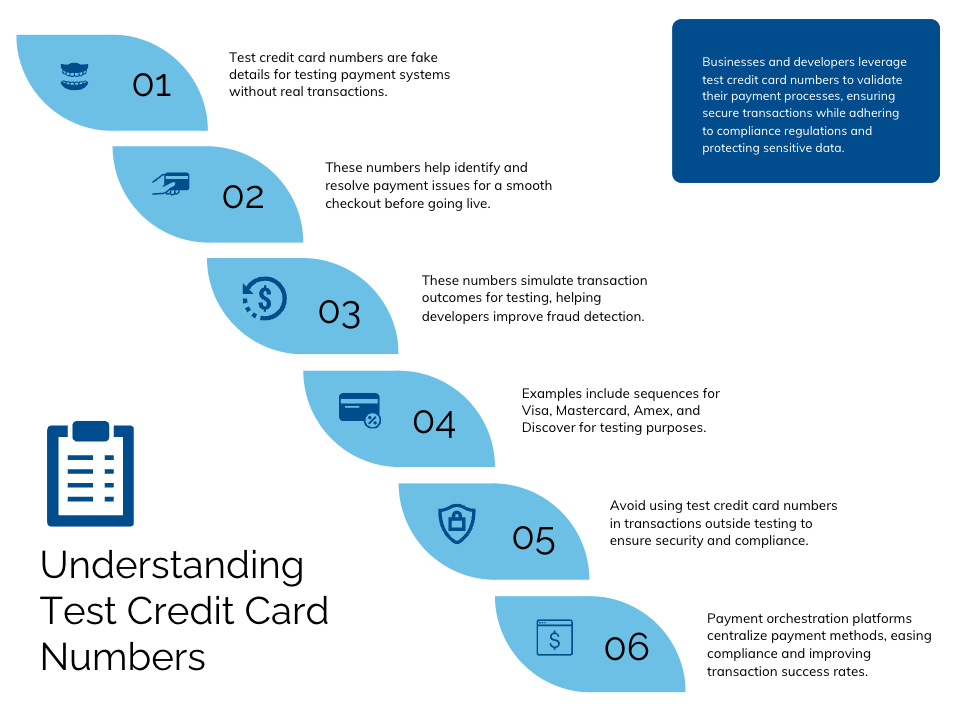
Test credit card numbers are dummy card numbers used for testing payment processing systems. They are provided by payment networks like Visa, Mastercard, and American Express to help businesses simulate real transactions without processing actual funds.

These numbers follow the Luhn algorithm, the same validation method used by real credit cards. However, they are restricted to sandbox environments, meaning they won’t work for real transactions. Developers and merchants use them to:

  • Test payment gateway integrations
  • Validate fraud detection mechanisms
  • Check the handling of transaction errors and declines
  • Ensure smooth user experience in credit card numbers for ecomm testing

If you are handling sensitive payment data, it’s essential to understand best practices for storing and securing cardholder information. Read more about how to store card data safely.

How to test credit card numbers

When testing a payment gateway or e-commerce checkout system, businesses need to simulate different types of transactions. This involves using testing credit card numbers to assess:

  1. Successful transactions – Ensuring payments go through when valid credit card numbers for testing are entered.
  2. Failed transactions – Testing scenarios where payments fail due to incorrect details or declined transactions.
  3. Refunds and chargebacks – Checking how the system processes refunds and disputes.
  4. 3D Secure authentication – Verifying if additional security layers, like OTP-based authentication, function correctly.

Each payment processor provides its own list of credit card testing numbers, which typically include different card networks, expiration dates, and CVV codes to test various transaction scenarios.

How scammers test credit card numbers

While random test credit card numbers are meant for legitimate testing, fraudsters use similar techniques for illicit purposes. This is known as card testing fraud, where cybercriminals attempt to validate stolen card details by making small transactions on different platforms.

Signs of credit card test numbers fraud include:

  • Multiple small-value transactions from the same IP address
  • Unusual spikes in declined transactions
  • Different cards being tested in rapid succession
  • Mismatched billing and shipping addresses

To combat fraudulent credit card testing numbers being used on your site, businesses can implement fraud prevention tools, enable velocity checks, and work with payment orchestration platforms to monitor suspicious activities. Learn more about credit card decline codes and how to fix them.

test credit card numbers infographic

How to generate test credit card numbers

Businesses and developers can generate test credit card numbers using tools provided by payment networks and processors. These generators follow the Luhn algorithm and typically include:

  • Card number – A 16-digit number that passes validation checks.
  • Expiration date – A future date that mimics a real credit card.
  • CVV – A three-digit security code for authentication testing.
  • Card brand – Visa, Mastercard, American Express, or Discover.

Some payment orchestration platforms offer built-in tools for testing credit card numbers for e-commerce transactions, streamlining the development and compliance process.

How to test CVV credit card numbers

The Card Verification Value (CVV) is a critical security feature for online transactions. When testing payment systems, businesses must check how credit card test card numbers validate CVVs. This involves:

  1. Entering valid CVVs – Ensuring transactions succeed when the correct test credit card numbers are provided.
  2. Using incorrect CVVs – Confirming that the system rejects payments with mismatched CVVs.
  3. Testing stored card transactions – Checking whether CVVs are required for recurring billing setups.

Testing credit card numbers for CVV authentication helps businesses prevent fraud and comply with PCI DSS standards. Learn more about how credit card schemes work.

Why businesses should use payment orchestration for testing

Manually testing credit card numbers across multiple payment gateways can be time-consuming and complex. A payment orchestration platform simplifies the process by:

  • Centralizing the testing of multiple payment methods
  • Reducing failed transactions by routing payments intelligently
  • Automating compliance with security standards
  • Providing built-in fraud detection and decline management tools

For businesses handling high transaction volumes, leveraging payment orchestration can improve success rates and streamline operations. If you want to understand the costs associated with processing transactions, check out credit card processing fees.

Frequently asked questions about test credit card numbers

How to test real credit card numbers?

Testing real credit card numbers is not recommended due to security and compliance risks. Instead, businesses and developers should use test credit card numbers, which are provided by payment networks for testing purposes. These numbers work in sandbox environments to simulate real transactions without processing actual payments. Using live credit card data for testing could lead to accidental charges, security breaches, or non-compliance with PCI DSS regulations.

Is it illegal to use test credit card numbers?

No, it is not illegal to use test credit card numbers as long as they are used in designated testing environments, such as payment gateways’ sandbox modes. However, using them for real transactions, fraudulent purposes, or unauthorized testing can lead to legal consequences. Always ensure you are testing within compliant frameworks provided by legitimate payment service providers.

What are some credit card numbers for test accounts?

Many payment providers offer specific credit card test card numbers for sandbox testing. Examples include:

  • Visa: 4111 1111 1111 1111
  • Mastercard: 5555 5555 5555 4444
  • American Express: 3782 822463 10005
  • Discover: 6011 0009 9013 9424

These numbers allow merchants to validate payment processing workflows without using real financial data. Each provider may have additional test cases to simulate declined transactions, expired cards, or CVV mismatches.

What are test credit card numbers for?

Test credit card numbers are used by businesses, developers, and payment processors to simulate online transactions. They help ensure that payment gateways, fraud detection tools, and checkout processes function correctly before going live. These numbers prevent errors, reduce fraud risks, and improve transaction security without exposing actual cardholder data.

What are test credit card numbers used for?

  • Simulating successful and failed transactions
  • Verifying fraud prevention mechanisms
  • Testing e-commerce checkout flows
  • Ensuring compliance with payment regulations
  • Debugging payment processing issues

By using credit card numbers for testing, businesses can optimize their payment systems while safeguarding customer data.

What does it mean by test credit card numbers?

A test credit card number is a non-functional card number created for the purpose of testing payment gateways, fraud detection tools, and transaction workflows. These numbers follow real credit card validation rules, such as the Luhn algorithm, but they do not have actual funds or banking association. They allow developers and businesses to test payment systems without the risks associated with using real financial data.

Testing credit card numbers is essential for businesses to ensure smooth payment processing and detect potential issues before going live. Whether testing checkout flows, fraud prevention, or CVV authentication, using credit card numbers for testing correctly can save time and prevent costly mistakes.

As online payments continue to evolve, integrating a payment orchestration platform can simplify credit card testing numbers and provide merchants with a seamless, fraud-resistant transaction experience.

Contact Gr4vy today to learn how payment orchestration can enhance your payment testing and security strategies.

Payment regulation in the USA: Updated guide

Payment regulation in the United States is anything but static. As new payment methods emerge, fraud tactics evolve, and consumer expectations shift, the regulatory framework must continuously adapt. In 2025, businesses handling payments are navigating one of the most complex financial regulatory environments ever seen.

Regulations are no longer just about protecting consumers—they are also shaping the future of commerce, driving innovation, and ensuring that financial institutions, fintechs, and merchants operate on a level playing field. From digital wallets and contactless payments to cross-border transactions and instant payment networks, the push for modernization has led to new rules and greater scrutiny. Businesses that fail to stay ahead risk fines, reputational damage, and disruptions to their payment operations.

This guide provides a comprehensive look at payment regulations in the USA, breaking down the governing bodies, key laws, and emerging trends that are influencing the payments industry in 2025. Whether you’re a retailer, fintech, or enterprise handling high-volume transactions, understanding these regulations is critical to maintaining compliance and ensuring seamless payment processing.

As payment ecosystems become more global, regulations governing international transactions also play a crucial role. For insights into global acquiring and cross-border payments, read this guide on card acquiring for international markets.

Why payment regulation exists

Regulatory oversight in the payments industry is designed to balance security, consumer protection, and financial system integrity. Payment regulations serve multiple purposes, including:

  • Ensuring financial stability – Payment regulations establish a secure foundation for the economy, preventing systemic risks that could destabilize financial markets.
  • Protecting consumers – Laws like the Electronic Fund Transfer Act (EFTA) and Truth in Lending Act (TILA) set transparency requirements and fraud protections for users.
  • Encouraging fair competition – Regulations prevent monopolistic practices and ensure all players in the financial ecosystem have a fair chance to compete.
  • Preventing fraud and money laundering – Anti-money laundering (AML) laws and Know Your Customer (KYC) requirements help financial institutions detect and prevent illicit transactions.
  • Ensuring compliance with technological advancements – As digital payments evolve, regulations provide guidance on adopting new technologies securely and responsibly.

For businesses expanding into alternative payment methods like digital wallets, crypto payments, and BNPL, compliance becomes even more critical. Learn more about how to accept alternative payment methods.

Key regulatory organizations overseeing payments in the USA

Federal Reserve System

The Federal Reserve (the Fed) plays a central role in overseeing the nation’s payment systems. It regulates financial institutions, manages the money supply, and ensures that payment networks operate efficiently and securely. The Fed’s initiatives, such as FedNow, are pushing the industry toward instant payments.

Consumer Financial Protection Bureau (CFPB)

The CFPB protects consumers by enforcing fair lending practices and regulating financial products like credit cards, prepaid cards, and digital wallets. It ensures that payment providers disclose fees, terms, and dispute resolution mechanisms clearly.

Office of the Comptroller of the Currency (OCC)

The OCC regulates national banks and federal savings associations, ensuring compliance with federal banking laws, including those related to payments and money transmission.

Federal Trade Commission (FTC)

The FTC oversees consumer protection in commerce, addressing deceptive business practices in financial services, digital payments, and e-commerce transactions.

Department of Justice (DOJ)

The DOJ enforces federal financial crime laws, including those related to fraud, money laundering, and payment network violations.

State financial regulators

Each state has its own financial regulatory body overseeing money transmitters, payment processors, and local banking institutions.

Payment networks and financial institutions

Visa, Mastercard, the Automated Clearing House (ACH), and financial institutions enforce their own regulatory rules and standards for compliance within their networks.

Key payment regulations shaping the industry in 2025

Electronic Fund Transfer Act (EFTA) & Regulation E

The EFTA, enacted in 1978, protects consumers by outlining rights and responsibilities for electronic payments, including debit card transactions, direct deposits, and mobile wallet transfers. Regulation E, which enforces EFTA, sets disclosure and dispute resolution requirements for banks and payment providers.

Truth in Lending Act (TILA)

TILA ensures that lenders and credit providers clearly disclose interest rates, fees, and payment terms, allowing consumers to make informed borrowing decisions.

Equal Credit Opportunity Act (ECOA)

The ECOA prohibits discriminatory lending practices, ensuring that all consumers receive fair access to credit and financial services.

Regulation CC

This rule governs check clearing and deposit availability, establishing timelines for when funds must be made available to customers.

Payment Card Industry Data Security Standard (PCI DSS)

While not a government-enforced regulation, PCI DSS sets security requirements for businesses handling card transactions, preventing fraud and data breaches. Companies working with credit card networks must comply with these standards to avoid penalties and reputational damage.

For businesses handling high transaction volumes, a payment orchestration strategy can help manage compliance while optimizing payment performance. Read about the top 10 benefits of using payment orchestration in 2025.

The rise of fintech and open banking regulations

As fintech companies disrupt traditional banking models, regulators are introducing new rules to govern digital lending, embedded finance, and alternative payments. Open banking initiatives, which require banks to provide access to consumer financial data via APIs, are reshaping the industry.

Instant payments and FedNow

The launch of FedNow has accelerated the shift toward real-time payments. Regulators are updating policies to address fraud prevention, settlement risks, and compliance measures for instant transactions.

Strengthening cybersecurity and fraud prevention mandates

With cyber threats becoming more sophisticated, payment regulations now require stronger authentication, encryption, and fraud detection technologies. Multi-factor authentication (MFA) and AI-driven security are becoming standard compliance requirements.

Cryptocurrency and stablecoin regulations

As digital currencies gain traction, regulators are establishing frameworks to ensure transparency, prevent illicit activity, and integrate crypto into the broader financial system securely.

What businesses should do to stay compliant in 2026

Payment regulations in the USA are constantly evolving, requiring businesses to be proactive in maintaining compliance. Staying ahead involves:

  • Keeping up with regulatory updates – Regularly reviewing changes in federal and state laws.
  • Partnering with a payment orchestration platform – Ensuring transactions are routed through compliant and cost-efficient channels.
  • Prioritizing security and transparency – Implementing strong fraud prevention measures and clear disclosures to build consumer trust.

Understanding and implementing regulatory compliance isn’t just about avoiding penalties—it’s about building a payments infrastructure that is secure, scalable, and ready for the future.

For expert guidance on optimizing your payment strategy while staying compliant, contact Gr4vy today and book a demo with our payment experts.

PCI compliance in 2025: what are the best practices?

In 2025, the stakes for protecting payment data are higher than ever. The rise of digital transactions, coupled with increasingly sophisticated cyber threats, has made compliance with the Payment Card Industry Data Security Standard (PCI DSS) a business imperative. PCI compliance isn’t just a checkbox exercise; it’s a critical foundation for securing customer trust and enabling smooth payment operations.

With PCI DSS 4.0.1 introducing updated guidelines, businesses now have tools to address modern challenges such as securing cloud infrastructures, handling API-driven payments, and mitigating risks from third-party providers.

The evolving cybersecurity landscape: Key threats in 2025

Cybercriminals are no longer lone hackers—they are well-funded organizations leveraging cutting-edge tools. In 2025, key threats include:

  • AI-powered phishing schemes that outsmart traditional detection methods.
  • Ransomware-as-a-service targeting payment processors and financial systems.
  • API exploitation in the context of open banking and interconnected payment systems.
  • Supply chain attacks that compromise third-party providers and vendors.

To address these threats, PCI DSS 4.0.1 emphasizes proactive measures such as real-time monitoring, advanced encryption standards, and regular security testing. For a deeper dive into building resilient payment systems, check out Gr4vy’s payment orchestration insights.

The cost of non-compliance: Financial and reputational risks

The consequences of non-compliance extend far beyond regulatory fines. Businesses that fail to meet PCI DSS requirements face:

  1. Hefty penalties: Monthly fines for non-compliance can quickly escalate to tens of thousands of dollars.
  2. Reputational damage: A data breach can lead to customer churn and long-term erosion of trust.
  3. Operational setbacks: Payment disruptions caused by stricter oversight from financial institutions.
  4. Legal liabilities: Breach-related lawsuits and settlements that drain financial resources.

Compliance not only minimizes these risks but also reinforces your brand’s reliability in the eyes of consumers and partners. For actionable steps to strengthen your security posture, explore Gr4vy’s article on vulnerability management.

PCI DSS version 4.0.1: What’s new and why it matters

The key goals of PCI DSS 4.0.1

PCI DSS 4.0.1 represents the latest evolution of the Payment Card Industry Data Security Standard, aligning security practices with modern threats and technologies. The key goals of this update include:

  1. Flexibility in implementation: Recognizing the diversity of business models, version 4.0.1 allows for customized approaches to compliance while maintaining a high security standard.
  2. Enhanced risk-based methodologies: A greater emphasis on identifying and addressing specific risks ensures that businesses can proactively secure sensitive data.
  3. Focus on continuous compliance: Moving beyond periodic audits, the standard encourages ongoing adherence through regular monitoring and reporting.
  4. Stronger authentication protocols: Enhancements to authentication requirements address emerging threats such as credential theft and phishing attacks.

These updates underscore the commitment of PCI DSS to providing adaptable, robust frameworks for businesses to secure payment data effectively.

Summary of updates in version 4.0.1

The transition from PCI DSS 4.0 to 4.0.1 introduces incremental yet impactful refinements, such as:

  • Clarity in language: Updated definitions and guidance make the standard more accessible to stakeholders across industries.
  • Alignment with global regulations: Improved compatibility with other standards, such as GDPR and CCPA, ensures businesses meet multiple compliance requirements seamlessly.
  • Simplified reporting templates: Revised documentation processes reduce the administrative burden of compliance.
  • Improved scoping guidance: Additional tools for defining the scope of PCI environments help businesses address vulnerabilities more effectively.

For businesses navigating these updates, Gr4vy’s payment security insights provide actionable strategies for meeting compliance requirements.

Major differences between PCI DSS 4.0 and 4.0.1

While PCI DSS 4.0 laid the groundwork for modern payment security, version 4.0.1 refines these principles with:

  • Expanded flexibility: A greater focus on risk-based approaches allows businesses to implement controls tailored to their environments.
  • Refined authentication requirements: Multifactor authentication (MFA) protocols are now mandatory for all administrative access, further reducing risks associated with stolen credentials.
  • Strengthened phishing and malware protections: Enhanced guidance helps businesses combat social engineering and emerging malware threats.
  • More detailed gap analysis processes: Tools for identifying and addressing compliance gaps have been expanded to support proactive risk management.

These distinctions ensure that businesses can stay ahead of evolving threats while maintaining compliance with industry standards.

Timeline for compliance with PCI DSS 4.0.1

The transition to PCI DSS 4.0.1 comes with a phased approach to ensure businesses have adequate time to adapt:

  • March 2024: PCI DSS 4.0.1 becomes the official standard, replacing earlier versions.
  • March 2025: Organizations must adopt updated requirements, with exceptions for specified transitional rules.
  • March 2026: Full compliance with all PCI DSS 4.0.1 requirements is mandatory.

Adopting the standard early allows businesses to leverage its benefits while mitigating compliance risks. Gr4vy’s guide to vulnerability management offers insights into aligning payment systems with these timelines effectively.

By understanding these changes and implementing the necessary updates, businesses can position themselves for long-term security and compliance success.

PCI DSS compliance requirements explained

Overview of the 12 foundational requirements

The Payment Card Industry Data Security Standard (PCI DSS) outlines 12 foundational requirements designed to protect cardholder data, secure payment systems, and mitigate risks. These requirements are critical for organizations that store, process, or transmit payment card information. Below, we break down each requirement and provide actionable insights for achieving compliance.

Requirement 1: Install and maintain network security controls

Strong network security is the foundation of PCI compliance. Organizations must:

  • Deploy and regularly update firewalls to control traffic between trusted and untrusted networks.
  • Configure routers and firewalls to restrict unnecessary inbound and outbound connections.

For more insights on securing your network, Gr4vy’s article on payment orchestration and risk management offers valuable guidance.

Requirement 2: Apply secure configurations to system components

Default configurations often leave systems vulnerable. Businesses must:

  • Change default passwords and settings on all devices.
  • Implement secure configurations for servers, databases, and other infrastructure.

Requirement 3: Protect stored account data

Stored cardholder data is a prime target for attackers. To secure it:

  • Encrypt stored cardholder data using strong cryptographic methods.
  • Minimize the retention of sensitive data to only what is strictly necessary.

Requirement 4: Encrypt cardholder data during transmission

Data transmitted over public or unsecured networks must be protected. Businesses should:

  • Use strong encryption protocols such as TLS to secure transmission.
  • Implement robust key management practices to protect encryption keys.

Requirement 5: Protect systems from malware

Malware is a significant threat to payment systems. To prevent infections:

  • Deploy and maintain anti-malware solutions across all devices.
  • Regularly update and patch software to address vulnerabilities.

Requirement 6: Maintain secure systems and software

Keeping systems up-to-date is critical for mitigating risks. Compliance involves:

  • Ensuring all software is patched promptly to address known vulnerabilities.
  • Following a formal process for software development and deployment.

Requirement 7: Restrict access to data on a need-to-know basis

Limiting access minimizes the risk of insider threats. Businesses must:

  • Implement role-based access controls to ensure employees only access what they need.
  • Periodically review and update access privileges.

Requirement 8: Strengthen user authentication protocols

Weak authentication is a common attack vector. Compliance requires:

  • Implementing multifactor authentication (MFA) for administrative access.
  • Ensuring unique IDs for all users to track activities effectively.

Requirement 9: Implement physical security controls

Physical access to cardholder data must be restricted. Best practices include:

  • Securing data centers and server rooms with access control systems.
  • Monitoring physical access using cameras and logs.

Requirement 10: Log and monitor all system activities

Comprehensive logging ensures visibility into potential security incidents. Businesses must:

  • Maintain logs of all access to systems handling cardholder data.
  • Regularly review logs to identify anomalies or suspicious activities.

Requirement 11: Conduct regular security testing

Testing identifies vulnerabilities before attackers can exploit them. This involves:

  • Performing regular vulnerability scans and penetration testing.
  • Testing security controls after any major system changes.

Requirement 12: Establish an organizational security policy

A robust security policy sets the tone for compliance. To comply:

  • Document and communicate security policies to all employees.
  • Provide regular training to ensure awareness and adherence.

By adhering to these 12 requirements, businesses can create a secure environment for processing payments and mitigate risks associated with handling sensitive data. For additional strategies on implementing these requirements, explore Gr4vy’s compliance tools and resources.

Advanced compliance strategies for 2025

How to effectively scope your PCI environment

Scoping your PCI environment is the first critical step in ensuring compliance while minimizing unnecessary effort. To effectively define your scope:

  1. Identify your cardholder data environment (CDE): Map out where cardholder data is processed, stored, or transmitted.
  2. Minimize scope wherever possible: Reduce the footprint of your CDE by segmenting systems and processes that don’t need access to payment data.
  3. Leverage tokenization and encryption: Replace sensitive data with tokens to remove systems from scope while ensuring security.
  4. Collaborate with third-party providers: Verify that your service providers are PCI-compliant and understand their impact on your scope.

For businesses navigating complex environments, Gr4vy’s updated guide on PCI compliance in 2025 can help streamline scoping and compliance.

Leveraging automation for real-time compliance management

Automation is transforming the way businesses approach PCI DSS compliance. Key benefits include:

  • Streamlined vulnerability management: Automated tools continuously scan for vulnerabilities, reducing the time and effort required for manual audits.
  • Real-time monitoring: Proactive detection of security incidents allows organizations to act before a breach occurs.
  • Simplified reporting: Automated systems generate accurate and consistent compliance reports, saving time during audits.

Adopting a payment orchestration platform, like Gr4vy’s, provides centralized visibility and control over your compliance processes, ensuring you stay ahead of evolving threats.

Implementing zero-trust architecture for payment security

Zero-trust architecture (ZTA) is a game-changer for securing payment systems. Unlike traditional models, ZTA assumes no user or device is trustworthy by default. To implement ZTA:

  1. Authenticate continuously: Enforce multifactor authentication (MFA) and real-time identity verification.
  2. Segment your network: Use micro-segmentation to limit access to sensitive systems and data.
  3. Monitor all activity: Implement tools to log and analyze user behavior, identifying potential threats in real time.
  4. Adopt least-privilege principles: Limit user access to only what is necessary for their role.

Zero-trust aligns seamlessly with PCI DSS 4.0.1’s focus on risk-based methodologies, offering robust protection against modern cyber threats.

Utilizing AI and machine learning for threat detection and mitigation

AI and machine learning (ML) are revolutionizing threat detection by identifying patterns and anomalies that traditional methods might miss. Use cases include:

  • Behavioral analytics: AI analyzes user activity to detect unusual behavior, such as unauthorized access attempts.
  • Phishing detection: ML models can flag malicious emails and links before they reach employees.
  • Fraud prevention: AI continuously monitors transactions to identify and block suspicious activities in real time.

Gr4vy’s article on vulnerability management explores additional strategies for integrating advanced technologies into your compliance efforts.

Building a security-first culture through regular training and awareness

Compliance isn’t just about tools and technology—it’s about people. Building a security-first culture ensures that every employee contributes to safeguarding cardholder data. Key steps include:

  • Regular training programs: Educate employees about PCI DSS requirements, phishing threats, and secure practices.
  • Real-world simulations: Conduct phishing tests and security drills to reinforce learning.
  • Leadership buy-in: Ensure that executives prioritize and visibly support security initiatives.

A security-first culture aligns your workforce with your compliance goals, making PCI adherence an organizational priority rather than an afterthought.

By adopting these advanced strategies, businesses can not only achieve PCI compliance but also strengthen their overall security posture in the face of evolving challenges.

Managing PCI DSS compliance challenges

Overcoming challenges in hybrid and multi-cloud environments

As businesses increasingly adopt hybrid and multi-cloud infrastructures, managing PCI DSS compliance becomes more complex. Ensuring security across diverse platforms requires:

  1. Consistent policies: Establish uniform security controls across all environments, regardless of the cloud provider.
  2. Real-time visibility: Use centralized monitoring tools to track and manage data flow between on-premises and cloud systems.
  3. Segmentation: Isolate the cardholder data environment (CDE) from other parts of the network to limit exposure.
  4. Collaboration with cloud providers: Verify that your cloud service providers meet PCI DSS standards and provide compliance documentation.

Addressing third-party risks: Vendors and service providers

Third-party vendors play a critical role in payment processing, but they also introduce significant risks. To manage third-party compliance challenges:

  • Assess vendor compliance: Regularly review your vendors’ compliance certifications and ensure they meet PCI DSS requirements.
  • Contractual obligations: Include PCI compliance requirements in vendor agreements to establish accountability.
  • Continuous monitoring: Implement tools to monitor third-party access to your CDE and ensure adherence to security protocols.

Reducing the complexity of audits with streamlined documentation

PCI DSS audits are notoriously complex, requiring detailed documentation and evidence. Simplify the process with these practices:

  1. Standardized templates: Use predefined templates to ensure consistency and completeness in documentation.
  2. Automation tools: Employ automated systems to collect and organize compliance data, reducing manual effort.
  3. Continuous compliance: Conduct regular internal audits to identify gaps and resolve them proactively before formal assessments.
  4. Clear evidence trails: Maintain clear records of compliance activities, such as vulnerability scans, employee training, and access logs.

Streamlined documentation not only simplifies audits but also fosters a culture of continuous improvement in compliance practices.

Achieving compliance for high-risk payment methods like BNPL

Buy Now, Pay Later (BNPL) services have surged in popularity, but they pose unique compliance challenges due to their complex transaction structures. To ensure PCI compliance for BNPL:

  • Secure APIs: Protect APIs that facilitate BNPL transactions with robust encryption and authentication mechanisms.
  • Data minimization: Only collect the minimum amount of data necessary for BNPL processing to reduce exposure.
  • Vendor alignment: Work with BNPL providers that demonstrate strong adherence to PCI DSS standards.
  • Regular risk assessments: Continuously evaluate risks associated with BNPL integrations and address vulnerabilities promptly.

By addressing these challenges head-on, businesses can navigate the complexities of PCI DSS compliance while securing their payment systems against emerging threats.

PCI DSS compliance in action: Case studies and examples

How a large retailer achieved PCI DSS 4.0.1 compliance

A global retail chain faced significant challenges in updating its payment systems to comply with PCI DSS 4.0.1. The company’s legacy infrastructure and decentralized operations created gaps in their compliance efforts. To address this, the retailer:

  1. Conducted a comprehensive audit to identify gaps in their cardholder data environment (CDE).
  2. Implemented a unified payment orchestration platform to standardize processes across global locations.
  3. Enhanced employee training programs to improve compliance awareness and adherence.
  4. Adopted real-time monitoring tools to ensure continuous compliance.

By streamlining their systems and focusing on proactive measures, the retailer achieved compliance while significantly reducing their risk of data breaches.

Overcoming compliance challenges in the financial sector

A financial institution managing sensitive payment data faced scrutiny due to increasingly stringent PCI DSS requirements. Key challenges included securing multi-cloud environments and managing third-party risks. The institution took the following steps:

  1. Developed a zero-trust architecture to ensure secure access across all systems.
  2. Strengthened vendor agreements to include clear PCI DSS compliance expectations.
  3. Deployed advanced encryption protocols to protect cardholder data during transmission and storage.
  4. Conducted regular penetration tests and vulnerability assessments to identify and mitigate risks.

These measures not only enabled the institution to meet PCI DSS 4.0.1 standards but also improved overall security for their payment operations.

Adopting PCI DSS best practices in a subscription-based business model

A subscription-based streaming service struggled to manage compliance due to its reliance on recurring payments and third-party payment processors. To align with PCI DSS 4.0.1, the company:

  1. Implemented tokenization to minimize the storage of sensitive cardholder data.
  2. Partnered with PCI-compliant payment processors to reduce their CDE scope.
  3. Established a robust incident response plan to address potential breaches.
  4. Provided ongoing cybersecurity training to employees handling payment data.

This proactive approach helped the company meet compliance requirements while maintaining a seamless experience for subscribers.

PCI DSS compliance tools and resources

Vulnerability scanning: What tools should you use?

Vulnerability scanning is a cornerstone of PCI DSS compliance. Effective tools help organizations identify weaknesses in their systems before attackers can exploit them. Features to look for in a vulnerability scanner include:

  • Automated scans with real-time reporting.
  • Support for authenticated and unauthenticated scans.
  • Detailed remediation guidance to address identified vulnerabilities.

Popular tools for vulnerability scanning include Qualys, Rapid7, and Tenable, each offering robust features to align with PCI DSS requirements.

Key documents for PCI DSS compliance: SAQ, RoC, and AOC

Documentation plays a vital role in demonstrating compliance. Key documents include:

  • Self-Assessment Questionnaire (SAQ): For smaller merchants managing their own compliance efforts.
  • Report on Compliance (RoC): A detailed report prepared by a Qualified Security Assessor (QSA) for larger organizations.
  • Attestation of Compliance (AOC): A formal declaration of compliance used to communicate with acquirers and stakeholders.

Maintaining accurate and up-to-date documentation simplifies audits and ensures transparency with partners and regulators.

Continuous monitoring tools for maintaining compliance

PCI DSS 4.0.1 emphasizes the importance of continuous compliance rather than periodic checks. Tools for continuous monitoring include:

  • SIEM platforms (e.g., Splunk, IBM QRadar): Collect and analyze logs to detect anomalies in real time.
  • Endpoint detection and response (EDR) tools: Monitor devices for suspicious activities.
  • Cloud security tools: Ensure compliance across hybrid and multi-cloud environments.

By investing in these tools, organizations can maintain a robust security posture and ensure ongoing alignment with PCI DSS requirements.

PCI DSS compliance and emerging payment methods

The role of PCI DSS in digital wallets and contactless payments

Digital wallets and contactless payments have revolutionized the way consumers interact with businesses. While these payment methods offer convenience and speed, they also introduce unique compliance challenges. PCI DSS plays a vital role in ensuring the security of these transactions by:

  1. Encrypting data: PCI DSS requires strong encryption standards to protect payment information during contactless and wallet-based transactions.
  2. Securing tokenization systems: Many digital wallets use tokenization to replace sensitive card data with unique tokens, reducing risk.
  3. Authenticating users: Multifactor authentication (MFA) ensures that only authorized users can access wallet accounts.

By adhering to PCI DSS requirements, businesses can provide secure experiences for customers while minimizing the risks associated with these innovative payment methods.

PCI compliance considerations for BNPL and recurring billing

Buy Now, Pay Later (BNPL) services and recurring billing models have surged in popularity but bring additional layers of complexity to PCI compliance. Key considerations include:

  • Data storage minimization: Retain only the data necessary for recurring billing or BNPL transactions.
  • API security: Ensure APIs connecting to BNPL providers are secured with strong encryption and authentication.
  • Vendor compliance: Partner exclusively with BNPL providers that adhere to PCI DSS standards.
  • Customer notifications: Provide clear communication about billing schedules and payment processing to maintain transparency.

These steps help businesses integrate modern payment options while remaining compliant with PCI DSS standards.

How PCI compliance applies to open banking and API-driven payments

Open banking and API-driven payment models are transforming financial services by enabling secure data sharing and third-party integrations. However, they also present new challenges for PCI compliance. Here’s how PCI DSS applies:

  1. Securing API endpoints: PCI DSS mandates robust encryption and authentication for all API connections.
  2. Monitoring access: Implement logging and monitoring tools to track API activity and detect unauthorized access.
  3. Data protection: Ensure sensitive customer information shared via APIs complies with PCI DSS encryption and storage requirements.

By embedding PCI DSS principles into API security, businesses can leverage the benefits of open banking without compromising security.

FAQs: Everything you need to know about PCI compliance in 2025

What is PCI DSS compliance, and who needs it?

PCI DSS compliance refers to adherence to the Payment Card Industry Data Security Standard, which is designed to protect cardholder data. Any business that processes, stores, or transmits payment card information must comply with PCI DSS.

How is PCI compliance enforced?

PCI compliance is enforced through acquiring banks and payment processors. Non-compliant businesses may face penalties, increased fees, or even the termination of payment processing agreements.

What are the penalties for non-compliance?

Penalties for non-compliance can range from fines of $5,000 to $100,000 per month to lawsuits, data breach recovery costs, and reputational damage. The specific amount depends on the severity of the breach and the volume of transactions.

How do PCI DSS compliance levels work?

PCI DSS compliance levels are determined by the volume of card transactions a business processes annually:

  • Level 1: Over 6 million transactions annually.
  • Level 2: 1 to 6 million transactions annually.
  • Level 3: 20,000 to 1 million transactions annually.
  • Level 4: Fewer than 20,000 transactions annually.

Each level has different validation requirements, with Level 1 being the most rigorous.

Can small businesses achieve PCI compliance?

Yes, small businesses can achieve PCI compliance by following the appropriate steps for their transaction volume. Completing a Self-Assessment Questionnaire (SAQ) and working with a PCI-compliant payment processor are key steps for smaller merchants to ensure compliance.

Preparing for the future of PCI compliance

Adapting to new updates in PCI DSS standards

The ever-evolving nature of cybersecurity threats means that PCI DSS standards will continue to adapt. Staying ahead requires businesses to:

  1. Regularly review updates to PCI DSS standards and integrate them into their compliance strategies.
  2. Implement proactive measures to address new vulnerabilities as they emerge.
  3. Maintain open communication with payment processors and vendors to ensure aligned compliance efforts.

By embracing these updates, businesses can create a resilient payment ecosystem ready for future challenges.

The future of cybersecurity regulations and their impact on PCI DSS

Cybersecurity regulations are becoming stricter worldwide, with governments introducing new laws to protect consumer data. As these regulations evolve, they will inevitably influence PCI DSS requirements. Businesses should:

  • Stay informed about global regulatory trends, such as GDPR and CCPA.
  • Align their security practices with both PCI DSS and broader legal requirements.
  • Leverage compliance as a competitive advantage to build trust with customers.

Partnering with compliance experts for long-term success

Navigating PCI DSS compliance can be challenging, especially for businesses with complex payment infrastructures. Partnering with compliance experts provides:

  • Access to specialized knowledge and tools.
  • Tailored strategies for maintaining ongoing compliance.
  • Guidance on integrating advanced security technologies.

For a seamless compliance journey, consider consulting with experts who understand your unique needs.

Why compliance is an ongoing process, not a one-time task

PCI compliance is not a static goal but an ongoing process that evolves with the threat landscape. Businesses must:

  • Continuously monitor and update their systems to stay compliant.
  • Conduct regular training to ensure employees are aligned with security best practices.
  • Treat compliance as a core component of their overall cybersecurity strategy.

Leveraging technology to stay ahead of emerging threats

Innovative technologies, such as AI-driven threat detection and automation, are essential for addressing the complexities of modern payment security. By investing in advanced tools, businesses can:

  • Streamline compliance efforts.
  • Identify and mitigate risks in real-time.
  • Ensure secure, frictionless payment experiences for customers.

Building a culture of compliance for sustained success

A culture of compliance begins with leadership and extends to every employee. Businesses can:

  • Promote accountability through clear policies and regular evaluations.
  • Foster collaboration between IT, legal, and operational teams.
  • Emphasize the importance of compliance as a shared responsibility across the organization.

As you prepare for the future of PCI compliance, partnering with a trusted expert can simplify your journey. Gr4vy’s payment orchestration platform offers tailored solutions to meet your compliance needs while optimizing your payment processes. Contact Gr4vy today to book a demo with an expert and discover how we can help you achieve seamless PCI compliance in 2025.


Optimizing payments for mobile wallets: Apple Pay, Google Pay, etc.

Mobile wallets have transformed the way consumers pay, offering seamless, secure, and contactless transactions. By 2026, Apple Pay, Google Pay, and Samsung Pay have become integral to e-commerce and in-store purchases, with adoption rates soaring worldwide. Businesses that optimize their payment systems for mobile wallets can reduce friction at checkout, improve customer satisfaction, and increase conversion rates.

In this guide, we explore key strategies for optimizing for mobile wallets, covering technical implementation, security best practices, and the role of payment orchestration in streamlining mobile payments.

Understanding mobile wallets: how they work

Mobile wallets store payment credentials securely on a device, allowing users to make transactions via NFC (Near Field Communication) or QR codes. These digital wallets offer an extra layer of security with tokenization, which replaces card details with encrypted tokens, minimizing fraud risks.

  • Apple Pay – Integrated with iOS devices, Apple Pay provides biometric authentication and seamless payments across apps and websites.
  • Google Pay – Available on Android, Google Pay supports online, in-app, and in-store payments with advanced security measures.
  • Samsung Pay – Features both NFC and MST (Magnetic Secure Transmission) technology for broader acceptance.
  • Regional alternatives – Platforms like Alipay, WeChat Pay, and Paytm cater to specific global markets, expanding mobile payment options.

Why businesses must prioritize mobile wallet optimization

Optimizing for mobile wallets is no longer optional—it’s a necessity. Here’s why:

  • Faster checkout – Reduces friction, improving customer experience and decreasing cart abandonment.
  • Enhanced security – Tokenization and biometric authentication lower fraud risks.
  • Higher conversion rates – Customers are more likely to complete purchases with one-click payment options.
  • Growing consumer demand – Mobile payments are becoming the default method for transactions globally.

Step-by-step guide to optimizing for mobile wallets

Ensure mobile-friendly website design

A seamless mobile experience starts with a responsive website. Make sure:

  • Checkout pages load quickly and function well on all screen sizes.
  • Mobile wallets are visibly displayed as payment options.
  • Autofill is enabled for payment details, improving efficiency.

Integrate Apple Pay and Google Pay

Integration can be done through major payment service providers (PSPs) that support mobile wallets. Businesses should:

  • Choose a PSP or payment orchestration platform that facilitates Apple Pay and Google Pay transactions.
  • Implement native payment buttons within mobile apps and websites.
  • Test mobile wallet payments for smooth execution.

Streamline checkout flows

A complicated checkout process leads to cart abandonment. Optimize by:

  • Allowing one-click payments.
  • Reducing unnecessary form fields.
  • Enabling guest checkout with mobile wallet options.

Optimize for biometric authentication

Face ID and fingerprint authentication provide a secure and frictionless payment experience. Ensure:

  • Mobile wallets leverage device authentication features.
  • Payment authorization is instant and requires minimal user input.

Maintain PCI DSS compliance

Mobile wallets enhance security, but businesses must still comply with PCI DSS standards to protect customer data. Compliance measures include:

  • Using tokenization to minimize exposure of sensitive cardholder information.
  • Encrypting transactions and ensuring secure data storage.
  • Regularly updating security protocols to prevent breaches.

The role of payment orchestration in mobile wallet optimization

Payment orchestration platforms help businesses simplify the integration and management of multiple mobile wallet providers. Instead of relying on a single PSP, payment orchestration allows merchants to:

  • Route transactions dynamically to the most efficient payment provider.
  • Improve authorization rates by selecting the best-performing PSPs for different regions.
  • Offer local mobile wallets alongside Apple Pay and Google Pay for international customers.
  • Reduce costs by optimizing processing fees and minimizing failed transactions.

For businesses expanding into global markets, using a payment orchestration platform ensures flexibility and scalability. Learn more about how payment orchestration improves checkout efficiency.

Mobile wallets and cross-border payments

As mobile wallets become more prevalent in international commerce, businesses need to account for:

  • Currency conversion fees – Transparent pricing helps reduce unexpected costs for customers.
  • Local mobile payment options – Integrating platforms like Alipay and GrabPay increases acceptance rates.
  • Regulatory compliance – Ensuring compliance with PSD2 and strong customer authentication (SCA) requirements.

Overcoming challenges in mobile wallet adoption

Addressing security concerns

Despite their advanced security features, some consumers and businesses remain hesitant about mobile wallets. To build trust:

  • Educate customers about the benefits of tokenization and encryption.
  • Offer fraud protection guarantees to encourage adoption.
  • Implement regular security audits to identify and address vulnerabilities.
  • Encourage the use of additional privacy tools, such as a VPN with free trial, to secure online transactions.

Ensuring compatibility with multiple devices

Different devices and operating systems handle mobile wallets differently. To maximize adoption:

  • Test mobile wallet functionality across various smartphones, tablets, and browsers.
  • Ensure seamless integration with both iOS and Android platforms.
  • Provide clear instructions for customers on setting up and using mobile wallets.

What is the mobile wallet payment mechanism?

A mobile wallet payment mechanism enables users to store payment card details digitally and conduct transactions through their smartphones or wearables. This is achieved using:

  • NFC technology – Enables contactless payments via a tap-to-pay system.
  • QR code payments – Used for online and in-store payments where NFC is not supported.
  • Tokenization – Converts sensitive card data into a unique token for secure transactions.
  • Biometric authentication – Uses fingerprint or facial recognition to approve payments.

The mobile wallet mechanism ensures fast, secure, and hassle-free transactions, making it a preferred choice for modern consumers.

What is the difference between e-wallet and mobile payment?

E-wallets and mobile payments are often used interchangeably, but they have key differences:

  • E-wallet refers to digital platforms that store card details, cryptocurrencies, and loyalty rewards (e.g., PayPal, Venmo, Alipay).
  • Mobile payment is a broader term encompassing transactions made via smartphones, including mobile wallets, direct carrier billing, and QR code-based payments.

While all mobile wallets are e-wallets, not all e-wallets function as mobile wallets. The distinction lies in how the transactions are processed and the level of integration with the device’s hardware.

What are mobile payment solutions?

Mobile payment solutions provide businesses with the infrastructure to accept payments through digital wallets and mobile-based systems. These solutions include:

  • Merchant payment gateways – Enable secure transactions from mobile wallets.
  • QR code-based payments – Allow users to scan and pay without entering card details.
  • In-app payment solutions – Integrate payment systems into mobile applications for seamless transactions.
  • Peer-to-peer payment apps – Platforms like Venmo and Cash App facilitate direct transactions between users.

These solutions play a critical role in modern commerce, making payments faster, safer, and more accessible across different industries and geographies.

  • Wearable payments – Smartwatches and other IoT devices are expanding the use of mobile wallets.
  • AI-driven payment experiences – Personalized and predictive payments enhance customer convenience.
  • Decentralized identity verification – Blockchain-based authentication could further secure mobile transactions.

FAQs: everything you need to know about mobile wallet optimization

How secure are mobile wallets?

Mobile wallets use tokenization and biometric authentication, making them more secure than traditional card payments.

Can small businesses implement Apple Pay and Google Pay?

Yes, through PSPs or payment orchestration platforms, small businesses can easily integrate mobile wallets.

Do mobile wallets reduce fraud?

Yes, their built-in security features significantly lower fraud risks compared to manual card entry.

How do mobile wallets impact transaction fees?

While fees vary by provider, increased transaction approval rates often outweigh any additional processing costs.

Mobile wallets are the future of payments, and businesses that optimize for them will see higher conversion rates and improved security. By leveraging a payment orchestration platform, companies can seamlessly integrate mobile wallets, reduce fraud, and expand into global markets.Contact Gr4vy today to learn how our payment orchestration solutions can help you optimize mobile wallet transactions and enhance your checkout experience.

The largest payment methods in Europe: A comprehensive guide

When was the last time you thought about how your customers prefer to pay? For businesses venturing into Europe, this question isn’t just theoretical—it’s the foundation of success. In a region where payment methods can vary dramatically from one country to the next, failing to meet local expectations means leaving money on the table.

Imagine offering only credit cards in a market dominated by digital wallets or neglecting local payment solutions like iDEAL in the Netherlands or Bancontact in Belgium. The result? Frustrated customers, abandoned carts, and missed opportunities.

Europe’s payment landscape isn’t just diverse; it’s rapidly evolving. Mobile payments, buy-now-pay-later options, and stringent regulations like PSD2 are reshaping how consumers transact online. To stay competitive, businesses must go beyond merely accepting payments—they need to craft a payment experience tailored to each market they serve.

This guide is here to help. We’ll break down the most popular payment methods in Europe, uncover key trends driving change, and provide actionable insights for optimizing your checkout process. Whether you’re expanding into new territories or looking to refine your existing operations, this is your roadmap to getting paid in Europe.

Europe’s top payment methods: A regional overview

1. Digital wallets: Leading the charge

Digital wallets are revolutionizing e-commerce in Europe, offering speed, convenience, and security. According to recent reports, digital wallets account for over 27% of online transactions in the region, surpassing traditional credit cards.

  • Key players: PayPal, Apple Pay, Google Pay, and Klarna.
  • Advantages: One-click payments, mobile integration, and enhanced security through tokenization.
  • Trends: The rise of mobile-first consumers and contactless payments has fueled the adoption of digital wallets.

2. Credit and debit cards: A consistent favorite

While digital wallets are on the rise, credit and debit cards remain a cornerstone of European e-commerce, accounting for 25% of online payments.

  • Popular providers: Visa, Mastercard, American Express.
  • Regional differences: Cards dominate in Western Europe, particularly in countries like the UK, France, and Italy.
  • Security: Strong customer authentication (SCA) under PSD2 regulation has bolstered trust in card payments.

3. Bank transfers: A preferred method in certain regions

Bank transfers are particularly popular in countries like Germany, Austria, and the Netherlands, where consumers prioritize security and direct payments.

  • Germany: Sofort and Giropay lead the way.
  • Austria: EPS is widely used.
  • The Netherlands: iDEAL processes a significant percentage of online transactions.

4. Buy now, pay later (BNPL): Gaining traction

BNPL solutions like Klarna and Afterpay are becoming increasingly popular, especially among younger consumers. These options allow shoppers to spread payments over time, boosting affordability and encouraging larger purchases.

  • Growth areas: Scandinavia, Germany, and the UK.
  • Trends: BNPL is particularly appealing for high-ticket items and in the fashion industry.

The chart below illustrates the current usage percentages of popular payment methods across Europe, highlighting the dominance of digital wallets and credit cards.

Learn how Baby Bunting achieved an uplift in authorization rates with Gr4vy. Read the Baby Bunting case study.

Country-specific payment preferences

Germany

  • Popular methods: PayPal, Giropay, Sofort.
  • Consumer behavior: Germans value security and transparency, often favoring payment methods that allow them to pay after delivery.

France

  • Popular methods: Credit cards, Cartes Bancaires, PayPal.
  • Trends: Digital wallets are gaining ground, particularly among younger demographics.

The Netherlands

  • Popular methods: iDEAL dominates online transactions.
  • Consumer behavior: Bank transfers are preferred, with high adoption rates of secure, direct payment options.

Nordic countries

  • Popular methods: Klarna, MobilePay, Swish.
  • Trends: Scandinavia leads in mobile payments, with a strong emphasis on digital wallets and BNPL.

Poland

  • Popular methods: Blik, bank transfers.
  • Trends: A growing e-commerce market with a strong preference for local payment methods.

Belgium

  • Popular methods: Bancontact, credit cards.
  • Trends: Consumers rely heavily on Bancontact for online and in-store purchases.

Italy

  • Popular methods: PostePay, credit cards, PayPal.
  • Trends: A preference for prepaid cards like PostePay reflects a cautious approach to online payments.

Spain

  • Popular methods: PayPal, credit cards, Bizum.
  • Trends: Peer-to-peer payment solutions like Bizum are gaining traction.

See how ARO Digital leveraged Gr4vy to scale payment capabilities efficiently. Explore the ARO Digital case study.

The rise of mobile commerce

With smartphone penetration exceeding 80% in most European countries, mobile commerce is driving payment innovation. Mobile-friendly solutions like Apple Pay, Google Pay, and region-specific apps such as Swish are transforming how consumers shop online.

The demand for local payment methods

Consumers in Europe often trust and prefer local payment options over global ones. This trend highlights the importance of offering region-specific methods to boost trust and conversions.

Cross-border e-commerce

As cross-border shopping grows, businesses must adapt to diverse payment preferences. Supporting multiple currencies, languages, and payment methods is critical for capturing international customers.

The impact of regulations

Regulations like PSD2 and strong customer authentication (SCA) are shaping the payment landscape, ensuring security while challenging businesses to enhance their checkout experiences.

The following chart depicts the growth trends for different payment methods over the past three years, showing the rapid rise of digital wallets and BNPL.

Optimizing your checkout for European customers

Offer diverse payment options

To cater to European consumers, ensure your checkout supports popular local methods alongside global ones. For example:

  • iDEAL in the Netherlands.
  • Bancontact in Belgium.
  • EPS in Austria.

Focus on mobile optimization

Mobile commerce is growing rapidly. Simplify forms, enable autofill, and integrate mobile wallets to enhance the user experience.

Prioritize transparency

Display all fees, taxes, and terms upfront. Hidden costs are a major reason for cart abandonment.

Leverage payment orchestration

A payment orchestration platform can help businesses manage multiple providers, optimize routing, and reduce payment failures. Gr4vy’s platform is designed to streamline this process while ensuring scalability and security.

Want to enhance your e-commerce experience for international customers? Read our guide on optimizing your checkout for global payments.

Payment methods in Europe: Frequently asked questions

What is the most popular payment method in Europe?

Digital wallets like PayPal and Apple Pay lead in popularity, accounting for over 27% of online transactions in Europe.

Why are local payment methods important in Europe?

European consumers trust local payment methods and often prefer them over global options. Supporting these methods enhances customer trust and boosts conversions.

How can businesses optimize payments for Europe?

Offering diverse payment methods, ensuring mobile optimization, and using payment orchestration platforms are key strategies.

What role do regulations like PSD2 play in payments?

PSD2 enhances security through strong customer authentication (SCA), reducing fraud while requiring businesses to refine their checkout processes.

Understanding and adapting to the diverse payment preferences in Europe is essential for e-commerce success. From digital wallets to local bank transfers, offering the right mix of payment methods can significantly enhance customer satisfaction and drive conversions. By leveraging payment orchestration and focusing on transparency, businesses can navigate the complexities of the European market and unlock new opportunities.

Ready to optimize your payment strategy for Europe? Contact Gr4vy today to learn how our solutions can help you succeed in this dynamic region.

How to optimize your checkout: Proven tactics to increase conversion rates

Your checkout process is a critical touchpoint in your customer’s journey—a make-or-break moment that directly impacts your bottom line. While your marketing efforts may drive traffic to your store and your product pages might generate interest, it’s at the checkout where that interest turns into revenue. Yet, many businesses underestimate the importance of optimizing this crucial step.

Cart abandonment rates remain alarmingly high, with studies showing that nearly 70% of online shoppers abandon their purchases at checkout. The reasons are varied: hidden fees, lack of preferred payment methods, a cumbersome process, or even concerns about security. Addressing these pain points isn’t just about reducing abandonment; it’s about creating a checkout experience that builds trust, enhances customer satisfaction, and drives repeat purchases.

This article explores how businesses can transform their checkout process through payment orchestration and payment optimization. We’ll delve into the technologies and strategies that make a tangible difference, from dynamic payment routing to personalized experiences. With practical insights and proven techniques, you’ll learn how to eliminate friction, meet customer expectations, and ensure every shopper who adds to their cart completes their purchase.

Why conversion rates matter for your checkout

Conversion rates are one of the most critical metrics for evaluating the success of your e-commerce operations. They tell you what percentage of visitors to your website actually complete their purchase, and a higher conversion rate directly translates to increased revenue. Here are some compelling reasons to optimize for conversions:

  • Improved revenue: Even small changes to checkout can lead to noticeable revenue growth.
  • Better customer experience: Simplified and seamless processes make customers more likely to return.
  • Competitive advantage: A higher conversion rate means your business is outperforming competitors in converting traffic.

Payment orchestration: The foundation of seamless transactions

Payment orchestration centralizes your entire payment ecosystem by integrating multiple providers, gateways, and payment methods into a unified platform. This not only simplifies management but also ensures a more efficient and reliable checkout experience.

The benefits of payment orchestration

  1. Higher transaction success rates: With intelligent payment routing, failed payments are minimized by rerouting through alternative gateways.
  2. Global payment capabilities: Supporting multiple currencies and local payment options increases accessibility.
  3. Increased scalability: Easily add new providers or payment methods as your business grows.
  4. Fraud prevention at scale: Orchestration platforms consolidate security measures to protect your operations across all channels.

To learn how to optimize your checkout for global customers, check out this guide on global payments by Gr4vy.

Advanced features of payment orchestration

Payment orchestration platforms go beyond basic transaction management by offering advanced features that elevate the checkout experience.

Intelligent transaction routing

With real-time analytics and dynamic routing capabilities, payment orchestration ensures that each transaction is processed through the most efficient and cost-effective channel. This reduces payment failures and enhances customer satisfaction.

Seamless integration with multiple providers

Orchestration platforms support seamless integration with a variety of payment gateways, PSPs, and alternative payment methods. This flexibility allows businesses to cater to a diverse global audience without compromising on operational efficiency.

Enhanced security protocols

Modern orchestration platforms include advanced security measures like tokenization, encryption, and real-time fraud detection. These features not only protect sensitive customer data but also help businesses comply with international payment regulations.

Learn more about these advanced features in Gr4vy’s payment performance tips.

How to optimize for better conversion rates

Optimizing your checkout isn’t just about simplifying forms—it’s about rethinking the entire process to meet customer needs. Below are practical strategies to improve conversion rates through payment optimization.

Provide multiple payment options

Shoppers expect to pay with their preferred method. Whether it’s credit cards, digital wallets, or local payment options, offering diversity makes your business accessible to a broader audience. Research shows that businesses incorporating popular local methods see a significant boost in conversions.

For more tips on catering to diverse payment preferences, explore Gr4vy’s payment optimization guide.

Focus on mobile-first checkout design

Mobile commerce continues to dominate online shopping trends, but poorly optimized checkouts can drive mobile users away. Ensure that:

  • Forms are simple and easy to fill out.
  • Payment methods are optimized for mobile use.
  • Features like autofill and biometric authentication are supported.

Reduce payment failures with dynamic routing

Payment failures are a leading cause of lost revenue. Dynamic routing—a core feature of payment orchestration—ensures that transactions are routed through the best-performing payment gateway. This minimizes failures and improves the overall experience.

Gr4vy’s article on boosting payment performance offers detailed insights into reducing payment failures.

Build trust through transparency

Hidden fees and unclear pricing are common reasons for cart abandonment. Ensure that:

  • All costs are displayed upfront.
  • Taxes, shipping, and fees are broken down clearly.
  • Return and refund policies are easily accessible.

Leverage analytics to refine your checkout

Use payment data to uncover patterns in customer behavior, identify bottlenecks, and adjust your strategy accordingly. Analytics tools offered by payment orchestration platforms can reveal which payment methods perform best or why certain transactions fail.

Real-world applications of payment orchestration

Supporting subscription-based businesses

Subscription models require reliable, recurring payment processing. Payment orchestration platforms can automate subscription billing, reduce churn caused by failed payments, and provide actionable insights to improve retention rates.

Facilitating multi-regional expansion

When expanding into new markets, businesses must accommodate local payment methods and currencies. Payment orchestration platforms simplify this process by integrating local providers and offering currency conversion tools, ensuring a frictionless experience for international customers.

Case study: The impact of checkout optimization

An e-commerce retailer expanding into international markets faced challenges with high cart abandonment rates and payment failures. By implementing a payment orchestration platform, they achieved:

  • A 25% increase in completed transactions through support for local payment methods.
  • A 15% boost in mobile conversion rates after optimizing their mobile checkout.

The result? A scalable and reliable checkout process that supports business growth while improving customer satisfaction.

Advanced techniques to enhance conversion rates

Personalization in checkout

Personalized checkout experiences can significantly impact conversion rates. Tailoring the process to customers’ preferences—from saved payment methods to localized currencies—creates a seamless experience. For example:

  • Returning shoppers can benefit from one-click payments using stored payment details.
  • International customers can be presented with their local currency and preferred payment methods.

By employing payment orchestration, businesses can implement these personalization strategies at scale, ensuring consistency across markets. Gr4vy’s guide to payment optimization offers actionable strategies for integrating personalization into your checkout process.

Utilizing payment orchestration for A/B testing

Payment orchestration platforms allow businesses to run A/B tests on different payment gateways and methods. These tests provide valuable data to:

  • Identify which payment methods lead to the highest conversions.
  • Optimize gateway performance by selecting providers with the best success rates.
  • Test user reactions to new payment options like digital wallets or buy now, pay later (BNPL).

Gr4vy’s article on boosting payment performance offers insights into using data-driven techniques to refine checkout processes.

Real-world examples of checkout optimization success

Baby Bunting: Increasing authorization rates

Baby Bunting, a leading retailer, implemented Gr4vy’s payment orchestration platform to address issues with failed transactions. By optimizing routing and integrating new payment providers, they achieved:

  • A measurable uplift in authorization rates.
  • Enhanced customer satisfaction due to fewer payment failures.

Read the full story: Baby Bunting case study.

Setplex: Empowering OTT payment acceptance

Setplex, an OTT platform, faced challenges with global payment acceptance. With Gr4vy’s orchestration, they integrated diverse payment methods, ensuring:

  • Smooth transactions for international customers.
  • Increased trust and conversion rates.

Discover how they transformed their checkout process: Setplex case study.

ARO digital: Scaling with payment orchestration

ARO Digital Strategy utilized Gr4vy to expand their payment capabilities efficiently. Key results included:

  • Scalability to support rapid business growth.
  • Improved checkout experiences tailored to their audience.

Learn more: ARO Digital case study.

Frequently asked questions

What are conversion rates in e-commerce?

Conversion rates measure the percentage of website visitors who complete a desired action, such as making a purchase. Higher conversion rates indicate effective sales strategies and user-friendly experiences.

How does payment orchestration improve conversion rates?

Payment orchestration enhances conversion rates by:

  • Reducing failed payments through intelligent routing.
  • Offering diverse payment methods to cater to a global audience.
  • Providing analytics for data-driven optimization.

How can analytics help improve checkout processes?

Analytics tools provided by payment orchestration platforms can:

  • Identify bottlenecks causing cart abandonment.
  • Highlight payment methods with high failure rates.
  • Provide insights into regional payment preferences to refine strategies.

Why is transparency important in checkout?

Transparency builds trust. Clearly displaying taxes, fees, and return policies reduces surprises for customers, increasing the likelihood of purchase completion.

How can I optimize my checkout for mobile users?

To optimize for mobile users, businesses should:

  • Simplify forms with autofill and minimal required fields.
  • Use responsive design to ensure the checkout adapts to any screen size.
  • Offer mobile-friendly payment options like digital wallets.

Transform your checkout with Gr4vy

Optimizing your checkout process is not just about improving numbers; it’s about creating a seamless and trustworthy experience for your customers. Whether you’re addressing cart abandonment, expanding globally, or looking to personalize your payment process, Gr4vy’s payment orchestration platform can help you achieve your goals.

Gr4vy offers the tools and insights needed to:

  • Integrate multiple payment providers seamlessly.
  • Ensure scalability for growing businesses.
  • Provide in-depth analytics to guide optimization strategies.

Ready to elevate your checkout experience and drive more conversions? Contact Gr4vy today to learn how our solutions can revolutionize your payment strategy.

Payment orchestration vs. payment aggregators: Which is best for your business?

As businesses strive to meet the demands of an increasingly global and digital market, choosing the right payment solution becomes a strategic decision. Whether you’re a startup launching your first online store or a global enterprise expanding into new markets, the tools you use to handle payments can significantly impact your success.

Two leading solutions, payment orchestration platforms and payment aggregators, offer distinct approaches to simplifying and managing payments. But their capabilities, benefits, and limitations cater to different business needs. In this article, we’ll explore how these two models work, the advantages they bring, and how to determine which one aligns with your goals for growth and scalability.

What is a payment aggregator?

A payment aggregator simplifies the payment process by allowing businesses to accept various payment methods through a single platform. Aggregators eliminate the need for merchants to establish individual accounts with each payment provider, making it an attractive choice for small and medium-sized enterprises (SMEs).

Key features of payment aggregators

  • Simplified onboarding: Quickly set up payments without negotiating multiple agreements.
  • Shared merchant account: Operate under a single account managed by the aggregator.
  • Basic reporting: Access standard transaction data.

Pros of payment aggregators

  1. Ease of use: Ideal for businesses looking for a quick start with minimal technical know-how.
  2. Lower upfront costs: Aggregators often charge lower setup fees, making them accessible for smaller businesses.
  3. Streamlined compliance: Aggregators handle fraud prevention and compliance, reducing administrative burden.

Cons of payment aggregators

  1. Limited control: Businesses have fewer customization options.
  2. Risk of account holds: Aggregators may freeze accounts if they detect suspicious activity.
  3. Transaction fees: Aggregators’ fees can be higher in the long run for high-volume businesses.

What is payment orchestration?

A payment orchestration platform acts as a centralized hub, integrating multiple payment gateways, service providers, and payment methods through a single API. Unlike aggregators, orchestration platforms offer businesses complete control over their payment ecosystems.

Key features of payment orchestration

  • Dynamic routing: Optimize transaction success rates by directing payments through the most efficient channels.
  • Integration flexibility: Connect with multiple PSPs, gateways, and alternative payment methods.
  • Advanced analytics: Gain actionable insights to enhance payment performance.

Pros of payment orchestration

  1. Enhanced scalability: Ideal for businesses planning to expand globally.
  2. Improved redundancy: Reduce downtime with backup payment processors.
  3. Cost optimization: Negotiate better rates with multiple providers and route transactions intelligently.

Cons of payment orchestration

  1. Initial setup complexity: Implementation may require more effort than aggregators.
  2. Higher costs for smaller businesses: Orchestration platforms’ advanced features may not be necessary for smaller operations.

Key differences between payment aggregators and payment orchestration

Control and flexibility

  • Payment aggregators: Limited options for customization and payment routing.
  • Payment orchestration: Full control to design bespoke payment workflows tailored to business needs.

Scalability

  • Payment aggregators: Best for SMEs with straightforward payment requirements.
  • Payment orchestration: Suited for enterprises with complex global payment needs.

Risk management

  • Payment aggregators: Fraud prevention and compliance are managed by the aggregator.
  • Payment orchestration: Businesses can implement tailored fraud detection and compliance measures.

Why payment orchestration is growing in popularity

As businesses scale, payment needs become more complex. A payment orchestration platform offers a strategic advantage by enabling:

  • Global reach: Seamlessly accept payments in multiple currencies and regions.
  • Payment redundancy: Avoid transaction failures by leveraging multiple providers.
  • Customer personalization: Offer preferred payment methods tailored to local preferences.

According to Gr4vy’s insights on payment orchestration, businesses leveraging this approach report higher success rates and lower operational friction.

Real-world examples of use cases

A small business choosing an aggregator

Consider a small online retailer looking to start accepting payments quickly without heavy investment. Using a payment aggregator allows them to integrate popular payment methods like credit cards and e-wallets without individual agreements with each provider. The simplified setup and lower costs make aggregators an ideal choice for this scenario.

A growing enterprise adopting payment orchestration

Now imagine a rapidly expanding e-commerce platform targeting global markets. Their customer base demands local payment methods, multi-currency support, and seamless transactions. By using a payment orchestration platform, the business can integrate multiple payment gateways, optimize routing to reduce costs, and enhance the customer experience with tailored options.

How to decide which solution fits your business

When deciding between payment aggregation and orchestration, consider the following factors:

Transaction volume

High-volume businesses benefit from orchestration’s cost optimization and redundancy. Aggregators, on the other hand, suit smaller businesses with limited volumes.

Growth plans

Expanding into new markets? Orchestration platforms’ ability to manage multiple currencies and regional payment methods makes them an excellent choice.

Customization needs

If you require dynamic routing or advanced fraud prevention, payment orchestration provides unmatched flexibility. Aggregators work best for businesses with simpler needs.

Frequently asked questions (FAQ)

What is payment orchestration?

Payment orchestration refers to the process of managing multiple payment providers, gateways, and methods through a single platform. It enables businesses to optimize payment routing, improve transaction success rates, and maintain flexibility. Learn more about payment orchestration here.

What is the difference between a payment aggregator and a payment processor?

A payment aggregator allows merchants to process payments through a shared account, simplifying setup. A payment processor, on the other hand, handles the backend transaction process between the merchant, the customer’s bank, and the acquiring bank.

What is the difference between PSP and payment orchestration?

A Payment Service Provider (PSP) offers access to various payment methods through a single service. Payment orchestration goes further by enabling businesses to manage multiple PSPs, optimize routing, and gain deeper insights into payment performance. Learn more about PSPs vs. orchestration here.

What is the difference between PG and PA?

A Payment Gateway (PG) captures and transfers payment data from the customer to the acquiring bank. A Payment Aggregator (PA) processes transactions through a shared account, handling compliance and risk management. Learn more about gateways vs. aggregators here.

Why payment orchestration is the future

As businesses grow, so do their payment needs. While aggregators offer simplicity for smaller operations, payment orchestration provides the control, scalability, and insights needed to thrive in competitive markets. Investing in the right solution now can streamline operations and boost customer satisfaction.

Ready to elevate your payment strategy? Contact Gr4vy today and discover how our payment orchestration platform can empower your business to scale efficiently.

Hidden fees of payment processors: What every merchant needs to know

Hidden fees in payment processing can slowly steal profit from businesses working silently in the background and chewing through profit unnoticed. Although payment processors advertise streamlined transactions and convenience to customers, the inherent complexity of their fee schedule typically makes it a battle for merchants to navigate unexpected charges. Knowledge of these charges is also very important to help the businesses develop the payment strategies that can bring the highest profit.

Payment orchestration emerges as a game-changing solution. It allows merchants to realize more revenue by improving authorization rates and reducing the number of steps in transaction routing. In this guide, we’ll uncover the various hidden fees, explore why they exist, and explain how payment orchestration can help businesses minimize costs while maximizing efficiency.

Understanding payment processors fees

What are payment processors fees?

Payment processors fees are the fees that retailers pay to run their customers’ transactions. These fees generally consist of:

  • Interchange fees: Paid to the issuing bank.
  • Assessment fees: Paid to card networks like Visa and Mastercard.
  • Processors markups: Charged by the payment processor for their service.

Merchants’ incurred costs vary depending on their pricing strategy:

  • Flat-rate pricing: A fixed percentage (e.g., 2.9%) and a per-transaction fee.
  • Interchange-plus pricing: An open pricing model that separates the rates of interchange, assessment, and markup.
  • Tiered pricing: A mixed approach with rates assigned based on eligibility but often obscured behind hidden costs.

Hidden fees in payment processing

What are hidden fees?

Hidden fees are any fees absent from a merchant agreement but still charged. Common examples include:

  • PCI compliance fees: Charged for meeting data security standards.
  • Batch processing fees: A fee for processing a batch of transactions at the end of each day.
  • Early termination fees: Penalties for ending a contract prematurely.
  • Monthly minimum fees: Charged if transaction volumes fall below a certain level.

By employing tools like Gr4vy’s payment orchestration platform, merchants can uncover hidden fees and optimize their payment workflows.

What is a hidden swipe fee?

Swipe fees are charges applied to card-present transactions. These often include hidden fees, especially on premium, reward, or corporate credit cards with higher interchange rates. Factors influencing swipe fees include:

  • Card type: Debit, credit, or premium.
  • Transaction type: In-person vs. online.
  • Merchant category: Retail, dining, or digital services.

Payment orchestration enables merchants to route transactions through the cheapest processing schemes, reducing hidden swipe fees.

Why are payment processing fees so high?

High payment processing fees arise due to factors like:

  • Interchange rates: Set by card networks and passed down to merchants.
  • Regulatory compliance: Fees for adhering to standards like PCI DSS.
  • Fraud prevention: Costs for fraud tools and chargeback protection.

Payment orchestration reduces these costs by optimizing transaction flows for the best price and highest authorization chances. Learn more about approval rate optimization

Exploring swipe fees and commission structures

What is the swipe processing fee?

Swipe fees, or interchange fees, are charges for point-of-sale transactions. They vary based on factors like:

  • Debit card swipe fees: Typically lower than credit cards.
  • Credit card swipe fees: Ranging from 1.5% to 3.5%, depending on card type and merchant category.

What is the commission for card swipe?

Card swipe commissions are the profit margin for payment processors. They may include:

  • Surcharges on premium cards.
  • Fees for foreign transactions.

Merchants can further reduce costs by using Gr4vy’s payment orchestration platform to consolidate payments and route them efficiently.

Hidden fees in subscription and recurring payments

Why subscription fees add complexity

Merchants offering subscription services face hidden fees such as:

  • Retry fees: Costs incurred when payment attempts fail.
  • Billing errors: Expenses related to disputes or chargebacks in automated billing systems.
  • Dunning management fees: Costs for processing customer payment failures.

Optimizing subscription payments

Payment orchestration helps merchants streamline subscription payments through:

  • Intelligent retries: Automatically reattempt failed payments at optimal times.
  • Multi-PSP connections: Ensures availability and reduces downtime during high-volume billing cycles.
  • Fraud prevention: Reduces disputes with robust security measures.

The role of real-time analytics in managing fees

How analytics reduce hidden fees

Real-time analytics help merchants identify inefficiencies such as:

  • High-cost routing: Transactions routed through expensive providers.
  • Excessive declines: Issues with specific PSPs or payment methods.
  • Cross-border inefficiencies: High costs for international payments.

With Gr4vy’s centralized dashboards, merchants gain insights to:

  • Optimize routing for cost savings.
  • Negotiate better terms with processors.
  • Monitor approval rates across providers.

Example: Using analytics to reduce swipe fees

A merchant discovers premium card transactions have higher fees. By reorganizing routing flows to prioritize lower-cost transactions, they significantly reduce processing charges.

Strategies to avoid payment processors hidden fees

Read contracts carefully

Before signing with a payment processor, merchants should:

  • Look for vague terms like “miscellaneous fees.”
  • Avoid contracts with rigid termination clauses.
  • Request a breakdown of interchange, assessment, and markup fees.

Leverage payment orchestration

Payment orchestration simplifies processing by integrating multiple vendors into one platform. With features like intelligent routing and dynamic failover, it ensures:

Understanding Visa and Mastercard swipe fees

Visa and Mastercard charge different interchange rates based on:

  • Transaction type: In-person vs. online.
  • Card type: Standard credit vs. rewards cards.
  • Region: Domestic vs. cross-border payments.

For example:

  • Standard credit card transactions: Around 1.8% to 2.5%.
  • Rewards cards: Higher fees due to additional benefits.
  • Cross-border payments: Extra charges for currency conversion.

Gr4vy’s payment orchestration platform can reduce these fees by routing cross-border transactions through local acquirers, avoiding double conversion costs.

Hidden fees in cross-border transactions

International transactions often include additional charges such as:

  • Currency conversion fees.
  • Cross-border fees: Typically 1% to 3% of the transaction amount.

Using local acquiring options and eliminating double conversions, Gr4vy’s platform helps merchants minimize cross-border fees.

The real cost of hidden fees

Hidden fees significantly impact merchants by:

  • Reducing revenue: High fees eat into profit margins.
  • Deterring customers: Passed-on costs may discourage repeat business.
  • Increasing admin tasks: Manual reconciliation of hidden charges wastes time.

FAQs about payment processors

What are payment processors fees?

Fees encompassing interchange, assessment, and processing markups to facilitate transactions.

Why are payment processing fees so high?

High fees result from interchange rates, compliance costs, and processor markups.

How can merchants avoid hidden fees?

By reviewing agreements carefully, clarifying terms, and using payment orchestration platforms like Gr4vy.

What are Visa and Mastercard swipe fees?

Fees for card transactions with varying rates based on card type, transaction type, and region.

What is the swipe processing fee?

A cost shared between the issuing bank and card network for each card-present transaction.

Hidden fees in payment processing are a significant challenge for merchants. By understanding these complexities and adopting payment orchestration, businesses can enhance revenue through improved authorization rates and cost efficiency.Take control of your payment stack with Gr4vy, a payment orchestration platform that automates workflows, reduces fees, and offers unmatched transparency. Contact us today to streamline your payments and increase profitability.