GR4VY

Single integration, multiple payment providers: how payment orchestration simplifies complex infrastructure

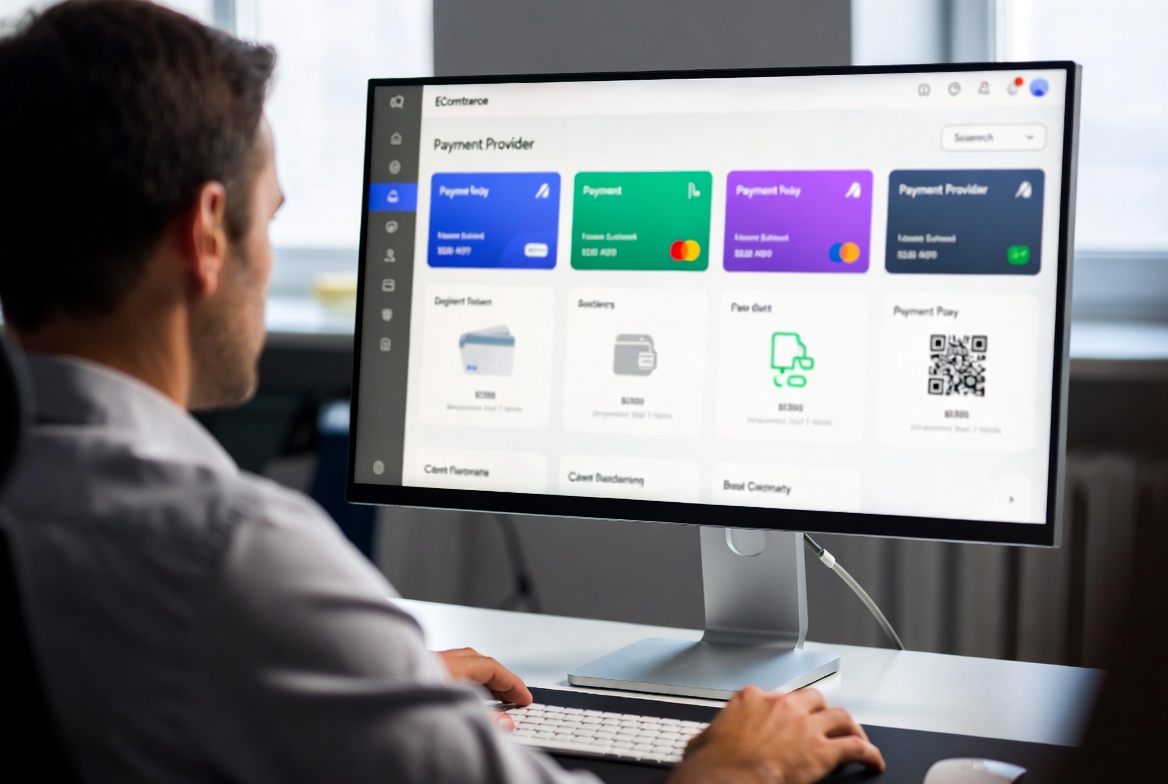
A company using five different payment providers maintains five separate codebases. Five token vaults. Five reconciliation reports. Five support tickets when something goes wrong. The engineering team spends roughly two months per year just keeping these integrations alive. The finance team manually matches transactions every week. And despite all this effort, approval rates still lag behind competitors who seem to scale effortlessly.

This is not a hypothetical. It is the reality for thousands of merchants who built their payment stacks organically, adding a provider here for cross-border, another there for digital wallets, another for a specific region. Each integration made sense at the time. Together, they create a tangled mess that slows down every part of the business.

Payment orchestration solves this problem by providing a single integration point for every provider you will ever need. One API connects you to dozens of payment service providers, gateways, acquirers, and payment methods. One dashboard shows performance across your entire stack. One token vault stores credentials that work with any provider. The complexity of managing multiple providers disappears behind a unified control layer.

This guide walks through the benefits of payment orchestration, showing how a single integration transforms payment operations from a source of friction into a competitive advantage.

The hidden cost of multiple direct integrations

Every direct integration with a payment provider carries visible and invisible costs. The visible costs are developer hours, API documentation, testing, and ongoing maintenance. The invisible costs are worse. Fragmented data that hides performance trends. Token silos that prevent switching providers. Routing logic that cannot adapt because each integration stands alone.

Consider a merchant using three providers. Provider A handles North American cards. Provider B processes European payments. Provider C supports digital wallets. Each integration was built separately, by different developers, at different times. Each has its own error handling, its own webhook parsing, its own retry logic.

When approval rates drop for European Visa transactions, is the problem Provider B? Is it the card network? Is it a specific issuing bank? The merchant cannot tell because data from Provider B lives in a separate dashboard with different metrics than Provider A. Finding the answer requires logging into three systems, exporting three reports, and manually correlating data in a spreadsheet.

When the merchant wants to add a backup provider for redundancy, they face months of development work. When they want to test a new routing strategy, they cannot because rules are hardcoded into each integration. When they want to switch away from an underperforming provider, they discover that customer tokens are locked in that provider’s vault.

Payment orchestration eliminates these problems by replacing multiple direct integrations with a single, unified API.

For a deeper look at the challenges of multi-provider management, read our guide on top payment challenges for 2026.

Benefit one: faster time to market

Adding a new payment provider through direct integration typically takes weeks or months. You must read the provider’s API documentation, implement authentication, build request and response handling, parse webhooks, set up error handling, test thoroughly, and deploy. Each provider is different, so little code can be reused.

With payment orchestration, adding a provider takes minutes. You log into the orchestration dashboard, select the provider from a library of pre-built connections, enter your API credentials, and configure routing rules. The orchestration platform handles all the integration complexity. Your checkout code does not change because the orchestration API remains the same regardless of which providers sit underneath.

This speed matters. When a new payment method gains popularity in a key market, the first merchants to offer it capture the most volume. When a competitor launches a better checkout experience, the ability to test and deploy new providers quickly determines who leads and who follows.

For a practical example of fast provider switching, read our guide on how to switch payment providers without downtime.

Benefit two: unified tokenization

Tokenization is essential for security and recurring payments. But traditional tokenization ties credentials to specific providers. A token from Provider A cannot be used with Provider B. This lock-in is a feature from the provider’s perspective and a trap from the merchant’s perspective.

Payment orchestration solves this with provider-agnostic tokenization. When a customer saves their payment details, the orchestration platform generates a token that works with any provider in your stack. You are no longer locked in. You can route that customer’s future transactions to Provider A today, Provider B tomorrow, and Provider C next week. The token stays the same.

This capability transforms how merchants manage recurring payments. Subscription businesses can switch processors without asking customers to re-enter payment details. They can route each recurring charge to the provider with the best approval rate for that specific card type. They can maintain backup providers and fail over instantly when issues arise.

For more on tokenization strategies, read our article on migrating stored card data between providers.

Benefit three: intelligent routing

With direct integrations, routing decisions are static. You decide which provider handles which transactions based on rules you hardcode. Visa transactions go to Provider A. European cards go to Provider B. Digital wallets go to Provider C. These rules may have made sense when you wrote them, but they never adapt.

Payment orchestration enables dynamic, intelligent routing. The platform evaluates each transaction in real time and selects the optimal provider based on dozens of variables: the customer’s location, the card type, the issuing bank’s historical approval patterns, the current performance status of each provider, the cost structures of different routing paths.

The results are measurable. Merchants using intelligent routing typically see authorization rate improvements of 3 to 8 percentage points and processing cost reductions of 15 to 30 percent. A single integration delivers both outcomes simultaneously.

For a comprehensive look at optimization metrics, read our article on top payment performance benchmarks for 2026.

Benefit four: automatic failover

Payment providers experience issues. Scheduled maintenance. Unexpected outages. Latency spikes. Fraud system malfunctions. With direct integrations, a provider issue means your checkout stops working for any transaction routed to that provider. You wait for them to fix it.

With payment orchestration, failover is automatic. The platform monitors provider performance continuously. When a provider returns errors, times out, or exceeds latency thresholds, the orchestration layer reroutes subsequent transactions to backup providers. The customer never knows anything happened.

This resilience protects revenue during incidents that would otherwise cause downtime. For businesses processing high volumes, even a few minutes of outage can cost thousands or millions of dollars. Automatic failover turns an outage from a crisis into a non-event.

Benefit five: unified reporting and reconciliation

Finance teams hate fragmented payment data. Each provider sends settlement reports in different formats, with different field names, on different schedules. Reconciling transactions across three providers takes hours each week. Errors are common.

Payment orchestration consolidates all transaction data into a single reporting interface. Every transaction, regardless of which provider processed it, appears in the same format with the same fields. Settlement reports from different providers are normalized into a consistent structure. Reconciliation becomes a matter of checking totals, not wrestling with spreadsheets.

This unification does not just save time. It reveals insights that fragmented data hides. Which provider has the highest approval rate for European Visa transactions? Which has the lowest cost for American Express? Which settles fastest in Latin America? With unified reporting, the answers are obvious. With fragmented data, they are buried.

Benefit six: simplified compliance

PCI compliance is expensive and time-consuming. Every system that touches cardholder data falls under scope. With multiple direct integrations, each provider connection potentially expands your scope. Each token vault must be secured and audited.

Payment orchestration reduces scope by centralizing sensitive data. The orchestration platform handles tokenization and stores credentials in a certified vault. Your systems interact only with tokens, which are outside PCI scope. Instead of managing security across multiple integrations, you manage one orchestration layer.

For merchants processing significant volume, the compliance savings alone often exceed the cost of the orchestration platform.

The comparison: direct integrations versus payment orchestration

AspectDirect integrationsPayment orchestration
Integration effortPer provider, weeks eachOne integration, minutes per additional provider
TokenizationProvider-specific, non-portableProvider-agnostic, portable across stack
Routing logicStatic, hardcodedDynamic, real-time, data-driven
FailoverManual or noneAutomatic, sub-second
ReportingSeparate dashboards, inconsistent formatsUnified, consistent across all providers
PCI scopeExpands with each providerCentralized, minimized
Switching providersRe-integration requiredConfiguration change
Time to add new methodMonthsDays or hours

The numbers that matter

A business processing $50 million annually with an 85% approval rate loses $7.5 million to declines. Raising approval rates to 90% recovers $2.5 million. That is not a marginal gain. It is transformative.

The same business paying 2.5% effective processing costs spends $1.25 million annually on fees. Reducing costs to 2.0% saves $250,000 per year. Over five years, that is $1.25 million.

Payment orchestration delivers both outcomes through intelligent routing, unified tokenization, and automatic failover. The cost of the platform is a fraction of the savings.

For more on approval rate optimization, read our guide on how to increase payment approval rates.

Frequently asked questions

How many providers do I need before payment orchestration makes sense?

If you use two or more providers, orchestration simplifies management and enables intelligent routing. Even with one provider, orchestration offers benefits like centralized tokenization and future flexibility.

Does payment orchestration replace my existing PSPs?

No. Orchestration sits above your providers. You keep your current relationships while adding a unified control layer. This allows you to benefit from orchestration without disrupting your existing setup.

How long does integration take?

A typical orchestration integration takes days or weeks, not months. Your developers integrate once with the orchestration API. Adding new providers later requires no additional code.

Is payment orchestration only for large enterprises?

No. While large enterprises have the most complex needs, orchestration platforms scale down as well as up. Smaller businesses benefit from simplified management, better reporting, and the ability to add providers as they grow.

What about security and compliance?

Payment orchestration platforms maintain PCI certification and reduce your scope by centralizing tokenization. Your systems handle only tokens, not raw card data.

The shift from complexity to control

The businesses that thrive in 2026 are not those with the most payment providers. They are those with the best control over the providers they use. Control comes from visibility, flexibility, and automation. Visibility into performance across all providers. Flexibility to add, remove, or switch providers at will. Automation to route transactions intelligently and fail over instantly.

Payment orchestration delivers all three. A single integration replaces dozens. A unified dashboard replaces fragmented reporting. A provider-agnostic token vault eliminates lock-in. Intelligent routing and automatic failover optimize every transaction.

The old way of managing multiple providers through separate integrations is not just inefficient. It is a competitive disadvantage. While you struggle with fragmented data and static routing, competitors using orchestration move faster, approve more transactions, and pay lower fees.

The question is not whether you will adopt payment orchestration. It is whether you will adopt it before your competitors do.

Ready to replace multiple integrations with a single connection that gives you control over your entire payment stack? Book a demo today.

Global payment trends for 2026 and 2027: what’s changing next

If you look at payment headlines from five years ago, the dominant stories were about buy now pay later and the rise of digital wallets. Those trends have matured. They are no longer emerging. They are table stakes. The question for 2026 and 2027 is not what is new, but what is next. Which shifts will separate leaders from laggards? Which technologies will move from experimentation to essential infrastructure? Which regulatory changes will reshape the competitive landscape?

The next eighteen months will see three fundamental forces converge. Real-time payment systems will expand from domestic curiosities to global rails. Artificial intelligence will move from fraud detection to transaction routing and customer personalization. And payment orchestration will become the standard architecture for any business serious about scaling internationally.

Understanding these trends now gives you the time to prepare, adapt, and position your business ahead of the curve.

Real-time payments go global

Real-time payment systems are not new. Brazil’s Pix launched in 2020 and now processes more transactions than all card networks combined. India’s UPI handles over twenty billion transactions per month. The FedNow service in the United States continues to add participating financial institutions.

What is changing in 2026 and 2027 is connectivity. These domestic systems are beginning to talk to each other. The first cross-border real-time payment corridors are opening, allowing Pix users to send funds to UPI users and vice versa. The impact on ecommerce will be significant. Cross-border transactions that once took days will settle in seconds. Fees that once included currency conversion markups and cross-border charges will fall dramatically.

For merchants, the implication is clear. Real-time payments will become a viable alternative to cards for international transactions. Businesses that integrate these methods early will capture customers who prefer bank-based payments over credit.

For a deeper look at how local methods compare to cards, read our guide on local payment methods vs international card schemes.

Artificial intelligence moves from fraud to routing

Machine learning has been used in payments for years, primarily for fraud detection. Models analyze transaction patterns, flag anomalies, and block suspicious activity. That application is now mature. The frontier is moving to routing optimization.

In 2026 and 2027, AI models will decide which payment processor should handle each transaction. They will consider dozens of variables in real time: the customer’s location, the card type, the issuing bank’s historical approval patterns, the current performance status of each provider, the cost structures of different routing paths. The model will predict which provider is most likely to approve the transaction and route accordingly.

Early adopters are already seeing authorization rate improvements of 3 to 8 percentage points from AI-driven routing. As models train on more data and become more sophisticated, those gains will increase.

For more on how AI is transforming payments, read our article on machine learning fraud models in payments.

Payment orchestration becomes the standard architecture

For most of ecommerce history, the standard payment architecture was one merchant, one processor. That model is breaking. Merchants now work with multiple PSPs across multiple regions. They offer dozens of payment methods. They manage fraud, tokenization, and reconciliation across fragmented systems.

Payment orchestration solves the fragmentation problem. It provides a unified layer that connects to any provider, routes transactions intelligently, and centralizes data and control. In 2026 and 2027, orchestration will move from a niche solution for large enterprises to the expected architecture for any business processing significant volume.

The table below shows how the adoption of multi-provider orchestration has grown and is projected to continue.

YearMerchants using 2+ PSPsMerchants using orchestration
202225%8%
202438%16%
202652%31%
2027 (projected)58%44%

For a foundational understanding of orchestration, read our guide on what is a payment orchestrator.

Embedded finance moves from novelty to necessity

Embedded finance, the integration of financial services into non-financial platforms, has been discussed for years. In 2026 and 2027, it will become expected. Customers will no longer tolerate being redirected to separate payment pages or banking apps. They will demand that payments, lending, and banking happen within the apps and websites they already use.

For merchants, this means offering more than just a checkout button. It means providing stored credentials that work across devices, one-click purchasing for returning customers, and instant financing options at the point of sale. It means integrating with digital wallets and local payment methods so customers never have to leave your experience.

The platforms that succeed at embedded finance will be those that treat payments as a core product feature, not a back-end utility.

Regulation tightens and expands

Three major regulatory trends will shape payments in 2026 and 2027. First, Europe’s PSD3 and Payment Services Regulation will harmonize rules across member states, eliminating the fragmentation that made cross-border compliance difficult. The new framework places greater emphasis on fraud prevention, data sharing, and customer protection.

Second, stablecoin regulation is arriving. The United States GENIUS Act and similar frameworks in other major economies will create clear rules for issuing and using stablecoins. This clarity will accelerate adoption for cross-border settlement and B2B payments.

Third, open banking requirements are expanding beyond Europe. Regulators in Brazil, Australia, and other markets are mandating that banks share customer data with authorized third parties. This will enable new payment initiation services and account aggregation tools.

Biometric authentication replaces passwords and OTPs

Strong Customer Authentication has been a source of friction since its introduction. Entering one-time passcodes, approving transactions in banking apps, answering security questions, all of these steps add seconds that feel like minutes to impatient customers.

Biometric authentication is the solution. Fingerprint and facial recognition are already common for unlocking phones and authorizing digital wallet payments. In 2026 and 2027, biometrics will expand to more payment contexts. Customers will approve transactions with a glance or a touch, with no additional steps. The security is stronger than passwords, and the experience is faster than OTPs.

Merchants that support biometric authentication through digital wallets and native checkout flows will see higher conversion rates than those relying on legacy authentication methods.

The rise of agentic payments

Perhaps the most futuristic trend is also the most imminent. Agentic payments are transactions initiated and completed by artificial intelligence agents on behalf of humans. An AI travel agent might book a flight and pay for it without the traveler ever opening a banking app. A smart refrigerator might reorder groceries and pay the supplier automatically.

In March 2026, Banco Santander and Mastercard completed Europe’s first live end-to-end payment executed by an AI agent. The transaction was processed through live payments infrastructure, with the AI agent treated as a visible, governed participant in the payment flow.

For merchants, agentic payments will require new infrastructure. AI agents will not fill out checkout forms or enter card details manually. They will need API-based payment initiation, machine-readable authentication, and programmable transaction limits. Payment orchestration platforms are well-positioned to support these requirements.

For more on this emerging trend, read our article on payment orchestration and AI-driven payments.

Network tokenization becomes mandatory for card-on-file

Card networks have been promoting network tokenization for years, but adoption has been uneven. That changes in 2026 and 2027. Networks are shifting liability for card-on-file transactions. Merchants using network tokens benefit from higher authorization rates and automatic credential updates. Merchants still using raw card numbers face higher decline rates and greater fraud exposure.

For subscription businesses, the shift is particularly significant. Network tokens auto-update when cards are reissued or expire, eliminating a major source of involuntary churn. Merchants who adopt network tokenization will retain customers who would otherwise be lost to outdated credentials.

For guidance on tokenization strategies, read our article on migrating stored card data between providers.

The BNPL shakeout

Buy now pay later exploded in the early 2020s, with dozens of providers competing for merchant and consumer attention. The market has consolidated. Several players have exited or been acquired. The remaining providers have matured their underwriting and risk models.

In 2026 and 2027, BNPL will settle into its role as a permanent payment option, not a speculative growth story. Merchants should offer BNPL where it drives higher average order values, but the urgency to integrate every provider has passed. Focus on the two or three BNPL providers that matter in your markets.

Data localization reshapes global architecture

Data protection laws in Europe, Brazil, India, and other regions require that certain payment data remain within geographic borders. This conflicts with the traditional model of routing all transactions through a central processor.

In 2026 and 2027, merchants will need regional infrastructure to comply with these laws. That does not mean building separate payment stacks for each region. It means using orchestration platforms that support regional token vaults and local acquiring while maintaining centralized management.

Merchants who ignore data localization requirements face fines, operational restrictions, and loss of market access.

The trends described above share a common theme: fragmentation is increasing, and centralized control is the only effective response. More payment methods, more regions, more regulations, more fraud vectors, more authentication requirements. Each new element adds complexity.

Businesses that try to manage this complexity through direct integrations will drown. The engineering cost alone is prohibitive, and the operational burden of reconciliation, reporting, and compliance will overwhelm finance and operations teams.

Businesses that adopt payment orchestration will thrive. They will add new methods through configuration, not code. They will route transactions intelligently to optimize approval rates and costs. They will centralize tokenization to eliminate provider lock-in. They will maintain unified reporting across all providers and regions.

The gap between orchestrated and non-orchestrated merchants will widen dramatically over the next eighteen months. Those who act now will build durable competitive advantages. Those who wait will find themselves locked into architectures that cannot adapt.

Frequently asked questions

What is the single most important payment trend for 2026?

Payment orchestration moving from niche to standard architecture. It enables all other trends: multi-provider routing, network tokenization, regional compliance, and AI-driven optimization.

How will real-time payments affect card usage?

Real-time payments will capture more domestic and regional transactions, especially for lower-value purchases and peer-to-peer transfers. Cards will remain dominant for cross-border, high-value, and credit-based transactions.

Is AI in payments safe?

When properly governed, AI improves security by detecting fraud patterns humans cannot see. The risk is not the technology but poor implementation. Models must be trained on quality data, monitored for bias, and audited regularly.

Do I need to prepare for agentic payments now?

Not urgently, but awareness is wise. The infrastructure required for agentic payments, API-based checkout, programmable authentication, and tokenization, aligns with the infrastructure that benefits human-initiated payments. Build for orchestration today, and agentic payments will be an incremental addition later.

What happens if I ignore these trends?

You will fall behind. Competitors who adopt orchestration will have lower costs, higher approval rates, faster market entry, and better customer experiences. The gap will compound over time.

Your next move

The next eighteen months will separate businesses that treat payments as strategic infrastructure from those that treat them as a utility. The trends are clear. The data is available. The tools exist.

You do not need to implement every trend at once. Start with the one that addresses your biggest current pain point. High decline rates? Focus on intelligent routing. Tokenization lock-in? Centralize your vault. Regulatory fragmentation? Build for regional compliance.

But start. Every month you wait is a month your competitors gain.

Ready to see how payment orchestration prepares your business for the trends of 2026 and 2027? Book a demo today.

20 payment scalability challenges: what breaks first as transaction volume grows

Processing one thousand transactions per month is forgiving. A failed payment here, a slow response there, a manual reconciliation that takes an hour. These are inconveniences, not crises. But processing one million transactions per month is merciless. The same tiny inefficiencies that were barely noticeable at low volume become catastrophic at scale. 

Latency that added milliseconds becomes seconds of customer wait time. Decline rates that seemed acceptable become millions in lost revenue. Manual processes that worked for a team of two become impossible for a team of twenty.

The transition from small to large volume is not a straight line. It is a series of breaking points where infrastructure that worked perfectly suddenly fails. Knowing what breaks first, and in what order, is the difference between scaling successfully and scrambling to fix emergencies while revenue burns.

Understanding each one helps you build infrastructure that grows with you rather than against you.

The first breaking point: one thousand to ten thousand transactions per month

At this stage, you are likely using one or two payment providers. Life is simple. But cracks begin to show.

Challenge 1: Manual reconciliation becomes painful. When transactions were few, matching payments to orders in a spreadsheet was fine. At ten thousand per month, that spreadsheet takes hours. Finance teams start complaining. Errors creep in. The real problem is not the time but the lack of visibility. You cannot optimize what you cannot measure.

Challenge 2: Chargebacks arrive faster than you can handle them. At low volume, chargebacks were rare events you handled individually. At higher volume, they become a steady stream. Without automated dispute management, you will miss deadlines and lose cases you could have won.

Challenge 3: Decline reasons become a mystery. Your approval rate drops slightly, but you cannot tell why. Is it a specific card type? A specific region? A specific provider? Without segmented reporting, you are guessing. Guessing is not a strategy.

For a deeper look at approval rate optimization, read our guide on how to increase payment approval rates.

The second breaking point: ten thousand to one hundred thousand transactions per month

This is where most merchants first feel real pain. The cracks become gaps.

Challenge 4: Your single provider becomes a single point of failure. One outage. One hour of downtime. Thousands of lost transactions. Customers who try to pay and cannot may never return. You realize that relying on one provider was a bet you did not know you were making.

Challenge 5: Cross-border fees explode. As you grow internationally, you notice that transactions from certain countries cost dramatically more. The fees are not clearly explained. They just appear on your statement. Without local acquiring, you are overpaying for every international transaction.

Challenge 6: Recurring payment failures spike. Subscribers get new cards. Cards expire. Credentials become outdated. Each failure means a lost customer who wanted to stay but could not. You start calculating involuntary churn and the numbers are alarming.

Challenge 7: Fraud filters block good customers. Your fraud provider, configured conservatively to protect you, is now declining legitimate purchases. You raise false positives with support. They suggest loosening rules. You loosen them. Fraud increases. The balance is impossible to strike without better data.

Challenge 8: Settlement delays hurt cash flow. Providers settle on different schedules. Some take three days, some five, some a week. Your finance team cannot predict when funds will arrive. Payroll becomes stressful.

Challenge 9: Reporting from multiple providers does not match. You work with two PSPs now. Their reports use different formats, different field names, different cut-off times. Reconciliation requires manual adjustments that no one fully trusts.

The third breaking point: one hundred thousand to one million transactions per month

At this scale, you are a serious business. Problems that were annoyances become existential threats.

Challenge 10: Provider performance varies wildly by region. Your primary PSP works great in North America but struggles in Europe. Approval rates for EU-issued cards are five points lower. You cannot move traffic easily because each provider requires separate integration. You are stuck.

Challenge 11: Tokenization silos lock you in. Each PSP stores its own tokens. You cannot use Provider A’s token with Provider B. If you want to route around a poorly performing provider, you cannot because the token is useless elsewhere. You are locked into relationships you would rather leave.

Challenge 12: Routing decisions require real-time data. Static rules like “send Visa to Provider A” are no longer sufficient. The best provider changes by hour, by card type, by issuing bank. Without real-time performance data, your routing is always outdated.

Challenge 13: 3D Secure friction kills conversion. Authentication is required more often now that you process higher volumes. Each challenge prompts customers to enter codes or approve on their banking app. Many abandon. Your approval rate drops, but you cannot turn off security.

Challenge 14: Network tokenization is too complex to manage manually. You know network tokens improve approval rates. But each PSP has its own implementation, its own certification, its own rules. Managing network tokens across providers is a full-time job your team does not have.

Challenge 15: A/B testing routing strategies is impossible. You suspect that routing certain card types to a different provider would improve results. But testing requires code changes, weeks of development, and careful measurement. The cost of testing exceeds the potential gain, so you never know.

For a comprehensive look at performance metrics, read our article on top payment performance benchmarks.

The fourth breaking point: over one million transactions per month

At this scale, you are a major enterprise. Every basis point matters. Every millisecond counts.

Challenge 16: Provider outages cause immediate revenue loss. When a major PSP goes down, you lose millions per hour. You have backup providers, but switching traffic requires manual intervention. By the time your team responds, the damage is done.

Challenge 17: Latency variability hurts conversion. Some providers respond in 200 milliseconds. Others take two seconds. Customers do not know which provider you are using, but they feel the delay. Slow transactions abandon at higher rates. You need sub-second consistency.

Challenge 18: Data localization requirements conflict with global processing. Different regions require payment data to stay within borders. Your current architecture sends everything through a central processor. Compliance becomes impossible without regional infrastructure.

Challenge 19: Vendor negotiations lack leverage. Your processors know you cannot easily leave. Their best pricing goes to merchants who can shift volume. Without that ability, you pay more than your competitors.

Challenge 20: Innovation slows to a crawl. Adding a new payment method or entering a new market requires months of development. Each provider integration is a project. Your roadmap is dictated by payment infrastructure, not by customer needs.

For a broader perspective on these challenges, read our guide on top payment challenges for 2026.

What breaks first: a summary

The table below shows the typical order in which scalability challenges appear as volume grows.

Transaction volumeFirst to breakSymptoms
1k – 10k per monthManual reconciliationFinance team drowning in spreadsheets
10k – 100k per monthSingle provider dependencyOutages cause revenue loss
100k – 1M per monthTokenization silosCannot route between providers
1M+ per monthProvider lock-inNo leverage, slow innovation

Why most merchants never fix these problems

The tragedy of payment scalability is that the solutions are well understood. Centralized tokenization. Multi-provider routing. Unified reporting. Real-time failover. These are not experimental technologies. They are proven capabilities.

But fixing the problems requires rebuilding payment infrastructure. And rebuilding payment infrastructure is terrifying. The risk of breaking something during the transition seems higher than the cost of living with broken systems. So merchants endure. They pay higher fees than necessary. They accept lower approval rates than possible. They watch competitors outpace them.

The merchants who do fix these problems share one characteristic: they stopped treating payments as a utility and started treating them as a strategic capability. They invested in infrastructure that gives them control rather than accepting the limitations of their providers.

For a comparison of build versus buy approaches, read our article on payment orchestration vs building in-house.

Frequently asked questions

At what volume should I start worrying about payment scalability?

The answer depends on your business model and risk tolerance. Some merchants feel pain at 10,000 transactions per month. Others scale to 100,000 before problems become urgent. The key is to watch for the warning signs: reconciliation taking too long, inability to compare provider performance, or fear of switching providers.

Can I solve these problems without an orchestration layer?

Theoretically, yes. You could build your own routing engine, your own token vault, your own unified reporting. But the engineering cost is substantial, and the ongoing maintenance burden is even larger. Most merchants find that specialized orchestration platforms deliver better results at lower total cost.

How do I know which challenge to address first?

Start with the one costing you the most money. For many merchants, that is low approval rates or high processing fees. Measure the gap between your current performance and industry benchmarks. The largest gap is your highest priority.

Does payment orchestration solve all 20 challenges?

Payment orchestration directly addresses most of them: provider fragmentation, tokenization silos, routing inflexibility, failover delays, unified reporting, and vendor lock-in. Some challenges, like 3D Secure friction or network tokenization complexity, are reduced but not eliminated. Orchestration gives you the tools to manage them, but you still need to configure them thoughtfully.

What is the cost of doing nothing?

Calculate your current approval rate. Compare it to 96%, which is achievable with optimization. The difference is lost revenue. Calculate your current processing cost. Compare it to best-in-class rates. The difference is margin leakage. Multiply by your volume. That number is the annual cost of doing nothing. For most merchants, it is substantial.

The path forward

Scalability is not about handling more transactions. It is about handling more complexity. A single provider processing one million identical transactions is easy. A multi-provider, multi-region, multi-method stack processing one million diverse transactions is hard. The merchants who succeed are those who build infrastructure that abstracts complexity rather than amplifying it.

The twenty challenges listed here are not inevitable. They are the result of architectural choices made earlier. Every integration you add, every token you store with a provider, every routing rule you hardcode, these decisions compound. At low volume, they are invisible. At high volume, they become the walls that contain you.

The good news is that you can redesign. You can add an orchestration layer that sits above your providers, unifying them without replacing them. You can centralize tokenization so your credentials work everywhere. You can build routing rules that adapt to real-time conditions. You can turn your payment stack from a collection of silos into a coordinated system.

The question is not whether your current infrastructure will break. It is when. And whether you will fix it before the break costs you more than the repair.

Many merchants wait until something breaks catastrophically. An outage. A compliance failure. A lost customer that represents years of acquisition cost. Do not be one of them. The warning signs are clear. The solutions are available. The only missing piece is the decision to act.

Ready to fix what breaks before it breaks your business? Book a demo today.

Gr4vy supports agentic payments through orchestration and launches development kit to prepare merchants for AI commerce

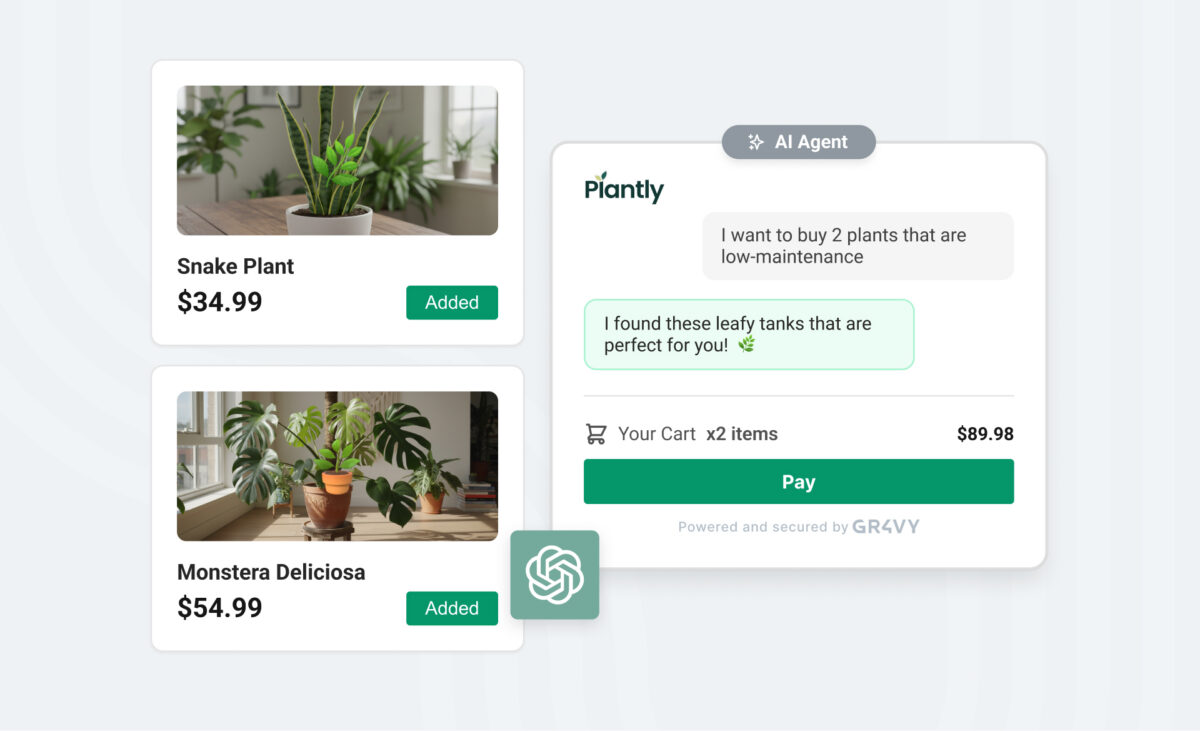
Gr4vy, the cloud-native payment orchestration platform, today announced it is fully ready to support agentic payment transactions through its orchestration layer, allowing merchants to manage and process transactions within AI-driven environments.  In addition, Gr4vy is launching its Agentic Development Kit (ADK), designed to equip and guide merchants in building and launching AI-native storefronts within platforms such as ChatGPT.

Consumers are relying on new ways to discover products, and it’s beginning to influence how they shop. While customers still initiate transactions, intelligent systems are already shaping decisions, surfacing products, and guiding checkout experiences. According to a recent Morgan Stanley research report, 23% of consumers in the U.S. have already made a purchase using AI in the past month. However, existing payment stacks were not built for this model, leaving merchants without the infrastructure or visibility needed to operate in AI-driven environments.

ADK gives merchants a practical way to make their products purchasable directly inside AI platforms without rebuilding their existing payment infrastructure. Merchants can launch AI-native storefronts, orchestrate AI transactions in real-time, and maintain full control over performance, security, and customer experience.

“AI is quickly becoming part of the checkout journey,” said John Lunn, Founder and CEO of Gr4vy. “We’re already enabling agentic payments inside ChatGPT today. The Agentic Development Kit is the next step, providing merchants with a structured way to adopt this model. You don’t need to rebuild your payments stack. You just need the right infrastructure layer to support it.”

Built on Gr4vy’s infrastructure-first approach, the Agentic Development Kit provides the framework and guidance for merchants to build storefronts within AI platforms like ChatGPT. Once live, these storefronts connect to Gr4vy through a single API, enabling merchants to process transactions using their existing payment stack or access 400+ payment methods and PSPs. 

Running on the Model Context Protocol (MCP), the ADK enables embedded shopping and checkout experiences directly within conversational interfaces. Through Gr4vy’s orchestration layer, merchants can implement real-time routing, retries, fraud rules, and dynamic workflows in a secure, PCI Level 1-compliant environment. The ADK also provides visibility into agentic transactions, enabling merchants to monitor performance, optimize conversion, and refine routing strategies.

“Merchants don’t need to rebuild their payment stack to participate in AI commerce,” said Lunn. “They need the right control layer, and that’s what Gr4vy provides.”

The Agentic Development Kit is available today.

Payment methods by country 2026: what dominates each market and how to accept them

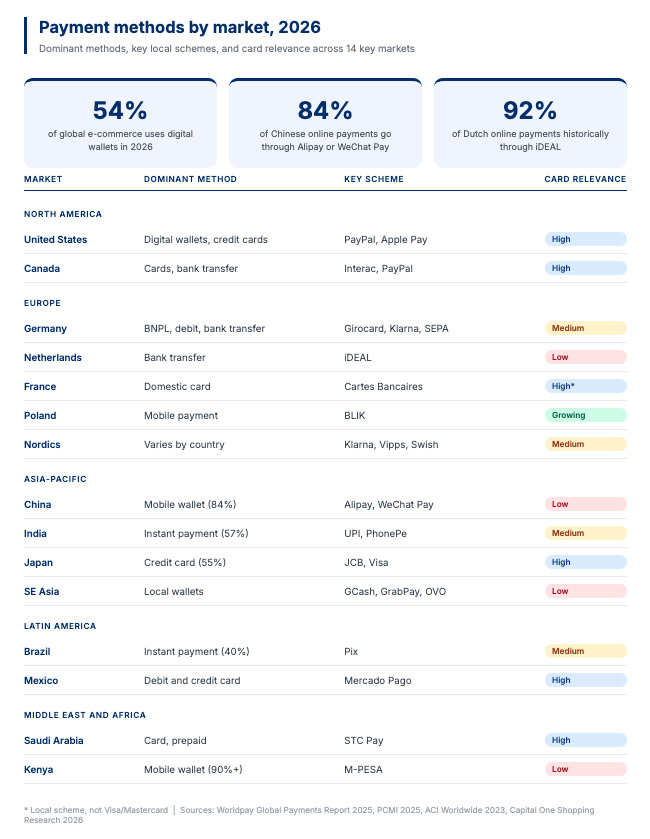
Offer the wrong payment method at checkout and the sale is already lost. According to Worldpay, digital wallets now account for 54% of e-commerce transactions globally in 2026, up from less than half just two years ago. That headline figure, though, tells merchants almost nothing useful. Japanese consumers pay online with credit cards 55% of the time. 

Dutch consumers expect iDEAL, a bank transfer scheme, so reliably that building a checkout without it guarantees abandonment. In Brazil, Pix, a government-built instant payment network, recorded 252 million transactions in a single day in December 2024 alone.

The practical question for any merchant selling across borders is which payment methods to support in which markets, and how to manage the operational weight of connecting to all of them. This guide works through the 12 most commercially significant markets in 2026, with the data behind each and what it takes to accept these methods reliably.

Why payment method preference varies so much by country

Consumer payment habits are shaped by a mix of banking infrastructure, regulation, cultural trust in financial institutions, and the timing of fintech adoption. A country that built strong real-time banking rails before smartphone wallets took off tends to retain those rails as a default. A country that leapfrogged traditional banking through mobile technology tends to run on wallets. A country where consumer credit was historically mistrusted tends to prefer bank transfers or debit.

These habits are deeply embedded, and a one-size-fits-all payment setup will underperform in most markets because of them. Understanding how local payment methods differ from international card schemes is the starting point for building a checkout that converts globally.

North America

United States

Credit cards still account for 31% of US online purchases, but digital wallets have closed the gap fast, reaching 39% of online transactions and projected to hit 52% by 2030. PayPal has a 71% penetration rate among US adults, which makes it the dominant e-commerce wallet by some distance. Apple Pay and Google Pay doubled their adoption between 2020 and 2025 but remain secondary to PayPal for online checkout. BNPL has found its footing with younger shoppers through Affirm, Klarna, and Afterpay, particularly in electronics, fashion, and home goods.

Visa and Mastercard are the baseline. PayPal adds meaningful conversion on top of that, and BNPL is worth evaluating in any category where average order values are high enough to make installments attractive.

Canada

Canada follows a similar card-heavy pattern to the US, with Visa and Mastercard dominant across both e-commerce and in-store. Interac, Canada’s domestic debit network, is widely used for in-store and online bank transfers. PayPal is the leading digital wallet. BNPL adoption is growing but still behind US levels.

Europe

Europe is where payment fragmentation is most pronounced. Visa and Mastercard dominate in some markets and barely register in others. Merchants expanding across Europe without a market-by-market payment strategy typically leave conversion on the table.

Germany

Cash still accounted for 51% of all German in-store transactions in a 2023 study, a figure that surprises most merchants entering the market for the first time. The Girocard debit scheme has over 100 million cards in circulation, and in the first half of 2025 debit cards made up 31% of non-cash payments. Online, BNPL runs deeper in Germany than in most comparable economies because German consumers have a long-standing habit of paying by invoice after goods arrive, a practice rooted in local consumer law. Klarna and PayPal are the methods that drive online volume. SEPA bank transfers handle B2B and recurring transactions. Card-only acceptance leaves a significant portion of the German market unreachable.

Netherlands

The Netherlands runs largely on iDEAL, a bank-initiated transfer scheme that historically captured around 92% of online payments. iDEAL is now migrating to a new version built on open banking infrastructure, but it remains the default for Dutch consumers at checkout. Credit card use is comparatively low. Any merchant launching in the Netherlands without iDEAL will see immediate checkout abandonment.

France

France has its own domestic card scheme, Cartes Bancaires, which processes the majority of card transactions. It coexists with Visa and Mastercard but operates on different rails and has different cost structures. PayPal is widely used online. For merchants, integrating Cartes Bancaires is not optional in France; it is the baseline.

Poland

Poland has become one of Europe’s more interesting payment markets. BLIK, a mobile payment method linked to bank accounts, processed over 420 million transactions in 2024 and has expanded into neighboring countries. Poland is also projected to be the fastest-growing country in the European payments market through 2031, at a CAGR of 15.05%. Card acceptance is growing, but BLIK is the preferred method for a large portion of the online population.

Nordic countries

Swish in Sweden, Vipps in Norway, MobilePay in Denmark, and online banking in Finland each lead their respective markets, and the overlap between them is smaller than the geography suggests. BNPL accounts for 23% of Swedish online transactions, driven by Klarna’s home-market strength. Danish consumers lean toward credit and debit cards at 52% of transactions. Finnish consumers default to online banking at 30%. A Nordic payment strategy that treats these four countries as a single market will get the mix wrong in at least three of them.

For a full breakdown of how regional compliance affects your payment setup, read our guide to payment orchestration in Europe.

Asia-Pacific

China

Alipay and WeChat Pay together account for 84% of Chinese online payments, with QR code transactions the norm in physical stores. Visa and Mastercard have negligible domestic penetration; UnionPay is the card network that actually matters. For international merchants selling into China, integrating Alipay and WeChat Pay through a compliant local partner is the only practical path to reaching Chinese consumers at checkout.

India

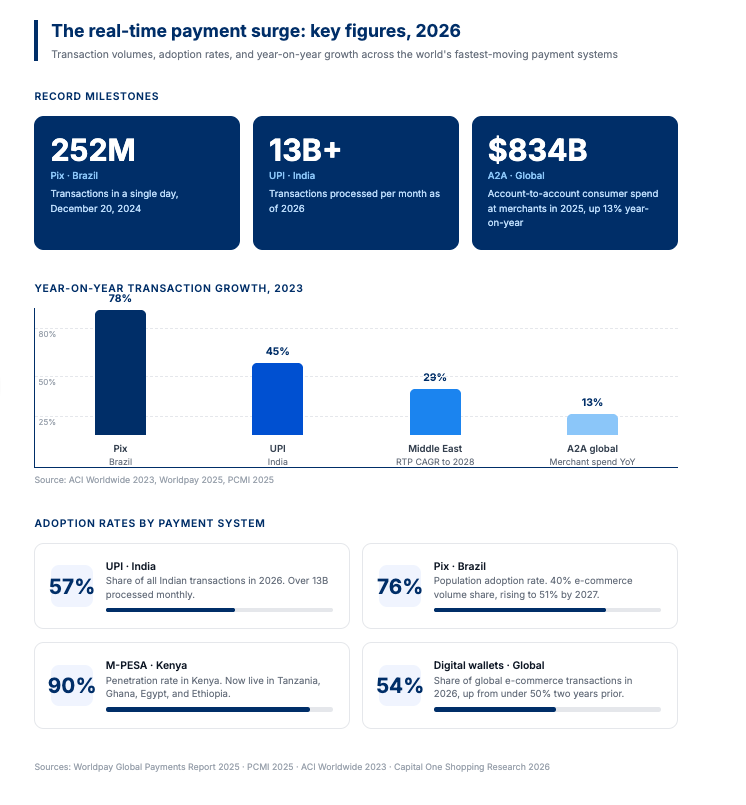
India’s UPI (Unified Payments Interface) is one of the most significant payment infrastructure stories of the decade. According to a 2026 study, UPI now accounts for 57% of transactions throughout India, with the system processing over 13 billion transactions per month. It contributed 55% to e-commerce volume in 2024 according to PCMI data. PhonePe and Google Pay are the largest UPI apps by volume. Credit and debit card acceptance matters for higher-value and international transactions, but any merchant selling in India without UPI integration is working around the country’s primary payment rail.

Japan

Japan is one of the few major markets where credit cards still dominate online payments at 55%, the highest rate of any country globally. This reflects both high credit card penetration and strong consumer trust in card-based transactions. Digital wallets are growing, but the credit card remains the default for Japanese online shoppers. In-store, QR code payments and IC card-based transit payments like Suica are common, but for e-commerce, card acceptance is the priority.

Southeast Asia

Southeast Asia rewards market-specific research rather than regional generalizations. GCash handles the bulk of digital payments in the Philippines. GrabPay and Touch ‘n Go lead in Malaysia. Dana and OVO are the dominant wallets in Indonesia. BNPL is growing across all three, and mobile-first infrastructure means local wallets carry more transaction volume than global card schemes in most of these markets.

Latin America

Brazil

Pix is Brazil’s payment story in 2026. The government-backed instant payment system has 76.4% adoption across Brazil’s 211 million people, commands a 40% e-commerce volume share according to PCMI data, and set a single-day record of 252.1 million transactions on December 20, 2024. By 2027, PCMI projects that share reaching 51%. Debit cards rank second in overall usage, and credit cards remain relevant for installment purchases, which Brazilian consumers use heavily given the country’s high credit card interest rates. Cash has dropped below 20% in urban areas but persists in rural markets.

Pix also carries lower transaction costs than card networks, which has a direct impact when cutting payment processing costs at scale.

Mexico

Mexico is still primarily card and cash-driven, with debit and credit cards the preferred methods for online purchases as of 2024. Cash remains the most used in-store payment method, though its share has been declining consistently since 2017. Digital wallets are growing, with mobile wallet market share rising from 4% in 2017 to 12% in 2023, driven largely by Mercado Pago.

Middle East and Africa

Saudi Arabia

Saudi Arabia has been transitioning from cash to digital payments faster than most markets in the region. Credit cards led online at 41% in 2021, and that share has continued to grow as card infrastructure matures. STC Pay and other local wallets are gaining ground. The country is also one of the highest users of debit and prepaid cards globally, at 33% of online transactions.

Kenya

Kenya’s M-PESA has over 90% penetration in its home market and has expanded to multiple African countries including Tanzania, Mozambique, Ghana, Egypt, and Ethiopia. In February 2025, Kenya ranked as the country with the highest digital payment adoption, with 80% of its population using digital payments. For merchants entering the Kenyan market, M-PESA integration is the single most important payment decision. Card acceptance matters for tourist-facing and international commerce, but domestic transactions run on M-PESA.

Payment methods by region: at a glance

RegionDominant methodKey local schemesCard relevance
United StatesDigital wallets, credit cardsPayPal, Apple PayHigh
GermanyBNPL, debit, bank transferGirocard, Klarna, SEPAMedium
NetherlandsBank transferiDEALLow
FranceDomestic cardCartes BancairesHigh (local scheme)
PolandMobile paymentBLIKMedium and growing
ChinaMobile walletAlipay, WeChat PayVery low (domestic)
IndiaInstant paymentUPI, PhonePeMedium
JapanCredit cardJCB, VisaHigh
BrazilInstant paymentPixMedium
MexicoDebit and credit cardMercado PagoHigh
Saudi ArabiaCard, prepaidSTC PayHigh
KenyaMobile walletM-PESALow

What this means for your payment stack

Supporting 12 different payment methods across 12 markets touches every layer of your payment stack: routing logic, reconciliation, compliance, and the checkout experience itself.

The merchants doing this well in 2026 are using a payment orchestration layer that connects to local payment methods through a single API, routes transactions based on availability and performance, and makes it possible to turn new methods on or off without engineering work.

For the payment method layer to work well, the checkout layer also needs to surface the right options to the right customers based on location and device. A German customer should see Klarna and SEPA. A Dutch customer should see iDEAL. A Brazilian customer should see Pix. Showing all methods to all customers hurts conversion. A checkout built to convert handles this dynamically, not through static configuration.

This is also where approval rate optimization becomes relevant. Even when you offer the right method, routing decisions determine whether the transaction succeeds. Read more about how to increase payment approval rates in 2026 through smarter routing and fallback logic.

The cost dimension matters too. Local payment methods like Pix, iDEAL, and UPI typically carry lower transaction fees than international card networks. The hidden costs in your payment stack shows how to quantify what you save by routing to the right method in each market.

Frequently asked questions

What is the most widely used payment method globally in 2026? 

Digital wallets account for 54% of global e-commerce transactions in 2026, making them the single largest category. The leading wallet varies significantly by market. Alipay leads in China, UPI apps lead in India, PayPal leads in the US and much of Europe, and M-PESA leads in Kenya.

Do I need to support local payment methods or is card acceptance enough? 

In most high-growth markets, card acceptance alone is not enough. In Brazil, Pix handles 40% of e-commerce volume. In the Netherlands, iDEAL has historically dominated with around 92% of online payments. In Germany, a significant share of consumers prefer BNPL or bank transfer online. Relying only on Visa and Mastercard will cost you real conversion in these markets.

How do I add local payment methods without rebuilding my integration? 

Payment orchestration platforms connect to local payment methods through a single API and a no-code rules interface. Instead of integrating each scheme individually, you connect once and configure which methods appear in which markets. Read more about what a payment orchestrator does and what capabilities it covers.

Which markets have the most complex payment requirements? 

China, India, Germany, and Brazil each require market-specific methods that sit outside standard card rails. Europe as a whole adds regulatory complexity through PSD2 and PSD3 and regional compliance requirements. Our guide to payment regulations across different regions in 2026 covers what merchants need to know.

What is the fastest-growing payment method by region? 

Real-time account-to-account payments are growing fastest. India’s UPI grew 45% in 2023, Brazil’s Pix grew 78% in the same period, and Poland’s BLIK processed over 420 million transactions in 2024. Account-to-account consumer spending at merchants reached $834 billion globally in 2025, a 13% year-on-year increase.

How do I handle stored card data when expanding to new markets? 

When you add new processors or PSPs to support local payment methods, stored card data needs to move with you. How to migrate stored card data between payment providers covers the process without disrupting existing customer relationships.

The numbers from 2026 make the case plainly. UPI processes 13 billion transactions a month in India. Pix broke 252 million transactions in a single day in Brazil. BLIK has crossed into multiple Central European markets. Digital wallets take 54% of global e-commerce volume. A decade ago, none of these methods existed at meaningful scale. Today, each one determines whether a checkout converts or abandons in its home market. The merchants doing this well have infrastructure flexible enough to add, route, and optimize payment methods without constant engineering involvement.

See how payment orchestration works with your existing processors and what it takes to go live in a new market. Book a demo.

Q4 2025 and Q1 2026 Product Updates

This is our dedicated space to keep you informed about Gr4vy’s latest feature enhancements and product releases. Over Q4 2025 and Q1 2026, we introduced new capabilities to give merchants greater visibility, flexibility, and control across the payment lifecycle, from authentication and orchestration to local payment methods and reporting. These updates focus on strengthening payment orchestration, authentication, local payment methods, and operational visibility across the payment lifecycle.

Payment Links now support tokenization for existing buyers, enabling merchants to securely store payment methods during checkout.

By associating payment links with a buyer profile, merchants can capture and store credentials in a single flow, supporting:

  • Faster repeat transactions
  • Subscription onboarding
  • One-click payment experiences

This simplifies payment collection and improves customer lifetime value and conversion.

Native 3DS for mobile checkout optimization

Gr4vy now supports native 3D Secure (3DS) for iOS and Android SDKs, removing the need for web-view redirects during authentication.

This enables:

  • Fully in-app authentication flows
  • Improved mobile checkout UX
  • 3DS authentication at vaulting and checkout

By reducing friction and maintaining UI consistency, merchants can improve mobile conversion rates and authentication success.

Expanding global and local payment methods

Gr4vy continues to expand local payment method coverage to help merchants improve conversion across regions.

Brazil
  • Pix via Adyen for one-off real-time payments
  • Pix Automático via dLocal for recurring payments
Europe
  • Wero via Nuvei, a bank-backed European digital wallet
  • Klarna via Nuvei, expanding Buy Now, Pay Later (BNPL) options
  • Online Banking Czech Republic via Adyen, supporting local bank transfers
Emerging markets
  • Bre-B and Capitec via dLocal, expanding regional payment options
Global card processing
  • Ecommpay (card), supporting full transaction lifecycle and advanced payment data

These additions help merchants localize checkout experiences, increase authorization rates, and reduce reliance on international card schemes.

More flexibility with payment orchestration

Plaid integration and bank payment orchestration

Gr4vy now integrates with Plaid Link, enabling merchants to securely capture bank account details while maintaining flexibility over processing.

Merchants can:

  • Capture bank details via Plaid
  • Route payments across processors (Plaid Transfer, Adyen, others)
  • Combine best-in-class UX with orchestration flexibility

This enables ACH and bank transfer optimization within a unified orchestration layer.

Adyen Direct Mode for native payment experiences

With Adyen Direct Mode, merchants can use native SDKs across web and mobile instead of redirect-based flows.

This results in:

  • Reduced checkout friction
  • Improved stability and performance
  • Better mobile payment experiences

Improved payment visibility and operations

Secure webhook delivery with OAuth

Outbound webhooks now support OAuth (Open Authentication), enabling secure delivery to enterprise systems that require bearer tokens.

This simplifies integration with platforms such as Salesforce and improves API security and reliability.

What this means for merchants

These updates are designed to help merchants:

  • Reduce checkout friction with improved authentication and mobile flows
  • Increase conversion rates through local payment methods and optimized UX
  • Expand globally with broader payment method coverage
  • Gain control over payment orchestration and routing strategies
  • Improve operational efficiency with better visibility and debugging tools

As payment ecosystems become more complex, merchants need flexible infrastructure to adapt quickly. These updates continue to position Gr4vy as a payment orchestration platform built for performance, scalability, and global growth.

To learn more about how these updates can help you streamline payments, expand globally, and future-proof your checkout, check out our documentation or visit gr4vy.com/pulse

Payment orchestration vs payment processor: understanding the differences in 2026

When a customer clicks “buy now,” a chain of systems springs into action. The payment processor is the workhorse in that chain, shuttling data between merchants, card networks, and banks. It handles the heavy lifting of authorization, clearing, and settlement. For decades, the processor was the only layer most merchants needed to think about.

But the payment landscape has fragmented. Merchants now work with multiple processors, gateways, fraud tools, and alternative payment methods. A single processor, no matter how capable, cannot optimize across this expanding universe. Enter payment orchestration, a layer that sits above processors and coordinates between them.

Confusing the two is like confusing a delivery truck with a logistics control center. The truck moves goods from point A to point B. The control center decides which truck to send, which route to take, and what to do if the first truck breaks down. Both are essential. But they solve different problems.

This guide breaks down the distinct roles of payment processors and payment orchestration platforms, explains when you need each, and shows how they work together to create resilient, high-performing payment infrastructure.

What is a payment processor?

A payment processor is the technical engine that communicates with card networks and issuing banks to authorize and settle transactions. When a customer submits their payment details, the processor forwards that information to the appropriate card network, receives the approval or decline from the issuing bank, and returns the result to the merchant. It also handles the settlement process that moves funds from the customer’s bank to the merchant’s account.

Processors come in different forms. Acquirers like Chase, Stripe, and Adyen act as merchant-facing processors, bundling processing with merchant accounts. Gateway-processors combine front-end payment collection with back-end processing. Some processors specialize in specific transaction types, like recurring billing or cross-border payments.

The key characteristic of a processor is that it executes transactions. It does not decide which path to take, which provider to use, or what to do when a transaction fails. Those decisions belong to the merchant or to a higher-level orchestration layer.

What is a payment orchestration platform?

A payment orchestration platform sits between your checkout and your payment processors. It does not process transactions itself. Instead, it decides which processor should handle each transaction, routes the transaction accordingly, and manages fallback options when things go wrong.

Orchestration platforms provide a unified API that connects to multiple processors, gateways, and payment methods. They offer centralized tokenization, intelligent routing, failover logic, and unified reporting. They give merchants control over their entire payment stack without requiring separate integrations for each provider.

If a processor is a specialized tool for moving money, an orchestration platform is the control system that deploys the right tool for each job.

For a detailed definition, read our guide on what is a payment orchestrator.

The key differences at a glance

The table below summarizes the fundamental distinctions between payment processors and payment orchestration platforms.

FeaturePayment ProcessorPayment Orchestration Platform
Primary functionAuthorizes and settles transactionsRoutes transactions to optimal processors
Number of providersWorks with one acquirer or gatewayConnects to multiple processors, gateways, and methods
Integration effortSeparate integration per processorSingle integration for all connected providers
Routing intelligenceMinimal or noneAdvanced rules based on cost, performance, location, etc.
Failover capabilityNone within processor’s scopeAutomatic rerouting when processors fail
TokenizationProvider-specific tokensProvider-agnostic tokens usable across processors
ReportingProcessor-specific dashboardsUnified reporting across all providers
Switching providersRequires re-integrationConfiguration change, no code changes

The numbers behind the difference

The shift from single-processor to orchestrated architectures is driven by measurable performance gaps. Merchants using multiple processors through an orchestration layer see authorization rates improve by 3 to 8 percentage points compared to relying on a single provider.

Consider a merchant processing $50 million annually. An 85% approval rate means $42.5 million in successful transactions. An 88% approval rate on the same attempted volume means $44 million. That $1.5 million difference is pure recovered revenue. The processor alone cannot deliver that gain because the issue is not processing speed but routing intelligence.

Cost differences are equally striking. Processing fees vary by as much as 30% between providers for identical transaction types. Merchants locked into a single processor pay whatever that processor charges. Merchants using orchestration can route transactions to the most cost-effective processor for each specific card type and region. The savings often exceed the cost of the orchestration platform by a wide margin.

For a comprehensive look at optimization metrics, read our article on top payment performance benchmarks for 2026.

When you need only a processor

For many small and early-stage businesses, a single payment processor is sufficient. If you process a few thousand dollars per month in a single market, accept only cards, and have no plans to expand internationally, the simplicity of a single processor outweighs the benefits of orchestration.

In this scenario, the processor handles everything: payment collection, authorization, settlement, and basic reporting. You have one contract, one integration, one dashboard. Complexity is low, and the cost of a more sophisticated solution would not be justified.

The trouble begins when you outgrow this model. Adding a second market, a new payment method, or a backup processor turns a simple setup into a fragmented mess. Each new provider requires its own integration, its own tokenization scheme, its own reporting. The time spent managing multiple providers quickly exceeds the time saved by having them.

When you need payment orchestration

Certain signals indicate it is time to add an orchestration layer above your processors.

You use two or more payment providers. Once you have multiple PSPs, you face the challenge of comparing performance, reconciling reports, and deciding which provider should handle which transactions. These tasks are nearly impossible without a unified layer.

You operate in multiple countries. Different markets have different payment preferences, regulatory requirements, and acquiring dynamics. A processor that excels in North America may perform poorly in Europe or Latin America. Orchestration lets you use local processors where they work best while maintaining centralized control.

You care about approval rates. If your decline rate exceeds 5%, you are leaving significant revenue on the table. Orchestration recovers many of these declines through intelligent routing and retry logic that no single processor can offer.

You want to avoid vendor lock-in. Processors are not interchangeable from a technical perspective. Switching processors typically requires re-integration and re-tokenization. Orchestration decouples your business from individual providers, giving you the freedom to switch or add processors at any time.

For guidance on building a multi-processor strategy, read our article on building a multi-PSP payment strategy.

How orchestration and processors work together

It is a common misconception that payment orchestration replaces payment processors. It does not. Orchestration sits above processors, coordinating between them. The processors still do the actual work of authorizing and settling transactions. The orchestrator decides which processor gets which transaction.

In a typical orchestrated flow, the customer submits payment details at checkout. The orchestrator evaluates routing rules: customer location, card type, transaction amount, current processor performance, cost structures. It selects the optimal processor and passes the transaction. The processor handles the authorization with the card network and issuing bank. If the processor returns a soft decline or times out, the orchestrator can reroute the transaction to a backup processor without the customer ever knowing.

This layered architecture gives merchants the best of both worlds. They use specialized processors for their specific strengths while maintaining a single control plane for routing, tokenization, and reporting. They are never locked into a single processor, yet they never lose the processing capabilities that make transactions possible.

For a practical look at switching between processors, read our guide on how to switch payment providers without downtime.

The compliance angle

Payment processors and orchestration platforms also differ in how they handle security and compliance. Processors are typically certified for PCI DSS and handle sensitive cardholder data during authorization. Orchestration platforms are also PCI certified and often reduce merchant scope by centralizing tokenization.

When you use a processor directly, your systems may need to handle raw card data depending on your integration method. When you use an orchestration platform, the platform handles tokenization, and your systems interact only with tokens. This reduces your PCI scope and simplifies compliance assessments.

Orchestration also helps with regional data requirements. You can configure token vaults in specific geographic regions to comply with local data protection laws while maintaining centralized routing logic. A single processor cannot offer this flexibility because its infrastructure is fixed.

The cost of getting it wrong

Choosing the wrong architecture carries real financial consequences. Merchants who stick with a single processor too long pay higher fees and accept lower approval rates than necessary. The cost is not just the extra basis points but the revenue lost to declines that could have been recovered.

Merchants who adopt orchestration without understanding processors may overcomplicate their stack. Adding an orchestration layer to a business that processes a few thousand dollars a month adds overhead without proportional benefit. The key is timing the transition to match your complexity and volume.

The sweet spot for most businesses is adding orchestration when they reach two or more processors or when they begin operating in multiple countries. At that point, the complexity of managing providers directly exceeds the cost and effort of implementing an orchestration layer.

Frequently asked questions

Can a payment processor also offer orchestration?

Some processors have added orchestration-like features, allowing merchants to route transactions within their ecosystem. However, these features are typically limited to the processor’s own network and do not provide the provider-agnostic capabilities of a dedicated orchestration platform.

Do I need to replace my processor to use orchestration?

No. Orchestration works with your existing processors. You keep your current relationships while adding the orchestration layer as a control plane. This allows you to benefit from orchestration without disrupting your existing setup.

How many processors do I need before orchestration makes sense?

If you use two or more processors, orchestration adds value by unifying management and enabling intelligent routing. Some merchants use orchestration with a single processor to gain centralized tokenization and future flexibility, but the full benefits emerge with multiple providers.

Does payment orchestration add latency to transactions?

Modern orchestration platforms are designed for sub-millisecond routing decisions. The added latency is negligible compared to the benefits of optimized routing and failover protection. In many cases, orchestration reduces overall latency by routing around slow processors.

Can orchestration help with recurring payments?

Yes. Centralized tokenization ensures that recurring payments continue even if you switch processors or if a processor experiences issues. The orchestration vault stores tokens that work with any processor, eliminating the credential migration problems that plague subscription businesses.

What the future holds

The line between processors and orchestration platforms is likely to blur. Some processors are building orchestration capabilities to retain merchants who would otherwise use third-party platforms. Some orchestration platforms are adding direct processing capabilities to reduce dependency on underlying PSPs.

But the core distinction will remain. Processors are optimized for transaction execution. Orchestration platforms are optimized for transaction decisioning. The best architectures will combine both, using orchestration to choose the right processor for each transaction and processors to execute those transactions reliably.

Merchants who understand this distinction will build payment stacks that are both powerful and flexible. They will not be locked into any single provider. They will not be limited by any single processor’s capabilities. They will have the freedom to optimize continuously as the payment landscape evolves.

Your move

If you are still managing multiple processors through separate integrations, you already know the pain. Separate dashboards, inconsistent reporting, manual reconciliation, and no easy way to shift traffic when one provider underperforms. You are spending hours on tasks that should take minutes. You are leaving revenue on the table because you cannot route around declining processors.

Payment orchestration is not about replacing your processors. It is about finally having the control to use them effectively. One integration connects you to all of them. One dashboard shows you how each performs. One set of routing rules directs traffic to the best provider for every transaction. And when a processor fails or underperforms, you route around it instantly.

The processors do the heavy lifting. The orchestration platform does the thinking. Together, they turn your payment stack from a collection of silos into a coordinated system that maximizes revenue and minimizes headaches.

You have built relationships with processors that serve your business. Now it is time to give yourself the tools to manage those relationships with the clarity and control they deserve.

See how payment orchestration works with your existing processors. Book a demo and discover the difference between managing providers and orchestrating them.

Gr4vy and Plaid Partner to Enable Pay by Bank Payments for Global Merchants

Merchants can add account-to-account payments through a single integration within Gr4vy’s orchestration layer

San Mateo, March 31, 2026: Gr4vy, the cloud-based payment orchestration platform, today announced a strategic partnership with Plaid, the global data network powering open-banking connections for fintechs and financial institutions. The collaboration enables merchants using Gr4vy to offer Pay-by-Bank, also known as account-to-account (A2A) payments, as part of their core checkout experience, providing a lower-cost alternative to card transactions without additional integration complexity.

Account-to-account payments are becoming an increasingly important part of the global payments mix as merchants seek to reduce fees and improve payment reliability. Industry estimates project the global A2A payments opportunity to reach approximately $4 trillion (£3 trillion) by 2030, driven by the expansion of open banking and real-time payment infrastructure across major markets.

Through the integration, Gr4vy merchants gain direct access to Plaid’s bank connectivity, allowing customers to authenticate and pay directly from their bank accounts during checkout. Plaid’s network supports millions of financial interactions each day and connects users to more than 12,000 financial institutions across the U.S., Canada, the U.K., and Europe. Its technology is used by leading fintech platforms, Fortune 500 companies and global banks.

John Lunn, Founder and CEO of Gr4vy, said the partnership reflects a shift in how merchants approach payment strategy. “By integrating Plaid into our orchestration layer, we’re enabling merchants to introduce Pay by Bank globally through a single connection, helping them reduce costs, improve conversion, and offer a trusted alternative to card payments.”

The integration also enables merchants to apply real-time ACH risk insights via Plaid Signal, approving more good payments and reducing failed payments due to insufficient funds or fraud. This allows payment routing and risk decisions to be managed within the same orchestration layer, rather than through separate systems.

Our partnership with Gr4vy makes it easier for merchants to adopt Pay by Bank within a modern payment architecture,” said Adam Yoxtheimer, Head of Partnerships at Plaid. “As open banking continues to shape how payments are initiated and authorised, this integration gives businesses a straightforward way to offer bank-based payments alongside cards.”

The partnership combines Plaid’s open-banking connectivity with Gr4vy’s flexible orchestration layer, enabling merchants to add Pay by Bank with minimal development effort, benefit from lower processing costs through ACH, and improve conversion by routing bank transfers using real-time, risk-aware decisioning. The Gr4vy–Plaid integration is now available to enterprise merchants and platforms looking to modernise their payment infrastructure and support bank-based payments through a unified orchestration layer.

PCI DSS compliance and payment orchestration: a strategic approach to security

In 2004, when the first version of the Payment Card Industry Data Security Standard was released, most businesses processed payments through a single acquirer using a simple integration. The compliance playbook was straightforward: secure your servers, encrypt stored data, and pass an annual audit. Two decades later, the payment landscape bears almost no resemblance to that simpler era.

Today, merchants routinely work with multiple payment service providers across dozens of markets. They integrate digital wallets, local payment methods, and recurring billing systems. They route transactions through orchestration layers that span multiple acquirers. And they store customer credentials in token vaults that exist outside traditional merchant environments. The question is no longer whether you can achieve PCI compliance, but how to build a compliance strategy that works with modern payment architecture rather than against it.

This is where payment orchestration transforms the compliance equation. By centralizing payment data, abstracting sensitive information from merchant systems, and providing unified control over how credentials are stored and transmitted, orchestration platforms fundamentally alter what it means to be PCI compliant. They do not just help you pass an audit. They reduce your compliance scope, simplify your security obligations, and let you focus on business growth rather than security overhead.

The evolution of PCI DSS and what it means for modern merchants

The PCI Security Standards Council releases updated versions of the standard periodically, and 2026 marks a significant milestone in how compliance is assessed. Version 4.0, which began its transition period in 2024, is now the baseline for all assessments. The shift from version 3.2.1 to 4.0 was not merely incremental. It introduced a fundamental change in philosophy: from prescriptive checklists to outcome-based security.

Under the old model, compliance meant proving you had implemented specific controls in specific ways. Under version 4.0, organizations must demonstrate that their security controls are effective given their unique environment. This change aligns with the reality of modern payment architecture, where one-size-fits-all solutions no longer apply.

For merchants using payment orchestration, this shift is advantageous. Rather than trying to retrofit legacy compliance requirements onto a modern stack, you can demonstrate how your orchestration architecture achieves the security outcomes PCI demands. Centralized tokenization, provider-agnostic vaulting, and unified API controls become evidence of security maturity rather than compliance complications.

How payment orchestration reduces PCI scope

The most expensive and operationally burdensome aspect of PCI compliance is scope. The more systems that store, process, or transmit cardholder data, the more of your environment falls under audit requirements. Each server, each database, each application that touches payment data adds complexity and cost to compliance.

Payment orchestration platforms are designed specifically to minimize this scope. When you integrate with a payment orchestrator, the platform handles the sensitive parts of payment processing, while your systems interact only with tokens and metadata.

Consider a typical ecommerce architecture without orchestration. Your checkout page collects card details, your servers process that data, your database stores encrypted credentials for returning customers, your billing system accesses those credentials for recurring charges, and each of these touchpoints falls within PCI scope. Every server, every database, every application becomes subject to audit requirements.

With payment orchestration, the flow changes fundamentally. Your checkout passes payment details directly to the orchestration platform, which handles tokenization before any sensitive data reaches your infrastructure. Your databases store only tokens, which are outside PCI scope. Your billing systems retrieve tokens from the orchestration vault, never raw card data. The only component that handles sensitive cardholder data is the orchestration platform itself, which is purpose-built for security and maintains its own PCI certification.

This scope reduction is not theoretical. Merchants who migrate to orchestration-based architectures routinely reduce their PCI assessment scope by 70 percent or more. What was once a sprawling compliance project involving dozens of systems becomes a focused exercise centered on a single, well-audited platform.

For a deeper look at how orchestration transforms payment operations, read our guide on what is a payment orchestrator.

Centralized tokenization and the vault advantage

Tokenization has long been recognized as one of the most effective ways to reduce PCI scope. The standard explicitly states that tokenized data is not considered cardholder data for compliance purposes, provided the token cannot be reversed without access to the tokenization system.

Where payment orchestration adds value is in centralizing tokenization across your entire provider ecosystem. In traditional architectures, each payment service provider maintains its own token vault. Tokens from Provider A cannot be used with Provider B. If you want to route transactions to multiple acquirers, you either store multiple tokens per customer or keep raw card data accessible.

This fragmentation creates compliance complexity. Each vault is a separate system with its own security requirements. Each token type requires its own management. And if you need to switch providers, you face the prospect of migrating stored credentials or re-tokenizing customer data.

Payment orchestration solves this by providing a single, centralized vault that works with any provider. When a customer saves their payment details, the orchestration platform generates a token that can be used with any PSP in your stack. This token lives in your orchestration vault, not in individual provider systems. You control access. You control retention. You control portability.

From a compliance perspective, centralized vaulting is transformative. Instead of managing security controls across multiple tokenization systems, you manage one. Instead of proving to auditors that every PSP integration meets your security standards, you demonstrate that the orchestration platform handles those requirements. Instead of worrying about data dispersion when you switch providers, you know your customer credentials remain under your control.

For more on tokenization strategies, read our guide on tokenization vs encryption.

Network tokenization and compliance benefits

Network tokenization adds another layer to the compliance and security conversation. When Visa or Mastercard issues a network token, that token is cryptographically bound to a specific merchant, device, and transaction context. It cannot be used outside that context, even if stolen.

From a compliance perspective, network tokens offer significant advantages. Because they are not usable outside their intended context, they are considered a more secure form of stored credential than traditional tokens. Many merchants find that network tokenization helps satisfy PCI requirements around stored account data while reducing fraud risk.

Payment orchestration platforms simplify network token adoption by managing the complexity of token provisioning, storage, and usage across multiple acquirers. Rather than implementing separate network token programs with each PSP, you manage network tokens centrally through the orchestration layer. The platform handles scheme-specific requirements, token lifecycle management, and integration with card networks.

For merchants processing significant recurring volume, network tokenization through orchestration delivers both compliance benefits and operational improvements. Authorization rates increase because tokens auto-update when cards are reissued. Fraud risk decreases because tokens are context-bound. And PCI scope shrinks because raw card data never enters your systems.

For a comprehensive look at approval rate optimization, read our article on how to increase payment approval rates in 2026.

Multi-provider architectures and compliance complexity

One of the most challenging aspects of modern payment architecture from a compliance perspective is the proliferation of provider relationships. Each new PSP you add brings its own integration, its own data flows, and its own security considerations. Auditors want to understand how data moves between your systems and each provider. They want to see evidence that each connection is secure. They want assurance that credentials stored with one provider cannot be exposed through another.

Managing this complexity directly is possible but operationally expensive. You must maintain security documentation for each provider relationship. You must ensure that each integration meets your security standards. You must track data flows across multiple systems and demonstrate to auditors that sensitive data is protected at every step.

Payment orchestration simplifies multi-provider compliance by consolidating these relationships into a single control point. Instead of managing separate integrations with each PSP, you integrate once with the orchestration platform. The platform handles connections to all underlying providers. From a compliance perspective, you are no longer managing dozens of provider integrations. You are managing one orchestration layer that abstracts the complexity.

This consolidation does not eliminate your responsibility for choosing secure providers. You still need to vet each PSP and ensure they meet your security requirements. But the operational burden of compliance shifts from managing multiple integrations to managing a single, well-architected platform that is designed for security and auditability.

For guidance on building multi-provider strategies, read our guide on how to switch payment providers without downtime.

Authentication and 3D Secure under PCI DSS

Strong Customer Authentication requirements under PSD2 and similar regulations have made authentication a critical component of payment security. PCI DSS version 4.0 reflects this evolution, with increased focus on how organizations authenticate users and manage access to payment systems.

For merchants, balancing authentication requirements with customer experience is an ongoing challenge. Too much friction drives abandonment. Too little exposes you to fraud and compliance issues. Payment orchestration helps strike this balance by centralizing authentication logic and applying it consistently across providers.

With orchestration, you can define rules for when to apply 3D Secure based on transaction risk, customer behavior, or regional requirements. You can route high-risk transactions through providers with stronger fraud capabilities while keeping low-risk traffic on faster, lower-cost paths. You can maintain consistent authentication policies across your entire payment stack, regardless of which underlying provider handles the transaction.

From a compliance perspective, centralized authentication management simplifies audits. Instead of documenting authentication flows for each provider, you demonstrate how your orchestration layer applies consistent controls. Instead of proving that each integration meets SCA requirements, you show how the orchestration platform manages those requirements on your behalf.

Data localization and cross-border compliance

For merchants operating globally, compliance extends beyond PCI DSS. Data protection regulations in Europe, Brazil, and other regions impose requirements on where payment data can be stored and how it can be transferred. These rules interact with PCI requirements in complex ways.

Payment orchestration platforms that support regional data residency give you flexibility to meet these requirements without rebuilding your stack. You can configure token vaults in specific regions to comply with local data protection laws. You can route transactions through local acquirers to keep data within jurisdiction. You can maintain centralized control over payment operations while respecting regional data boundaries.

This capability is particularly valuable for merchants expanding into markets like Brazil, India, or the European Union, where data localization requirements are strict and enforcement is active. Rather than building separate payment stacks for each region, you maintain a unified orchestration layer with regional configurations.

For a deeper understanding of regional compliance requirements, read our guide on payment regulations across different regions in 2026.

The compliance burden of building vs buying

For businesses considering whether to build their own payment infrastructure or use a payment orchestration platform, compliance considerations often tip the balance. Building your own tokenization vault, your own routing logic, and your own integrations with multiple PSPs means taking on the full compliance burden yourself.

Every component you build must be designed to meet PCI requirements. Every integration must be secured. Every data flow must be documented for auditors. Every change to the system must be evaluated for compliance impact. The cost of building compliant infrastructure is not just the development effort, but the ongoing burden of maintaining compliance across a complex, custom system.

Using a payment orchestration platform shifts this burden. The platform is purpose-built for compliance, with certifications that you can leverage in your own assessments. The token vault is maintained by security experts who handle updates, patches, and security monitoring. Provider integrations are managed by the platform, with compliance documentation available when you need it.

For most businesses, the compliance savings alone justify the investment in orchestration. What would be a multi-year, multi-million dollar compliance project becomes a configuration exercise with a certified platform.

For a detailed comparison of build versus buy approaches, read our article on payment orchestration vs building in-house.

Frequently asked questions

How does tokenization reduce PCI scope?

Tokenized data is not considered cardholder data for PCI purposes, provided the token cannot be reversed without access to the tokenization system. When you store only tokens, the systems that store them fall outside scope. Payment orchestration centralizes tokenization, so only the orchestration platform handles sensitive data.

Do I need to validate my orchestration platform’s PCI compliance?

No. The platform should maintain its own PCI certification, which you can reference in your compliance documentation. Your assessment focuses on your integration with the platform and your internal systems, not the platform’s internal operations.

What about network tokens and PCI compliance?

Network tokens are considered a secure form of stored credential and are treated favorably under PCI standards. They reduce fraud risk and can help satisfy requirements around stored account data. Payment orchestration simplifies network token management by centralizing provisioning and usage across multiple acquirers.

How does payment orchestration help with authentication compliance?

Orchestration centralizes authentication logic, allowing you to apply consistent 3D Secure and SCA policies across all your payment providers. This simplifies compliance documentation and helps you balance security with customer experience.

Can payment orchestration support data localization requirements?

Yes. Many orchestration platforms support regional data residency, allowing you to store tokens and process transactions in specific geographic regions to comply with local data protection laws while maintaining centralized management.

PCI DSS compliance in 2026 looks very different from compliance in 2004. The standard has evolved from a checklist of controls to an outcome-based framework that demands security strategies tailored to modern architectures. Payment orchestration, which barely existed a decade ago, has become one of the most effective tools for achieving those outcomes.

The merchants who have embraced payment orchestration take a different path. They centralize tokenization, reduce scope, and maintain a single control point for all payment data. When auditors ask where cardholder data lives, the answer is simple: in the orchestration platform, nowhere else. When regulations change, they update configurations rather than rebuilding integrations. When they add new providers or enter new markets, they do so without expanding their compliance footprint.

This is the strategic advantage of payment orchestration. It does not just help you pass your next PCI assessment. It transforms compliance from a recurring operational burden into a built-in feature of your payment architecture. You spend less time managing security overhead and more time building the products and experiences that grow your business.

The choice is not between compliance and innovation. It is between a payment stack that makes compliance harder every time you grow and one that makes compliance simpler. Payment orchestration offers the latter path. The question is whether you are ready to take it. Explore how a payment orchestration platform can reduce your scope, centralize your security controls, and give you freedom to grow without compliance friction.

Migrate between payment providers: step by step guide to switching PSPs in 2026

Every business that scales eventually outgrows its payment provider. Higher fees, lower approval rates, missing features, or poor support become too costly to ignore. Yet many merchants stay with providers that no longer serve them well because the thought of switching feels overwhelming. The risks seem too high: what if transactions fail during the cutover? What if recurring payments stop? What if customer data gets lost?

These fears are not unfounded. A single hour of payment downtime during peak season can cost a mid-sized business tens of thousands of dollars. And improperly handled payment data can lead to compliance violations that carry fines far larger than the savings from switching.

But staying with a suboptimal provider also carries costs. In 2026, the difference between a well-optimized payment stack and a mediocre one can mean millions in lost revenue over a few years. The businesses that thrive are those that treat providers as replaceable components, not permanent fixtures.

This guide walks you through a step-by-step process to switch payment providers without disruption. You will learn how to protect recurring revenue, safeguard customer data, and build a foundation that makes future migrations routine rather than terrifying.

Why merchants switch payment providers

The reasons for switching vary, but they all come back to one goal: better performance. Lower fees drive many migrations. A provider charging 20 basis points more than competitors costs $20,000 annually for every million dollars processed. For a business processing $50 million, that is $1 million over five years.

Higher approval rates motivate switches just as often. A provider that approves 85% of transactions compared to a competitor’s 88% leaves 3% of revenue on the table. On $10 million in attempted sales, that is $300,000 in lost annual revenue that cost nothing to acquire.

Better features drive others. A provider might lack support for key local payment methods needed for expansion, or its recurring billing tools may be outdated. As business models evolve, provider capabilities must evolve with them.

Poor service or reliability forces changes. Frequent outages, unresponsive support, or unexplained holds on funds create operational risk that eventually outweighs the effort of switching.

Whatever the reason, the decision to switch is only the first step. The real work lies in executing the migration safely.

The risks of switching: what can go wrong

Understanding what can go wrong is essential to preventing it. These risks are real, but they are also manageable with proper planning.

Transaction downtime is the most visible risk. If your new provider is not fully operational when you cut over, customers cannot pay. According to industry estimates, payment downtime can cost a merchant between $5,000 and $50,000 per minute during peak shopping periods . Even a brief outage can cause lasting reputational damage.

Recurring payment interruptions affect subscription businesses particularly hard. If stored credentials do not transfer correctly, recurring charges fail. Involuntary churn from a poorly executed migration can erase years of customer acquisition work.

Data loss or corruption can happen if credentials are mishandled. Payment data is highly sensitive. A mistake during migration could lead to PCI compliance violations and potential fines.

Declined transaction spikes may occur immediately after cutover if routing logic is not optimized or if the new provider’s fraud filters are unfamiliar with your transaction patterns.

Reconciliation confusion creates operational drag. Transactions processed partly by the old provider and partly by the new one must be reconciled correctly. Mismatches can take weeks to untangle.

Chargeback handling complexity increases when disputes arrive after migration. Chargebacks for transactions processed by the old provider must still be managed, even if that relationship has ended.

None of these risks are inevitable. With the right approach, they can be avoided entirely.

Two migration approaches: big bang versus phased migration

There are fundamentally two ways to approach a payment provider migration. The choice between them determines how much risk you carry and how much flexibility you retain.

Big bang migration means turning off the old provider and turning on the new one on a designated date. Every integration must work perfectly before cutover. There is no fallback if something goes wrong.

Phased migration means running both providers in parallel, gradually shifting volume from the old to the new while maintaining the ability to route transactions to either at any time.

FeatureBig Bang MigrationPhased Migration
Downtime riskHigh. If new provider fails, payments stopLow. Multiple providers available throughout
Rollback capabilityDifficult. Credentials may already be migratedEasy. Traffic can be shifted back instantly
Performance comparisonNot possible until after cutoverPossible. Compare real-time approval rates during transition
Credential migrationMust migrate all at once or before cutoverCan migrate gradually, on each customer’s next transaction
Testing scopeMust test everything before go-liveCan test with small percentage of live traffic
ComplexityLower planning complexityHigher planning complexity but lower execution risk
Best suited forLow-volume businesses, simple payment flowsBusinesses with significant recurring revenue or high transaction volume

For businesses with recurring revenue or high transaction volumes, phased migration is almost always the safer choice. The ability to test with real traffic, compare provider performance, and roll back instantly if issues arise far outweighs the additional planning required.

Step-by-step guide to a safe migration

1. Audit your current payment landscape

Before moving anything, understand exactly what you have. Document every provider you use, every integration point, every stored credential, and every routing rule. Identify which transactions go to which providers and why.

Map your recurring payment flows separately. Understand which customers have stored credentials with which providers, how those credentials are tokenized, and what happens when recurring charges fail.

This assessment becomes your migration roadmap. You cannot move what you do not understand.

2. Define success criteria for the new provider

Before selecting a new provider, clarify what success looks like. Are you primarily seeking lower costs, higher approval rates, better geographic coverage, or specific features? Quantify your targets so you can measure whether the migration achieves them.

Also define acceptable performance during migration. What approval rate is acceptable during the initial traffic shift? What response time? Having clear thresholds helps you make objective decisions about whether to proceed or pause.

3. Choose a migration approach

Based on your business complexity and risk tolerance, decide between big bang and phased migration. For most businesses with recurring revenue, phased migration is the safer choice.

If you choose phased migration, you will need the ability to route traffic to multiple providers simultaneously. This capability is available through payment orchestration platforms or, if you have the engineering resources, through custom-built routing logic.

4. Set up parallel processing

Establish the new provider alongside your existing one. This means integrating the new PSP into your stack while keeping the old one fully operational. Your checkout should continue using the old provider while you prepare the new one.

If you are using a payment orchestration layer, adding a new provider becomes a configuration task. The orchestrator handles the technical integration while you keep routing traffic through existing providers until you are ready to switch.

For direct integrations, your developers will need to build the new connection, test it thoroughly, and ensure it can handle production traffic before you send any real volume.

5. Test thoroughly before sending live traffic

Before routing any real customer transactions, test the new provider extensively. Use sandbox environments to verify that transactions flow correctly, that webhooks arrive as expected, and that settlement data matches.

For recurring payments, test the full lifecycle. Create a test subscription, let it run through several billing cycles, and verify that each charge succeeds and reconciles correctly.

If you are using a phased approach, consider routing test transactions through the new provider alongside live traffic to validate performance without affecting customers.

6. Begin with a small percentage of traffic

When you are ready to go live with the new provider, start small. Route perhaps 1% to 5% of traffic to the new PSP, choosing transactions that are representative but not critical. Low-value transactions or non-recurring purchases make good candidates.

Monitor every metric you care about: approval rates, response times, error rates, settlement timing. Compare these to the same metrics for your existing provider over the same period.

If you see anomalies, investigate immediately. A problem that affects 1% of traffic is much easier to diagnose and fix than one that affects 100%.

7. Migrate recurring credentials gradually

Recurring payments require special handling. You have several options for migrating stored credentials.

One approach is to migrate credentials at the time of next use. When a recurring customer’s next billing date arrives, attempt the charge through the new provider. If it succeeds, store the credential with the new provider for future charges. If it fails, fall back to the old provider and consider migrating differently.

Another approach is to migrate credentials in batches, prioritizing active customers over inactive ones. This reduces risk because active credentials are more likely to be valid and because you can verify migration success through subsequent transactions.

A third approach, available with centralized tokenization, is to store credentials in a vault that works with any provider. This eliminates the need to migrate credentials at all, as the same token can be used with both old and new PSPs. For businesses with significant recurring revenue, this is often the safest path.

8. Increase traffic gradually

Assuming the new provider performs well, gradually increase the percentage of traffic it handles. Move from 5% to 10% to 25% to 50% over days or weeks, depending on your comfort level and transaction volume.

At each stage, continue monitoring. Look for performance changes as volume increases. Some providers handle small volumes well but struggle at scale. Increasing gradually reveals these issues before they become critical.

9. Validate settlement and reconciliation

As traffic shifts, ensure that settlement funds are arriving correctly. Compare payout amounts, timing, and fees against expectations. Work with your finance team to confirm that reconciliation processes can handle the hybrid period where transactions are split between providers. If you use automated reconciliation tools, ensure they are configured to recognize transactions from both providers.

10. Decommission the old provider

Once you are confident that the new provider meets all your needs and that no transactions still depend on the old provider, you can decommission the old integration. Keep in mind that chargebacks for old transactions may still arrive, so maintain access to reporting and dispute handling capabilities even after processing stops.

The role of tokenization in seamless migration

Tokenization is one of the most powerful tools for reducing migration friction. When payment credentials are tokenized and stored centrally, they are not tied to any single provider. The same token can be used with multiple processors, enabling transactions through whichever provider you choose.

Without centralized tokenization, migrating stored credentials means either moving sensitive data from one provider’s vault to another, a complex and risky operation, or asking customers to re-enter their payment details, which creates friction and increases churn.

Centralized token vaults solve this problem. When a customer first provides payment details, those details are tokenized and stored in the vault. The token, not the raw data, is shared with payment providers. When you switch providers, you simply start using the same token with the new provider. The customer’s payment method continues working without interruption.

For businesses with significant recurring revenue, centralized tokenization is not just convenient but essential. The cost of re-entering payment details for thousands of subscribers, and the churn that inevitably results, far exceeds the investment in proper tokenization infrastructure.

For a deeper look at how tokenization works, read our guide on migrating stored card data between providers.

Common pitfalls and how to avoid them

Underestimating testing requirements: Testing a new payment provider is not a one-hour activity. You need to test every transaction type, every edge case, every webhook, every settlement report. Allocate sufficient time and resources.

Ignoring settlement timing differences: Providers settle on different schedules. A provider that settles next-day may create different cash flow patterns than one that settles in three days. Understand these differences and adjust your financial planning accordingly.

Forgetting about reporting and reconciliation: Your finance team needs to reconcile transactions across old and new providers during migration. Ensure reporting tools can handle this hybrid period before you start moving traffic.

Neglecting chargeback handling: Chargebacks for old transactions will arrive after migration. Maintain access to the old provider’s dispute tools and ensure you have processes for responding to chargebacks even after processing stops.

Moving too quickly: The desire to complete migration can tempt you to increase traffic faster than monitoring can validate. Slow and steady wins the migration race.

Failing to communicate internally: Sales, support, and finance teams all need to know about the migration. Support agents in particular must understand what customers may experience and how to respond to questions.

When to consider permanent multi-provider strategy

For many businesses, the ideal end state is not a single provider but a multi-provider strategy maintained permanently. This approach offers benefits that go beyond migration.

Redundancy protects against provider outages. If one provider goes down, transactions automatically route to others. Your checkout never stops working.

Optimization improves performance. Different providers excel at different transaction types. Routing each transaction to the best provider maximizes approval rates and minimizes costs.

Leverage strengthens negotiations. Providers who know they compete for your volume offer better terms than those who know they have your business locked in.

Geographic coverage expands naturally. You can use local providers in each market rather than forcing all traffic through a global generalist.

For guidance on building this capability, read our article on building a multi-PSP payment strategy.

Frequently asked questions

How long does a typical payment provider migration take?

With a phased approach, migration can take anywhere from a few weeks to several months, depending on complexity. The key is that you can start seeing benefits from the new provider within days or weeks, even as full migration continues gradually.

Do I need to migrate all customers at once?

No. Gradual migration allows you to move customers over time. Recurring customers can be migrated on their next billing date. New customers can go to the new provider immediately. Inactive customers can wait indefinitely.

What happens to recurring payments during migration?

With proper planning, recurring payments continue uninterrupted. If you migrate credentials gradually, each customer’s next charge goes through whichever provider you have configured for them. Centralized tokenization eliminates credential migration entirely.

Can I switch back if the new provider underperforms?

With a phased approach, yes. Because you maintain both providers simultaneously, you can shift traffic back to the original provider at any time. This safety net makes migration far less risky.

How do I know which provider performs better for my business?

Run them in parallel and compare. With both providers handling real traffic, you can measure approval rates, response times, and costs side by side. This data reveals which provider truly performs best for your specific transaction mix.

What about PCI compliance during migration?

If you handle card data directly, migration introduces compliance considerations. Using centralized tokenization reduces PCI scope because sensitive data never touches your systems. Always consult your compliance team before migrating any payment functionality.

Building freedom to choose

A payment migration done well is not just about moving from one provider to another. It is about building a payment infrastructure that gives you the freedom to choose the best tools for your business, whenever you need to.

When your payment stack is designed for flexibility, switching providers becomes a routine capability rather than a high-risk project. You can add a new provider in days, compare performance in real time, shift traffic gradually, and keep your checkout running through it all. The fear of downtime disappears. The worry about lost credentials fades. You are no longer locked in.

The businesses that thrive in 2026 are those that treat payment providers as replaceable components in a well-architected system. They do not tolerate underperformance or overcharging. They test new providers constantly, add the ones that work, and remove the ones that do not. Their customers never notice the changes because the experience never breaks.

If your current provider no longer serves your needs, you have options. The path to a better payment stack is clear, and the risks are manageable with the right approach. What matters is not whether you switch today, but whether your infrastructure is ready to give you the freedom to choose. Learn how to design for flexibility and take control of your payment future. Explore how a modern approach to payment infrastructure can transform your business. Book a demo.