GR4VY

How to increase payment approval rates in 2026

For every 100 customers who try to pay you, between 5 and 15 will fail. Their cards will be declined, their transactions will time out, or their payments will be blocked by overly sensitive fraud filters. They will leave your site empty-handed, and most will never return.

This is not a minor leak. It is a hole in your revenue large enough to drive significant growth through. A one percent improvement in approval rates for a business processing ten million dollars annually recovers one hundred thousand dollars in revenue that cost nothing to acquire. For larger merchants, the numbers become staggering. A two or three point gain can add millions to the bottom line.

Yet many businesses still treat declines as random events rather than problems to be solved. They accept the industry average as inevitable. In 2026, this approach leaves money on the table. The gap between average and best-in-class approval rates has never been wider, and the tools to close that gap have never been more accessible.

Whether you are processing thousands of transactions or millions, these approaches will help you recover revenue that is currently slipping away.

Why approval rates matter more than ever

For most of payments history, merchants focused primarily on cost. The goal was to find the cheapest processor and negotiate the lowest possible rates. That one-dimensional calculus is breaking down in the face of today’s commerce realities.

A one or two percent improvement in approval rates can add millions of dollars in revenue annually for larger merchants. This shift in perspective means payments are increasingly viewed as a revenue driver rather than a necessary evil.

The stakes are particularly high for subscription businesses. When a recurring payment fails, it is not just a lost transaction. It can interrupt access to software, media, or essential services. A single lapse can lead to customer attrition that might have been avoided with better payment infrastructure.

In 2026, payment reliability is becoming indistinguishable from product reliability. Customers expect services to work continuously without interruption. Meeting that expectation requires approval rates that approach best-in-class levels.

Understand why transactions decline

Before you can fix declines, you must understand why they happen. Not all failures are created equal, and treating them the same way guarantees suboptimal results.

Hard declines are permanent failures. These include stolen cards, closed accounts, or expired credentials that cannot be updated. Further attempts will never succeed and should be stopped immediately to avoid unnecessary costs and network penalties.

Soft declines are temporary issues that can often be resolved. Common triggers include insufficient funds, processor timeouts, communication failures between systems, or overly sensitive fraud filters.

Understanding this distinction is the foundation of any approval optimization strategy. Attempting to retry a hard decline wastes time and money. Failing to retry a soft decline leaves revenue on the table.

For a deeper look at how different decline types affect your business, read our guide on transaction fees and hidden costs.

Implement intelligent routing

Not all payment processors perform equally. Approval rates vary by card type, issuing bank, geographic region, and even time of day. One acquirer might have better rates for Visa transactions in Germany. Another might approve more Mastercard payments in France. A third might offer superior processing for cross-border transactions.

Intelligent routing sends each transaction to the optimal provider based on real-time conditions. This approach has been shown to achieve approval rates as high as 96.3% when properly implemented. By analyzing transaction data across providers, routing systems identify which paths deliver the highest approval rates for each specific transaction type.

Modern routing solutions use machine learning to analyze transaction patterns and recommend optimized sequences. They identify which providers perform best for each merchant’s specific situation and adjust priority order accordingly. This real-time responsiveness to live transaction data ensures that routing decisions reflect current conditions, not historical averages.

For businesses operating across multiple markets, intelligent routing is particularly valuable. Transactions routed through local acquirers can achieve up to 16% higher acceptance rates compared to relying on a single provider . Domestic processing aligns with issuer risk models, decreasing false declines and improving overall performance.

Master smart retry logic

Soft declines represent some of the most recoverable revenue in your payment flow. With the right approach, many can be converted to successful transactions on subsequent attempts.

The key is timing. Static retry schedules that attempt charges every three, six, or nine days are increasingly ineffective in today’s complex payment environment. Smart retry logic adapts to the specific reason for decline and the customer’s context.

For insufficient funds declines, timing attempts to coincide with payroll cycles can significantly increase success rates. This “payday effect” is a cornerstone of intelligent retry logic. By analyzing regional trends and customer history, systems can predict when a balance is most likely to be replenished.

Time zone optimization matters as well. Transactions processed during an issuer’s peak business hours often see higher approval rates. Intelligent systems adjust retry timing based on the issuing bank’s location to avoid late-night maintenance windows.

Some declines can be recovered through different routing paths. If a specific processor is experiencing latency, routing the retry through an alternative provider may succeed where the first attempt failed. One in four retried transactions can be recovered through this process when executed properly.

For a comprehensive look at retry strategies, read our article on top payment challenges for 2026.

Leverage network tokenization

Network tokens represent one of the most powerful tools for increasing approval rates in 2026. Unlike static card numbers, network tokens are dynamic, scheme-issued credentials that automatically update when a card is reissued or expires.

The impact on approval rates is substantial. Visa data shows tokenization lifting authorization rates by approximately 4.7% while reducing e-commerce fraud by roughly one-third . For recurring payment businesses, this improvement translates directly to reduced involuntary churn and more stable revenue.

Network tokens work by replacing raw Primary Account Numbers with cryptographically secure tokens that are specific to a merchant, device, or transaction domain. They retain trust and support seamless payments even when underlying card details change. Combined with one-time-use cryptograms, they significantly improve authorization rates while reducing fraud risk and PCI scope.

For subscription businesses, network tokens are particularly valuable. They ensure that recurring charges continue even when customers receive new cards, eliminating a major source of involuntary churn.

Optimize checkout experience

The checkout experience directly impacts approval rates. Complex flows, slow response times, or poorly designed interfaces lead to abandonment before transactions even reach the authorization stage.

Localizing checkout for different regions and markets is essential for better performance. Consumer payment preferences vary widely across geographies, and limiting options can reduce both acceptance rates and overall conversion. Offering the right mix of local methods, digital wallets, and cards ensures that customers can pay the way they prefer.

Digital wallets like Apple Pay and Google Pay deliver consistently high acceptance due to their tokenized credentials and built-in authentication. By 2026, wallets are set to dominate e-commerce payments in many markets. Integrating them into your checkout flow is no longer optional for merchants seeking optimal approval rates.

For a deeper look at checkout optimization, read our guide on checkout built to convert.

Balance fraud prevention with acceptance

Fraud prevention and payment approval are often viewed as opposing forces. Tighten controls too much and you block legitimate customers. Loosen them too much and fraud losses increase. The optimal balance maximizes profitable revenue, not just minimizes fraud .

Overly strict fraud controls are a major cause of false declines. When legitimate transactions are blocked due to overly sensitive filters, the revenue loss often exceeds the fraud that would have been prevented. Modern fraud systems use machine learning to make this balance more precise, evaluating each transaction based on dozens of signals rather than applying blanket rules.

Dynamic authentication tools like 3-D Secure allow you to apply stepped-up verification only when risk warrants it. By forcing or skipping 3DS based on anti-fraud scores, cart data, or custom metadata, you can strike the perfect balance between security and conversion.

Monitor and analyze continuously

Approval rate optimization is not a one-time project. It requires continuous monitoring and adjustment as conditions change. Payment providers update their systems. Issuers adjust their risk models. Consumer behavior shifts with seasons and market conditions.

Set clear KPIs including approval rates, conversion, cost per transaction, and issuer- or method-level declines. Use real-time dashboards to spot anomalies by market, BIN range, and payment method. When you see a drop in performance for a specific provider or region, investigate immediately.

A practical decline analysis workflow includes segmenting declines by region, issuer, and method; identifying top decline codes and root causes; adjusting routing based on findings; A/B testing changes; and feeding learnings back into optimization models.

For businesses managing multiple providers, consolidated analytics are essential. Fragmented data hides patterns and makes optimization impossible. A unified view across all providers reveals opportunities that would otherwise remain buried.

Build redundancy through multiple providers

Relying on a single payment provider creates a single point of failure. If that provider experiences issues, your approval rates suffer with no alternative path. Multi-provider redundancy protects against this risk while enabling optimization.

With multiple acquirers, you can route transactions to the provider most likely to approve each specific payment. You can also fail over automatically when one provider underperforms, ensuring that customers can always complete their purchases.

A hybrid model using local acquiring in core markets plus global acquiring for other regions delivers the best mix of approval rates, cost efficiency, and reach . Local acquiring in priority markets maximizes domestic approvals while global acquirers provide coverage for lower-volume regions.

For guidance on building this capability, read our article on building a multi-PSP payment strategy.

Keep stored credentials current

Outdated payment credentials are a major source of preventable declines. When customers receive new cards, their stored credentials become invalid unless automatically updated.

Account updater services automatically refresh expired or replaced card details, ensuring that subscription billing and recurring payment systems remain active. This happens behind the scenes, maintaining a seamless customer experience while protecting revenue.

For businesses with significant recurring revenue, account updater services are essential. Without them, every card expiration becomes a potential churn event. With them, most of those customers continue paying without interruption.

Test and iterate continuously

The most successful payment operations treat optimization as an ongoing discipline, not a one-time project. They run experiments, measure results, and refine their approach based on data.

A/B testing of routing rules, checkout flows, and retry strategies reveals what works best for your specific customer base. Testing built into your workflow allows you to experiment faster, adapt smarter, and unlock new revenue opportunities while keeping risk under control.

The businesses that lead in approval rates will be those that embrace continuous improvement. They will monitor performance daily, test new approaches regularly, and adapt as the payment landscape evolves.

Frequently asked questions

What is a good payment approval rate?

Approval rates vary by industry, region, and transaction type, but best-in-class merchants using modern optimization techniques can achieve rates above 96%. The key is comparing your performance to similar businesses and continuously improving.

How much can optimization improve my approval rates?

Merchants typically see improvements of three to eight percentage points after implementing comprehensive optimization strategies. For businesses processing significant volume, this represents substantial recovered revenue.

What is the difference between hard and soft declines?

Hard declines are permanent failures that cannot be recovered through retry attempts. Soft declines are temporary issues like insufficient funds or processor timeouts that can often be resolved with well-timed retries.

How do network tokens increase approval rates?

Network tokens automatically update when cards are reissued or expire, eliminating declines caused by outdated credentials. They also add cryptographic protection that reduces fraud risk and can improve issuer confidence.

Should I use multiple payment providers?

Yes. Multiple providers provide redundancy and enable intelligent routing to the best-performing path for each transaction. This approach has been shown to significantly improve approval rates compared to relying on a single provider.

Increasing payment approval rates in 2026 requires a strategic approach that goes beyond basic processing. It demands intelligent routing, smart retry logic, network tokenization, optimized checkout experiences, balanced fraud prevention, continuous monitoring, provider redundancy, and up-to-date credentials.

The businesses that master these elements will capture revenue that competitors leave on the table. They will build customer trust through seamless payment experiences. They will turn their payment infrastructure from a cost center into a competitive advantage.

The gap between average and best-in-class approval rates represents one of the largest untapped opportunities for many businesses. Closing that gap requires investment in the right tools and strategies, but the returns are direct and measurable. Every recovered transaction is revenue that cost nothing to acquire.

Discover how payment orchestration gives you the control, visibility, and flexibility to optimize every transaction. Book a demo today to see what modern payment optimization can do for your business.

Payment orchestration in Europe: a complete guide for 2026

The European payments landscape is undergoing its most significant transformation in a generation. A wave of new regulations and the accelerating shift toward embedded finance are reshaping how money moves across the continent. At the center of this transformation sits payment orchestration, a technology that helps businesses navigate complexity while improving performance and controlling costs.

For merchants operating in Europe, understanding payment orchestration is no longer optional. The fragmentation that has long defined European payments, with dozens of local methods, varying regulatory requirements, and differing consumer preferences, creates challenges that single-provider solutions cannot solve. Orchestration provides the layer of intelligence and control needed to turn this complexity from a burden into an advantage.

This guide explains what payment orchestration means in the European context, why it matters more than ever in 2026, and how businesses can leverage it to succeed across the continent.

The European payments landscape in 2026

Europe has always been a complex market for payments. Unlike regions dominated by a handful of card networks, Europe consists of dozens of deeply entrenched local methods, each one a product of regional banking systems, regulatory culture, and consumer habits.

In the Netherlands, domestic bank transfer methods process the majority of online payments while cards represent a much smaller share. If you are an online business hoping to sell to consumers in the Netherlands, offering local payment options is essential.

In Belgium, domestic schemes process billions of transactions annually and remain the leading choice for consumers. In Poland, account-to-account schemes already handle most eCommerce transactions. Across the Nordics, local wallets dominate. In Denmark, the vast majority of consumers have used domestic wallets for recent online purchases, while in Norway and Sweden similar patterns hold.

Yet despite this local fragmentation, cards still dominate at the aggregate level across Europe. International card schemes underpin most digital consumer spend across the region.

The result is a structural challenge for merchants seeking to expand into Europe. To operate in markets where consumers overwhelmingly prefer local payment methods, they must add all of them while still offering international cards to maintain reach and conversion. This creates significant technical and operational complexity.

What is payment orchestration?

Payment orchestration platforms are software platforms that enable companies to integrate and process payments across multiple payment service providers, payment gateways, and other payment channels. These platforms allow businesses to integrate various payment methods, including credit cards, mobile wallets, and bank transfers, providing a seamless experience for both merchants and customers.

The core function of payment orchestration is intelligent routing. The software optimizes payment transactions by selecting the most cost-effective or reliable payment processor for each individual transaction based on real-time conditions. It also provides features like fraud prevention, transaction monitoring, and analytics, helping businesses improve payment acceptance rates and reduce costs.

In essence, payment orchestration acts as a unified layer between your business and the complex web of payment providers, acquirers, and methods that power modern commerce. Instead of managing multiple direct integrations, you integrate once with the orchestration platform, which then handles connections to dozens or hundreds of underlying providers.

Why payment orchestration matters in Europe

Several converging trends make payment orchestration particularly valuable for businesses operating in Europe in 2026.

Navigating regulatory complexity

Europe is in the midst of its most significant payment regulatory overhaul since the introduction of PSD2. The Third Payment Services Directive, known as PSD3, and the new Payment Services Regulation are together reshaping the rules for payment service providers across all member states.

By transferring central behavioral regulations to the PSR, the European Union is eliminating the national implementation leeway that created fragmentation under PSD2. This increases legal and planning certainty but also leads to more uniform and stricter enforcement of regulations with less room for national interpretation.

The new rules place even greater emphasis on security and fraud prevention. Strong Customer Authentication requirements remain, but they are supplemented by improved transaction monitoring and the reintroduction of IBAN name matching. This verification of payee feature requires payment service providers to check that the recipient’s name matches the account number before a transfer completes, helping prevent misdirected payments and certain types of fraud.

For businesses managing their own payment integrations, keeping pace with these evolving requirements across multiple countries is a significant burden. Payment orchestration platforms embed compliance into their infrastructure, handling regulatory updates so merchants do not have to.

For a deeper look at how PSD3 and other regulations are reshaping the landscape, read our guide on payment regulations across different regions in 2026.

Managing local payment fragmentation

The diversity of payment methods across Europe creates significant operational complexity. Each method requires its own integration, its own certification process, its own reconciliation logic, and its own understanding of local rules. For a merchant operating in multiple European countries, the technical burden multiplies with each market entered.

Payment orchestration solves this by providing a single integration point for dozens of payment methods. Once connected to an orchestration platform, merchants can activate new methods through configuration rather than code. A business selling in France can add methods for Belgian customers without building a new integration. A subscription service can offer local methods in the Netherlands alongside those in Poland through the same unified API.

This capability is particularly valuable as new schemes emerge. Payment orchestration platforms can add new methods quickly, giving merchants immediate access without additional development work.

Optimizing for cost and performance

Different payment providers perform differently across transaction types, regions, and card schemes. One acquirer might have better rates for certain transactions in Germany. Another might approve more payments in France. A third might offer superior processing for cross-border transactions.

Payment orchestration enables intelligent routing that sends each transaction to the optimal provider based on real-time conditions. This improves approval rates, reduces costs, and ensures that if one provider experiences issues, traffic automatically routes to others.

The financial impact is significant. Merchants using orchestration typically see authorization rate improvements of several percentage points, directly translating to recovered revenue. Cost reductions from optimized routing add further to the bottom line.

Supporting embedded finance and B2B payments

Embedded finance is moving from experimentation to infrastructure in 2026. Enterprises and SaaS platforms are no longer asking whether they should embed payments, cards, or accounts, but how to do it securely and at scale.

In the B2B space, this shift is particularly pronounced. The European B2B payments landscape is undergoing fundamental change driven by a rare convergence of regulatory pressure, technical standardization, and growing determination among businesses to regain control of their financial flows.

With structured invoice data becoming standard across Europe, payments can finally be automated end to end. Payment orchestration platforms enable this automation by routing payments intelligently, handling reconciliation, and integrating with core business systems like ERPs and CRMs.

The market for payment orchestration in Europe

The payment orchestration platform market is growing rapidly globally, and Europe represents a significant portion of this growth. Key countries including Germany, the United Kingdom, France, the Netherlands, Italy, and Spain are driving adoption.

Several forces are fueling this expansion. Demand for cross-border interoperability and unified settlement is increasing as merchants expand internationally. The need for operational resilience is driving businesses to seek more sophisticated solutions. Strategic consolidation and cost structure optimization are becoming competitive imperatives.

The evolution from simple transaction routing to comprehensive payment operations management will lead to sizable demand in the coming years. Businesses increasingly recognize that payments are not a commodity to be minimized but a capability to be optimized.

For a broader perspective on how orchestration addresses emerging challenges, read our analysis of the top payment challenges for 2026.

How orchestration addresses European payment challenges

Payment orchestration platforms solve several specific challenges that European merchants face.

Unified integration: Instead of building and maintaining separate integrations for each payment method in each country, merchants integrate once with an orchestration platform. The platform handles connections to all underlying providers, presenting a consistent API regardless of which method or provider is ultimately used.

Intelligent routing: Orchestration platforms can route transactions based on multiple factors including cost, expected approval rate, geographic location, and current provider performance. For a European merchant, this means sending a transaction through the acquirer that offers the best rates in that specific country while routing another transaction through a different provider that has higher approval rates for that card type.

Fallback and redundancy: If a payment provider experiences issues, orchestration platforms automatically route transactions to alternative providers. This ensures that checkout remains available even when individual components fail, protecting revenue and customer experience.

Unified reporting and reconciliation: By consolidating data from multiple providers, orchestration platforms provide a single view of payment performance across all European markets. Finance teams can reconcile transactions without logging into multiple dashboards or combining spreadsheets manually.

Simplified compliance: Payment orchestration platforms keep integrations updated as regulatory requirements evolve. When PSD3 introduces new rules, the platform handles the updates, ensuring merchants remain compliant without diverting development resources.

Building a European payment strategy with orchestration

For merchants looking to succeed in Europe, a thoughtful payment strategy built around orchestration offers significant advantages.

Start with market priorities: Identify your target markets and research the top payment methods in each. Your orchestration platform should support all of these out of the box, allowing you to offer the right methods from day one.

Design for compliance from the beginning: With PSD3 and PSR taking effect, compliance must be built into your payment flows, not added later. Work with orchestration providers that handle regulatory requirements and keep integrations updated as rules evolve.

Measure and optimize continuously: Use the analytics capabilities of your orchestration platform to track authorization rates, costs, and performance by provider, method, and region. Let data guide your routing decisions and identify opportunities for improvement.

Prepare for emerging methods: Payment preferences evolve. Build infrastructure flexible enough to add new methods as they gain traction, without requiring major development projects each time.

Consider the full customer journey: Payment optimization extends beyond the transaction moment. Think about how payments integrate with your broader customer experience, from checkout design to post-purchase communication and reconciliation.

Frequently asked questions

What is payment orchestration and how does it work in Europe?

Payment orchestration is a software layer that connects merchants to multiple payment providers through a single integration. In Europe, this means accessing dozens of local payment methods across different countries without building separate integrations for each. The platform routes transactions intelligently based on real-time conditions and provides unified reporting.

Why is payment orchestration particularly valuable in Europe?

Europe’s payment landscape is highly fragmented, with different countries preferring different local methods. Orchestration simplifies this complexity by providing one integration for dozens of payment methods. It also helps merchants navigate evolving regulations like PSD3 and adapt to changes in the payment landscape.

Do I need payment orchestration if I only sell in one European country?

Even within a single country, having multiple payment providers through orchestration provides redundancy, improves approval rates through intelligent routing, and gives you leverage in negotiations with providers. As you grow, the same infrastructure supports expansion into new markets without rebuilding your payment stack.

Can payment orchestration help with B2B payments in Europe?

Yes. As electronic invoicing and structured payment data become standard across Europe, orchestration platforms enable automated payment reconciliation and integration with ERP systems, reducing manual work and improving efficiency.

Payment orchestration has moved from a nice-to-have capability to essential infrastructure for businesses operating in Europe. The combination of regulatory evolution, payment method fragmentation, and the shift toward embedded finance creates complexity that single-provider solutions cannot manage effectively.

By providing a unified layer that connects to multiple providers, routes transactions intelligently, and adapts to changing requirements, orchestration turns European payment complexity from a burden into an advantage. Merchants can offer the right methods in each market, optimize for cost and performance, and respond quickly to new opportunities without rebuilding their infrastructure.

The businesses that thrive in Europe will be those that treat payments as a strategic capability rather than a utility. They will invest in flexible infrastructure, measure performance continuously, and adapt as the landscape evolves. Payment orchestration provides the foundation for this approach.Ready to build a payment strategy that works across Europe’s complex landscape? Discover how payment orchestration can help you navigate regulation, optimize performance, and deliver the experiences your customers expect. Book a demo today to learn more.

How to switch payment providers without downtime

Changing payment providers is one of those tasks that businesses know they should do but often postpone. The current provider might be expensive, lacking features, or difficult to work with. Yet the prospect of switching feels overwhelming. What if transactions fail during the cutover? What if recurring payments get interrupted? What if customers cannot complete purchases for hours or days?

These fears are understandable. Payment processing is critical infrastructure. When it breaks, revenue stops and customer trust erodes. But staying with a provider that no longer serves your needs also carries costs, often larger than the perceived risks of leaving. Higher fees eat into margins. Lower approval rates leave money on the table. Outdated technology limits your ability to innovate and expand.

The good news is that switching payment providers without disrupting your business is entirely achievable. It requires the right strategy, careful planning, and a clear understanding of what makes migrations succeed or fail. This guide will walk you through everything you need to know to change payment providers seamlessly, whether you are moving from one processor to another or expanding to work with multiple providers for the first time.

Why businesses switch payment providers

Understanding why businesses make the switch helps clarify what success looks like in a migration. The reasons are as varied as the businesses themselves.

Cost reduction remains a primary driver. Processing fees vary significantly between providers, and as volume grows, even small percentage differences translate to substantial dollars. A merchant processing ten million dollars annually might save hundreds of thousands by moving to a provider with better rates. These savings justify the migration effort many times over.

Higher approval rates motivate switches just as often as cost. A provider that approves 85% of transactions costs more in lost revenue than a slightly more expensive provider that approves 90%. Merchants who track authorization rates by provider often discover that the cheapest option is not the most profitable.

Better features and capabilities drive migrations. A provider might offer superior recurring billing tools, better installment payment support, or stronger fraud detection. As business models evolve, provider capabilities must evolve with them. Sticking with a provider whose roadmap does not align with your needs means accepting limitations indefinitely.

Geographic expansion often requires new providers. A processor excellent in North America may have limited capabilities in Latin America or Asia. Adding new markets means adding providers that can serve those regions effectively. The alternative is forcing customers in those markets to use payment methods they do not prefer.

Poor service or reliability forces changes. Frequent outages, unresponsive support, or unexplained holds on funds create unbearable operational risk. When trust in a provider erodes, continuing the relationship becomes untenable regardless of other factors.

Consolidation and simplification motivates some switches. Businesses that have accumulated multiple providers over time may move to a single provider or a unified approach to reduce complexity and gain better visibility into their payment operations.

Whatever the reason, the goal is the same: improve your payment operations without disrupting the customer experience that generates your revenue.

The risks of switching: what can go wrong

Before planning a migration, it helps to understand what can go wrong. These risks are real, but they are also manageable with proper preparation.

Transaction downtime is the most visible risk. If your new provider is not fully operational when you cut over, customers cannot pay. Every minute of downtime costs revenue and damages customer trust. Recovery from downtime takes far longer than the downtime itself, as customers who encountered errors may not return.

Declined transactions may increase during migration if routing logic is not optimized or if data migration issues cause authentication failures. Customers who are declined may not try again. Even if they eventually succeed, the friction increases abandonment risk.

Recurring payment interruptions affect subscription businesses particularly hard. If stored payment credentials do not transfer correctly, recurring charges fail. This leads to involuntary churn, customers who wanted to stay but could not because of technical issues. Recovering these customers requires outreach and re-entry of payment details, work that could have been avoided.

Settlement delays can disrupt cash flow. If funds do not arrive on schedule, businesses may struggle to meet their own obligations while waiting for payments to clear. Payroll, supplier payments, and other commitments depend on predictable settlement timing.

Reconciliation confusion creates operational drag. Transactions processed partly by the old provider and partly by the new one must be reconciled correctly. Mismatches can take weeks to untangle, consuming finance team time that should be spent on higher-value activities.

Chargeback handling complexity increases when disputes arrive after migration. Chargebacks for transactions processed by the old provider must still be managed, even if that relationship has ended. Maintaining access to reporting and dispute tools from former providers is essential but often overlooked.

Customer experience friction may emerge if the checkout flow changes in ways that confuse or frustrate users. Even small differences in form fields, validation messages, or error handling can increase abandonment. Customers expect consistency. Changes that are obvious to them raise questions and reduce trust.

None of these risks are inevitable. With careful planning and the right approach, they can be avoided entirely.

The migration approaches

There are fundamentally two ways to approach a payment provider migration. The choice between them determines how much risk you carry and how much flexibility you retain throughout the process.

The big bang approach

The traditional approach is a big bang migration. On a designated date, you turn off the old provider and turn on the new one. This approach has the virtue of simplicity but carries significant risk.

Under the big bang model, you must complete all integration work before the switch. Every feature must work perfectly. Every edge case must be handled. Every recurring payment credential must be migrated. There is no room for error because there is no fallback.

If something goes wrong, customers cannot pay until you fix it. If you discover a problem with the new provider after cutover, you cannot easily revert because customer credentials may already be migrated. The pressure to get everything right on the first try creates stress and increases the likelihood of mistakes.

Big bang migrations also require extensive testing and coordination. You need to simulate real transactions, verify settlement flows, confirm reporting accuracy, and train support teams, all before going live. Despite best efforts, issues that only appear under real production load can still emerge.

For businesses with low transaction volumes or simple payment needs, big bang can work. The stakes are lower and the testing burden is smaller. But for any business with significant revenue or complex payment flows, the risks of big bang outweigh its simplicity.

The parallel run approach

A better approach for most businesses is parallel run. Instead of switching all traffic at once, you run both providers simultaneously, gradually shifting volume from the old to the new while maintaining the ability to route transactions to either at any time.

With parallel run, you add the new provider to your infrastructure and begin sending a small percentage of traffic to it. You monitor performance closely. If the new provider performs well, you increase the percentage. If issues arise, you reduce it or route traffic back to the original provider. At no point are customers unable to pay, because multiple providers remain available.

This phased approach offers several advantages over big bang migration.

Continuous availability is built in. Customers can always pay because multiple providers are always available. Even if one provider experiences issues during migration, transactions route to another automatically. The customer never knows anything changed.

Risk isolation limits the impact of any problems. By starting with a small percentage of traffic, you can validate the new provider’s performance without exposing your entire business to potential issues. A problem that affects 1% of traffic is far less damaging than one that affects 100%.

Performance comparison becomes possible. Running old and new providers in parallel lets you compare approval rates, response times, and costs with real traffic. You may discover that the new provider performs better for some transaction types and worse for others, informing ongoing optimization.

Gradual credential migration reduces pressure. Recurring payment credentials can be migrated over time rather than all at once. Customers whose cards are used frequently get migrated sooner. Inactive customers can wait, reducing the volume of data that must be handled immediately.

Rollback capability remains throughout. If the new provider underperforms, you can reduce its traffic or eliminate it entirely without disrupting service. You are never committed until you choose to be.

For businesses with significant recurring revenue, this gradual approach is particularly valuable. Losing even a small percentage of recurring customers to payment failures can cost more than the entire migration effort.

Hybrid and transitional approaches

Some businesses adopt hybrid approaches that combine elements of both models. For example, you might migrate new customers immediately to the new provider while leaving existing customers with the old provider. This limits the volume that must be migrated at once and provides a natural testing ground for the new provider.

Another hybrid approach is to migrate by product line or business unit. If you have multiple distinct offerings, you can move one completely while leaving others untouched. This isolates risk and allows you to refine your migration process before applying it to more critical volume.

The right approach depends on your business structure, transaction mix, and risk tolerance. The common thread is building in options. The more flexibility you maintain throughout migration, the less likely you are to experience significant disruption.

Tokenization and credential migration

One of the most complex aspects of switching providers is migrating stored payment credentials. For businesses with recurring revenue, these credentials represent future revenue. Losing them or rendering them unusable creates immediate financial impact.

The credential problem

When you store a customer’s card details with a payment provider, that provider typically returns a token you can use for future charges. That token is specific to that provider. If you switch to a different provider, the old token is worthless. You need either the raw card details, which you probably do not have for compliance reasons, or a way to obtain new tokens from the new provider.

Without a strategy for handling this, you face two unpleasant options. You can ask customers to re-enter their payment details, which creates friction and inevitably leads to some customers not returning. Or you can attempt to migrate the underlying card data, a complex and risky operation that expands your compliance scope.

Centralized tokenization

The most elegant solution to this problem is centralized tokenization. Instead of storing tokens with each provider individually, you store payment credentials in a central vault that you control. When you need to charge a customer, you retrieve the credential from your vault and pass it to whichever provider you want to use for that transaction.

With centralized tokenization, switching providers becomes simple. You keep the same credentials in your vault and start using them with the new provider. The customer’s payment method continues working without interruption. No re-entry required. No mass migration of sensitive data.

This approach also enables the parallel run migration model. Because your vault works with any provider, you can route some transactions to the new provider and some to the old one using the same underlying credentials. You can compare performance, gradually shift volume, and maintain fallback capability, all without complex credential synchronization.

For businesses with significant recurring revenue, centralized tokenization is not just convenient but essential. The cost of re-entering payment details for thousands of subscribers, and the churn that inevitably results, far exceeds the investment in proper tokenization infrastructure.

For a deeper look at how tokenization works and why it matters, read our guide on migrating stored card data between providers.

Testing before you switch

Thorough testing is essential to any successful migration. The goal is to identify issues before they affect customers, not after. Testing should cover multiple dimensions.

Functional testing verifies that basic transactions work. Can you authorize a charge? Can you capture it? Can you refund it? Do webhooks arrive as expected? These fundamentals must work before you consider sending real traffic.

Edge case testing explores less common scenarios. What happens when a card is declined? What happens when a transaction times out? What happens when a customer disputes a charge? Your new provider’s handling of these situations affects your operations and customer experience.

Volume testing assesses performance under load. Some providers handle small volumes gracefully but struggle at scale. Testing with simulated high volume reveals these limitations before they affect your business.

Recurring payment testing verifies the full subscription lifecycle. Create a test subscription, let it run through several billing cycles, and verify that each charge succeeds and reconciles correctly. Test what happens when a recurring charge fails and needs retry.

Settlement and reconciliation testing ensures you can get your money. Process test transactions, wait for settlement, and verify that funds arrive as expected and that reporting matches actual activity. Any discrepancies here will multiply when multiplied by real transaction volume.

Reporting and analytics testing confirms you can monitor performance. Log into your new provider’s dashboard and verify that you can see the data you need. If you rely on exported data for reconciliation, test those exports thoroughly.

The time invested in testing pays for itself many times over in avoided problems. Rushing this phase is the most common cause of migration failures.

Common migration pitfalls and how to avoid them

Even with careful planning, certain pitfalls can derail a migration. Being aware of them helps you avoid the most common mistakes.

Underestimating testing requirements: Testing a new payment provider is not a one-hour activity. You need to test every transaction type, every edge case, every webhook, every settlement report. Allocate sufficient time and resources.

Ignoring settlement timing differences: Providers settle on different schedules. A provider that settles next-day may create different cash flow patterns than one that settles in three days. Understand these differences and adjust your financial planning accordingly.

Forgetting about reporting and reconciliation: Your finance team needs to reconcile transactions across old and new providers during migration. Ensure reporting tools can handle this hybrid period before you start moving traffic.

Neglecting chargeback handling: Chargebacks for old transactions will arrive after migration. Maintain access to the old provider’s dispute tools and ensure you have processes for responding to chargebacks even after processing stops.

Moving too quickly: The desire to complete migration can tempt you to increase traffic faster than monitoring can validate. Resist this urge. Slow and steady wins the migration race.

Failing to communicate internally: Sales, support, and finance teams all need to know about the migration. Support agents in particular must understand what customers may experience and how to respond to questions. A customer who contacts support about a payment issue should never be the first person to inform you that something is wrong.

Overlooking international and cross-border considerations: If you operate globally, test thoroughly with cards and payment methods from your key markets. A provider that performs well for domestic transactions may struggle with international ones.

When to maintain multiple providers permanently

For many businesses, the ideal end state is not a single provider but a multi-provider strategy maintained permanently. This approach offers benefits that go beyond migration.

Redundancy protects against provider outages. If one provider goes down, transactions automatically route to others. Your checkout never stops working. For businesses where every minute of downtime costs revenue, this redundancy is invaluable.

Optimization improves performance. Different providers excel at different transaction types. One might have better rates for Visa cards. Another might approve more American Express transactions. A third might perform best for international payments. Routing each transaction to the best provider maximizes approval rates and minimizes costs.

Leverage strengthens negotiations. Providers who know they compete for your volume offer better terms than those who know they have your business locked in. The ability to shift volume creates leverage that translates to better pricing and service.

Geographic coverage expands naturally. You can use local providers in each market rather than forcing all traffic through a global generalist. Local providers often have better approval rates and lower costs because they understand local banking infrastructure.

Experimentation becomes possible. With multiple providers, you can test new entrants alongside incumbents without committing full volume. If a new provider performs well, you can increase their share. If not, you can reduce it. Your business improves continuously rather than in occasional leaps.

Maintaining multiple providers permanently does add complexity, but modern approaches turn this complexity into a manageable configuration. Rather than managing multiple integrations separately, you manage routing rules in a unified way.

For guidance on building this capability, read our article on building a multi-PSP payment strategy.

The cost of not switching

Before concluding, it is worth considering the cost of not switching when you know you should. These costs are less visible than migration risks but often larger.

Higher processing fees compound over time. A provider charging 20 basis points more than competitors costs $20,000 annually for every million dollars processed. Over five years, that is $100,000 per million in lost margin. For a business processing $50 million annually, that is $500,000 over five years, enough to fund significant infrastructure improvements.

Lower approval rates cost even more. If your current provider approves 85% of transactions and a competitor approves 88%, that 3% difference on a million dollars in attempted sales is $30,000 in lost revenue annually. That revenue cost you nothing to acquire because customers were already trying to buy. It is pure loss.

Missed market opportunities accumulate. If your provider lacks payment methods essential in growing markets, you cannot serve those customers. Every sale lost to a competitor who offers local payment options is permanent. In markets where local methods dominate, card-only merchants effectively exclude themselves.

Innovation delays slow your entire business. When your payment provider’s roadmap does not align with your needs, you wait. Months turn into years. Competitors who can move faster capture market share. The opportunity cost of waiting can far exceed any processing savings.

Operational friction consumes team time. If your current provider requires manual work for tasks that should be automated, that time adds up. Finance teams reconciling manually, developers building workarounds for missing features, support agents handling avoidable issues, all of this is cost that a better provider would eliminate.

Calculating these costs makes the investment in migration easier to justify. A migration that requires significant effort pays for itself quickly if it saves substantial fees, recovers lost revenue, and frees team time for higher-value work.

Frequently asked questions

How long does a typical payment provider migration take?

With a parallel run approach, migration can take anywhere from a few weeks to several months, depending on complexity. The key is that you can start seeing benefits from the new provider within days or weeks, even as full migration continues gradually.

Do I need to migrate all customers at once?

No. Gradual migration allows you to move customers over time. Recurring customers can be migrated on their next billing date. New customers can go to the new provider immediately. Inactive customers can wait indefinitely or be migrated in batches.

What happens to recurring payments during migration?

With proper planning, recurring payments continue uninterrupted. If you migrate credentials gradually, each customer’s next charge goes through whichever provider you have configured for them. Centralized tokenization eliminates credential migration entirely, as the same credential works with any provider.

How do I know which provider performs better for my business?

Run them in parallel and compare. With both providers handling real traffic, you can measure approval rates, response times, and costs side by side. This data reveals which provider truly performs best for your specific transaction mix, which may differ from general industry benchmarks.

What about PCI compliance during migration?

If you handle card data directly, migration introduces compliance considerations. Using centralized tokenization reduces PCI scope because sensitive data never touches your systems. Always consult your compliance team before migrating any payment functionality and ensure your migration plan maintains compliance throughout.

Conclusion

Switching payment providers without downtime is not only possible but increasingly common among businesses that treat payments as strategic infrastructure rather than a utility to be tolerated. The businesses that thrive are those that view providers as replaceable components of a flexible system, not permanent fixtures to be endured indefinitely.

The key is approach. A parallel run migration eliminates the risks of big bang cutovers while delivering the benefits of provider choice. You can test new providers with real traffic, compare performance objectively, and shift volume gradually based on data rather than guesswork. If a provider underperforms, you can reduce their traffic just as easily as you increased it. No downtime. No customer disruption. No revenue loss.

This flexibility transforms the relationship between merchants and payment providers. Rather than being locked in, you gain the ability to optimize continuously, adding and removing providers as your needs evolve and as the market offers better options. Your payment infrastructure becomes a source of competitive advantage rather than a constraint on your growth.

The cost of staying with a suboptimal provider is real and measurable. Higher fees, lower approval rates, missed market opportunities, and delayed innovation all add up. When calculated honestly, these costs almost always exceed the investment required to build a flexible payment infrastructure that puts you in control.

Discover how modern approaches to payment infrastructure give you the freedom to choose the best providers for your business, switch when it makes sense, and never worry about downtime. Book a demo today to learn more. 

Local payment methods vs international card schemes: a complete guide for 2026

The way people pay online is changing faster than ever. For decades, international card schemes dominated global e-commerce, offering merchants a simple way to accept payments from customers anywhere in the world. But that era of one-size-fits-all payments is ending.

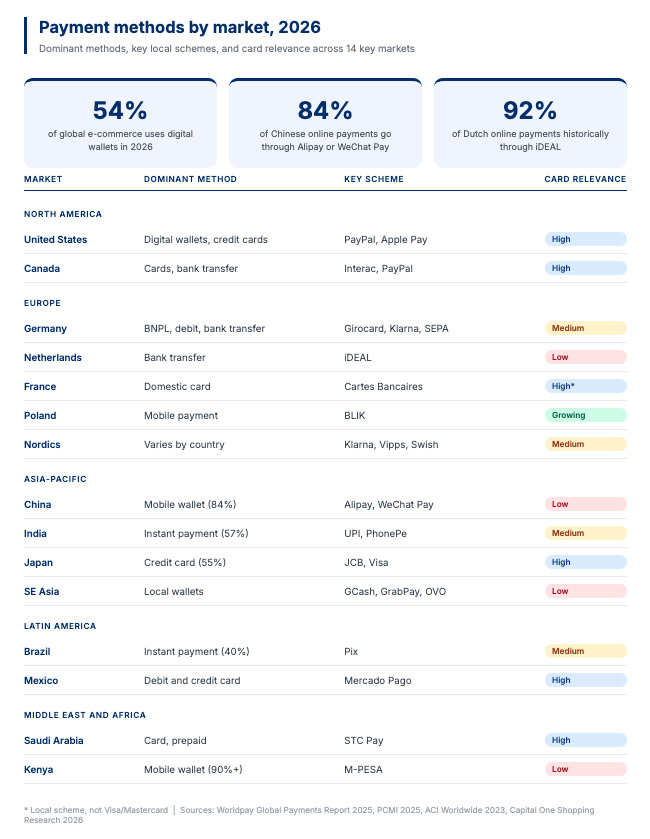
Today, local payment methods are reshaping the landscape. From Brazil’s Pix to India’s UPI, from mobile money in Africa to domestic card schemes like RuPay, these local options are becoming the preferred way to pay in market after market. The shift is so dramatic that in some countries, international cards are no longer the primary payment method but a secondary option.

For merchants expanding globally, this creates both opportunity and complexity. Offer the right local methods and you unlock new customer segments and higher conversion rates. Stick with cards alone and you risk leaving significant revenue on the table. This guide will help you understand the key differences between local payment methods and international card schemes, and how to build a strategy that leverages the strengths of both.

Understanding the two ecosystems

Before comparing options, it helps to understand what each category represents and how they function.

International card schemes refer to global networks like Visa, Mastercard, American Express, and China’s UnionPay (which, while dominant in China, operates as an international scheme abroad). These networks provide standardized infrastructure for processing card payments across borders, with consistent rules for authorization, settlement, dispute resolution, and fees. A merchant accepting Visa in the United States can accept the same card from a customer in Japan, with largely the same process.

Local payment methods encompass everything else. This category includes domestic card schemes like Brazil’s Elo, France’s Cartes Bancaires, or India’s RuPay. It includes real-time payment systems like Pix in Brazil, UPI in India, and FedNow in the United States. It covers digital wallets like GCash in the Philippines, Mercado Pago in Latin America, and mobile money services like Kenya’s M-PESA. And it includes bank transfer methods like iDEAL in the Netherlands, Sofort in Germany, and PSE in Colombia.

The fundamental difference lies in scope. International schemes prioritize global interoperability, enabling transactions anywhere cards are accepted. Local methods prioritize domestic efficiency, offering lower costs, faster settlement, and features tailored to specific market needs.

The global dominance of international card schemes

International card schemes remain the backbone of cross-border e-commerce for good reason. Their strengths are substantial and, for many use cases, indispensable.

Global acceptance is their primary advantage. A customer with a Visa or Mastercard can use it at millions of merchants worldwide, online and offline. For merchants selling to customers across multiple countries, accepting these cards provides immediate reach without requiring separate integrations for each market.

Standardized rules simplify operations. Authorization processes, chargeback procedures, fee structures, and dispute resolution follow consistent patterns across markets. This predictability reduces operational complexity for merchants operating internationally.

Established infrastructure means reliability. Card networks have spent decades building robust processing systems with high uptime, sophisticated fraud detection, and established relationships with issuing and acquiring banks worldwide. Merchants benefit from this maturity without needing to build it themselves.

Consumer familiarity drives conversion. Cards remain the most recognized payment method globally. Even in markets where local methods dominate, cards are still understood and trusted by consumers, particularly for higher-value purchases and cross-border transactions.

The market remains highly concentrated, with the top three players controlling approximately 95% of the global market. China UnionPay, Visa, and Mastercard lead, followed by American Express, Discover, and JCB.

The rise of local payment methods

Despite the strengths of international schemes, local payment methods are gaining ground rapidly. In many of the world’s fastest-growing markets, they have already become the dominant way to pay.

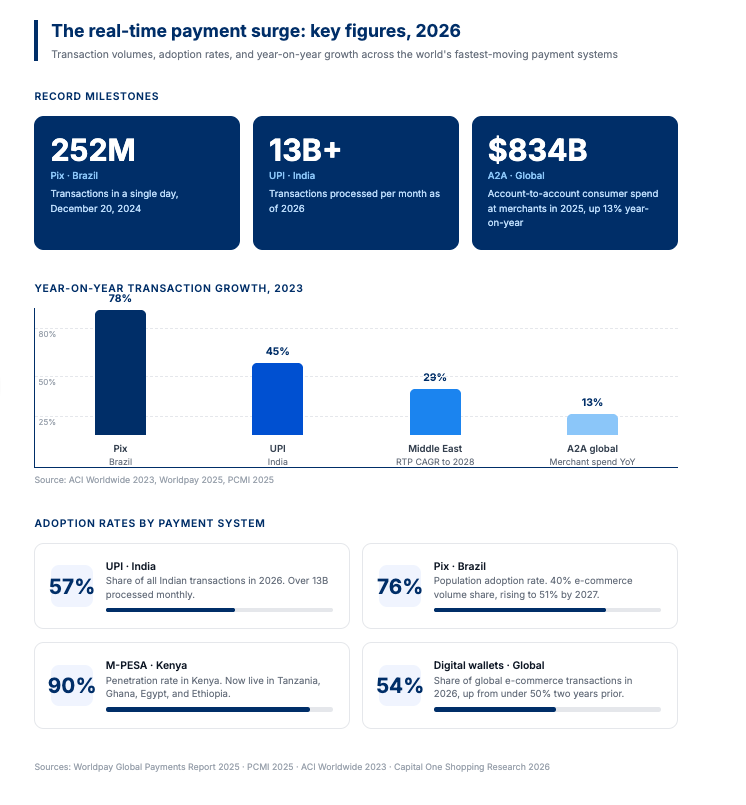
Brazil’s Pix overtook credit cards as the most-used e-commerce payment method in 2025, capturing 42% of total purchase value compared to 41% for cards. Launched in November 2020, Pix now reaches 177 million users, about 83% of the population, and accounts for 51% of all payments by volume. The system continues to evolve, with Pix Automático enabling recurring transactions and expanding access to subscription services for the 60 million Brazilians without credit cards.

India’s UPI processes massive transaction volumes, with account-to-account transfers accounting for 75% of e-commerce volume. Yet interestingly, the fastest-growing payment method in India is credit cards, led by the domestic scheme RuPay. Local cards are expected to grow at 23% annually through 2028, outpacing UPI’s 15% expansion and international cards’ 6% growth.

Africa’s mobile money ecosystem, led by Kenya’s M-PESA, processes over $1.4 trillion annually. M-PESA alone handled 81 billion transactions last year and serves more than 91% of Kenyans. In this environment, cards often function as the alternative payment method, not the primary one.

Southeast Asia’s digital wallets like GCash and Maya have captured over 90 million users in the Philippines, equivalent to nearly all adults, while cards are used by only 21% of the adult population. Credit cards remain exclusive in many Southeast Asian markets due to the absence of credit bureaus for underwriting.

Several factors explain this shift toward local methods. Lower fees make them attractive to merchants. Faster settlement improves cash flow. Regulatory support from central banks accelerates adoption. And perhaps most importantly, these methods are designed around local consumer behavior, offering experiences that feel natural to each market’s population.

Comparative analysis: local methods vs international schemes

Cost structure

International card schemes typically charge interchange fees plus processor markups. For cross-border transactions, these costs increase further. Stripe’s 2026 pricing shows domestic card transactions at a base rate, with international cards incurring an additional 1% fee and currency conversion adding another 2%.

Local payment methods often offer lower costs. Account-to-account transfers bypass interchange entirely. Domestic schemes operate with lower overhead. Many local methods have fee structures set by local regulators rather than global networks. For merchants with significant volume in a market, these savings can be substantial.

Approval rates

Local methods frequently achieve higher approval rates within their home markets. They are designed for local banking infrastructure, understand local risk patterns, and face fewer of the cross-border friction points that can trigger declines on international cards.

For merchants, higher approval rates translate directly to more revenue. A method that costs slightly more but approves significantly more transactions is often the better choice. This is particularly true in markets where card penetration is low or where local methods have achieved near-universal adoption.

Settlement speed

Real-time local payment systems like Pix, UPI, and FedNow settle funds instantly or within seconds. This compares favorably to card settlement cycles that typically take one to three business days. For businesses managing cash flow, especially small and medium enterprises, faster settlement provides meaningful working capital advantages.

Customer reach

International cards excel at reaching customers across markets. A single integration provides access to cardholders worldwide. Local methods, by contrast, require separate integrations for each market but often reach customer segments that cards miss, including unbanked and underbanked populations.

In Brazil, eight out of ten companies using Pix through payment processors are micro-businesses, with 84% relying on it to purchase software. These are customers who typically lack credit cards for online transactions, representing a previously inaccessible market for global providers.

Fraud and risk

Both approaches have different risk profiles. Card transactions benefit from established chargeback mechanisms that protect consumers, though these can create merchant liability. Local account-to-account payments often lack traditional chargeback rights, which reduces merchant risk but can leave consumers vulnerable. In practice, fraud migrates to wherever controls are weakest, so both systems require robust prevention measures.

The convergence trend: when local and global meet

The sharp distinction between local methods and international schemes is blurring. Several trends point toward convergence rather than displacement.

Domestic schemes integrating with instant payment rails represents a powerful hybrid. India’s RuPay has grown by embedding itself into the UPI system, allowing real-time transactions to draw directly on credit limits. Consumers can use the familiar UPI interface while accessing credit through the card network. This combination leverages the strengths of both approaches.

International schemes adding local features reflects adaptation. Visa and Mastercard increasingly support local payment method functionality, enabling features like installment payments that are essential in markets like Brazil and Mexico. They are also participating in the development of frameworks for agentic commerce and tokenization standards.

Cross-border interoperability initiatives aim to connect domestic real-time systems. Brazil’s Pix, India’s UPI, and other national systems are exploring connections that would allow seamless cross-border payments. If successful, this would give local methods some of the global reach that has been the exclusive domain of international schemes.

Building a multi-method strategy for 2026

Given the strengths of both approaches, the optimal strategy for most merchants is not choosing one over the other but intelligently combining both.

Market-by-market prioritization

Start by understanding payment preferences in each target market. In Brazil, Pix is essential. In the Netherlands, iDEAL dominates. In Nigeria, local cards like Verve and mobile money matter more than international schemes. In Germany, bank transfers and digital wallets compete with cards.

Research from PaymentsJournal emphasizes that you do not need a checkout with 100 different options. You need to focus on the three or four most relevant payment methods for each particular market. Partnering with a provider that offers local expertise can help identify which options matter most.

Technology integration

Managing multiple payment methods across multiple markets creates significant technical complexity. Each method requires its own integration, its own reconciliation, its own understanding of local rules. This is where payment orchestration becomes valuable.

By integrating with a unified platform, merchants can access dozens of payment methods through a single API. New methods can be added through configuration rather than code. Routing logic can direct each transaction to the optimal provider based on method, cost, and performance. The complexity of managing multiple methods is handled by the platform, not by the merchant’s engineering team.

Testing and optimization

Payment performance varies by method, market, and transaction type. The only way to know what works best is to measure continuously. Track authorization rates by method. Compare costs across providers. Monitor conversion rates with and without specific local options. Use the data to refine your strategy over time.

Some merchants find that offering a local method increases overall conversion enough to justify the integration cost many times over. Others discover that certain methods underperform in their specific vertical. Continuous testing reveals these insights.

Regional deep dives

Latin America

Latin America represents one of the most dynamic payment landscapes globally. Brazil leads with Pix now dominating e-commerce, capturing 42% of transaction value compared to 41% for cards. Pix Automático, launched in June 2025, has grown 41% monthly, enabling recurring payments for subscription services.

In Mexico, retailers offering installments recorded an average 41% revenue increase over six months. OXXO cash payments remain essential for reaching unbanked consumers. Mercado Pago continues expanding its wallet ecosystem.

Colombia’s Bre-B real-time payment system, launched in October 2025, mirrors Brazil’s Pix and aims to transform domestic payments. Early adoption will determine whether it achieves similar scale.

Asia

India presents a fascinating hybrid model. UPI processes enormous volumes, yet local cards are growing fastest. RuPay’s integration with UPI Autopay allows real-time transactions drawing on credit limits, combining the familiarity of UPI with the credit access of cards.

In Southeast Asia, digital wallets dominate. The Philippines sees GCash and Maya reaching near-universal adult adoption. Indonesia’s regulatory restrictions on e-commerce card use push even banked consumers toward wallets and QR transfers. Credit cards remain exclusive due to limited credit bureau infrastructure.

Africa

Africa’s payment landscape varies significantly by region. Kenya’s M-PESA dominates, with mobile money processing the majority of transactions. Nigeria sees Verve cards capturing 90% of debit card online sales, with the domestic scheme issuing 100 million cards in a country of 232 million people. Egypt’s card adoption grows through debit, while cash remains significant.

For merchants entering African markets, understanding which methods matter where is essential. Mobile money in East Africa, local cards in Nigeria, bank transfers in South Africa, each market requires a tailored approach.

Europe

Europe presents a different dynamic. International cards remain strong, but local methods maintain significant shares in specific countries. iDEAL dominates the Netherlands. 

Bancontact leads in Belgium. Cartes Bancaires holds substantial share in France. The rise of Wero, the European Payments Initiative’s unified solution, may reshape the landscape by providing a pan-European alternative to international schemes.

Several developments will shape the local versus global payment landscape in coming years.

Real-time rail interoperability will connect domestic systems, potentially giving local methods global reach. If Pix can send payments directly to UPI or FedNow, the distinction between local and global blurs significantly.

Stablecoin adoption for cross-border commerce may create new rails that combine local efficiency with global reach. In markets facing inflation or currency controls, stablecoins already serve practical needs for value preservation and cross-border movement.

Agentic commerce, where AI agents make purchases on behalf of consumers, will favor payment methods that are programmable and automated. Real-time account-to-account systems may integrate more easily with AI than legacy card rails built for human-led processes.

Regulatory evolution will continue shaping the landscape. Europe’s PSD3, Brazil’s stablecoin law, India’s UPI framework, all influence which methods thrive. Merchants who build flexible infrastructure can adapt as rules change.

Frequently asked questions

Should I accept both local methods and international cards?


In most markets, yes. Cards provide broad coverage and work for cross-border customers. Local methods reach segments cards miss and often offer better economics. The optimal mix varies by market but rarely excludes either category entirely.

Which is cheaper: local methods or international cards?


Local methods typically have lower fees within their home markets, especially account-to-account transfers that bypass interchange. International cards cost more, particularly for cross-border transactions, but offer broader acceptance. The right choice depends on your specific mix of customers and transaction types.

How do I decide which local methods to add first?

Start with markets where you have the most customers or highest growth potential. Research the top three payment methods in each market and prioritize those. Work with payment partners who can provide local expertise and consolidated access.

Do local methods work for recurring billing and subscriptions?

Increasingly yes. Brazil’s Pix Automático supports recurring payments. India’s UPI Autopay enables subscriptions. Local methods are evolving to support the full range of commerce models, not just one-time purchases.

Can I use the same integration for multiple local methods?


With a payment orchestration platform, yes. A single integration can provide access to dozens of local methods across multiple markets, with new methods added through configuration rather than code.

What happens to my card acceptance when I add local methods?

Cards and local methods complement each other. Most merchants see overall conversion increase when adding relevant local options, as they capture customers who prefer or can only use those methods. Card transactions typically remain stable or grow alongside local method adoption.

The choice between local payment methods and international card schemes is not an either-or decision. The most successful merchants in 2026 will be those who understand the strengths of both and build strategies that leverage each where they perform best.

International cards provide global reach, standardized rules, and broad consumer familiarity. Local methods offer lower costs, faster settlement, and access to customer segments that cards cannot reach. Together, they create a comprehensive payment capability that maximizes conversion across markets and customer types.

The complexity lies in managing this diversity. Each method requires integration, monitoring, reconciliation, and optimization. Doing this manually for dozens of methods across multiple markets is impractical for all but the largest enterprises.

This is where payment orchestration becomes essential. By providing a unified layer that connects to multiple payment methods and providers, orchestration platforms simplify the complexity while preserving the flexibility to adapt as markets evolve. Merchants can offer the right mix of local and global methods in each market, optimize routing based on performance and cost, and add new methods as opportunities emerge, all without rebuilding their payment infrastructure.

Discover how payment orchestration can help you offer the right mix of local methods and international cards in every market, without the technical burden of managing each integration separately. Book a demo today to learn more.

Payment regulations across different regions in 2026

The regulatory landscape for payments has never been more dynamic. Across the globe, governments and financial authorities are reshaping the rules that govern how money moves, who can move it, and what protections apply when things go wrong. For businesses operating internationally, keeping pace with these changes is no longer just a compliance exercise. It is a strategic necessity that affects product design, customer experience, and market entry decisions.

This guide provides a comprehensive overview of the most significant payment regulations taking effect across key regions in 2026. We will cover Europe’s sweeping new payment framework, major developments in the United States, Asia’s embrace of digital assets and real-time rails, Latin America’s continued innovation, and emerging rules in other markets. Understanding this landscape will help you navigate complexity, avoid costly missteps, and identify opportunities where regulatory change creates competitive advantage.

Europe: PSD3 and the new payment services framework

The European Union is undergoing its most significant payment regulatory overhaul since the introduction of PSD2. The Third Payment Services Directive, known as PSD3, and the new Payment Services Regulation are together reshaping the rules for payment service providers across all member states.

What PSD3 and the PSR change

The most fundamental shift is structural. By transferring many behavioral regulations from a directive to a regulation, the EU is eliminating the national implementation leeway that created fragmentation under PSD2. This means the same rules will apply directly and uniformly across all member states, increasing legal certainty for businesses operating across borders.

For payment institutions and electronic money institutions, the changes are substantial. These entities will now be subject to the full scope of regulations governing payment institutions, with stricter capital requirements, broader obligations around customer fund protection, and enhanced ICT resilience standards. Institutions that already hold licenses may need to reapply for authorization or demonstrate compliance with the new standards during transition periods.

Security and fraud prevention take center stage

PSD3 places even greater emphasis on transaction security and fraud prevention. Strong Customer Authentication requirements remain, but they are supplemented by improved transaction monitoring and the reintroduction of IBAN name matching. This verification of payee feature requires payment service providers to check that the recipient’s name matches the account number before a transfer completes, helping prevent misdirected payments and certain types of fraud.

Perhaps most significantly for merchants, liability rules are tightening. Similar to frameworks already in place in the UK and Singapore, payment service providers will be required to reimburse consumers for losses in certain fraud scenarios. At the same time, new rules facilitate fraud data sharing between institutions, with narrowly defined possibilities for recourse against telecommunications companies whose infrastructure has been used by fraudsters.

The European Payments Council has already launched consultations to stabilize the Verification of Payee scheme rulebook, with updates continuing through 2026. EU payment service providers should be finalizing their IBAN name check implementations, including designing customer journeys for mismatch outcomes and exception handling.

Open banking evolution

The regulatory framework for open banking is also being strengthened. Dedicated, secure interfaces and clear rules on interface governance aim to improve availability and quality. Customers will gain more transparency and control over data access, including authorization dashboards that show exactly who has access to their financial information.

Digital euro moves closer

December 2025 saw the Council of the EU agree its position on regulations establishing a legal framework for a retail digital euro. The Council clarified key design features including distribution via supervised intermediaries, holding limits, offline functionality, and member state duties to monitor cash acceptance and availability. For banks and payment service providers, this means preparing for wallet onboarding, privacy and AML controls, holding limit monitoring, and offline use capabilities. Merchants should be reviewing digital euro acceptance flows and point-of-sale integration requirements.

Implementation timeline

Following the political agreement reached by Parliament and Council in November 2025, the PSD3 and PSR package is expected to be formally adopted and published in the first half of 2026. The PSR will generally apply directly in all member states 18 months after entry into force, while PSD3 must be transposed into national law within 18 months. A transitional phase applies for institutions already authorized, giving them time to adapt their governance, organization, and processes to the new requirements.

For businesses operating in or with Europe, the message is clear: start your gap analysis now. Legal and operational teams should work together to translate regulatory requirements into processes, controls, IT systems, and contracts, particularly for governance, third-party management, fraud controls, and API governance.

United States: federal shifts and state-level action

The United States presents a complex picture in 2026, with significant federal developments alongside active state-level rulemaking. The change in administration has brought a different approach to financial regulation, while new laws create frameworks for emerging payment technologies.

Federal payments modernization

The U.S. Department of the Treasury, in coordination with the IRS and other federal agencies, is advancing the transition to fully electronic federal payments pursuant to Executive Order 14247, signed in March 2025. This policy shift covers both disbursements from the federal government, including tax refunds, benefits, grants, and vendor payments, and payments to the federal government, including tax balances due, fees, and penalties.

The purposes are clear: defend against financial fraud and improper payments, increase efficiency, reduce costs, and enhance security. Paper instruments are far more likely than electronic payments to be lost, stolen, altered, or delayed. Moving to direct deposit and other secure electronic options improves speed, accuracy, and protection for both the public and government.

For individual taxpayers, the changes are already taking effect. The IRS generally stopped issuing paper refund checks after September 30, 2025. Taxpayers without bank accounts can still receive refunds through alternative electronic methods, including certain mobile apps and prepaid debit cards, with limited exceptions for hardship cases.

For businesses paying taxes, the IRS strongly encourages electronic payment options including IRS Direct Pay, the Electronic Federal Tax Payment System, and online account portals. While checks and money orders are still accepted for now, the agency will reduce its reliance on paper over time.

Federal Reserve payment account proposal

In December 2025, the Federal Reserve issued a request for information on a new special purpose payment account prototype. This stripped-down Federal Reserve Bank account is designed for payments-focused institutions that are legally eligible for master accounts but have faced long, uncertain reviews.

A payment account would be separate from a traditional master account and used solely to clear and settle the account holder’s own payment activity. It would be subject to tight structural limits: capped overnight balances, no interest on overnight balances, no discount window access, and no intraday credit. The account could settle Fedwire Funds, FedNow, and certain other transfers, but not ACH, check, or other transactions.

For eligible fintechs and special purpose banks, a payment account could provide a practical, albeit constrained, way to gain direct access to Federal Reserve payment rails while reducing reliance on correspondent banks.

State-level developments

At the state level, several trends merit attention. New York’s FAIR Act, which took effect February 17, 2026, expands the scope of the state’s General Business Law to explicitly prohibit unfair, deceptive, or abusive acts or practices across all business activities. For payments firms, this broadening of enforcement powers heightens regulatory risk around product design, pricing transparency, marketing practices, and customer communications .

States continue to enact laws targeting earned wage access products, with California, Connecticut, Nevada, South Carolina, Missouri, and Wisconsin among those establishing frameworks. These laws often require registration and fee payments, while some state regulators have pursued enforcement actions alleging that EWA products constitute illegal payday lending.

The patchwork of state laws governing convenience fees and surcharges also continues to evolve, generating class action litigation against lenders and servicers. Plaintiffs increasingly allege that such fees violate state consumer protection statutes or debt collection laws.

Faster payments adoption

Financial institutions are continuing to adopt FedNow and real-time payment capabilities, moving from receive-only transactions to both sending and receiving. As adoption grows, so does attention to the associated fraud risks, with artificial intelligence emerging as a key tool for combating fraud in instant payments.

Asia: digital assets, real-time rails, and AML focus

Asia presents a diverse regulatory picture in 2026, with major economies advancing frameworks for digital assets, expanding real-time payment capabilities, and strengthening anti-money laundering requirements.

China: enhanced AML measures

China introduced new special preventative measures targeting money laundering and terrorist financing risks, effective February 16, 2026. These measures require financial institutions to continuously monitor sanctions lists published by the National Counter Terrorism Leading Group, the UN Security Council, and the People’s Bank of China.

Firms must verify customers and trading partners against these lists as part of customer due diligence and apply enhanced AML controls, including freezing assets or restricting transactions where necessary. Institutions are also required to report both identified customers and any special administrative measures taken to their relevant AML authorities. Notably, the framework includes penalties for non-compliance, with individual employees potentially held legally responsible, reinforcing the importance of strong governance and accountability structures.

Hong Kong: tokenized deposits advance

The Hong Kong Monetary Authority launched EnsembleTX in November 2025, the pilot phase of Project Ensemble, enabling real-value transactions using tokenized deposits and digital assets. Building on earlier sandbox experimentation, the pilot will operate through 2026 with the aim of delivering faster, more transparent, and more efficient settlement of tokenized transactions.

The HKD Real Time Gross Settlement system will initially facilitate interbank settlement, before the pilot infrastructure is gradually updated to support 24/7 settlement of tokenized central bank money. Banks and industry participants involved in the pilot should prepare to integrate tokenized deposit use cases into liquidity and treasury operations and to test settlement procedures.

Singapore: BLOOM extends settlement capabilities

In October 2025, the Monetary Authority of Singapore launched BLOOM to extend settlement in tokenized bank liabilities and well-regulated stablecoins, while applying standardized risk approaches. Under BLOOM, industry participants will collaborate on focus areas including the distribution and clearing of settlement assets, programmable compliance controls to automate compliance checks, and agentic payment.

Industry participants such as banks, financial institutions, and clearing network operators may apply to take part in trials and advance BLOOM’s objectives, while keeping abreast of further related developments.

Regional payment system evolution

Across Asia, real-time payment systems continue to mature. The focus is shifting from launch to scaling, with attention to interoperability, cross-border connectivity, and the development of value-added services built on real-time rails. For businesses operating in the region, understanding local payment preferences and the regulatory frameworks supporting them remains essential.

Latin America: real-time payments hit their stride

Latin America continues to demonstrate how thoughtful regulation can accelerate fintech innovation. Several significant developments in 2026 merit attention.

Brazil: Pix evolution and stablecoin regulation

Brazil’s Pix, already a massive success, continues to evolve from a payments rail into a broader financial product. Pix Automático has the potential to disrupt subscription payments by enabling recurring transactions directly through the Pix infrastructure. Pix Parcelado formalizes BNPL-like behavior without cards, further eroding the relevance of physical cards for large segments of the population.

Brazil’s Stablecoin Law, effective in early 2026, represents a landmark development. By institutionalizing stablecoins for B2B cross-border settlement, Brazil becomes one of the first major markets to formally integrate the asset class into its financial system. The implications for cross-border payments, treasury management, and FX hedging are significant, extending well beyond crypto-native players.

Phase four of Open Finance is expected to roll out in early 2026, introducing credit portability, payment initiation without redirection, and payroll portability. The real question is not adoption but impact, particularly on checkout conversion, pricing, and customer acquisition dynamics.

The Central Bank continues to expand its oversight of fintechs, formalizing supervision of new business models. While election cycles may create bursts of regulatory activity followed by pauses, the trend toward structured oversight is unlikely to reverse.

Colombia: Bre-B enters a defining year

After its 2025 launch, Colombia’s Bre-B real-time payment system enters a defining year in 2026. With mandated interoperability in place, attention turns to whether usage reaches critical mass and starts displacing cards for everyday payments. Success will depend less on technology and more on merchant and consumer habit change.

Mexico: DiMo and open finance

Mexico’s DiMo may finally reach the scale required to challenge the country’s cash-heavy economy, with tens of millions of social program recipients being onboarded. If adoption sticks, it could unlock entirely new fintech use cases for informal and underbanked users.

After years of perceived stagnation following the Fintech Law, 2026 could mark a reset. Mandatory open finance standards and broader DiMo adoption have the potential to materially expand addressable markets. A meaningful shift from cash to digital would unlock new embedded finance opportunities across payments, lending, and wallets.

Mexico’s CNBV is actively enforcing the Fintech Law, signaling a broader trend of regulatory normalization as ecosystems mature.

Across Latin America, regulators are tightening enforcement as fintech ecosystems mature. This is less about restriction and more about creating the conditions for responsible scaling. At the same time, artificial intelligence is becoming embedded across product, risk, and operations, with regulators increasingly focusing on areas like fraud, identity, and automated decision-making.

Other notable developments

Global cross-border payments focus

The Financial Stability Board continues to urge action to improve cross-border payments. In October 2025, the FSB published a progress report on the G20 Roadmap noting that while most roadmap actions have been completed, tangible user benefits remain limited. The FSB has called for stronger implementation at national levels and greater private-sector engagement, with focus shifting from policy design to supporting implementation and stakeholder coordination.

United Kingdom: payments vision and stablecoin framework

The UK is advancing several significant initiatives. The Payments Vision Delivery Committee released its strategy for next-generation retail payments infrastructure in November 2025, focusing on expanding payment choices, promoting financial inclusion, tackling financial crime, ensuring system resilience, and improving interoperability.

The FCA has prioritized stablecoin payments for 2026, with sandbox testing for safe experimentation. Banks, EMIs, and crypto firms should align issuance, redemption, backing asset custody, and wallet risk controls with the evolving regime.

Commercial Variable Recurring Payments continue to advance, with the FCA aiming to expand cVRPs into e-commerce and unlock new open banking use cases. Businesses should prepare for first live payments under the UK Payments Initiative scheme, with the FCA assessing adoption and growth by year-end.

Argentina: enhanced reporting obligations

Through General Resolution 5804, Argentina’s tax authority expanded the scope and detail of information that digital platforms and payment service providers must report. The amendments, which apply to informative sworn statements filed from May 2026 onward, require detailed reporting on account holders, balances, and transactions, with specific thresholds triggering enhanced reporting requirements.

Poland: complaint handling framework

The Act on the Handling of Complaints on Financial Market Entities took effect on February 12, 2026, establishing a new framework for complaint handling and dispute resolution. Payments providers and financial institutions operating in Poland must ensure their processes align with the new requirements.

Norway: AML rule updates

Norway implemented updated AML rules on February 6, 2026, incorporating changes to the EU’s high-risk third-country list. Financial institutions operating in or through Norway must ensure risk assessments, customer due diligence, and transaction monitoring reflect the updated list of jurisdictions with strategic AML deficiencies.

Navigating the complex regulatory landscape

For businesses operating across multiple regions, the regulatory complexity described above presents significant challenges. Compliance teams must track deadlines across dozens of jurisdictions. Product teams must design experiences that meet varying local requirements. Legal teams must interpret how overlapping frameworks apply to specific business models.

Several principles can help navigate this complexity.

Build regulatory awareness into product development: The days of building first and addressing compliance later are over. Regulatory requirements should inform product design from the outset, particularly for features involving authentication, data sharing, fraud prevention, and customer communications.

Invest in flexible infrastructure: Regulatory requirements change, and they change at different paces across regions. Rigid systems that require redevelopment for each new rule create bottlenecks and increase risk. Flexible payment infrastructure that can adapt through configuration rather than code enables faster responses to regulatory change.

Monitor continuously, not periodically: Regulatory deadlines arrive throughout the year, not just at predictable intervals. February 2026 alone saw 45 regulatory milestones across multiple jurisdictions . Continuous monitoring, supported by appropriate tools and intelligence, is essential.

Engage with industry developments: Many regulations emerge from industry consultation processes. Participating in these consultations, whether directly or through industry associations, provides insight into upcoming changes and an opportunity to shape outcomes.

Consider the strategic dimension: Regulation is not just a constraint. It can also create opportunity. Brazil’s open finance framework, the EU’s PSD3, and the US Genius Act all create new possibilities for innovative products and services. The businesses that understand these frameworks earliest are best positioned to capitalize on them.

Frequently asked questions

When do the major 2026 payment regulations take effect?

Timelines vary by region. PSD3 and the PSR are expected to be formally adopted in the first half of 2026, with application 18 months later. The US Genius Act requires agency rules by July 18, 2026. Brazil’s Stablecoin Law is effective early 2026. Many other measures, including China’s enhanced AML rules and New York’s FAIR Act, took effect in February 2026.

How do PSD3 and PSR differ from PSD2?

PSD3 and the PSR represent an evolution rather than a revolution, but with important differences. Key changes include the shift to a regulation for many requirements, eliminating national variation; enhanced fraud prevention including mandatory IBAN name matching; expanded scope bringing e-money institutions fully into the framework; and stricter liability rules for certain fraud scenarios.

How will the US transition to electronic federal payments affect businesses?

For businesses receiving federal payments, the shift to electronic methods means ensuring banking information is current with relevant agencies. For businesses paying the IRS, electronic payment options are strongly encouraged, though checks and money orders remain accepted for now. Over time, paper methods will be phased out.

What is IBAN name matching and why does it matter?

IBAN name matching, also called Verification of Payee, requires payment service providers to check that the recipient’s name matches the account number before a transfer completes. It helps prevent misdirected payments and certain types of fraud. Under PSD3, EU payment service providers must implement this capability.

How do real-time payment regulations differ across regions?

Real-time payment frameworks vary significantly. In Europe, the focus is on instant euro payments with new rules enabling 24/7 transfers. In Brazil, Pix continues to evolve with new features like recurring payments. In the US, FedNow adoption grows alongside private sector real-time payment networks. Each framework carries different requirements for participation, fraud prevention, and customer protections.

What should businesses do to prepare for 2026 regulatory changes?

Start with a gap analysis comparing current practices to new requirements. Prioritize areas with the earliest deadlines or highest operational impact. Engage legal and compliance expertise early. Invest in flexible payment infrastructure that can adapt to changing rules. Monitor regulatory developments continuously throughout the year.

For businesses, this complexity brings both challenges and opportunities. The challenge lies in keeping pace with change, ensuring compliance across multiple jurisdictions, and avoiding costly missteps. The opportunity lies in building systems and strategies that turn regulatory requirements into competitive advantages, whether through superior customer experiences, lower risk, or faster market entry.

The businesses that succeed will be those that treat regulation not as an obstacle to be overcome but as a foundational element of their payment strategy. They will build flexible infrastructure that adapts to change. They will invest in regulatory intelligence and expertise. And they will view compliance not as a cost center but as a source of customer trust and business resilience.

Ready to navigate the complex payment regulatory landscape with confidence? Discover how a flexible payment orchestration platform can help you adapt to changing rules across regions, maintain compliance without sacrificing performance, and focus your resources on growth rather than regulatory firefighting. Book a demo today to learn more.

Payment orchestration vs building in-house: which is right for your business?

Every business that scales eventually faces a critical decision about its payment infrastructure. The path that worked when processing a few thousand dollars a month becomes strained under the weight of millions. New markets demand new payment methods. Customer expectations rise. Fraud tactics evolve. And somewhere along the way, the question emerges: should we build our own payment orchestration layer, or buy a dedicated solution?

This is one of the most consequential technology decisions a growing business can make. It shapes not only your payment performance but your engineering roadmap, your operational costs, and your ability to adapt to future changes. There is no single right answer for every company. The choice depends on your specific context, resources, and strategic priorities. This guide will walk through the factors you need to consider, the tradeoffs involved, and the questions to ask before making a decision.

Understanding the two approaches

Before comparing options, it helps to clearly define what each approach entails.

Building in-house means developing your own payment orchestration layer. This involves creating a unified API that connects to multiple payment service providers, building routing logic to direct transactions, implementing failover mechanisms, developing a tokenization vault, and creating the reporting and analytics tools needed to monitor performance. It also means maintaining all of this infrastructure over time, updating integrations as providers change their APIs, and ensuring continued compliance with security standards like PCI DSS.

Using a payment orchestration platform means subscribing to a dedicated solution that provides these capabilities out of the box. Your developers integrate once with the platform’s API, and the platform handles all connections to underlying payment providers, routing logic, tokenization, and reporting. The platform provider maintains the integrations, manages security compliance, and continuously updates the system as the payment landscape evolves.

At first glance, building in-house might seem like the more flexible and cost-effective option, especially for companies with strong engineering teams. But the reality is more complex. The total cost of ownership for a custom-built solution often exceeds expectations, and the opportunity cost of diverting engineering resources from your core product can be substantial.

The core function of any orchestration layer is intelligent routing and unified data management. To understand exactly how these capabilities translate into better performance, read our detailed guide on payment orchestration and AI-driven payments, which explores how modern systems optimize transactions in real time.

The case for building in-house

There are legitimate reasons why some companies choose to build their own payment orchestration layer. Understanding these helps clarify when the build approach makes sense.

Complete control over the codebase: When you build your own system, every line of code is yours. You decide exactly how routing logic works, how data is stored, and how the system evolves. For companies with highly specialized needs that no off-the-shelf solution can accommodate, this level of control is essential. You are not limited by another company’s product roadmap or feature priorities.

No recurring software fees: Building in-house eliminates the per-transaction or monthly subscription costs of a third-party platform. For businesses processing enormous volumes, these fees can add up. If your engineering costs are already sunk, the marginal cost of building and maintaining a payment layer may compare favorably to ongoing platform fees.

Deep integration with internal systems: A custom-built solution can be tightly coupled with your existing architecture in ways that a third-party platform cannot. If your payment needs are deeply intertwined with proprietary systems or unique business logic, building internally may be the only way to achieve seamless integration.

Perception of competitive advantage: Some companies view payments as a core differentiator. They believe that unique payment capabilities can set them apart from competitors and want complete ownership of that differentiation. For these businesses, building in-house feels like protecting intellectual property.

However, these benefits come with significant caveats. Control means responsibility. Eliminating software fees means absorbing development and maintenance costs. Deep integration means carrying that integration burden forever. And competitive advantage only matters if your payment capabilities are truly unique and valued by customers, which is rarely the case.

The hidden costs of building in-house

The decision to build often focuses on visible costs like developer salaries and server expenses. The hidden costs are what catch companies by surprise.

Ongoing maintenance burden: Payment providers change their APIs regularly. New security requirements emerge. Card networks update their specifications. Compliance standards evolve. Every change requires engineering time to update your custom code. This is not a one-time project but a permanent operational cost that grows with the number of providers you support.

Opportunity cost of engineering talent: Every hour your engineers spend building and maintaining payment infrastructure is an hour they cannot spend on your core product. For most businesses, payments are a utility, not a differentiator. Investing engineering resources in utilities means slowing down innovation on what actually makes your business unique.

Compliance complexity: Handling payment data comes with serious compliance obligations. PCI DSS requirements dictate how data must be stored, transmitted, and protected. Building a compliant tokenization vault requires deep security expertise. Mistakes can lead to data breaches, fines, and lost customer trust. A dedicated platform spreads these compliance costs across many customers, making them more affordable for each.

Feature gaps that emerge over time: Your in-house system will do what you built it to do. But the payment landscape evolves rapidly. New payment methods appear. New optimization techniques emerge. New fraud tools become available. Keeping pace with these changes requires continuous investment. Most companies find that their internal system gradually falls behind what modern platforms offer.

Scaling challenges: As your transaction volume grows, your in-house system must scale accordingly. This means designing for high availability, building redundancy across regions, and handling traffic spikes during peak periods. These are non-trivial engineering challenges that require specialized expertise.

The case for using a payment orchestration platform

For most businesses, a dedicated payment orchestration platform offers compelling advantages over building in-house.

Faster time to market: Integrating with a platform takes weeks, not months or years. Your developers complete a single integration, and instantly gain access to dozens or hundreds of payment providers. New providers can be added through configuration, not code. This speed matters when you are entering new markets or responding to competitive pressure.

Lower total cost of ownership: While platforms charge fees, these are often lower than the fully loaded cost of an internal team building and maintaining equivalent functionality. The math becomes even clearer when you factor in the opportunity cost of engineering time. Paying a platform fee is often cheaper than paying developers to build and maintain the same capabilities.

Access to specialized expertise: Payment orchestration is what platforms do every day. They see how hundreds of merchants route transactions. They track provider performance across industries and regions. They know which routing strategies work and which fail. This collective intelligence is built into the platform, giving you benefits you could not replicate internally without similar scale.

Continuous innovation: Platforms are incentivized to keep their offerings current. When new payment methods gain traction, platforms add them. When new optimization techniques emerge, platforms implement them. When compliance requirements change, platforms update their systems. You benefit from this innovation without any development work on your end.

Reduced compliance burden: By using a platform’s tokenization and secure data handling, you can significantly reduce your PCI DSS scope. The platform handles the most sensitive parts of payment processing, simplifying your compliance obligations and reducing risk.

Built-in redundancy and failover: Professional platforms are designed for high availability. They operate across multiple data centers, monitor provider performance continuously, and automatically fail over when issues arise. Replicating this level of operational maturity internally requires significant investment.

Comparing the economics

The financial comparison between building and buying depends heavily on your specific situation, but a general framework helps clarify the tradeoffs.

Build costs include:

  • Initial development time (engineering salaries)
  • Ongoing maintenance (continued engineering time)
  • Infrastructure costs (servers, databases, networking)
  • Compliance costs (audits, security tools, potential fines)
  • Opportunity cost (features not built because engineers were working on payments)

Buy costs include:

  • Setup or integration fees
  • Monthly platform fees
  • Per-transaction fees
  • Potential overage charges

For a business just starting to scale, the buy option almost always makes more financial sense. The upfront investment required to build a robust orchestration layer is substantial, and the ongoing maintenance costs are permanent. As volume grows, the per-transaction fees of a platform may eventually make build economics more attractive, but this crossover point is higher than most companies estimate because they underestimate maintenance costs.

A useful exercise is to project your costs over a three to five year horizon under both scenarios, including realistic estimates for engineering time and maintenance burden. Most companies find that buy remains cheaper far longer than they expected.

Strategic considerations beyond cost

While economics matter, they are not the only factor. Several strategic considerations should influence your decision.

Speed of adaptation: Markets move quickly. A new payment method emerges in a key region. A competitor launches a smoother checkout experience. A regulatory change requires immediate action. With a platform, you adapt through configuration. With a custom build, you adapt through development cycles. The platform gives you speed.

Risk management: When you build your own system, you assume all the risk. If a provider integration breaks, your engineers fix it. If a security vulnerability emerges, your team patches it. If a compliance requirement changes, your organization addresses it. A platform shares these risks across its customer base, making them more manageable for each individual business.

Focus on customer experience: Your customers do not care whether you built your payment orchestration layer or bought it. They care about whether their payment works smoothly. By using a platform, you free your team to focus on the customer experience improvements that actually differentiate you, rather than the plumbing behind them.

The pace of change in payments is accelerating. Making the right infrastructure choice today means positioning yourself for what comes next. To understand the forces shaping the industry, explore our analysis of the top payment challenges for 2026 and how businesses are preparing.

Making the transition

For businesses currently using a custom-built solution, switching to a platform is not an all-or-nothing decision. Many companies adopt a hybrid approach, using a platform for new markets or new payment methods while maintaining their existing system for legacy traffic. This allows gradual migration without disrupting current operations.

The key is to ensure that your platform choice supports this hybrid model. Some platforms allow you to start with a single use case and expand over time, giving you flexibility in how you transition.

Frequently asked questions

Can a platform really match the flexibility of a custom build?

Modern platforms are designed for flexibility. They offer configurable routing rules, customizable checkout experiences, and APIs that give you control over most aspects of payment processing. For the vast majority of use cases, they provide all the flexibility most businesses need.

What about data ownership and portability?

Reputable platforms give you full ownership of your data and provide tools to export it. You should always verify a platform’s data policies before committing, but data lock-in is not an inherent feature of platforms.

How long does integration take?

A typical integration with a payment orchestration platform takes weeks, not months. Your developers complete a single API integration, and the platform handles connections to all underlying providers. Ongoing changes require configuration, not code.

What happens if the platform goes down?

Professional platforms are built for high availability with redundancy across providers, data centers, and sometimes regions. They also support failover to backup providers automatically. Your business continuity is part of their value proposition.

The decision between building your own payment orchestration layer and using a dedicated platform is one of the most important infrastructure choices you will make. It affects your engineering roadmap, your operational costs, your risk profile, and your ability to adapt to change.

For most businesses, the advantages of a platform far outweigh the benefits of building in-house. Faster time to market, lower total cost, reduced compliance burden, and continuous innovation create a compelling case. The resources saved can be redirected toward the customer experiences and product features that truly differentiate your business.

But the right answer depends on your specific context. The key is making a deliberate, informed decision based on a clear understanding of your needs, your resources, and your strategic priorities. Take the time to evaluate both options thoroughly. Your payment infrastructure is too important to leave to chance.

Ready to explore how a payment orchestration platform can transform your payment operations without diverting your engineering team from your core product? Book a demo today to see the difference a dedicated solution can make.

The ultimate guide to payment optimization in 2026

Every business that accepts payments leaves money on the table. It is an uncomfortable truth, but one that every merchant eventually confronts. Some revenue is lost to failed transactions that could have succeeded. Some disappears into fees that could have been avoided. Some vanishes when customers abandon their carts at the final step. Payment optimization is the discipline of recovering that lost revenue. It is the practice of systematically improving every stage of the payment flow to maximize approval rates, minimize costs, and create a frictionless experience that converts browsers into buyers.

As we move through 2026, the complexity of the payment landscape has never been greater. New payment methods emerge constantly. Consumer expectations evolve rapidly. Fraud tactics grow more sophisticated. And the margin for error shrinks with every percentage point of competition. This guide will walk you through the essential strategies, metrics, and technologies that define payment optimization in 2026. Whether you are just beginning to examine your payment performance or looking to fine-tune an already sophisticated operation, these principles will help you turn your payment stack from a cost center into a competitive advantage.

What is payment optimization in 2026?

Payment optimization has evolved significantly from its origins. It is no longer simply about ensuring a transaction can be processed. Modern payment optimization is a holistic, data-driven discipline that touches every part of the payment lifecycle. It begins before the customer even reaches the checkout page and continues long after the funds have settled in your account.

At its core, payment optimization in 2026 is about three interconnected goals. The first is maximizing conversion, ensuring that every customer who wants to pay can do so successfully. The second is minimizing cost, reducing the fees and operational expenses associated with each transaction. The third is enhancing control, giving businesses the visibility and flexibility to adapt their payment strategy to changing conditions without engineering bottlenecks.

Achieving these goals requires a fundamental shift in how businesses approach their payment infrastructure. The old model of a single payment processor handling all transactions is no longer sufficient. Modern optimization demands a multi-provider strategy, intelligent routing logic, real-time data analysis, and the ability to experiment and iterate continuously. It treats payments not as a utility to be managed, but as a performance engine to be tuned.

Why payment optimization matters more than ever in 2026

Several converging trends have elevated payment optimization from a nice-to-have to a business imperative.

Rising customer expectations: Consumers in 2026 expect payments to be instant, seamless, and tailored to their preferences. A checkout that takes too long, fails without explanation, or lacks their preferred payment method is a dealbreaker. Research consistently shows that a significant percentage of shoppers will abandon a purchase if their preferred payment option is not available. In a competitive market, that lost revenue goes directly to a competitor who has optimized their offering.

Thinning margins: Economic pressures have squeezed profit margins across industries. Every basis point saved on payment processing fees directly impacts the bottom line. For businesses processing millions in volume, small percentage improvements in cost translate to significant dollars saved. Payment optimization is one of the most direct levers for improving profitability without increasing sales.

The complexity explosion: The number of payment methods, providers, and regional variations has grown exponentially. A business selling internationally in 2026 must navigate dozens of local payment preferences, varying interchange rates, different fraud regulations, and a patchwork of settlement timelines. Without optimization, this complexity becomes chaos.

Fraud evolution: As security measures improve, fraud tactics evolve in response. Machine learning enables both better fraud detection and more sophisticated attacks. Optimization today must balance robust fraud prevention with minimal friction for legitimate customers, a task that requires sophisticated tools and constant adjustment.

The core pillars of payment optimization

Effective payment optimization rests on several foundational capabilities. These are not one-time fixes but ongoing disciplines that require attention and investment.

1. Intelligent transaction routing

Not all payment processors are created equal. Approval rates vary by card type, issuing bank, geographic region, and even time of day. Cost structures differ between providers based on transaction volume, card mix, and negotiated rates. Intelligent routing is the practice of directing each transaction to the optimal processor based on real-time conditions.

A well-designed routing strategy considers multiple variables simultaneously. It might route a Visa credit card from a European customer through a local acquirer to avoid cross-border fees while sending an American Express transaction through a processor with preferential rates for that network. It monitors processor performance continuously, detecting when one provider’s approval rate drops and automatically shifting traffic to another. It can even factor in the specific bin range of the card, routing high-value rewards cards differently from standard consumer cards.

The goal of intelligent routing is not simply to find the cheapest option, but to optimize for the best combination of approval probability and cost. A slightly more expensive processor that approves three percent more transactions is often the better choice. The key is having the data and control to make that decision for every single transaction.

For a deeper look at how to structure a multi-provider approach, read our guide on building a multi-PSP payment strategy.

2. Smart retry logic

Transaction failures are inevitable, but not all failures are permanent. Many declines are what the industry calls “soft declines.” These are temporary issues that can be resolved with a second attempt. Common examples include insufficient funds, bank system outages, or network timeouts.

Smart retry logic is the practice of intelligently retrying failed transactions in a way that maximizes the chance of success without creating customer frustration or unnecessary costs. This means understanding the reason for the decline and tailoring the retry strategy accordingly.

A transaction declined due to insufficient funds might be retried in two or three days, when the customer has been paid. A decline caused by a bank system error might be retried in a few hours, when the bank’s systems are back online. A decline due to suspected fraud might not be retried at all, as additional attempts could trigger further security flags.

The most sophisticated retry systems also consider the time of day, the customer’s typical payment behavior, and the performance history of the specific processor. They may route the retry attempt through a different provider than the original transaction, especially if the decline reason suggests the first provider’s network was the issue.

3. Checkout experience optimization

The point of payment is where revenue is won or lost. A frictionless checkout experience is non-negotiable in 2026. This means more than just a clean design, it means a checkout that adapts to each customer individually.

Modern checkout optimization begins with payment method presentation. Showing the customer their preferred methods first, based on their location, device, and past purchase history, significantly increases conversion. A German customer should see PayPal and SEPA direct debit prominently. A Brazilian customer expects Pix as a primary option. A returning customer should have their stored card details presented seamlessly, with clear indicators of which card they used previously.

Form design matters immensely. Each additional field customers must fill out increases abandonment risk. Smart optimization reduces friction by requesting only essential information, using inline validation to catch errors immediately, and supporting auto-fill for common fields. Mobile optimization is particularly critical, given the growing percentage of transactions completed on smartphones. Buttons must be tappable, forms must be scrollable, and loading times must be minimal.

Payment page performance also affects conversion. Every additional second of load time reduces conversion rates measurably. Optimizing the technical performance of the checkout page, including efficient JavaScript, optimized images, and fast API responses, is a direct revenue driver.

4. Cost management and fee optimization

Payment costs are complex and often opaque. The headline rate quoted by a processor is only the beginning. Interchange fees vary by card type. Scheme fees add additional layers. Cross-border fees, currency conversion markups, and monthly account fees all contribute to the final cost per transaction.

Cost optimization requires visibility into all these components. Businesses need to understand not just what they are paying on average, but how costs break down by card type, region, and payment method. This granular view reveals opportunities for savings.

One common optimization is routing transactions to domestic acquirers whenever possible. Cross-border transactions carry higher interchange rates and often additional fees. By processing a transaction locally, businesses can reduce costs significantly while often improving approval rates.

Another strategy is actively managing the card mix. Premium rewards cards carry higher interchange fees than standard cards. While declining these cards is rarely desirable, understanding their impact on costs informs pricing strategy and negotiations with processors.

Alternative payment methods can also reduce costs. Bank transfers, digital wallets, and local payment methods often carry lower fees than international card transactions. The key is offering these options strategically, in markets where they are popular, and understanding their full cost including any integration or monthly fees.

For a comprehensive look at what you might be missing, read our breakdown of transaction fees and hidden costs.

5. Fraud management without friction

Fraud prevention and payment optimization are often viewed as opposing forces. Tighten fraud controls and you block more fraud, but you also increase false declines. Loosen controls and you approve more legitimate customers, but you also let through more fraud. The art of optimization is finding the balance that maximizes profitable revenue.

Modern fraud management leverages machine learning to make this balance more precise. Instead of static rules that apply the same logic to every transaction, ML models evaluate each transaction individually based on dozens or hundreds of signals. They learn from historical data, continuously improving their accuracy.

The most sophisticated approach is layered fraud prevention. Different tools address different risk vectors. Device fingerprinting identifies suspicious hardware. Behavioral analytics detect unusual browsing patterns. Velocity checks flag rapid-fire attempts. Network analysis reveals connections between accounts. Each layer adds protection without adding friction for customers who appear legitimate.

Context matters enormously in fraud decisions. A high-value electronics purchase from a new customer in a different country deserves different scrutiny than a low-value subscription renewal from a five-year customer. Optimized fraud systems apply appropriate scrutiny based on risk, not blanket rules.

To understand how machine learning is transforming this space, explore our article on machine learning fraud models in payments.

Key metrics for payment optimization

You cannot optimize what you cannot measure. A robust optimization program tracks a core set of metrics, segmented in ways that reveal actionable insights.

Authorization rate: The percentage of transactions approved by the issuing bank. This is the most fundamental metric of payment performance. Track it overall, but also by processor, by card type, by region, and by payment method. A low authorization rate for a specific processor on a specific card type signals a routing opportunity.

False decline rate: The percentage of legitimate customers who are incorrectly declined. This metric is harder to calculate directly but can be inferred from post-decline behavior. Customers who are falsely declined rarely try again. Monitoring decline rates and cross-referencing with customer feedback helps identify problems.

Cost per transaction: The total cost of processing, including interchange, scheme fees, processor markups, and any monthly fees. Calculate this both as a percentage of transaction value and as a flat fee. Track how it varies by payment method and region.

Checkout abandonment rate: The percentage of customers who begin the checkout process but do not complete it. Analyze abandonment at each step of the flow. High abandonment at the payment method selection page suggests missing options. High abandonment at the final submit suggests technical issues.

Chargeback ratio: The percentage of transactions that result in disputes. High chargeback ratios not only cost money directly but can trigger network monitoring programs and higher processing rates. Track chargebacks by reason code to understand whether they stem from fraud, customer service issues, or processing errors.

Retry success rate: For transactions that initially fail, the percentage that succeed on retry. This metric reveals both the quality of your retry logic and the underlying health of your transaction flow.

The role of payment orchestration in optimization

Achieving the level of control described above requires a fundamental architecture decision. The traditional approach of integrating directly with one or two payment processors creates silos that make optimization nearly impossible. Each provider has its own reporting, its own routing logic, and its own limitations. Comparing performance across providers becomes a manual exercise in spreadsheet reconciliation.

Payment orchestration solves this problem by introducing a unified layer between your business and your payment providers. This layer becomes the single integration point, the single source of truth for transaction data, and the single control panel for routing logic.

With orchestration, adding a new payment provider becomes a configuration change, not a development project. Routing rules can be adjusted in real time without touching code. Transaction data from all providers flows into a single reporting interface, enabling true apples-to-apples comparison. Failover between providers happens automatically when one experiences issues.

Orchestration also enables capabilities that are simply impossible with fragmented integrations. Network tokenization can be managed centrally, with tokens usable across multiple processors. 3D Secure logic can be applied consistently regardless of which provider ultimately processes the transaction. A/B testing of routing rules becomes practical, with the system automatically measuring results and directing traffic to the winning configuration.

The businesses that lead in payment optimization in 2026 will be those that have embraced orchestration as the foundation of their payment strategy. It is the difference between managing complexity and being overwhelmed by it.

For a comprehensive overview of what lies ahead, read our analysis of the top payment challenges for 2026.

Common optimization mistakes to avoid

Even well-intentioned optimization efforts can go wrong. Here are pitfalls to watch for.

Optimizing for cost alone: The cheapest processor is rarely the best processor if it has lower approval rates. A processor that saves you ten basis points but loses two percent of transactions is costing you money. Always optimize for net revenue, not gross cost.

Ignoring geographic variation: What works in one market may fail in another. Payment preferences, regulatory requirements, and issuer behavior all vary by region. Apply optimization strategies locally, not globally.

Static rules in a dynamic environment: Payment performance changes constantly. Processors update their systems. Issuers adjust their risk models. Consumer behavior shifts with seasons and events. Rules that made sense last month may be suboptimal today. Build systems that adapt continuously.

Neglecting the customer experience: Optimization that focuses only on back-end metrics can harm the front-end experience. Aggressive retry logic that attempts multiple cards without customer notification creates confusion. Overly complex routing that slows checkout completion frustrates users. Keep the customer perspective central.

Failing to measure what matters: Vanity metrics distract from true performance. Average approval rate across all transactions hides problems in specific segments. Track the metrics that directly impact revenue and customer satisfaction.

Frequently asked questions

What is the difference between payment optimization and payment orchestration?

Payment optimization is the goal, the outcome of improved approval rates, lower costs, and better customer experience. Payment orchestration is the primary technology enabler, the platform that gives you the control and visibility needed to achieve that goal across multiple providers.

How much can optimization improve my approval rates?

Results vary by industry, geography, and current setup, but merchants typically see improvements of three to eight percentage points in authorization rates after implementing comprehensive optimization. For a business processing millions in revenue, this represents significant recovered sales.

Is payment optimization only for large enterprises?

No. While large enterprises have the most to gain in absolute dollars, businesses of all sizes benefit from optimization. Small and medium businesses often have the most to gain because they have fewer resources to manage complexity manually. Modern orchestration platforms are designed to scale with businesses at any stage.

How often should I review my optimization strategy?

Continuously. Payment performance changes daily, so monitoring should be ongoing. Major strategy reviews should happen quarterly, with adjustments made as soon as data supports a change. The best approach is to build systems that adapt automatically, reducing the need for manual intervention.

Does optimization increase fraud risk?

Not if done correctly. Optimization and fraud prevention should work together. Intelligent routing can actually improve fraud outcomes by sending higher-risk transactions to providers with stronger fraud capabilities. The key is integrating fraud decisioning into the optimization logic, not treating them as separate functions.

Payment optimization as competitive advantage

In 2026, the path to optimization is clear. It requires visibility into your current performance, control over your provider relationships, and the ability to experiment and adapt continuously. It demands a shift from static, single-provider thinking to dynamic, multi-provider orchestration. And it rewards those who make the investment with measurable returns that compound over time.

Your payment stack is one of your most valuable business assets. Treat it that way. Invest in its performance. Measure its output. Optimize its operation. The revenue you recover will be your own.

Ready to transform your payment performance? Discover how a payment orchestration platform can give you the control, visibility, and flexibility to optimize every transaction. Book a demo today and see what modern payment optimization can do for your business.

What is banking-as-a-service (BaaS)?

Banking as a Service, commonly known as BaaS, is fundamentally reshaping how financial products are created, distributed, and consumed. It represents a model where licensed banks integrate their digital banking services directly into the products of non-bank businesses. This integration is achieved through application programming interfaces, or APIs. In essence, BaaS allows any company, from a large retailer to a technology startup, to embed regulated financial services like payments, lending, and bank accounts into their own customer experience without needing to become a bank themselves.

This model is a cornerstone of the broader embedded finance revolution. It turns financial services from standalone products into flexible features that can enhance any digital platform. For end users, this means accessing financial tools seamlessly within the apps and websites they already use for shopping, traveling, or managing their business. For companies, it opens a new frontier for innovation, customer engagement, and revenue. This guide will explain the core components of BaaS, how it functions, its key benefits, and the important considerations for any business looking to leverage this powerful model.

The core components of banking as a service

Understanding BaaS requires breaking it down into its essential architectural layers. These layers work together to connect regulated banking with consumer-facing applications.

The Licensed Bank (The Regulated Foundation)

At the base of any BaaS platform is a fully licensed and regulated bank. This institution holds the banking charter that is legally required to offer core financial services such as holding deposits, providing insured accounts, and issuing credit. The bank manages the regulatory compliance, anti-money laundering checks, and the ultimate safeguarding of funds. Their role is to provide the secure, compliant “rails” upon which financial services operate.

The BaaS Platform (The Technology Bridge)

Sitting atop the licensed bank is the BaaS provider or platform. This entity builds and maintains the critical technology infrastructure, primarily the APIs, that abstract the bank’s complex core systems into simple, developer-friendly functions. These platforms handle the technical heavy lifting: they ensure connectivity, security, data standardization, and often provide additional services like customer onboarding interfaces, card issuance networks, and compliance tools. They act as the essential intermediary that translates bank capabilities into embeddable products.

The Third-Party Brand (The Customer Experience Layer)

This is the non-bank business that integrates the BaaS platform’s APIs into its own application or website. This brand controls the end-user experience, including the interface design, branding, marketing, and customer support for the financial product. They decide which financial features to offer—such as a branded debit card, instant payouts, or a savings wallet—and how they fit into the user’s journey. The customer interacts solely with this company’s brand, often unaware of the underlying bank and technology providers powering the service.

How banking as a service works: the process flow

The functionality of BaaS is best illustrated through a real-world sequence. Consider a gig economy platform that wants to offer instant earnings payouts to its workers.

First, the platform partners with a BaaS provider. Developers from the platform integrate the provider’s APIs into their backend systems and user app. This process might involve adding code for identity verification, account creation, and payment initiation.

When a gig worker opts in, they initiate the flow through the platform’s app. The platform collects the worker’s personal details for onboarding via a secure interface supplied by the BaaS provider. This data is instantly sent via API to the BaaS platform.

The BaaS platform then performs several critical actions in the background. It routes the identity information to its partner bank for mandatory regulatory checks, such as Know Your Customer and anti-money laundering screening. Simultaneously, it triggers the creation of a virtual ledger account or a full bank account number for the worker, all held under the bank’s license.

Once approved, the BaaS platform sends a confirmation back to the gig platform’s app. The worker now sees a new “Wallet” or “Instant Cash Out” option in their interface. When they complete a job, the platform uses another API call to instruct the BaaS provider to move funds. The provider directs its partner bank to transfer money from the platform’s master account into the worker’s newly created account, enabling an instant payout. The entire complex process of compliance, ledger accounting, and fund movement is completed in seconds, hidden behind a simple button in the gig app.

Key benefits of adopting a BaaS model

The rise of BaaS is driven by the significant advantages it offers to both the companies that embed it and their end customers.

For Embedding Businesses (The Brands):

  • Accelerated Market Entry: BaaS eliminates the need to spend years and hundreds of millions of dollars obtaining a banking license and building core financial infrastructure. Companies can launch a regulated financial product in months, not years.
  • Enhanced Customer Loyalty and Engagement: By offering valuable, integrated financial tools, companies solve pain points directly within their ecosystem. This increases “stickiness,” reduces churn, and transforms transactional relationships into deeper, everyday financial partnerships.
  • New Revenue Streams: BaaS opens avenues for revenue through interchange fees (on card transactions), account servicing fees, interest margin on lending products, or premium subscription tiers for enhanced financial features.
  • Rich Data Insights: The financial activity within embedded products generates a new layer of valuable data, enabling companies to better understand customer behavior and personalize other offerings.

For End Users (Consumers and Businesses):

  • Unprecedented Convenience: Financial services become contextual and frictionless. Users can pay, save, borrow, or insure without switching to a separate banking app, all within a workflow they already know.
  • Increased Access and Inclusion: BaaS enables non-traditional players to design financial products for underserved niches, often with more tailored features and lower barriers to entry than traditional banks offer.
  • Integrated Experiences: Financial management becomes embedded into the user’s life—budgeting for freelancers within their invoicing app, or business cash flow management within their e-commerce platform.

Critical considerations and challenges with BaaS

Adopting BaaS is a major strategic decision with complexities that must be carefully managed.

Regulatory and Compliance Liability: While the licensed bank bears the primary regulatory burden, the embedding brand is not free from responsibility. They must ensure their customer onboarding, marketing, and data usage comply with financial regulations. The reputational risk for any failure ultimately rests with the brand facing the customer.

Dependency and Partner Risk: Your financial product’s stability, roadmap, and compliance health are now tied to your BaaS provider and their underlying bank. A technical failure, security breach, or regulatory action against your provider directly impacts your service and your brand’s reputation. Due diligence on partners is critical.

Integration Complexity and Cost: While faster than building a bank, BaaS integration is still a significant technical undertaking. It requires dedicated developer resources, a clear product strategy, and ongoing maintenance. Providers often charge setup fees, monthly platform fees, and per-transaction costs, which must be factored into the business model.

Balancing Brand Control with Compliance: Designing a sleek, branded user experience while embedding mandatory compliance steps (like identity checks) is a key design challenge. The user journey must feel native to your brand while still meeting stringent regulatory requirements enforced by the BaaS stack.

The BaaS ecosystem is dynamic and evolving rapidly. Several key trends are shaping its future.

Specialization and Vertical BaaS: Rather than offering a one-size-fits-all toolkit, providers are increasingly developing solutions tailored for specific industries, such as BaaS for SaaS companies, gig platforms, or real estate marketplaces. These vertical solutions come with pre-configured features and compliance frameworks that fit the niche perfectly.

Tighter Integration with Payment Ecosystems: The line between BaaS and payments is blurring. Leading providers are embedding sophisticated payment orchestration capabilities directly into their offerings, allowing clients to manage account funding, cross-border payouts, and transaction routing from a single platform. This creates a more unified and powerful financial infrastructure stack.

Focus on Profitability and Sustainability: The initial wave of BaaS focused on growth and customer acquisition. The next phase emphasizes building sustainable, profitable financial products. This means more sophisticated tools for risk-based pricing, interchange optimization, and leveraging financial data to create smarter, more profitable customer offerings.

Evolving Regulatory Landscape: Regulators worldwide are increasing their scrutiny of embedded finance models. Expect clearer guidelines and potentially new rules around consumer protection, data privacy, and the specific responsibilities of each party in the BaaS chain. Successful providers and brands will be those that prioritize compliance by design.

Frequently asked questions

Is banking as a service the same as open banking?

No, they are related but distinct. Open banking is a regulatory framework that mandates banks to securely share customer data (with consent) with authorized third parties via APIs. BaaS is a commercial model where banks actively provide their full banking services (not just data) to be white-labeled and embedded by other companies. Open banking can be a component that enables certain BaaS features.

What is the difference between BaaS and embedded finance?

Embedded finance is the broader outcome: the integration of financial services into non-financial customer experiences. Banking as a Service is one of the primary enablers of embedded finance. It is the underlying infrastructure model that makes it technically and legally possible to embed core banking products.

How long does it take to implement a BaaS solution?

Implementation timelines can vary widely based on the complexity of the financial product. A basic stored-value wallet or branded card program might take 3 to 6 months with a competent team. More complex offerings involving lending or full deposit accounts can take 9 to 18 months, factoring in development, compliance integration, and testing.

What are the typical costs associated with BaaS?

Costs are usually multi-layered: an initial setup/ integration fee, a recurring monthly platform fee, and variable per-transaction or per-account fees (e.g., for card issuance, API calls, or monthly account maintenance). Some providers also share a portion of revenue streams like interchange.

Can small and medium-sized businesses use BaaS?

Absolutely. While early adopters were often large tech companies, the BaaS model has democratized access. Many providers now offer modular, scalable solutions that allow SMEs and startups to begin with a single feature, like instant payouts, and expand their financial product suite as they grow.

Banking as a Service is more than a technological shift, it is a fundamental rearchitecture of the financial services industry. It dismantles the traditional barriers between banking and commerce, enabling a future where financial utility is seamlessly woven into the fabric of our digital lives. For forward-thinking businesses, it presents a powerful opportunity to build deeper relationships, unlock new value, and create innovative experiences that were once the sole domain of large institutions.

Success in this space, however, requires careful strategy. It hinges on selecting the right technology and banking partners, designing experiences that balance innovation with robust compliance, and building on a foundation that can scale securely.

Is your business ready to explore how embedded financial products can transform your customer experience? Understanding the infrastructure is the first step. Talk to our experts to learn how a modern payment orchestration strategy can provide the control, flexibility, and performance.

Merchant ID explained: definition, purpose, and how to find it

For any business accepting card payments, there is a silent but essential partner working behind every transaction. This partner is not a person, but a unique code known as a Merchant ID, or MID. It functions as your business’s permanent fingerprint within the vast global payment networks. While customers never see it, this identifier is the cornerstone of your ability to get paid. A clear grasp of what your MID is, why it matters, and where to locate it is fundamental to managing your payment operations, resolving processing issues, and maintaining a healthy financial relationship with your bank or provider.

This comprehensive guide will detail everything you need to understand about your Merchant ID. We will define it clearly, explain its critical function in the payment flow, and provide you with actionable steps to find your own MID, regardless of your current payment setup.

What is a merchant ID (MID)?

A Merchant ID, universally abbreviated as MID, is a unique alphanumeric code assigned specifically to your business by an acquiring bank or a payment service provider (PSP). This code, typically 15 digits long, is permanently linked to your merchant account. In the architecture of global card networks like Visa and Mastercard, the MID acts as the primary routing instruction. It tells every transaction where to go.

You can think of it as the dedicated address for your business’s incoming payments. Each time a payment is initiated, the transaction data is packaged and sent through the payment ecosystem with your MID attached. This ensures that the funds are correctly identified and deposited into your specific merchant account, not another business’s. Without this precise identifier, the complex system of moving money from a customer’s issuing bank to your account would lack its most critical directional signal.

How a merchant ID works in a transaction

The MID springs into action from the moment a customer decides to pay. Its role is passive yet pivotal, woven into the standard transaction flow that moves data and money. Understanding this flow highlights why the MID is indispensable.

First, a customer initiates a payment by presenting their card or payment details. At this point, the payment gateway or point-of-sale system captures the transaction information and prepares it for authorization. This data package includes the transaction amount, the customer’s card details, and crucially, your business’s Merchant ID.

This bundled information is then sent to the payment processor, which routes it through the appropriate card network. The network uses the MID as a key to identify the correct acquiring bank the merchant uses. The authorization request, now clearly marked for your business, reaches the customer’s issuing bank. The bank performs its checks for available funds and fraud risk.

If approved, the authorization response travels back along the same path. The approval is not just a simple yes, it is a yes tagged with your MID, confirming that the reserved funds are destined for your account. Later, during the settlement process, this identifier is used again to ensure the actual transfer of money from the issuing bank, through the acquirer, and into your merchant account. The entire process hinges on the accuracy of this identifier. It is the consistent thread that ties authorization to settlement, guaranteeing you receive the payment for the goods or services you provided.

Why your business absolutely needs a merchant ID

The necessity of a Merchant ID is not a matter of preference but a fundamental requirement of the card payment ecosystem. Its primary purpose is to facilitate the accurate and secure movement of funds. Without a unique MID, there is no reliable mechanism for payment networks and banks to distinguish your business’s transactions from those of millions of others. Funds would have no verified destination, making electronic commerce as we know it impossible.

Beyond this basic function, your MID is central to your business’s financial identity and operational health. It is the reference point for your payment processing history. Banks and providers use it to track your processing volume, monitor for fraudulent activity, and calculate your risk profile. This profile directly influences critical aspects of your business, such as the processing rates you are offered and the stability of your merchant account.

Furthermore, your MID is essential for accountability and issue resolution. When you need to investigate a specific transaction, query a batch of settlements, or resolve a chargeback dispute with evidence, your MID is the primary key used to locate all related records across different systems. It streamlines communication between you, your provider, and the banks involved.

It is important to clarify a common point of confusion. While every business accepting card payments must have a Merchant ID associated with their activity, not every business owner will see or directly manage one. This distinction often depends on your payment model.

If you obtained a traditional merchant account directly from an acquiring bank, you were assigned a MID and you can find it on your statements. However, if you use a modern, aggregated payment service provider or a payment orchestration platform, you are likely operating under a master merchant account. In this model, the provider uses their own master MID for processing, and they employ sub-identifiers or their own internal account IDs to track and route your transactions. This simplifies the experience for you, as you do not need to manage the MID directly, but the essential identifying function still occurs behind the scenes within the provider’s system. This setup is one way a unified platform reduces complexity, allowing you to focus on your business rather than payment infrastructure details.

Understanding your MID is key to managing your payment identity, which directly impacts your costs. The structure of your payment stack—including how your MID is managed—plays a huge role in your bottom line. Many businesses are unaware of the full picture. To uncover the less obvious fees affecting your margins, read our analysis on the hidden costs in your payment stack.

How to find your merchant ID: a step by step guide

Locating your Merchant ID is typically a straightforward process, though the method depends on how you receive your payments. There is no public directory for MIDs, as this would be a security risk. Instead, you find it within your own business and banking documents. Here are the most common and effective places to look.

1. Check your monthly merchant account statement

This is the first and most reliable place to search. Your monthly statement from your acquiring bank or dedicated payment processor will almost always display your MID prominently.

  • Where to look: Examine the top section of the first page, often near your business name and address. It may be labeled as “Merchant ID,” “MID,” “Acquirer ID,” or “Merchant Number.”
  • What it looks like: It will be a string of about 15 digits, often alphanumeric (containing both numbers and letters).

2. Review your online banking or processor portal

If you have an online dashboard for your merchant account or payment service provider, your MID is frequently listed in the account settings or profile section.

  • Where to look: Navigate to sections like “Account Information,” “Merchant Profile,” “Business Settings,” or “Legal Details.”
  • Pro tip: Some providers display a truncated version of the MID in transaction details. Look for a long reference number on a completed sale record.

3. Inspect your payment terminal or hardware

For physical businesses using dedicated countertop terminals, the MID is sometimes printed on the device itself.

  • Where to look: Carefully check the sides, back, or bottom of the terminal. You may need to power it off and look for a small sticker containing technical details.
  • Important note: This is less common with modern, streamlined hardware and is more typical of older models.

4. Contact your provider directly

If you have searched your documents and online portals without success, the most direct method is to contact your payment provider’s customer support.

  • Be prepared: Have your business details ready for verification. They will ask questions to confirm your identity before disclosing your MID.
  • Ask clearly: Request your “full Merchant ID number” to ensure you get the correct 15-digit identifier, not an internal shorthand.

For businesses using modern payment platforms that abstract away this complexity, you may not have a direct MID. Instead, you will have a provider-specific account ID. This serves the same functional purpose for customer support and reporting within that ecosystem. If you need your underlying MID for a specific legal or financial requirement, your provider’s support team can provide it upon request.

How to get a merchant ID number

You do not apply for a Merchant ID in isolation. A MID is automatically assigned to you when you are approved for a merchant account. Therefore, the process of “getting” a MID is synonymous with the process of establishing a formal payment processing relationship.

If you are opening a traditional merchant account with an acquiring bank, the MID is generated as part of your account setup after you pass their underwriting review. If you are signing up with a payment service provider or a payment orchestration platform, your account creation will similarly generate the necessary identifiers within their system, whether it’s a traditional MID or a platform-specific account ID.

The requirements to qualify are essentially the requirements to obtain a merchant account. Providers will assess your business type, estimated processing volume, average transaction value, and overall risk profile. You will need to provide standard business documentation, which may include your business license, articles of incorporation, Employer Identification Number (EIN), and potentially personal information for the business owners. Once approved, your account and its associated identifiers are established.

For a deeper look at how modern platforms streamline this entire ecosystem, including provider management, you can read our guide on how to build a multi-PSP payment strategy. This approach fundamentally changes how businesses interact with the underlying financial infrastructure.

Can you have more than one merchant ID?

Yes, it is entirely possible for a single business to hold multiple Merchant IDs. This usually aligns with having multiple, distinct merchant accounts. Common scenarios include:

  • Operating separate business entities: If you own multiple legally distinct companies, each will need its own merchant account and, therefore, its own MID.
  • Segmenting revenue streams: A single company might use different MIDs for distinct divisions or revenue channels. For example, a retailer might use one MID for its physical store and a separate one for its e-commerce website. This can simplify accounting and financial analysis.
  • Using different payment processors: Some businesses may maintain accounts with multiple providers for redundancy or to access specific benefits. Each provider relationship would come with its own MID.
  • High-risk processing: In some cases, a business in a higher-risk industry might be required to use a specialized high-risk merchant account, which would have its own MID separate from any standard account they hold.

Managing multiple MIDs and the accounts they represent can introduce operational complexity. This is another area where a payment orchestration platform provides significant value. It can unify reporting and management across multiple underlying providers and their associated MIDs from a single dashboard, giving you the benefits of diversification without the administrative burden.

Operating with multiple merchant IDs and providers can quickly become an administrative challenge. The modern solution to this complexity isn’t manual management, but intelligent unification. Learn how a strategic approach can consolidate control and turn multiple provider relationships into a competitive advantage in our guide to building a multi-PSP payment strategy.

Can you lose your merchant ID?

Yes, it is possible to have your Merchant ID revoked or terminated. This is a serious action typically taken by the acquirer or provider and means you can no longer process card payments through that specific account. The most common reasons for losing a MID include:

  • Excessive chargebacks: Consistently high chargeback ratios are a major red flag for acquirers, as they indicate potential fraud, customer dissatisfaction, or poor business practices. Exceeding the card network’s thresholds (like Visa’s Dispute Monitoring Program) can lead to immediate termination.
  • Fraudulent activity: If the account is used for or associated with fraudulent transactions, the provider will swiftly shut it down.
  • Violation of terms of service: This can encompass a wide range of activities, from processing transactions for unauthorized products to failing to maintain PCI DSS compliance.
  • Business closure or insolvency.

If you decide to switch providers, you do not “lose” your old MID in a punitive sense, but you will relinquish it. Your new provider will assign you a new MID for your new account. The old MID will become inactive once the old account is closed.

Frequently asked questions

What is the difference between a merchant ID and a terminal ID?

A Merchant ID identifies your overall business merchant account. A Terminal ID (TID) is a sub-identifier that specifies a particular point-of-sale device or specific software checkout within your business. One MID can have multiple TIDs associated with it for different locations or sales channels.

Is a merchant ID the same as a store ID?

They are similar but not always identical. A “Store ID” is often an internal identifier used by your payment processor or business software to label a specific location. It may map to a unique Terminal ID. The Merchant ID remains the higher-level account identifier.

Can I change my merchant ID?

You cannot arbitrarily change your MID. It is permanently tied to your merchant account. The only way to get a new MID is to close your existing merchant account and open a new one, which may not be desirable due to the application process and the break in your processing history.

Is my merchant ID sensitive information?

Yes, treat it like any important business financial identifier. While not as sensitive as a bank account number, it is a key piece of your payment identity and should not be shared publicly. Providing it to trusted parties like your accountant or when integrating with certain business software is standard, but general confidentiality is best.

Mastering your payment identity

Your Merchant ID is more than just a number on a statement. It is the foundational code that connects your business to the global financial system, enabling you to receive electronic payments securely and reliably. Understanding its role demystifies a part of your payment operations and empowers you to manage your financial relationships more effectively.

Whether you are tracking down your MID for an audit, setting up a new accounting system, or simply satisfying your own curiosity, knowing where and how to find this identifier is a mark of sound business management. In today’s landscape, however, the goal is often to reduce the complexity of dealing with such underlying details.

Modern payment solutions, particularly payment orchestration platforms, are designed to abstract this complexity. They provide you with a unified control layer, clear reporting, and simplified management, allowing you to leverage multiple providers and payment methods without being burdened by the intricacies of individual MIDs and processor relationships. This lets you focus on what matters most: growing your business and serving your customers.

Ready to simplify your payment management and gain a clear, unified view of your entire transaction landscape? Discover how a payment orchestration platform can streamline your operations, reduce costs, and provide the control you need. Book a demo today to see how you can transform your payment infrastructure from a source of complexity into a strategic asset.

What is payment infrastructure? A 2026 updated guide

Every dollar in online revenue depends on a system most businesses never see until it fails. Your payment infrastructure directly determines how much revenue you capture, how customers experience your brand, and how efficiently your operations run. Cart abandonment, transaction declines, and operational overhead all trace back to this critical foundation. Modern solutions now simplify this complexity, transforming payment infrastructure from a cost center into a competitive advantage.

Understanding payment infrastructure beyond the basics

Payment infrastructure is more than technology. It is the complete ecosystem enabling money movement between buyers and sellers. This includes the visible checkout experience customers interact with, the intelligent routing systems that optimize transactions, and the financial networks that actually move money.

Traditional definitions describe a linear pipeline. The reality is a dynamic ecosystem. We can understand it through a three-layer framework.

The presentation layer encompasses what customers see: checkout interfaces, payment method displays, and mobile optimization.

The orchestration layer acts as the intelligent brain, handling routing decisions, fraud prevention, and transaction optimization.

The processing layer forms the financial rails: gateways, processors, card networks, and banking systems.

Core components: The building blocks explained

Front-end components: What customers see

Payment gateways capture and encrypt sensitive data, initiating the transaction process. The checkout experience represents your brand’s final touchpoint before purchase completion. Payment method localization ensures customers see their preferred ways to pay, whether credit cards, digital wallets, or regional options. Mobile optimization addresses the growing majority of transactions initiated on smartphones, requiring seamless responsive design.

Middleware components: The intelligent brain

Payment orchestration platforms represent the evolution of payment infrastructure. Instead of managing multiple disconnected systems, orchestration provides a unified control layer. This approach allows businesses to manage providers, route transactions intelligently, and optimize performance without custom engineering. Companies like Gr4vy exemplify this evolution, offering no-code orchestration that replaces complex integrations.

Fraud prevention systems screen transactions in real time, balancing security with customer experience. Tokenization services replace sensitive payment data with secure tokens, reducing PCI compliance scope and enabling seamless payment method storage for subscriptions and one-click purchases.

Back-end components: The financial rails

Payment processors and acquirers handle transaction authorization and settlement with financial networks. Card networks including Visa and Mastercard establish the rules and connectivity between banks. Alternative payment networks provide non-card payment options like digital wallets and bank transfers. Issuing banks provide payment instruments to consumers and authorize transactions. Acquiring banks work with merchants, managing their accounts and risk. Settlement and reconciliation systems ensure funds reach merchant accounts and transaction records align.

How payment infrastructure actually works: The complete flow

The standard transaction journey

A customer initiates payment by entering details at checkout. The payment gateway encrypts this data and routes it through the infrastructure. Fraud screening systems evaluate transaction risk based on patterns and signals. The authorization request travels to the payment processor, then to the appropriate card network. The network routes the request to the customer’s issuing bank.

The issuing bank verifies the transaction. It checks account status, available funds, and fraud patterns. It approves or declines the request instantly. The response travels back through the network to the processor and gateway. The merchant receives the authorization result, completing the customer-facing portion of the transaction.

Clearing and settlement occur later, usually within one to three business days. Funds move from the issuing bank through the network to the acquiring bank, then to the merchant account. Reconciliation systems match transactions with settlements, ensuring accurate financial reporting.

A single payment provider creates a critical point of failure and limits your growth. The modern solution is a strategic, multi-provider approach that builds redundancy and optimization directly into your payment stack.

The modern orchestrated flow

Payment orchestration introduces intelligence and optimization throughout this process. Instead of a fixed path, transactions follow dynamic routing based on real-time conditions. The system evaluates multiple factors: provider performance, transaction cost, regional preferences, and success probability.

Intelligent retry logic automatically attempts failed transactions through alternative routes. Multi-provider failover ensures continuity during outages or performance degradation. Real-time optimization continuously adjusts strategies based on transaction outcomes, creating a self-improving system.

Why traditional infrastructure fails growing businesses

The fragmentation problem

Businesses typically add payment providers as they expand into new regions or customer segments. Each addition creates another integration, another dashboard, another reporting format. This fragmentation obscures visibility into overall performance. Teams waste time logging into multiple systems to reconcile data that should be unified.

The redundancy gap

Many businesses rely on single providers for critical functions. If that provider experiences an outage, transactions stop. Even brief disruptions during peak sales periods can mean significant revenue loss. True redundancy requires not just backup providers, but automated systems to switch between them seamlessly.

The localization challenge

Consumer payment preferences vary dramatically by region. Brazilian shoppers prefer PIX and Boleto. Dutch customers expect iDEAL. German consumers commonly use SEPA direct debit. Traditional infrastructure often lacks the flexibility to add and manage these regional methods efficiently, forcing businesses to choose between excessive development costs or limited market coverage.

The optimization blind spot

Without centralized intelligence, businesses cannot optimize transaction routing effectively. Should a transaction route through Processor A or Processor B? The answer depends on card type, transaction amount, customer location, time of day, and each provider’s current performance. Manual routing rules cannot account for these dynamic variables, leaving money on the table through suboptimal approval rates and higher costs.

The scalability ceiling

Early-stage payment infrastructure often works adequately for initial volumes. As transaction numbers grow, limitations emerge. Batch processing causes delays. Manual reconciliations become impossible. Provider negotiations require constant attention. The system that supported initial growth becomes the bottleneck preventing further expansion.

The payment orchestration revolution: A new paradigm

Understanding payment orchestration

Payment orchestration introduces a unified layer between your business and multiple payment providers. Think of it as air traffic control for transactions. Instead of each airline building its own control tower, all flights coordinate through a central system that optimizes routes, manages traffic, and ensures safe efficient operations.

This approach transforms payment infrastructure from a static collection of integrations into a dynamic adaptive system. For businesses, this means one integration point instead of many, one dashboard instead of several, and intelligent optimization instead of guesswork.

Key capabilities of modern platforms

No-code workflow creation enables business teams to design and modify payment logic without engineering involvement. Using visual editors and rule builders, companies can implement sophisticated routing strategies, set up intelligent failover, and launch new payment methods in days rather than months.

Unified provider management brings all payment relationships into a single interface. Performance metrics, fee structures, and service agreements become comparable and actionable. Adding a new provider becomes a configuration task rather than a development project.

Dynamic routing optimization automatically selects the best path for each transaction. The system considers multiple variables in real time: provider success rates for specific card types, cost structures for different transaction values, regional performance patterns, and current system health indicators.

Real-time analytics and A/B testing provide immediate insight into what works. Businesses can experiment with different routing strategies, payment method presentations, and checkout flows, measuring impact on conversion rates and transaction costs.

Global payment method aggregation delivers local payment options through pre-built integrations. Instead of negotiating with each regional provider individually, businesses access hundreds of payment methods through their orchestration platform, activating them as needed for specific markets.

The business impact

Conversion rates improve through higher authorization rates and reduced checkout friction. Intelligent routing sends transactions through the most reliable paths for each specific context. Dynamic payment method presentation shows customers their preferred options first. Seamless failover recovers transactions that might otherwise be lost.

Cost reduction occurs through optimized routing that selects providers based on total transaction cost, not just headline rates. Domestic processing in local currencies avoids cross-border fees. Intelligent retry logic recovers soft declines without additional charges. Consolidated reporting reduces operational expenses.

Operational efficiency increases dramatically. Finance teams reconcile payments from a single data source. Technical teams maintain one integration instead of dozens. Business teams launch new payment methods and optimize flows without waiting for development resources. Compliance teams manage security standards through centralized tokenization.

Companies implementing payment orchestration typically see authorization rate improvements of 3-8 percentage points, cost reductions of 15-30% on processing fees, and development time reductions of 60-80% for payment-related projects.

Understanding the components is the first step. The next is understanding how each one contributes to your total processing costs, which are often far less transparent than they appear. To uncover the hidden fees in your payment stack and learn how to control them, dive deeper into our analysis.

Building future-proof payment infrastructure: Best practices

Architectural principles

API-first design ensures your payment infrastructure integrates seamlessly with other business systems. Your CRM, ERP, accounting software, and analytics platforms should connect effortlessly to payment data. Modern payment orchestration platforms provide comprehensive APIs alongside no-code interfaces, supporting both technical and business users.

Microservices approach breaks payment functionality into discrete independent services. This allows teams to update, scale, or replace components without affecting the entire system. One service might handle tokenization, another fraud screening, another routing logic. This modularity future-proofs your investment, allowing easy adaptation to new technologies and business requirements.

Cloud-native deployment ensures scalability and reliability. Payment infrastructure should handle seasonal spikes, promotional surges, and organic growth without performance degradation. Cloud platforms provide the elasticity to scale processing capacity on demand, with built-in redundancy across geographic regions.

Implementation checklist

Start with orchestration rather than individual integrations. Even if beginning with a single payment provider, implement through an orchestration layer. This establishes the foundation for future expansion without rearchitecting your payment stack.

Prioritize redundancy and failover capabilities from the beginning. Ensure every critical function has at least one backup path. Automated failover should trigger without manual intervention, maintaining transaction flow during provider issues.

Build for global expansion from day one. Choose solutions that support multi-currency processing, international payment methods, and regional compliance requirements. Even if initially serving a single market, infrastructure should accommodate future geographic growth.

Implement comprehensive monitoring with real-time alerts. Track authorization rates, transaction costs, checkout conversion, and system performance. Set thresholds that trigger investigations before issues affect customers or revenue.

Critical success factors and metrics to track

Key performance indicators

Authorization rates measure the percentage of transactions banks approve. Track this metric overall, but also segment by payment method, card type, issuing region, and transaction amount. Significant variation between segments indicates optimization opportunities.

Transaction costs include interchange fees, assessment fees, and processor markups. Calculate total cost as a percentage of transaction value. Compare costs across providers and routing paths to identify savings opportunities.

Checkout conversion rates track how many initiated transactions complete successfully. Analyze abandonment points within the payment flow. Identify whether customers drop off at payment method selection, data entry, or authorization stages.

Fraud rates and chargeback ratios balance security with customer experience. Overly aggressive fraud prevention increases false declines, losing legitimate revenue. Insufficient protection exposes the business to financial loss and compliance risk.

Operational efficiency metrics include payment-related support tickets, manual reconciliation hours, and time to launch new payment methods. These indicators reveal infrastructure maturity and team productivity.

Optimization strategies

Provider performance-based routing dynamically selects payment paths based on real-time success rates. The system learns which providers perform best for specific transaction types and adjusts routing accordingly.

Geographic optimization routes transactions through domestic processors when possible, avoiding cross-border fees and improving authorization rates. It also ensures customers see locally preferred payment methods.

Basket size-based routing selects different providers for small versus large transactions, optimizing for cost structures that vary by transaction value. Some providers offer better rates for high-volume low-value transactions, others for lower-volume high-value ones.

Customer segment personalization tailors the payment experience based on customer history and value. High-value returning customers might see streamlined one-click checkout, while new customers receive more payment options and clearer security indicators.

Payment orchestration is more than a technical layer; it’s the strategic answer to the most pressing challenges facing merchants. To see exactly how it solves issues like global expansion and cost control, explore our breakdown of the top payment challenges for 2026.

AI and machine learning integration

Predictive routing optimization will anticipate the best payment path before transaction initiation, considering historical patterns, current system loads, and even time-of-day factors.

Dynamic fraud prevention will move beyond rule-based systems to behavioral analysis, identifying subtle patterns that indicate fraud without blocking legitimate customers.

Personalized payment experiences will adapt to individual customer preferences and behaviors, showing the most relevant payment methods first and streamlining the checkout flow based on past interactions.

Embedded finance and invisible payments

Payment functionality will increasingly embed within non-financial applications. Ride-sharing apps process fares automatically. Retail apps enable one-click replenishment of frequently purchased items. Subscription services manage billing seamlessly in the background.

This trend moves payments from a discrete step in a transaction to an integrated feature of the customer experience. Successful implementation requires extremely reliable infrastructure with minimal friction points.

Real-time 

Settlement times will continue to compress, moving from next-day to same-day to real-time fund availability. Reporting and reconciliation will happen continuously rather than in batch processes.

This acceleration creates opportunities for better cash flow management and more responsive business operations. It also increases the importance of robust infrastructure that can handle continuous data streams without latency or errors.

Regulatory evolution

Global standards like ISO 20022 will create more consistent data formats across payment systems, enabling better analytics and smoother cross-border transactions.

Regional regulations will continue to evolve, with initiatives like PSD3 in Europe shaping security requirements and consumer protections. Flexible infrastructure adapts to these changes without complete reimplementation.

Consumer expectations around data privacy and transparency will influence how payment data gets collected, stored, and used. Infrastructure must support these requirements while maintaining performance.

Frequently asked questions about payment infrastructure

What is payment infrastructure?

Payment infrastructure is the complete system that enables money to move securely from a payer to a payee. It is not a single piece of software, but the entire ecosystem of technology, financial institutions, rules, and networks that work together to authorize, process, and settle transactions. This includes everything the customer sees, like the checkout page, and all the hidden components, such as gateways, processors, banks, and fraud systems.

What are the core components of payment infrastructure?

The core components are typically grouped into three layers. The presentation layer is what the customer interacts with, including the checkout experience and available payment methods. The orchestration layer is the intelligent control center that manages transaction routing, fraud prevention, and optimization across different providers. The processing layer consists of the financial rails themselves: payment processors, card networks like Visa and Mastercard, and the issuing and acquiring banks that hold the funds.

How does payment orchestration improve infrastructure?

Payment orchestration acts as a unified command layer over your entire payment stack. Instead of managing separate, disconnected integrations with each bank and payment service, an orchestration platform like Gr4vy connects to them all. This allows you to intelligently route each transaction to the best provider, automatically retry failed payments, and easily add new payment methods. The result is higher approval rates, lower processing costs, and the ability to make changes without engineering help.

Why is my business’s payment infrastructure failing?

Common failures stem from fragmentation, lack of redundancy, and an inability to adapt. Using multiple providers without a unified system creates operational complexity and hides performance insights. Relying on a single provider is a major risk if they experience an outage. Furthermore, infrastructure that cannot easily add local payment methods or adjust routing rules will hinder global expansion and optimization, leading to dropped sales and higher costs.

What is the first step to modernizing our payment infrastructure?

The most effective first step is to implement a payment orchestration layer. This approach allows you to consolidate control and intelligence without immediately replacing all your existing providers. By starting with orchestration, you establish a flexible foundation. You gain immediate benefits like better analytics and failover capabilities, and you create a system where adding new regions, payment methods, or providers becomes a simple configuration task rather than a complex development project.

The competitive advantage of modern infrastructure

Your payment infrastructure is no longer just a utility. It is a strategic asset that directly influences revenue, customer loyalty, and operational efficiency. Businesses that treat payments as a core competency gain measurable advantages over those who view it as a necessary cost.

The evolution from fragmented integrations to unified orchestration represents a fundamental shift in how companies manage transactions. This approach delivers concrete benefits: higher conversion rates through optimized routing, lower costs through intelligent provider selection, and greater agility through simplified management.

The cost of maintaining outdated infrastructure extends beyond fees and inefficiencies. It includes missed revenue from declined transactions, lost customers from poor checkout experiences, and constrained growth from inflexible systems.

Modern solutions like payment orchestration platforms make advanced capabilities accessible without massive investment. They transform payment management from a technical challenge into a business optimization opportunity.

Ready to transform your payment infrastructure? See how payment orchestration can increase your conversion rates and drive profitability. Contact Gr4vy now to learn about the unified control layer that turns payment complexity into competitive advantage, offering personalized payment experiences to every customer while optimizing costs and reducing fraud.