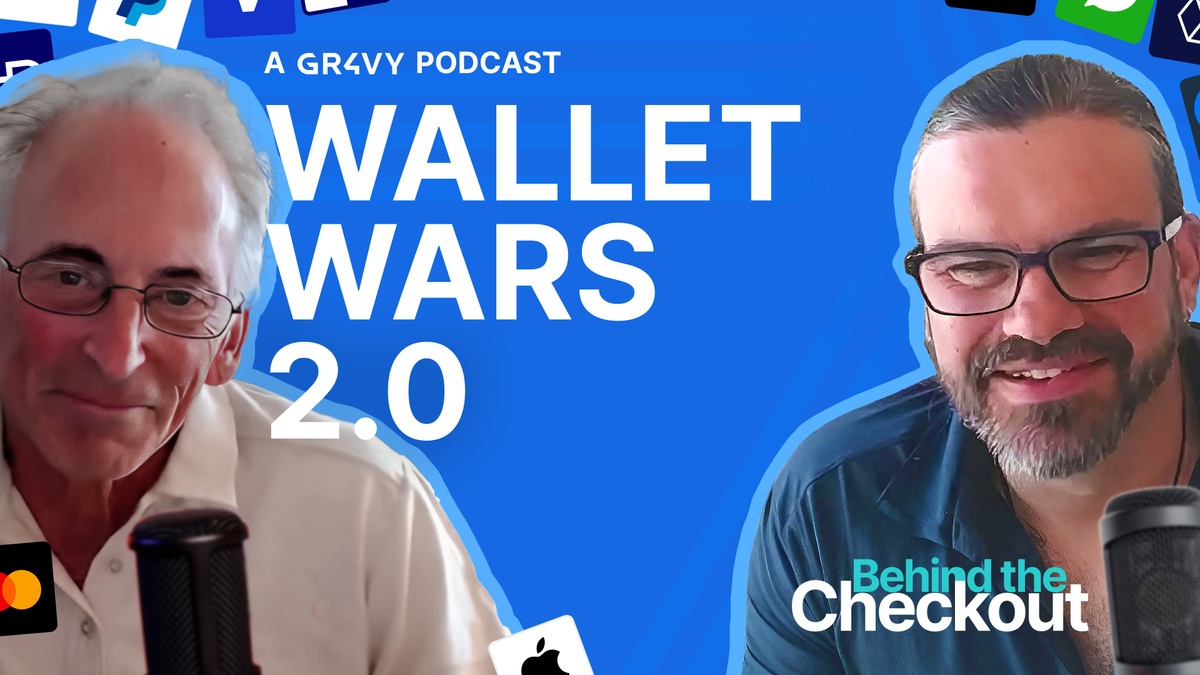

From Apple Pay and Google Pay to Click to Pay and PayPal, a new wave of wallet competition is redefining how we pay, who we trust, and what merchants need to prioritize. On Behind the Checkout, Gr4vy’s podcast, John Lunn, Founder and CEO of Gr4vy, talks to Steve Klebe, a veteran of CyberSource, Google and Stripe, now a board member and advisor to several payments companies, about what’s really driving the wallet wars and what they mean for merchants. The conversation below is lightly edited for clarity.
Key insights from the episode
- Wallet adoption is driven by both consumer preference and checkout placement. Steve Klebe says payment providers now surface and position the most relevant wallets, while many consumers stick with what they already use.
- The wallet wars are about disintermediation, not consumer need. Steve argues consumers already have more than enough choice; the battle is over who owns the customer experience and the data it generates.
- Defaults are taking choice away from consumers. Stored cookies and platform wallets like Link and Shop Pay can push shoppers straight into one option, which John Lunn warns can hand control to a more expensive payment method.
- Click to Pay won’t end the wallet wars. Every player has economic or strategic reasons to keep its own wallet, and Steve believes online-only wallets will struggle without in-store support.
- Consumers care more about convenience than security. In the US, where consumers rarely bear fraud losses, security matters less to them than avoiding typing card numbers.
- Super apps risk getting in the way of payment. Steve wants consumers to be able to opt out of extra offers, and sees wallet loyalty as wishful thinking for most players.
- Agentic wallets are more feature than company. Steve expects strong but convenient identity and authentication to be essential if agents are to shop for consumers.
- The best payment experience is the one you don’t notice. Steve points to Uber, where payment simply disappeared into the ride.
Steve Klebe has decades of experience driving innovation at companies including CyberSource, Google and Stripe, and is now a board member and advisor to several payments companies. He’s known as the Kevin Bacon of payments, because everywhere you go, someone is connected to him.
John Lunn is Founder and CEO of Gr4vy, the cloud-native payment orchestration platform.
What’s driving digital wallet adoption?
John Lunn: Steve, welcome to the show. It’s great to have you here.
Steve Klebe: Thanks, John. It’s a pleasure to be here, as always. This is such an interesting topic. You can’t wake up any morning and open one of the various newsletters or blogs without seeing something; just this morning there was a Click to Pay announcement out of Europe, which I’m sure confuses a lot of people. It’s a thrill to get the chance to talk about it. I was actually looking back, and my first experience with wallets was in 1993, at a company called CyberCash, 32 years ago. We had a wallet, but it was a thick wallet. The consumer had to get a floppy disk, if any of you remember those, and the alternative was downloading it over a 36k baud modem. It took about an hour and a half to install the wallet. Needless to say, that didn’t go anywhere.
John Lunn: One of the earliest ones I remember was the Britney Spears fan club. They were actually one of the first groups to issue an NFC reader: you could tap your Britney Spears fan club card against your USB NFC reader, get into the fan club and buy Britney Spears merchandise.
Steve Klebe: Well, I’m glad to say I missed the whole NFC craze. Or the NFT craze.
John Lunn: Very good. Let’s kick off. What’s really driving the surge in digital wallet adoption? Are we seeing true consumer preference, or just better tech placement at checkout?
Steve Klebe: I’d say a bit of both. Tech companies, whether Gr4vy, Stripe or whoever, have put a fair amount of work into intelligently surfacing the relevant wallets, and literally positioning them so the most appealing ones show up at the top of the list. At the same time, some consumers are set in their ways and have preferences. I have an Android phone, I worked on Google Pay, and my default is Google Pay. I like it because I can use it both at the physical point of sale and online, almost universally. But there’s a lot of competition now for the eyeballs and the clicks, so it’s a moving target and will continue to be for some time.
John Lunn: Is this a UX battle, or is it about what you happen to have in your pocket? Is it just convenience, or are customers actually loyal? You’re loyal to Google, but you worked there and you have a Google phone. PayPal has been around a long time, and it’s still used a lot because people are used to it. What’s driving this?
Steve Klebe: There are probably no simple answers to any of these questions, because for any given segment of the population, the answer will vary. Some of it is sheer inertia. Like you said, PayPal was the poster child for alternative payments, as we used to call them, before the sexier term became digital wallets. They owned the market, especially on desktop, and continued to. When Google Pay, Apple Pay and, to a slightly lesser extent, Samsung Pay came along and the battle pivoted, PayPal lost a bit of its mojo, but of course it’s been working very hard to get some of it back. Then, just as that happens, you have Link from Stripe, Shop Pay from Shopify, and this new thing, Paze, which Early Warning has built on behalf of the large issuing banks. So consumers are being given a plethora of choices.
In the early days of Google Wallet and Google Pay, we’d do deals with merchants to get people to adopt. I don’t see many of those happening today. When Visa and Mastercard were heavy in the wallet game, and I guess they still are with Click to Pay, although I heard recently that it’s pretty much been wound down in the US and is mainly a European play at this point, they’d spend millions of dollars, I’ll say, bribing merchants to do the integration work and feature the wallet. This isn’t a wallet comment, but the recent news was that Visa was going to pay Apple something like a billion dollars just to be the brand for the next generation of the Apple Card.
All the narratives talk about why this is so good for the consumer, but realistically, the consumer already has more than enough choices. This is really a battle about disintermediation: who owns the customer experience, what data can be extracted from the sequence of events, and how that data can be used. This battle is going to rage on long after I stop caring about it. It’s a never-ending quest to be the brand, similar to the whole top-of-wallet discussion.
“The consumer has more than enough choices already. This is really a battle about disintermediation and who owns the customer experience.”
Steve Klebe, payments board member and advisor
Think of the energy that goes into being top of wallet. Apple Pay and Google Pay make it really easy for consumers to switch their top-of-wallet card with one flick of a finger, and the card brands hate that, because they spend so much energy getting people to pick their card in the hope that inertia takes over once they’ve picked it. There’s a lot of money at stake, and whenever there’s a lot of money at stake, there’s going to be endless creativity to try to alter behavior.
Are wallet defaults taking choice away from consumers and merchants?
John Lunn: What’s different this time? I was heavily involved in what I’d call Wallet Wars 1.0: V.me, whatever the Mastercard one was called, PayPal, and then Google and Apple coming in a bit later. That was very much about buying preference on the merchant side. How did you persuade a merchant to put you on their website? The answer was to give them some money; that’s really what it came down to. When merchants ask me today what they should do, I say, first, put your hand out and see who gives you the best money, and after that, consider what your customers actually want, which should probably come first.
What’s very different for me in this version is that customer choice has kind of been taken away. If you go to a Shopify-based website and you’ve used Shop Pay, it instantly kicks you into the Shopify world, and off you go. I think Stripe does something similar, and frankly so does Click to Pay. You can go out of your way to force yourself back to the other options, but we’re all lazy, and we’ll do whatever’s quickest and easiest. That raises an interesting question for merchants: how do you participate? If you’ve added all of them to your website, which one takes over, and how do you control that? Ultimately, you don’t want to give control away to what could be a more expensive payment method.
“You don’t want to be giving control away to what could be a more expensive payment.”
John Lunn, Founder and CEO, Gr4vy
Steve Klebe: I actually had that happen just yesterday. I got an electronic invoice by text from my dentist, clicked through, and they were using Stripe, which I knew, though I don’t think most people would have noticed. Because I’ve used Link before and the cookie was on my phone, it just defaulted to Link. I didn’t even bother looking to see if there was another option, though I’m sure there was. Not so long ago, the very first option was to start filling out a checkout form. That’s where Chrome, Safari and Edge Autofill tried to intervene, but those experiences were never great; they never quite filled out the whole form. Usually, just below that, there’d be an array of icons to choose from.
When I was at Google, one of the things I did was work with companies like Stripe and Adyen to make Google Pay a default, so merchants didn’t have to opt in. They could opt out, but they didn’t have to opt in, and if the consumer was on an Android phone, Google Pay was not only automatically present, it became the primary option. Now that Stripe is pushing Link, Google Pay is still there, but it has taken on lesser stature. That just shows how important this is to everyone: Visa, Mastercard, Discover, the big card issuers, you name it, and PayPal. PayPal is obviously trying to compete too; I can’t remember the brand name for that experience, but you probably know it. That’s their attempt to compete with how natural and embedded the Apple Pay and Google Pay experiences are.
The experience I had with Link yesterday was interesting. Some of this is biased by my work experience and having been at this for 32 years, but I still would have preferred to just use Google Pay, because I had to wait. It didn’t take more than a nanosecond, but I had to wait for an OTP to arrive on my phone and then type it in manually; I don’t know if OTP autofill was there. The other big thing happening, which I think you’re going to get to later, is the whole passkey experience, which potentially has implications here as well.
Will Click to Pay kill the other wallets?
John Lunn: Let’s move on to that, particularly in the context of Click to Pay. Many people in the US won’t really know what Click to Pay is, but outside the US it’s getting huge traction, first in Australia, which was its launch market, and now in Europe. It’s becoming a new way to pay outside North America. From past experience, the US eventually bends after many years of resistance.
For those in the audience who don’t know, Click to Pay is a standard developed by the main card companies, and the real aim is to get rid of guest checkout. When you reach a checkout page, it recognizes you, and instead of asking you to type in your card number and expiry date, it shows you the last four or six digits of your cards, whether Amex, Visa or Mastercard. Then a passkey already installed on your device completes the payment. There’s no typing, it runs on your existing acquiring fees and deals, and it processes the payment completely seamlessly. So it’s not really a wallet, because no money is stored anywhere, but it’s an improved checkout experience running on the native rails. Compared with other wallets sitting on the same rails, you’d presume it makes sense economically, because there’s no extra party involved. Doesn’t this eventually kill the other wallets?
Steve Klebe: I think there’s so much motivation, whether direct economic motivation or ego, that people are never going to give up trying to carve out a portion of this market for themselves. If you’re Stripe, you want a lot of people using Link, because that helps you convince merchants to choose Stripe as their PSP, and that’s far more important to them than a lot of other things on their priority list. And if you’re Visa or Mastercard and someone uses Click to Pay instead of Apple Pay, the 15 basis points that get shaved off and sent to Apple don’t go there. Same with Link. Those 15 basis points have added up to some real money for our friends at Apple. Side note: Google never got to participate in that arrangement, so it doesn’t get anything, though of course everyone would say Google is using the data, so it’s getting something out of it.
A key point for me, and I try to remove myself and think about the general population, is wallets that are strictly online and don’t also support in-store. With enough promotion, forced placement and positioning, they can all get some traction. But I think these new wallets would struggle big time, not only to get ubiquitous acceptance even online, but to operate efficiently in store. The hill you have to climb to work in an NFC environment is extremely high and expensive. So I’m a big fan of the omnichannel experience, and some of these other wallets will carve out niches here and there.
During my time at Stripe, I was amazed. I personally wasn’t a big Link fan, but I knew that, just like Shop Pay, by the sheer mass of merchants on their platforms, they’d get some adoption, because at the end of the day the average consumer just doesn’t care. The only thing they care about is not having to type in their credit card number. Most consumers might say they care about security, but they care much more about convenience than security.
“They might say they care about security, but they care much more about convenience than they care about security.”
Steve Klebe, payments board member and advisor
Are wallets still more secure, or is that just a shiny wrapper?
John Lunn: I was going to bring that up next. The big selling point in the early days of PayPal was that it was more secure: it kept your details safe and didn’t share anything with people outside the environment. Where your data is and how safe it is: is that still true, or is this just wrapping risk in a different, shiny wrapper?
Steve Klebe: We know from all the effort that goes into PCI compliance and the like that the industry really cares about preventing fraud, and in the age of AI, the crooks are getting smarter and smarter, so these things really matter. Some consumers care about it. Again, the phenomenon in the US is different from outside the US. Here, the consumer has virtually no direct exposure, other than maybe being inconvenienced if their card number is stolen; they don’t typically take any losses. Whereas in many places in Europe, if you allow your card to be compromised, you’ll actually eat the loss. So it matters a lot more there, and that’s one reason the predecessor to Click to Pay got more traction in places like Australia and Europe, because people have more responsibility than they do here. As long as there are these 100% security guarantees, the average consumer doesn’t think about it much.
Personally, in the early days of the internet, if I was shopping at Macy’s, I’d just type my number in. But if I searched Google for something obscure, say a Statue of Liberty figurine from some random website, I’d use PayPal, because, as a standard consumer and knowing what I knew about what was going on in the industry, I felt much more confident using PayPal. The rhetoric and narratives continue to harp on that issue, but how much of it has sunk in, and how many consumers actually care? If you’ve had your card stolen, which plenty of people have, even if you didn’t take a hard loss, you’ve been inconvenienced by having it reissued, especially in this age of subscriptions. It’s a royal pain to change your card on file across 15 merchants. So I think it matters. But everyone in the space proclaims their system is secure, and whether one is slightly more secure because it uses full biometric authentication and provisioning, like Apple Pay and Google Pay, versus another, I’m not sure how many consumers can truly distinguish the nuances between those approaches.
Do wallets need to become super apps?
John Lunn: There’s a cost behind these things, a cost per transaction, and at least a perception in some places that PayPal, for example, is more expensive than going direct. Sometimes that’s true, sometimes not. But it’s becoming quite hard to differentiate between wallets, so we’re seeing wallets add more and more functionality. If you’ve logged into your PayPal account recently, it feels more like a Yahoo advertising platform than a wallet, full of adverts, promotions, vouchers and coupons. And PayPal and others are starting to add stablecoins or crypto to the wallet, as some of the recent Stripe announcements show. Do wallets have to change? Do they have to become super apps? They look jealously at the super apps in China. Is that happening, or is that where you think it’s heading?
Steve Klebe: I think it’s kind of happening, with different approaches. The question is whether that will actually be the winning strategy. I was also thinking about BNPL and how it’s being woven into the wallet experience, whether at Google, Apple, Stripe and so on. I’m a big believer in simplicity. PayPal, for example, has been through multiple phases of this. About a decade ago, they created an entire restaurant system featuring restaurants with 5% off deals and so on. Honestly, all it did for me was get in the way. I’d already decided what I wanted to buy; I just wanted to check out and get back to my life, and they were putting all this other stuff in my way.
So I think there’s a catch-22 with the concept of a super app. You should be allowed to opt in to those experiences, or at least be given the opportunity to opt out. One of my favorite sayings is that opting in is the killer of all good ideas, and by the way, you can quote me on that any time you want. But I do think people should be given the option of opting out. I don’t know how many would consciously opt out, and some people might really like having all these choices, benefits and promotions coming at them. We live in a very big, complicated, diverse world, and I don’t think there’s one answer.
“One of my favorite sayings is opting in is the killer of all good ideas.”
Steve Klebe, payments board member and advisor
To your point about what seems to have worked very well in Asia, those wallets are really like social networks. The wallet functionality was just one of the reasons to have the app on your device, and in many cases it became secondary. And if you look at why Google has spent tens, maybe over the years hundreds, of millions of dollars investing in Google Pay in all its iterations: most people pay for things once, twice, three or five times a day. It’s part of your everyday life, and Google has a motivation to be part of your everyday life. As long as companies like Apple and Google have their various vested reasons to keep engaging, many other wallets will keep picking at whatever segment they think they can. But loyalty to wallets, I think, is wishful thinking for most players.
“Loyalty to wallets, I think, is wishful thinking for most players.”
Steve Klebe, payments board member and advisor
John Lunn: Presumably that’s Elon’s plan with X and turning it into a bank. He has the social network, so maybe that’s the plan.
Steve Klebe: That’s another example. I won’t get into the politics, but by the sheer mass of X’s traffic, some people won’t give it a second thought and might use whatever X comes up with for its wallet. Look at Venmo’s history. They’re trying to monetize it a bit now: if you want a transfer to be immediate, you have to pay, but if you’re willing to let it go second day, you don’t. They’re also driving some merchant acceptance. But for years and years, it was a completely free service, because they knew that’s what it would take to build an audience, and that there would eventually be value in that audience. And one of the feathers in PayPal’s cap is that Venmo is built into its Braintree PSP offering, or whatever it’s called now.
As you know, the payments industry, from both the consumer and the service provider perspective, is so fragmented and so competitive, but also so massive, that people can carve out little pieces. At Google, we would always have wanted more, but in some mobile-first apps we had around 30% share of wallet, while on desktop we struggled to get 1%, because PayPal still had the mojo on desktop. That wasn’t as important to us, because thinking about the future, we mostly cared about people living their lives on their mobile phones; desktop was less of a priority. That’s why, like I said earlier, you wake up every morning to someone announcing a new wallet, and I don’t think that’s going to change anytime soon.
The future of wallets: agentic, identity and invisibility
John Lunn: That brings us to the last question: the future of wallets. I’ve been spending a lot of time on agentic commerce over the last couple of weeks, and we have a separate podcast on that coming. One trend is that I’ve seen three companies recently create agentic wallets, which feels a bit like PayPal 1.0 for agentic commerce, around convenience and keeping a firewall between agents and the rest. So maybe that’s one space where wallets are making a comeback. What is the future of wallets? Is it biometrics, AI and agentic, loyalty, or something completely different?
Steve Klebe: Not to sound too boring, but I think it’s all of the above. As an angel investor, I wouldn’t invest in a company bringing an agentic wallet to market, because I think it’s more of a feature than a company. But of course people are going to try, so the battle will rage on. Everything you just mentioned, stronger authentication balanced with even more convenience, is key. I don’t believe the super app concept will take over the world. And the other thing that always comes to mind is the different segments of the population, how long it takes to get anything to critical mass, and how much it costs to get broad acceptance. I know personally, because I built the program at Google to get over 200 PSPs globally to accept Google Pay. Every single one was a negotiation and a technical integration, and not many companies can afford that kind of effort.
“I wouldn’t invest in a company that was bringing an agentic wallet to market, because I think it’s more of a feature than a company.”
Steve Klebe, payments board member and advisor
You mentioned biometrics, but the other thing happening is identity in general, and that ties into agentic. Without extremely secure yet convenient consumer authentication built seamlessly into these things, we could end up with a real disaster on our hands. And I know my demographic won’t be the target audience for letting a bot go shopping and complete the transaction. Just as there was around crypto 10 years ago, there’ll be a craze. Right now every company launching has AI in its name, and the next phase is everyone having the word agentic in their name, and we’ll see whether it sticks.
These are all tools that will ultimately have some impact, but if they’re effective, they’ll have to blend into the background. I think we were all in awe when Uber launched, compared with the taxi experience. One of the most profound reasons I started taking Ubers, aside from how easy it was to get a ride from wherever I was in the city, was the payment experience: it was simply embedded, compared with what you go through in a taxi. So the more we can make these things disappear, which is always the biggest challenge, the better. The best UIs are the ones you don’t notice. That’s somewhat challenging for startups trying to convince the world they’re bringing something truly different, because “you won’t even notice we’re there” isn’t usually in the pitch to raise money.
“The best UI are the ones you don’t notice.”
Steve Klebe, payments board member and advisor
John Lunn: I had firsthand experience of that the other day, when I was in Barcelona for MRC and the country lost all its power. Uber doesn’t work anymore, by the way, without internet. Anyway, Steve, I really appreciate your time. Your insights, as usual, are highly valuable. You’ll see Steve everywhere you go in payments, and you probably know someone who knows Steve. Thanks again, Steve.
Steve Klebe: Take care, John. Good seeing you, as always.
Explore more from Behind the Checkout
Watch more conversations with payments leaders in the Behind the Checkout series. To see how a payment orchestration platform lets merchants offer every major wallet while keeping control over which ones appear and in what order, talk to the Gr4vy team.