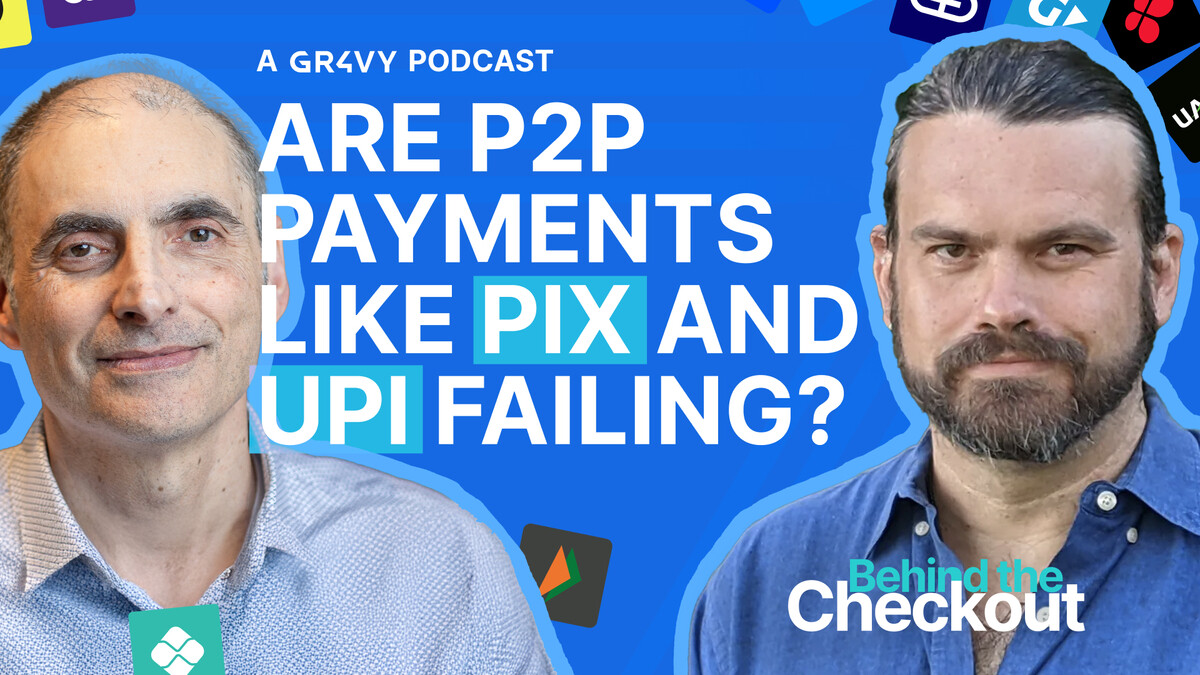

From Pix in Brazil to UPI in India, there has been massive excitement around instant bank transfers and real-time rails. But are we seeing the impact, or is it still early promise? On Behind the Checkout, Gr4vy’s podcast, John Lunn, Founder and CEO of Gr4vy, asks Daniel Kornitzer of EBANX whether real-time payments are solving real problems, or whether the industry is mistaking scale for success. The conversation below is lightly edited for clarity.
Key insights from the episode
- Pix and UPI solved genuine financial inclusion problems. Daniel Kornitzer says 91% of adults in Brazil use Pix, and that in India only about 15 million of 60 million merchants can be served profitably by card networks.
- Adoption comes from relevance, not lack of choice. Daniel describes rapid growth as the meeting of merchant acceptance and consumer preference, and cites EBANX data showing merchants in Brazil gain 16% in revenue and 25% in customer base by adding Pix.
- Real-time rails and cards grow together. In Brazil, Pix is forecast to grow 35% and cards 21% over the next two to three years, as a growing middle class moves from physical to digital payments.
- Regulators work best as catalysts alongside industry. Daniel points to India’s UPI and Brazil’s collaborative governance model as examples, with Colombia’s Bre-B and Europe’s SEPA Instant following.
- Account-to-account needs consumer incentives in card-heavy markets. Interest-free periods, chargeback rights and rewards give consumers reasons to prefer cards, and Daniel estimates the real cost of the card schemes at 20 to 25 basis points rather than 2.5%.
- No payment method is immune to fraud. Push payments where the consumer logs in tend to be secure, but social engineering remains hard to stop, and smaller US banks’ fear of real-time risk is slowing RTP and FedNow adoption.
- Real-time rails will eventually replace ACH, not cards. Daniel expects pay-ins through request for payment to follow payouts, while card use continues to grow.
- Interoperability will come piece by piece. UPI already connects with several countries, including Singapore’s PayNow, and Daniel expects integration rather than replacement across rails, stablecoins and cards.
Daniel Kornitzer is head of global partnerships at EBANX and has been at the forefront of global payment innovation, including running e-wallets earlier in his career.
John Lunn is Founder and CEO of Gr4vy, the cloud-native payment orchestration platform.
Have Pix and UPI lived up to the hype?
John Lunn: Daniel, good to have you here. Let’s get straight into it. Real-time payments such as Pix, UPI and others have been hailed as game changers, but are they really solving real problems, or are we just mistaking scale for success?
Daniel Kornitzer: First of all, great to be here, John. It’s a pleasure and a privilege to be on this fireside chat. I believe real-time payments in Brazil and India have solved genuine financial inclusion challenges. They’ve addressed long-standing gaps by providing essentially instant, secure, low-cost payments, and I think that’s the reason behind the explosive growth. In Brazil, 91% of adults use Pix. More broadly, real-time payments create a pathway into the economy for millions, if not hundreds of millions, of consumers. So I think they’ve proven their worth.
John Lunn: Maybe we should rewind a little; I dove into the deep question too soon. Perhaps we should explain to the audience what Pix and UPI are, and why they were needed.
Daniel Kornitzer: Let’s start with UPI, which came earlier. It was developed by the regulator in conjunction with the industry, addressing the needs of a country that at the time was pretty much dominated by cash payments: India. There’s an even broader picture there, the so-called India Stack. It started with Aadhaar, the biometric platform, which serves multiple purposes, from voter registration to KYC for bank account opening: a broad biometric system for 1.4 billion people. Couple that with a product like UPI, developed jointly by the regulator and the industry to provide real-time, super low-cost, secure payments, push and pull, available everywhere, and it transformed the country’s payments and created massive adoption.
The last time I was in India, I saw a beggar with a QR code. Instead of putting 10 or 20 rupees into a cup, you could push the money directly to that person. And let’s not forget that India has 60 million merchants, of which only 25%, or 15 million, can be served profitably by Visa and Mastercard. The other merchants are too small and probably can’t afford a terminal. Having a payment method that allows digital payments without a high barrier to entry is a game changer.
“In India, there is 60 million merchants of which only 25% or 15 million can be served profitably by Visa MasterCard.”
Daniel Kornitzer, head of global partnerships, EBANX
Brazil is the same. It’s been five years since Pix launched, and it transformed the country by replacing mostly cash and boleto payments, which were antiquated and cumbersome, with something that lets the average consumer buy in real time, efficiently and securely.
Is Pix and UPI adoption about choice or necessity?
John Lunn: Let me dig into that: efficient and secure. Adoption is huge, 91% as you said. But is that because there’s no choice? Is the experience really that great, or is it just that it’s all there is if you don’t have a credit card?
Daniel Kornitzer: I look at it differently. I think the key word is relevance. These payment methods are very relevant to consumers and merchants, and ultimately the consumer does have a choice: they could still pay by cash, boleto or other means. Back when I was running e-wallets, I always used to say the key is the confluence of merchant acceptance and consumer preference. When merchants offer a certain payment method and consumers prefer it, for whatever reason, you’ve got dynamite, because then you get rapid expansion.
“The key is the combination or the confluence of merchant acceptance and consumer preference.”
Daniel Kornitzer, head of global partnerships, EBANX
What’s changed in these countries is that having Pix and UPI as options has led to massive adoption, because they fill a gap, solve a problem, and reduce people’s time and cost. It’s not just consumers who benefit from a real-time payment. Our stats show that merchants in Brazil see a 16% increase in revenue by adding Pix to the mix, and a 25% growth in their customer base. At the end of the day, it’s not a zero-sum equation. Cards and local payment methods coexist and almost feed into each other, creating more innovation. In Brazil, for example, Pix is forecast to grow by 35% in the next two to three years, but cards are also expected to grow by 21%. So both are growing.
We have a combination of two things: countries where the middle class and disposable income are growing, coupled with a shift from physical to digital. The two combined create a perfect environment for growth, because you’ve got two things compounding. That’s why you see such tremendous growth.
“Cards and local payment methods coexist and actually almost feed into each other, creating more innovation.”
Daniel Kornitzer, head of global partnerships, EBANX
Are regulators pushing real-time payments too hard, too fast?
John Lunn: That’s Brazil and India, and I think the rest of the world looks a bit jealously at the systems built there. The regulator definitely helped in India. To be polite, it definitely biased merchants and consumers toward that payment method and made it very hard for others to rise. Relatively recently in the European Union, the commissioner said they want a Pix or UPI for Europe, mainly as a defensive move. The concern there is that Visa, Mastercard, Amex and PayPal are all American-run companies, and the mood in Europe at the moment is that it needs more sovereignty and its own payment systems. So are regulators pushing too hard, too fast? Are they trying to force real-time payments where there isn’t necessarily consumer demand or need? Are markets ready for it? Let’s start there, and then we can talk about the US and other developed markets.
Daniel Kornitzer: It’s a great question. My view has always been that regulators have a twofold responsibility. On one hand, they’re gatekeepers protecting the financial stability of their home financial systems. But they also have a second, equally important mandate: to foster innovation, so that consumers and businesses get access to competitive, great services, hopefully at lower cost, creating value for consumers, businesses and the country as a whole. For example, there’s a McKinsey study showing that countries implementing open data can expect up to a 5% bump in GDP. That’s not insignificant. So I see regulators as catalysts, in a way. The proactive ones foster that innovation and show leadership.
They also don’t need to act on their own; there’s room for collaboration with the industry. In India, as we discussed, the regulator developed UPI with the industry. Brazil also has a very collaborative governance model, led by the central bank, which leads to adoption, great services and trust in general. That’s why Brazil has 175 million Pix users moving half a trillion US dollars a month, which is very significant. The stats in India are also mind-boggling. Colombia is coming out with Bre-B, a Pix-like system, while Europe has SEPA Instant. So I understand the push to make real-time, very cost-effective systems available.
But it’s not about favoring one method over another. I always say our role is not to be prescriptive and tell people to use this or that. It’s to make available all the methods relevant to consumers in a given geography, and then let consumers choose what works for them. It’s their prerogative. Our job is to put those tools at their disposal and let the market go where it wants to go.
“Our role is not to be prescriptive… It’s to make available all the methods that are relevant to a consumer in a given geography.”
Daniel Kornitzer, head of global partnerships, EBANX
Why account-to-account payments struggle in Europe and North America
John Lunn: I think Europe in particular is having a moment when it comes to bank-to-bank and peer-to-peer payments. With the release of the open banking spec years back, we saw the rise of a number of bank-to-bank payment companies, and recently we’ve seen a number of them shrink. Some have failed, gone out of business or moved into different models. I think the biggest challenge for those companies has been consumer adoption. From a merchant perspective, everyone would love a payment method with no interchange, a few cents per transaction and no risk, and there’s a lot of excitement in the merchant community. But consumers in those markets have no real incentive to use bank-to-bank payments, and not even over credit cards so much as over the likes of Apple Pay, Google Pay and PayPal. There isn’t an obvious reason to go out of your way to use an open banking payment over something quick and simple like Apple Pay. So is it going to die? Are we done? Or will it move into particular businesses, like billing, or sadly even gaming?
Daniel Kornitzer: No. First of all, in India and Brazil these systems started as person-to-person and evolved over time into person-to-business. In Brazil, the stat is that 42% of Pix payments go to a business. If you include business-to-business, it’s higher, maybe 60%, but person-to-business is something like 42%. Once people become familiar with a method, going from P2P to P2B is a natural evolution.
In Europe and North America, and you brought up open banking, which I’m a fan of, I do agree that there has to be something in it for consumers to adopt these payment methods. Let’s not forget, when I use my card, and I’m based in Canada, I get a month of free interest. Two, I get chargeback rights: if something doesn’t pan out, I call my issuer and say, please reverse this transaction, I never got the shoes. And third, I get quite interesting loyalty rewards or cashback, which are not insignificant. So even though I may have money sitting in my account, what’s my motivation for using an account-to-account payment when I have so many goodies coming to me from using credit cards? Depending on the region, there will have to be appropriate incentives to encourage consumers to use the technology, and I think it will happen, provided those are put in place.
“What’s my motivation for using an account to account payment when I have so many goodies coming to me from the use of credit cards?”
Daniel Kornitzer, head of global partnerships, EBANX
John Lunn: If you’re a credit card company with nice chunky margins from interchange and everything else, you can afford to give benefits. Maybe one of the problems is that bank-to-bank or peer-to-peer payments have all along been based on the dream of virtually free payments, and with UPI they are free. When they’re virtually free, there’s no marketing budget anymore. How does that get solved?
Daniel Kornitzer: If I may, John, I’d like to debunk the notion that credit cards are as expensive as they appear on the surface. Let’s not forget that interchange gets translated into consumer goodies one way or another. If we look at the actual cost of the card schemes, it’s probably in the order of 20 to 25 basis points. It’s not zero, and it’s more expensive than the local rails, but we’re not comparing 2.5% to 20 basis points. The real cost of the scheme is maybe 20 to 25 basis points, and that includes things like guaranteed settlement, ubiquity, dispute resolution and chargeback rights. So there is value there, significant value. The comparison has to be apples to apples.
Ultimately, I love an environment where consumers have a choice and can pay with a credit card, a debit card, an e-wallet or account to account. There’s nothing wrong with that, because people may have their reasons for preferring one payment method. With a credit card, they obviously get access to credit, or they may even try BNPL. In other cases, if they have the money sitting in their account, they can use account to account. I’m a firm believer in consumer choice.
John Lunn: The European experience so far, and this could change, has been that consumers aren’t necessarily choosing this as the way they want to buy goods and services. They’re using it for large payments, payments they perhaps don’t want on credit, like bill payments, or, unfortunately in some cases, payments they don’t want appearing on their credit card statements.
How risky are bank-to-bank payments?
John Lunn: Let’s talk about fraud and risk. The MRC’s risk and fraud survey this year had bank-to-bank payments as the number two area of fraud and risk that merchants were most worried about, across most of the world. The idea that bank-to-bank payments are chargeback-free isn’t necessarily the whole story. The UK has reacted by trying to put some of that responsibility back on the banks, but the fraudsters aren’t going anywhere; they will find a way. How real is the fraud risk, and is resolving it a major part of getting merchants to adopt faster?
Daniel Kornitzer: For those of us who have been in payments a long time, I used to say there are more types of fraud than flavors in an ice cream parlor, and we all have scars from the types of fraud we’ve seen in our fintech lives. No payment method is immune to fraud; that’s a reality. That said, if I take the example of Pix, I think it’s one of the safest and most reliable payment methods in the world. Some areas of fraud, like social engineering, are very hard to combat, because someone may convince an unsuspecting consumer to write a check to a fraudster, if you’re in the States, or share their password. It’s so hard to counter those kinds of fraud attempts. But I do believe these methods, especially push methods where the consumer has to log in or provide their credentials and then push the funds, tend to be secure.
“There is more types of fraud than flavors of ice cream in an ice cream parlor.”
Daniel Kornitzer, head of global partnerships, EBANX
But it’s an arms race that never ends. We build taller walls, and they build taller ladders to climb over them. The issue is that we’re not just dealing with hackers in their basements trying to impress their friends. We’re dealing with rogue nations, organized crime and groups like Anonymous, a variety of threats that, by the way, have the means to use the same technologies the good guys use, AI and all of that. So I don’t expect this to be over. It’s a cat-and-mouse game where we always have to be vigilant. At EBANX, of course, we use machine learning and AI, as well as local anti-fraud signals, to curtail this issue.
John Lunn: In the early days of PayPal, fraud nearly killed PayPal. We had a weekend to fix it, or there would be no PayPal today. Fraudsters will generally find the easiest route to steal the money, and if one route is easier than another, that’s the way they’ll go. In my head, it’s a bit undecided at the moment, because there’s no chargeback mechanism. As a consumer, if you send money to someone, it’s assumed to be your own fault; you shouldn’t have sent it. That’s the same as cash, and sort of the same as checks, though with a check you can probably get it stopped within a few days. Perhaps that’s one reason consumers are hesitating, or perhaps they just don’t understand it right now.
Why smaller US banks are slowing real-time payments, and what replaces ACH
Daniel Kornitzer: Absolutely. You see that, for example, in the market penetration of RTP and FedNow in the US. The 5,000-plus US banks, especially the smaller ones, are used to having 48 business hours to turn down a check, return it for non-sufficient funds, or refuse to honor it for a variety of reasons. In a real-time scenario, they have seconds to make that decision, and many of the smaller ones don’t feel capable of doing that safely. That fear is slowing down adoption. The big banks have the means and the strong tools, processes and people to manage it, but it’s definitely slowing adoption in the US.
John Lunn: I always like to try to predict the future a little on this podcast. Do you see RTP or FedNow becoming a consumer payment option at retail checkout, or are we way past that? Do you see consumers switching?
Daniel Kornitzer: Think about this: ACH was built around 60 years ago. As a former member of a national risk management task force, I love ACH, but the time has come for it to evolve to RTP and FedNow, and I do believe those systems will eventually take over. On the money-out side, it’s an obvious choice: if you’re an insurance company paying claims, a title company, doing remittances, or in any environment doing payouts, that capability is by and large available today. The one that has to move forward is the money in. With things like request for payment, it will be easier for consumers to pay in real time. Say you’re paying a bill that’s due today. You don’t want a penalty for paying late, so if the payment can be sent in real time rather than by e-check or ACH credit, which can take two or three business days to land, you make sure it arrives on time. It also removes the risk of NSF, because if the payment is pushed by the consumer, it can’t be turned down for lack of funds. So I believe it will eventually replace ACH, within a certain timeframe.
John Lunn: But not Visa and Mastercard at checkout?
Daniel Kornitzer: No. If you look at the examples we discussed, India and Brazil, most of the replacement has been of cash and things like boleto. Cards are still growing. It’s replacing the non-digitized economy.
Will domestic real-time payment systems ever work across borders?
John Lunn: In future, we’ll have UPI in India, Pix in Brazil, whatever Europe comes up with, which will probably be seven different things, the UK’s own system, and the US with two different things. But they’re all domestic schemes at the moment. The other day, a friend of mine went to India, got in a taxi and wanted to pay, but the driver only accepted cash or an Indian payment method, not Visa or Mastercard. Is there any future where these systems can talk to each other and be interoperable? If you’re a UPI user in India and you go to Brazil on holiday, will you be able to use UPI on top of the Pix rails? Do you see that coming together?
Daniel Kornitzer: That’s a great question. Let’s face it, these methods were put in place as local rails, and they work extremely well in their own jurisdictions. But take UPI: over the years, it has connected to Nepal and to PayNow in Singapore, and through Project Nexus to multiple countries in Southeast Asia. There are similar initiatives around cross-border connectivity of payment methods. Cross-border payments are a little more complicated and may have slightly different AML requirements, but yes, I see growing interoperability of the rails, particularly where some of these systems inspire other countries’ systems. They’re almost by definition quite similar, and if they use similar standards like ISO 20022, I think the plan is there for them to eventually interconnect. It’s going to happen over time.
From our perspective, EBANX will make use of interoperability as it becomes available, the same way we jump on new features the methods launch. For example, about two weeks ago Brazil launched Pix Automático, for subscription and recurring payments, and India already has UPI AutoPay, which is great for streaming platforms, SaaS and AI platforms, or anyone collecting recurring payments. As they come up with new features, we’re very keen to be first out of the gate, and it will be the same with interoperability. But it will take time, because cross-border payments are inherently different from domestic ones. It won’t happen all at once; it will happen piecewise, because it requires two jurisdictions to agree on the terms of engagement for interoperability. But we do see it happening.
“It will happen kind of piecewise because it requires the two jurisdictions to come to terms and agree on the terms of engagement for interoperability.”
Daniel Kornitzer, head of global partnerships, EBANX
Integration, not replacement: real-time payments in five years
John Lunn: We try to take out the crystal ball toward the end of this podcast. Where are we in five years? Is every website going to offer bank-to-bank payments, whether through the local scheme or a unified, interoperable one? Is it 30% of checkout?
Daniel Kornitzer: That’s a tough question, and your crystal ball is probably better than mine. It’s always hard to predict. There’s open banking, and we haven’t even talked about stablecoins; there are all kinds of interesting things happening that are great tools and solve problems. We talked about interoperability of local rails. I see a path where it’s more integration than replacement. In other words, I see things coming together into a set of tools that a company, a PSP or a merchant can use to put a full set of options in place for their consumers.
I don’t see one taking over and replacing another, the same way we said account-to-account payments and cards aren’t a zero-sum game: both are growing, because the pie is growing. Maybe Pix is growing at 35% and cards at 21%, but both are growing nicely, and I see the same happening with a confluence of different technologies. Maybe stablecoins are better suited to cross-border, because there’s more complexity there. But I don’t see Pix and UPI being replaced, because they do the job magnificently. They have scale and super low costs, so why fix a problem that isn’t actually a problem? My prediction is integration rather than replacement among all these technologies coming together.
“I guess my prediction is integration as opposed to replacement between all these confluence of technologies coming together.”
Daniel Kornitzer, head of global partnerships, EBANX
John Lunn: There’s only a certain amount of cake, though. We’re not going to make a bigger cake, so I guess we’ll see.
Daniel Kornitzer: But the cake is growing. In emerging markets, there are going to be 700 million more consumers in the next nine years, and you have the tailwinds of the shift from physical to digital. So the pie is going to be significantly bigger. You’re right that in the end it all adds up to the total, but that total is growing massively, so there’s room for different things to grow in an industry experiencing rapid growth.
John Lunn: I really appreciate your time today, Daniel. Thank you for coming on and sharing your expertise.
Daniel Kornitzer: Thank you, John. It’s been a pleasure.
Explore more from Behind the Checkout
Watch more conversations with payments leaders in the Behind the Checkout series. To see how a payment orchestration platform lets merchants offer Pix, UPI and other local payment methods alongside cards through a single integration, talk to the Gr4vy team.