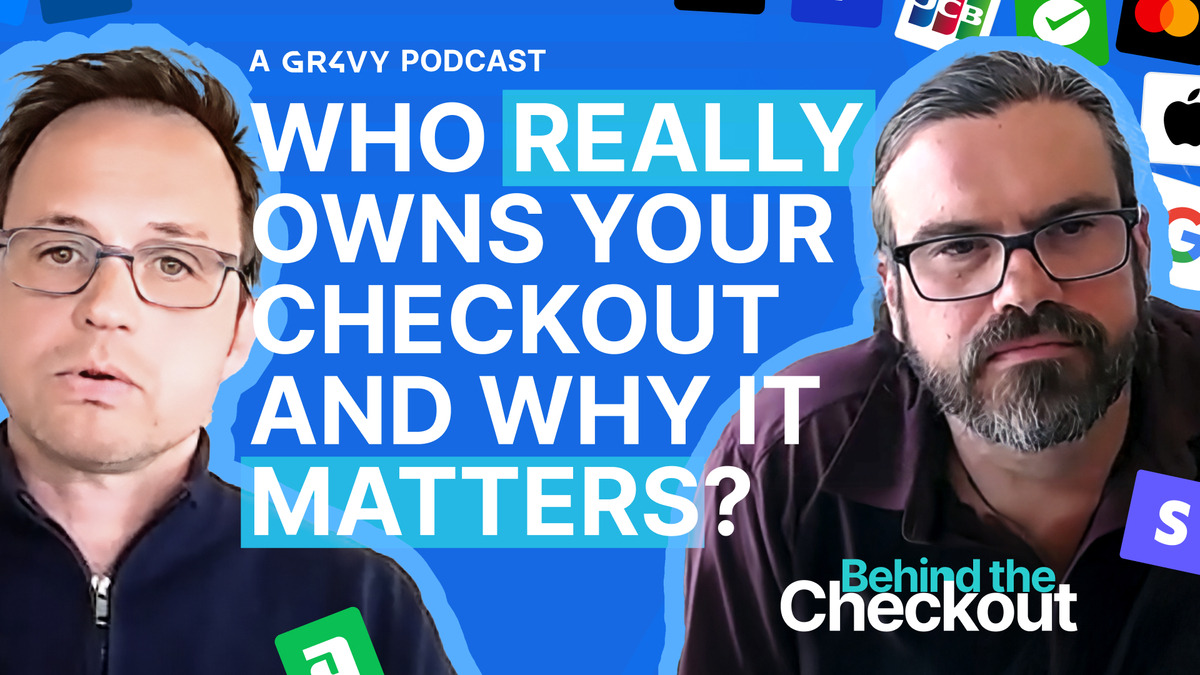

As brands, platforms and payment providers compete for the final, critical interaction, the last click, new strategies and tensions are emerging, with real implications for revenue and user experience. On Behind the Checkout, Gr4vy’s podcast, John Lunn, Founder and CEO of Gr4vy, asks Marko Medenica, an expert in global payments and fintech strategy who has held leadership roles at Google and Grammarly, who should own the checkout and how that answer has changed. The conversation below is lightly edited for clarity.
Key insights from the episode
- Ideally, the merchant should own the checkout. Marko Medenica describes it as a sensitive moment in the purchase journey, essentially a contract the customer enters, and so part of the merchant’s offering.
- Whether to own it depends on two things: how core payments are to the business, and its size. For smaller merchants where payments aren’t core, outsourcing can make sense, as a build-versus-buy decision made with an eye on future tech debt.
- Outsourcing no longer has to mean lock-in. Marko has seen billion-dollar businesses run by one or two payments people who orchestrate providers for vaulting, processing, data and chargebacks while keeping strategic freedom.
- Relying on a single provider is a strategic risk. If the provider is acquired, drops you after a fraud spike, or doesn’t expand to your next market, you have no fallback, which Marko calls a strategic rather than technical failover problem.
- Bringing checkout in-house can be done piece by piece. Merchants can use a third-party vault and hosted fields, control the experience, and orchestrate across PSPs without taking on full PCI scope.
- Merchants underestimate change, global differences and data needs. The optimal setup can shift within months, payments differ culturally and regulatorily by country, and very few merchants have enough data alone to optimize at meaningful granularity.
- Wallets competing for pre-checkout bring speed at the cost of data and control. Marko advises an intentional decision about which to support, with a plan to revisit it as the business grows.
- Traditional checkout will persist alongside agentic commerce. Marko expects payments to add channels, not remove them, over the next five years.
Marko Medenica is an expert in global payments and fintech strategy who has held leadership roles at Google and, most recently, Grammarly.
John Lunn is Founder and CEO of Gr4vy, the cloud-native payment orchestration platform.
Who should own the checkout?
John Lunn: Marko, it’s great to have you here.
Marko Medenica: Thank you for having me, John.
John Lunn: Let’s kick it off with the big question. Who should own the checkout, and how has that answer changed over the last decade?
Marko Medenica: Key question. I’d love to take 30 seconds to level-set on what I mean by checkout, at least for this opinion. I’ve seen that it varies between companies, and even within companies people think of different things when they think of the checkout experience. Think of the journey of checking out for a simple item sale. The merchant needs to decide what they’re selling: which item or bundle, to whom, only to new users or existing ones, with what pricing model, whether it’s a subscription, one-time or usage-based, at what price point, whether it’s discounted, in what currency. That tends to sit within checkout flows, but I think of it as billing or commerce tools rather than payments. Once you know what you’re selling and to whom, that’s where payments come in: which payment methods are we offering, how are we storing and updating the data associated with them, and how do we process the actual payment collection or disbursement? That’s what I mean by checkout, at least for this conversation. Would you generally agree with that, John?
John Lunn: I think so. Going back 10 years or so, you had shopping cart companies that you essentially threw things over to, and they dealt with the entire shopping cart and checkout experience. Checkout for me now is the last bit: basically the way you do the payment, not the rest of it.
Marko Medenica: Great, so we’re on the same page. To answer your question, I believe that ideally the merchant should have control of that process, because it’s a sensitive moment in a purchaser’s journey. It’s essentially a contract you’re entering, and therefore it’s part of your offering to your audience.
“Ideally the merchant should have the control of that process because it is a sensitive experience in a purchaser’s journey. It’s a contract essentially that you’re entering.”
Marko Medenica, global payments and fintech strategy expert
However, I’ve found that it probably depends on whether payments are the heart of your offering. If you’re just selling widgets, how critical is the checkout to the value you add to the world? That’s one differentiator. The second is sheer size, because the financial difference you can make at the checkout is proportional to your size. So ideally, as a merchant, you’d want to own it, but early on, especially if payments aren’t the heart of your offering, it might be fine to outsource it. It’s almost a build-versus-buy decision. As long as you’re aware of the potential tech debt down the road, you should want to own it, but there are a lot of situations where it makes sense for the merchant not to have to think about this until it makes sense.
Has this changed over the years? I think it definitely has, and it doesn’t have to do with AI. For one, it’s because of folks like you. Small merchants have always been able to outsource payments, but at the great cost of walking themselves into a corner strategically. Back in the day, you’d essentially hand everything we just defined, your commerce tools and payments, to a provider, and they would own your customer data. A lot of those contracts were exclusive; I’ve negotiated out of a few exclusive contracts myself recently. That used to be a reality that was hard to avoid.
Today, I’ve seen businesses in the billions run with one or two people who know what they’re doing, orchestrating a number of providers for vaulting, processing, data management and chargeback management. They essentially outsource everything and keep their strategic freedom down the road. So in today’s world, if payments aren’t the heart of your business and you’re small, that approach makes a lot more sense. Then, as you grow, or if you’re a marketplace or something where payments are truly core to what you do, strongly consider what it would take to own it.
“Today, I’ve seen businesses in the billions that are run with one or two folks that know what they’re doing, essentially orchestrating a number of providers.”
Marko Medenica, global payments and fintech strategy expert
Hosted payment pages, hosted fields, or a checkout of your own?
John Lunn: There’s definitely a user experience side to this as well. There’s nothing that puts you off shopping more than getting to a checkout page with three fields in some font from 1972 that looks like someone hacked it together. Your instant reaction is, my God, do I really want to put my credit card into that? So when you’re smaller, your consumers being used to the Shopify checkout, or checkouts they’ve seen a hundred times, definitely helps them through the process, whereas hacking it together yourself can put people off and make them nervous.
Marko Medenica: That’s a very good point. I thought you were heading toward wanting to own it because of the experience, but it’s actually the other way around.
John Lunn: Especially if you’re small and you do it badly. As you get bigger, with designers and so on, you can make people more comfortable with it. Maybe it’s just because I’m a payments geek, but if I get to an unusual checkout page, it’s almost a warning sign in my head. Originally, the power was all with the carts, and then it shifted toward the PSPs, and hosted payment pages became the thing to use. Even now, I’d say a number of the more SMB and mid-size payment processors still push you toward a hosted payment page. Is that starting to shift?
Marko Medenica: Honestly, I don’t know. I think we’ve gone back and forth. As APIs and developers got better, we shifted away from hosted pages for a few years, which also came with the popularity of growth teams, who could experiment with buttons and so on. More recently, I think the pendulum has swung back toward hosted pages, as global offerings come out and providers offer things like, we’ll show the payment methods that make sense for that geography and that customer, or they already have it stored with us, so you might as well use it, because it’ll be better UX. So I think we’re now in a move back to hosted pages. That’s my feeling, at least. What do you think?
John Lunn: There’s an incentive question too. I think we’re starting to get to a bit of a hybrid. Things like credit card fields can be hosted fields, because a credit card field is a field. But if you want to deal with 10 Buy Now, Pay Later providers, you don’t want to build all that UI and UX yourself; it’s too much. So, back to what you said earlier, it depends what you’re selling and where. As you get more international, there are parts you really don’t want to build. Look at something like Klarna, which is fantastic, but there are eight different Klarna options, and which Klarna you present to which customer matters. If you build that from scratch, it will take a long time, so you should host something like that.
Marko Medenica: Yeah, I agree with that.
The risks of not owning your checkout
John Lunn: But what are the risks of not hosting it yourself?
Marko Medenica: This goes back to the build-versus-buy evaluation. I always like to think about what makes sense now, plus a few scenarios for where I might end up as a business. If you don’t host your own experience, you not only don’t own the UX and the journey your user goes through, you also don’t have any optionality. Say you’re with a PSP that offers this on a plate and it’s really easy. What happens tomorrow if that PSP gets acquired and decides not to work with you? Or you have a fraud spike and they want to offload you? Now you’re in scramble mode, because you’ve put all your eggs in one basket. That’s definitely one risk: failover, so to speak, but of a strategic kind rather than a technical one.
“That’s definitely one risk is that failover, so to speak, but not of a technical kind, more of a strategic kind.”
Marko Medenica, global payments and fintech strategy expert
Other risks of not having multiple options are clearly cost, clearly auth rates in the card world, and also the ability to expand. If your provider isn’t heading to the country you’re heading to, what do you do? You end up orchestrating on your own end, with that provider for one country and another just for a new country, bringing complexity back to you. So it helps to have an idea not just of what you need now, but of what you’re likely to need a year, two years or five years from now. But it is that buy-versus-build decision.
How hard is it to bring checkout in-house?
John Lunn: The next question is really how hard it is to move away. If you’re using a hosted checkout page and you now want to bring it in-house, how difficult is that? There are security and auditing implications, a lot of them, but how difficult is it actually?
Marko Medenica: That’s a great question. It’s not easy. You’ve been in payments forever, and one of the typical things that happens with people entering the field is that they think, wow, this could be done much more elegantly. Then they dive in and the complexity just blows up. Some of these are very old systems, and they’re also regulated and taxed. None of it was built to be elegant, so bringing something in-house is hard.
To your earlier question, it has become easier, because you can now choose piece by piece what to bring in-house and what not to. For example, instead of bringing card vaulting in-house and dealing with compliance yourself, you could use a vendor like you for the vault, use hosted fields to fully control the experience, and orchestrate to however many PSPs you’d like. So you can take only some pieces. It really helps if you know why you’re doing it. What’s the goal: ultimate control over UX, negotiating power on pricing, or the ability to scale very fast? Then you can pick the pieces that make sense to bring in-house and make your job easier. Bringing everything in-house is very hard, and there’s a reason only a few merchants, really the mega-merchants, do most of it in-house. Everybody else outsources at least part of it.
John Lunn: Then let’s rear the ugly head of PCI. The minute you start touching payment information yourself, you open the door to PCI. There are different levels of PCI, as we know, but what’s your experience? Do people understand it? You have the engineers saying, we should do this in-house because we can control it, and then the regulatory side asking, my God, what does this mean for us?
Marko Medenica: Listen, nothing that’s regulated is easy or elegant. Depending on the level of PCI compliance, it can get quite involved. It usually breaks out beyond your payments team, and you need to involve your CISO and your compliance people, who manage a bunch of other compliance frameworks too. I’ve found that for all but the largest merchants, and companies where payments are the heart of their offering, it makes sense to try to stay away from it and ingest only what you need. For example, you could ingest only the BIN, which used to be six digits and is now eight or nine, so you can make intelligent decisions about routing or analyze your data by bank, card type or whatever makes sense for your business. That still requires a level of PCI compliance, but it’s quite light compared with vaulting yourself. So I go back to the same framework: unless this is what you do, why get into it? Why distract yourself from your core product?
“Nothing that’s regulated is easy or elegant.”
Marko Medenica, global payments and fintech strategy expert
What merchants underestimate about owning the last click
John Lunn: Exactly. You’ve worked inside some very big platforms. What do most people underestimate about owning that last click? What’s the one thing people forget about until it kicks them in the face?
Marko Medenica: I’d highlight three things. One is change over time: this isn’t a static field, and the world isn’t static. Two is global differences, since a lot of businesses today are global. And three is the sheer amount of data you need to make decisions of material value to you.
For example, if you take control of the entire thing, you might know the optimal setup for something today, but that might not be true six months from now, or even three months from now in some cases. Stack up the decisions you’re making, some on UX and how you present something, some regulatory, some on routing for cost or conversion, and they just might not hold six months from now. Unless you plan to keep an eye on every decision you’ve made forever, at any one point you might be underperforming your potential.
On global differences: payments are an emotional, cultural thing, and the differences are huge. Going country by country, you’ll find that not only do the banking stacks and regulations differ, but so does how people think about a transaction. That’s a monumental amount of work, and it too changes over time; we’ve seen India and Brazil change overnight in the last few years.
And the last is the amount of data. If you think, I want to own all this data so I can choose what to show to whom and where to route each type of transaction, very, very few merchants will have enough data to do that at any meaningful granularity. By definition, then, it makes sense to have somebody in the middle who can collect data across a large number of sellers and do something interesting with it. Those are the three things that come to mind first.
“Very, very few merchants will have enough data to do this. And then by definition, therefore, it makes sense to have somebody else in the middle who can collect data across a large number of sellers.”
Marko Medenica, global payments and fintech strategy expert
Is checkout ownership really about data ownership?
John Lunn: The data point is important, because maybe checkout ownership is really about who owns the data and who can do what with it. There are lots of companies promising very high auth rates, and charging for it, frankly, because they have all the data, but it wasn’t their data to start with. If you want to own your data 100%, in most cases merchants won’t have enough. But if you’re using someone else’s, what are the rules? Who gets to use it for what? Whose data is it? How does that pan out in the end?
Marko Medenica: I think of it very specifically. Is my concern that someone will take away my data, that somebody else owns my customers? That would be serious. But today, with proper contracting, that shouldn’t be a concern. You should always be able to own your customers.
“You should always be able to own your customers.”
Marko Medenica, global payments and fintech strategy expert
The other side of the data question is whether somebody else also gets access to my data, which is a somewhat different question. By definition, your vendors will, but what else can they use it for, as you pointed out? Do I need to give my users control to opt in or out of that? Does that make my life more difficult, or my offering more confusing? Or am I exposing myself? If you’re funneling most of your business through a single party and you’re private, you’re effectively exposing your financials to a third party. That second question is the more interesting one for a business to work out. What I’ve seen, at least, is that for smaller businesses the benefit of accessing the intelligence of a pool of merchants tends to outweigh the risk of someone having insight into, or access to, your data, and a lot of those risks can be mitigated as well.
Do wallets and one-click buttons make the checkout disappear?
John Lunn: Is this conversation about who owns the checkout actually pointless, because the world is changing? We’ve got even more wallets rising, invisible payments, one-click: Apple Pay, Google Pay, PayPal, Fastlane and so on, and they kind of replace the checkout. They’re all fighting to become pre-checkout. When you get to that checkout page, if you happen to be a Shopify user, maybe Shop Pay pops up instantly, or Fastlane would love to take over from PayPal, or maybe Mastercard OneClick would like to. Does the checkout just go away? And if it does, what happens to consumer choice and, more importantly here, merchant choice?
Marko Medenica: I’m seeing all those trends unfold as well. I think it depends, again: the best non-answer. There are benefits to these platforms for merchants. As we said, if you’re small, the familiarity of that UX might actually encourage a purchase. Because the user already has an account with that platform, it’ll go faster and I’ll lose fewer customers. And my time to market will be much shorter, because I don’t have to build it. So there are benefits. And then there are costs: now I’m sending my user somewhere else, I don’t know what they’re going through, I especially can’t track what they go through over time, and I’m sharing my data and my business with that platform.
John Lunn: And a lot of them are moving toward marketing. I don’t know if you’ve opened the PayPal app recently, but it looks like a marketplace now. Are they using that data to lure away your customers?
Marko Medenica: There are real costs to it. So a very intentional decision about whether to support those platforms is in order, depending on where you are. If you’re just starting out, you care about getting to market as quickly as you can, you don’t have massive volumes, and payments aren’t in any way the heart of your offering, maybe go for it, with a plan to reconsider once you reach point A, B or C. But everybody is fighting for eyeballs and attention, and part of the play is indeed to take your users’ attention and monetize it in some way.
Should a startup build its own checkout?
John Lunn: And AI is going to be doing all our shopping for us soon anyway. If you were advising an ambitious startup today, would you tell them to start by building their own checkout, or start with someone else and move later? I think you’ve already answered this, but what would you advise?
Marko Medenica: I’ve mentioned it a couple of times already, so let me reiterate it more clearly as a recipe I would follow. If I’m brand new and this isn’t the core of what I’m building, my goal would be to get it off my mind and free me up for my core work, without locking myself into a corner strategically. That’s a key piece, and it’s possible these days. You could pretty easily orchestrate your processing and, of course, your vaulting. Other companies will give you access to your data in pretty amazing ways if you want to dig into it later. There are companies that handle fraud, and companies that handle checkout operations. To the extent you can get all of this off your mind, if it’s not core to what you do, without making it difficult to get out of tomorrow, which is why I mention orchestration, I’d recommend it. Set it up so you can focus on your core thing.
“My goal would be to get it off my mind and free me up for my core work without locking myself into a corner strategically.”
Marko Medenica, global payments and fintech strategy expert
Then, if you later decide to start offering financial services, say you’re a vertical platform offering embedded services, that becomes core to your offering, and you need to think about how much control to take back. Or you get massive, and now percentage points or even basis points really matter. Maybe you want to improve your auth rate by strategically picking where you send your traffic, or work on cost, or on fast expansion, whatever the case may be. Then you look at the world through that lens. So, to repeat, the two key differentiators for me are: is this what you do, the core of your offering? And how large are you? Does optimizing this at the margin matter for you?
Will we still have checkouts in five years?
John Lunn: We always like to end this podcast by asking about the next five years. Will we still have checkouts? What will it look like? Predict the future, please.
Marko Medenica: Oh boy. My instinct, and I haven’t done research and have nothing to support this with, is that we’ll still have a dual world. A number of people will want to shop in what we’d call the traditional way, today’s e-commerce, because they like to, the same way retail didn’t go away; some people like to walk in. I don’t think people will want to lose the ability to just do things themselves. But there has clearly been a rise in agentic commerce, and I do think it makes a lot of sense for many use cases. As happens in payments, we’re not taking anything away; we’re just adding complexity. Now we have to handle in-person retail, online and agents, all of it. I don’t think the traditional, quote-unquote, model is going away in the next five years, just because we’re human, and some of us like doing it ourselves for certain things.
“As it happens in payments, we’re not taking anything away. We’re just adding complexity.”
Marko Medenica, global payments and fintech strategy expert
John Lunn: I don’t know if anyone enjoys paying, but we’ll see. I really appreciate your time today, Marko. Thanks for all your great insights, and thank you for listening to the podcast today.
Marko Medenica: Thanks for having me, John.
Explore more from Behind the Checkout
Watch more conversations with payments leaders in the Behind the Checkout series. To see how a payment orchestration platform lets merchants control their checkout, vault and routing across multiple providers without vendor lock-in, talk to the Gr4vy team.