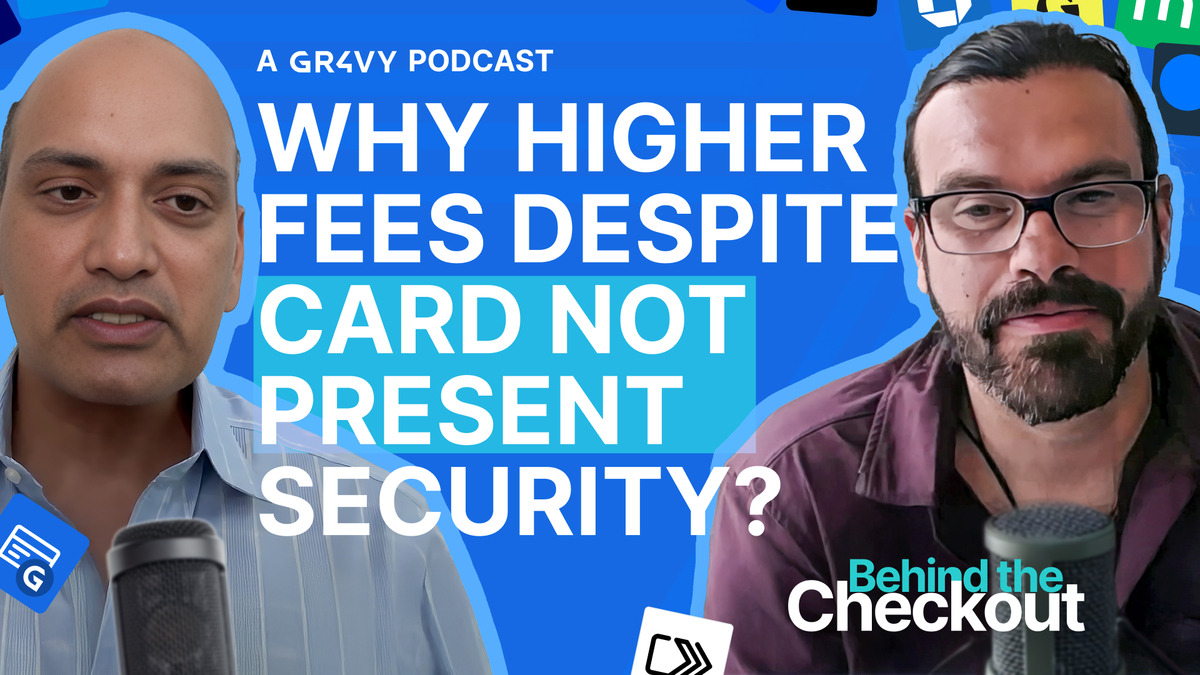

Why is interchange still higher for card-not-present transactions, even though online payments are more secure than they have ever been? On Behind the Checkout, Gr4vy’s podcast, John Lunn, Founder and CEO of Gr4vy, puts the question that has puzzled many merchants to Anand Goel, founder and CEO of Optimized Payments.
Key insights from the episode
- Interchange pays for the issuer’s cost and risk, and funds rewards. Anand Goel explains that it covers the cost of money and credit risk for the issuing bank, generates significant revenue, and pays for the miles and points consumers earn.
- Card-not-present still carries more fraud overall. EMV made card-present payments much more secure and pushed fraud online, and security measures like 3D Secure, tokenization and device fingerprinting are not yet used everywhere.
- The pricing reflects market dynamics as much as risk. Interchange structures date back roughly 50 years to when card-not-present meant mail and telephone orders, and the players who benefit from higher fees have little incentive to change them.
- There is no risk-based interchange pricing today. Every merchant pays the same rate regardless of the security technology it uses, which Anand sees as a missed opportunity to reward safer merchants.
- Merchants carry both the fraud liability and the higher fee. Anand calls the setup very one-sided, since higher card-not-present interchange should in theory offset the fraud risk the merchant already holds.
- Biometric in-app payments get no credit. A tap with a phone counts as card present, while a biometric-authenticated in-app payment on the same phone is priced as card not present.
- Rising costs are driving surcharging and alternative rails. Merchants are steering customers to ACH with discounts and adding card surcharges, and Anand expects innovation to come from alternative payment rails.
- A redesign should rest on transparency, risk management and incentives for security. Merchants that implement network tokens, SCA and 3DS should pay lower fees than those that don’t.
Anand Goel is founder and CEO of Optimized Payments, an independent advisor that works with merchants on payment costs and performance.
John Lunn is Founder and CEO of Gr4vy, the cloud-native payment orchestration platform.
What interchange is, and why it costs more online
John Lunn: Anand, welcome to the show. Let’s dive in.
Anand Goel: Good to see you, John, and good to be with you.
John Lunn: Let’s start with a really simple question. What the hell is interchange?
Anand Goel: Good question; start with the basics. Interchange is the fee merchants pay, and it goes to the bank that issued that specific credit or debit card. Interchange pays for the bank’s cost of money and the risk it takes on in extending credit, but it’s also a big revenue generator for banks. And for us as consumers, it pays for all the miles and points we love from using our cards.
John Lunn: Got it. There are different levels of interchange and a number of elements in the calculation, but generally, at least in the US and most markets, interchange is higher for an online, card-not-present payment than for an offline or in-person payment where you hand over a piece of plastic. Over the years, that has perhaps limited the innovation that could happen in store. You’ve seen people run experiments walking around with tablets to kill the line at checkout, and it’s always been a problem because of the available technology. It’s definitely easier to integrate with a card-not-present rail than a card-present one.
But it’s always been assumed, in my opinion, that a card-present transaction, where you walk into a store and hand over a card, is more secure and less risky than a card-not-present transaction online. Anecdotally, my partner doesn’t sign her cards, and I’ve given a crap about it for years, because I’m European. Honestly, I give my kids my credit card to go and buy bubble tea, and no one ever checks. So why is interchange higher? How is that more secure than 3D Secure and everything else added together?
Anand Goel: There’s a lot there, John. With the implementation of EMV in the US, card-present transactions have become a lot more secure. You’re probably more familiar with it from Europe, which has had EMV for a long time. There’s also EU regulation that caps credit and debit interchange fees, which is quite different from the US. The US was late in implementing EMV, and that has significantly reduced counterfeit fraud, but a lot of that fraud has shifted online.
So when you look at the risk profiles, even with 3DS, tokenization and device fingerprinting, those implementations aren’t ubiquitous in the market. As a baseline, card-not-present transactions are riskier, and that’s where more of the fraud happens. With card present, whether you’re tapping or dipping, the transactions are secure, and the issuer has the liability. With card not present, the merchant owns the liability.
John Lunn: Let’s be honest: a card with no signature on it, held by a different person walking into a store, versus being online with your device fingerprinted, a passkey running and 3D Secure verifying you with your bank. How is the first more secure? I don’t get it.
Anand Goel: In your retail example, if someone loses their card, yes, someone else could use it until it gets reported and deactivated. In that case, the merchant isn’t on the hook, because liability for all chip EMV cards shifts to the issuer, even in the case of fraud. That’s just how the industry has been set up and evolved over the years. And I agree with you: with the modernization of e-commerce and online payments, risk has come down. I think the gist of your question is that, despite modernization and greater use of 3DS and tokenization, costs haven’t come down. And the question is why.
Is card-not-present interchange about risk or control?
John Lunn: Exactly. Is this more about control and less about risk and fraud?
Anand Goel: I think it’s probably both. There’s no doubt interchange structures reflect both security considerations and market dynamics. We’re dealing with market dynamics created over roughly the last 50 years, when there was just card present and card not present. Card not present meant MOTO, mail order and telephone order. How often do we see people doing mail order or telephone order transactions now? Not very much, and those had little security. Online transactions have become more secure, but the industry has been slow to evolve because of infrastructure and the incentives in the market. With higher interchange fees for card-not-present transactions, there are definitely players who benefit. Are they eager to make those changes? Probably not.
“With having higher interchange fees for card not present transactions, there are definitely players that benefit. And are they eager to make those changes? Probably not.”
Anand Goel, founder and CEO, Optimized Payments
Why there is no risk-based interchange pricing
John Lunn: Optimized Payments is very much into the data here. What does the fraud landscape actually look like across card-not-present and card-present channels? And are issuers doing dynamic pricing based on risk levels, or, as you said, is the infrastructure creaking a bit? Can they say to Merchant A, you’re doing all this good work on risk and fraud, so we’ll give you lower interchange than Merchant B, which is doing nothing? Is that happening? That’s a big question, so let’s start with the fraud landscape across card-not-present and card-present.
Anand Goel: Broadly speaking, there have been significant shifts in the fraud landscape. Card-present fraud has dropped substantially since EMV adoption. Card-not-present fraud remains relatively higher, though it’s stabilizing for certain merchants and in certain e-commerce verticals where companies have adopted 3DS, tokenization and SCA. The challenge with a big, broad bucket like card not present is that fraud isn’t uniform. It varies by merchant category code, by geography, since markets like Europe mandate SCA, and even by transaction size. Even in card not present, you don’t see much fraud on small-ticket transactions, because there’s not much to be had; you see it on high-ticket transactions.
So to your second point: given the varying degrees of fraud controls in card not present, is there such a thing as risk-based pricing? Unfortunately, no, not today. Even though issuers have more data than ever and could theoretically use it to make risk-based pricing decisions, the card networks and the rest of the industry haven’t evolved to give merchants the benefit of risk-based pricing. I think that’s an area of opportunity. Everyone is subject to the same rate, regardless of the technologies they implement, when there could be incentives across the system. If you give merchants incentives to implement certain technologies, they’re more likely to do it and make the whole system safer.
“Everyone is subjected to the same rate, regardless of the technologies you implement.”
Anand Goel, founder and CEO, Optimized Payments
John Lunn: The interesting thing over the last few years, particularly around 3D Secure, is that incentives were put in place to adopt it, with liability shift as part of that. It didn’t really work until it was mandated, and then it was a case of, we have to do this now. Liability shift has definitely been attractive to merchants, but we’re probably not going to dig too deeply into VAMP today. The new VAMP requirements have almost said, yes, you’ve got liability shift, but you’re still responsible. So it’s carrot and stick happening at the same time, and it feels a little one-sided, as if it’s all on the merchant.
Merchants pay for the fraud liability and the higher fee
Anand Goel: Clearly, the way the system is set up today, not only does the merchant own the liability for fraud, but they also have to pay higher interchange fees. Theoretically, shouldn’t the higher interchange fees offset the increased fraud risk? But no, it is very one-sided. We work with a lot of merchants as a third party looking at the system as a whole, and new use cases are developing where we pay with our mobile phones. Even if it isn’t an NFC transaction, it’s authenticated: you use biometrics to get into your device, and you pay for a card-not-present transaction through an app, or online while shopping. I’d think that’s a lot more secure, but merchants aren’t being rewarded for it, either with liability shift or with lower interchange fees. That’s a significant area of opportunity, where the merchant community needs to keep lobbying and pushing the card networks for changes in market dynamics.
“Not only does the merchant own the liability of fraud, but they also have to pay higher interchange fees.”
Anand Goel, founder and CEO, Optimized Payments
John Lunn: In some markets, Australia being a good example, where there’s Click to Pay and passkeys, some of the card associations are starting to look not at interchange itself, but at a lower fee, and also at liability shift, which is interesting. So there’s hope we might get there.
Why a tap with your phone is priced differently from an in-app payment
John Lunn: We talk about EMV, but I can’t remember the last time I actually used my plastic card, because I’m a Google person; I use Google Pay. Is that EMV? Is it the same level of security? Why is it different from an online payment?
Anand Goel: It depends on how you’re using Google Pay. I’m an Apple guy, so you might have to educate me a bit. I’ve got my phone right here with all my cards loaded. At a checkout, if I use my phone, I’m using NFC, which is the same as dipping or tapping the card in my hand. Those are both card-present transactions, and the merchant gets exactly the same interchange rate whether I use a card or my phone.
John Lunn: But it’s not EMV, right?
Anand Goel: It is with Apple. Apple worked with the networks and issuers. I don’t know exactly how the technology works, but it’s considered a secure transaction and lumped into the same category as EMV, as a card-present authenticated transaction.
John Lunn: It’s authenticated. I look at it and think I’m doing pretty much the same thing online with Apple Pay or Google Pay, but I don’t necessarily have the phone. Maybe passkeys solve this, because a passkey says the phone is the key sitting there: you’re remote, but you have the device. Maybe that gets us there in future. But at the moment, again, it feels like the infrastructure hasn’t quite caught up with the technology.
Anand Goel: I’m with you there. Whether I use my phone for an NFC transaction or go into an app and make a purchase, both are authenticated through biometrics, and I’m in my phone. I think your point is, why are there different fees for NFC versus an in-app purchase? And I don’t know that I have a great argument for you, man. I agree there’s a lower risk profile for an in-app or online purchase through my phone, and the issuers and networks should give it consideration. Currently they don’t.
Is interchange slowing down in-store innovation?
John Lunn: Interestingly, we work with a lot of merchants in Australia, where interchange is actually very similar between card present and card not present, because card-not-present interchange rates are so low. What we’ve seen there is a lot more merchant innovation in what you can do in a customer-present environment. I say customer present because it’s not necessarily card present: if your interchange rates are the same, you’re no longer tied to a point of sale or a physical device that has to scan a card. It’s frustrated me for years that there are so many cool things we could have done in payments if you didn’t have to walk over to a machine and tap, insert or swipe a card. Are we slowing down innovation unnecessarily?
Anand Goel: Even in Europe, where debit and credit interchange rates are set at 20 and 30 basis points, it definitely spurs creativity in different use cases, and innovation. Even in the US, I know there have been pilots of using your phone to pay at the gas pump. Not an NFC transaction, but a mobile app that activates the pump: you approach it, geolocation knows you’re at the gas station at pump four, it activates, and you don’t have to pull out a card. Some of those initiatives have been slowed by cost, liability shift and all of that.
So you can argue that some of these artificial artifacts created over the last 50 years persist and need to change. With advances in technology, you could be customer present but card not present, as you mentioned. What additional experiences could you create if you didn’t have to adhere to the economics that have been created? I hear a lot of that conversation at industry conferences and forums, and I think it comes down to industry incentives. At the end of the day, issuers make higher interchange fees, and these big financial institutions use that money to pay for richer rewards.
“You could be customer present, but card not present.”
Anand Goel, founder and CEO, Optimized Payments
You talked about Australia and we talked about Europe. In the US, even though debit volumes have increased, we’re still a very credit card-focused society. We love our cards, and for a lot of us it’s the points and benefits we get from using them. It’s hard to move consumers who are so attached to those rewards, and rewards cost money, whether it’s miles or cashback. Issuers want to keep providing those incentives while still making a margin, so they have to keep interchange fees at 200 basis points. That’s the historical, legacy thinking. Does it need to be that way? No, clearly not.
Surcharging, ACH discounts and the move to alternative rails
John Lunn: And those benefits are shrinking. Look at the numbers over the years: your credit card is probably less attractive than it was even last year. I have one where they just completely changed the benefits, and it’s frustrating. Then there are new payment methods coming through, maybe not Buy Now, Pay Later, but things like bank-to-bank payments. Could they just leapfrog cards because they’re cheaper? Could we end up with cards used in store only, because of the low interchange there, while other methods take over online?
Anand Goel: One thing we’re seeing with a number of our clients is incentives and disincentives that drive consumer behavior. For example, I use T-Mobile, and for ages I paid my T-Mobile bill on autopay with my credit card. Because I was paperless and on autopay, I got about a $10 discount. About two years ago, I got a notification saying that benefit would be significantly reduced or go away if I used a card, but if I used ACH, I could keep the $10 discount. I did the math, the $10 was better for me, and I switched to ACH. The same thing has happened with other providers over the last couple of years; my home insurance company did the same, and I migrated to ACH.
In certain industries, I’m also seeing surcharging if you use a credit card, while a debit card obviously has no fee. I went to a restaurant that wanted to charge an extra 3% because I used a card, and I’m seeing more and more of that. I think it’s one of the effects of unchecked increases in the cost of payments. The networks have been increasing scheme fees over time, and interchange on credit cards has been increasing too, which pushes up the cost of payments. Merchants are feeling it more and more, and asking how to get out of the cycle of paying all these ridiculous fees. The consequence is more surcharging in the market, even in retail.
John Lunn: I was in Australia the other day, and they surcharged me at the counter for paying with a card. I asked how I could avoid it, and they said to use an Australian debit card. So as a foreigner, I essentially had to pay a surcharge.
Anand Goel: That’s crazy. I think this is going to grow unless the industry imposes some self-control to slow its rate of increase, or actually reverses some of the increases that have happened over time. I think innovation is going to come from alternative payments and alternative rails, combined with incentives and disincentives.
“The innovation is going to come from these alternative payments, these alternative rails with a combination of incentives and disincentives.”
Anand Goel, founder and CEO, Optimized Payments
How to redesign interchange from a clean sheet
John Lunn: Interesting. If you could sit down with a clean sheet and redesign how interchange works, how would you do it?
Anand Goel: If I were a merchant, I’d do it quite differently than if I were an issuer, but I’ll keep my current role at Optimized Payments, as an independent party in the market. I’d recognize the value the system provides. The card networks and issuers do provide value: a system that facilitates fast transactions and funding to merchants, and lets consumers spend money they don’t have to carry with them, so they can make bigger purchases. Merchants benefit, and the whole system benefits. But today the benefits are greater on the network and issuer side than for merchants.
So if I could redesign the payments system from scratch, I’d focus on a few guiding principles: one, transparency; two, risk management; and three, incentives for security adoption. They go together. Transparency means helping the merchant community understand what goes into pricing: these rates are higher because of X, Y and Z. Then, to our earlier point about risk-based pricing, if you’re a merchant that has implemented all these security measures, network tokens, SCA, 3DS, you should pay a lower fee than someone who hasn’t. And the last is security adoption: if you implement these things, your fees go down, and if you don’t, they’ll be higher. Those are the three guiding principles I’d use to create a brand-new system from scratch.
“If you are a merchant that has implemented all these security measures, you’re doing network tokens, you’re doing SCA, 3DS, you should pay a lower fee than someone who hasn’t done those things.”
Anand Goel, founder and CEO, Optimized Payments
John Lunn: In a previous role, I ran an experiment with one of my portfolio companies on who pays for incentives. By having merchants incentivize behavior, we managed to move 90% of consumers using the app from a gas station on one side of the road to a completely different gas station on the other side, by giving cashback on fuel. That cashback was paid for by the fuel station on the new side of the road, not by the card. I don’t think the consumer really cares where the incentive comes from. So I wonder whether there’s a model where there are incentives to use certain payment methods on certain websites, shared and paid for not purely by interchange but by merchant discounts and so on. There might be a way to break the mold a little and move it toward what consumers really care about, which is getting a good deal.
“I don’t think the consumer really cares where the incentive comes from.”
John Lunn, Founder and CEO, Gr4vy
Anand Goel: Absolutely, and I’ve seen some examples of that in the market. I don’t remember the name, but one gas station had an app where you could load your banking credentials, and it gave you a discounted fuel price if you paid with them instead of cards. And I saw a grocery store, I think it was Meijer, where the loyalty card sign-up had a place to enter your bank information. They’d link your loyalty card to your bank account, and when you checked out with your loyalty card and authenticated, you’d get more points paying from your bank account than with a card. Imagine if all the different loyalty programs that merchants and companies have incentivized you, not always with discounts, but with more points for using preferred payment methods. Not only does that reduce costs, it also reduces risk, and with faster payments it may also get you your money faster.
John Lunn: There are all kinds of interesting things you could do, particularly in grocery. A lot of people are going through hard times at the moment, and it takes a while to pay off a credit card bill. It’s paid on a certain day of the month, but you might get paid on a different day and still need groceries. With a real-time payment, that consumer has funds in real time. They might have been paid 10 minutes ago, and they might need milk and diapers for the kids. I think there’s a lot we could do there to make a better, more inclusive system with incentives, and, as you say, disincentives too. A lot of interesting things could happen, but that’s the dream state.
What card fees and payments look like in five years
John Lunn: I always try to ask toward the end of these sessions: five years’ time, where are we? What does this look like?
Anand Goel: I’m excited about some of the alternative payments being experimented with, whether it’s Venmo; I don’t know about crypto, I’m a bit slow on that with mass merchant adoption and the time it takes. When I think about where the source of value comes from, it could be credit, someone extending you credit. It could be prepaid, money loaded into some vehicle, whether cards or PayPal-like balances. Or it could be bank accounts. With pay by bank, you now have services like Plaid, where you don’t have to give out your banking credentials. They facilitate linking accounts and can check balances, and I think other services will be built on top, where you know when people will be paid and when they’ll have balances. So there’s tremendous opportunity to tap into pay by bank and disintermediate some of the card networks over time. They’ll always be part of the system, but I think they need market pressure to bring them to heel a bit.
“They’re always going to be part of the ecosystem, but I think they need market pressures to come to heel a bit.”
Anand Goel, founder and CEO, Optimized Payments, on the card networks
I don’t know about government regulation; it’s always slow. There’s the Credit Card Competition Act, which I think would be tremendous for the industry because it would force change, but I wouldn’t hang my hat on it. I’m excited about some of what our industry is doing with pay by bank.
John Lunn: So basically, if it doesn’t change, the industry will move and go somewhere else.
Anand Goel: That’s it.
John Lunn: I really appreciate your time today. Hopefully we’ve helped highlight, if not answer, where change needs to happen, or should happen. Thanks for joining the podcast.
Anand Goel: Thank you, John. It was good seeing you.
Explore more from Behind the Checkout
Watch more conversations with payments leaders in the Behind the Checkout series. To see how a payment orchestration platform helps merchants route payments to lower-cost methods and providers, and add network tokens and 3DS through a single integration, talk to the Gr4vy team.