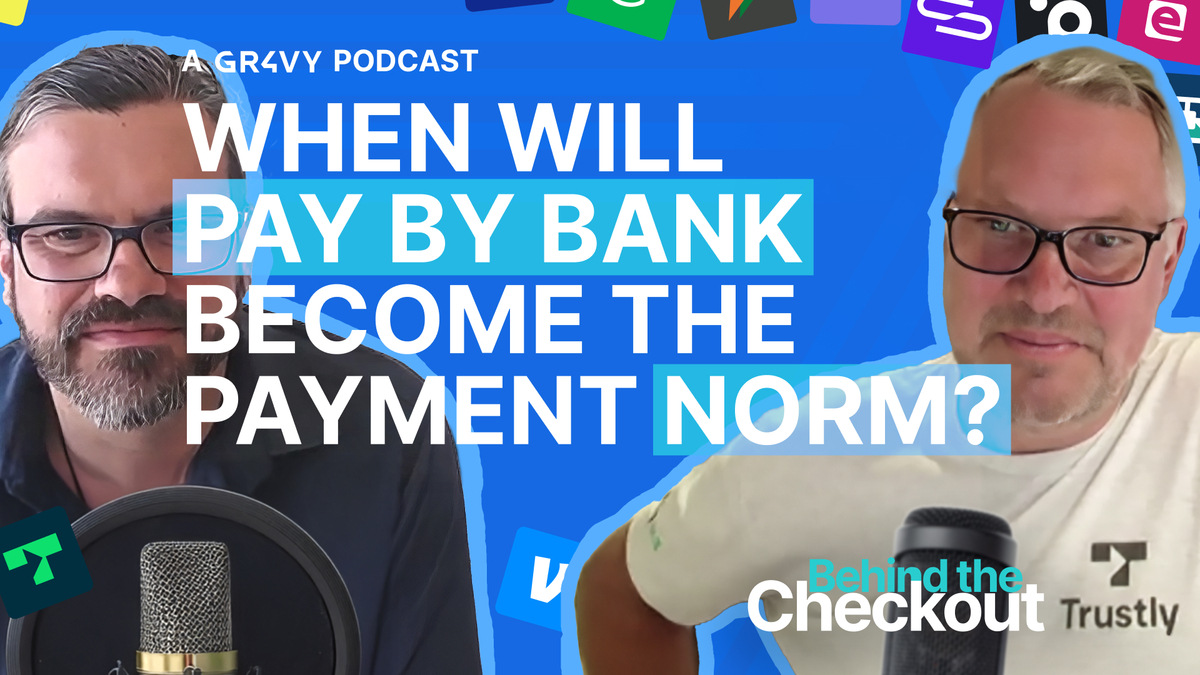

Pay by bank, also known as bank-to-bank, account-to-account or open banking payments, is evolving fast thanks to real-time rails like RTP and Pix. But when will it become the norm? On Behind the Checkout, Gr4vy’s podcast, John Lunn, Founder and CEO of Gr4vy, talks to Alexandre Gonthier, founder and CEO of Trustly Inc, about adoption challenges, fraud trends, and how pay by bank might eventually take the lead worldwide. The conversation below is lightly edited for clarity.
Key insights from the episode
- Pay by bank is “next-gen ACH”. Alexandre Gonthier explains that it runs on the wholesale bank-to-bank networks every country already has, bypassing the Visa, Mastercard and American Express rails.
- It fixes ACH’s two biggest problems. Consumers sign in to their bank instead of typing account and routing numbers they don’t know, and risk checks let providers guarantee funds in real time even when the underlying network settles in batches.
- Real-time rails grow fastest where the experience is clearly better. UK Faster Payments, Pix and Zelle show demand, but fraud liability pushes banks to impose velocity limits that cap what the rails can be used for.
- Pay by bank fraud in the US is mostly around Zelle and payouts today. Consumer-to-business real-time payments via request for payment are still only being piloted, though money mules using real-time transfers to drain accounts remain a risk.
- Consumers won’t use a brand they don’t know with their money. A unifying brand will come with scale, as Visa grew out of Bank of America’s card.
- Billers are already won; retail needs incentives. Pay by bank is over half of billing volume at some large billers, while in e-commerce it barely registers, and Alexandre argues merchants must give consumers a clear reason to switch.
- The right message changes adoption overnight. Telling donors more of their money reaches the nonprofit took Trustly’s share of checkout from 5% to 25%.
- Open banking data can help people paid paycheck to paycheck. Trustly is working on approving purchases when a consumer is short of funds but due to be paid in days, and scheduling the debit for then.
Alexandre Gonthier is founder and CEO of Trustly Inc, the global leader in pay by bank, with years of experience driving innovation in the space.
John Lunn is Founder and CEO of Gr4vy, the cloud-native payment orchestration platform.
How pay by bank works, and how it differs from cards and wallets
John Lunn: Alexandre, welcome to the show. It’s great to have you here.
Alexandre Gonthier: Thanks very much, John. I’m happy to be here.
John Lunn: Why don’t we start with the basics? How do pay by bank, or open banking, payments actually work, and how do they differ from a card-based payment or a wallet transaction?
Alexandre Gonthier: If you don’t mind, I’ll start with the naming, because it’s quite funny; there are so many names that people get confused. It started as online banking-enabled payments, 20 or 25 years ago in the UK. Then came open banking, which became open banking payments. Then investment bankers started talking about account-to-account payments, or, as you mentioned, bank-to-bank payments. And now there’s the term pay by bank. Open banking payments are the same thing as online banking-enabled payments.
Then there’s the question of the category. If it doesn’t use the Visa, Mastercard or American Express rails, how does it work? It works directly from bank account to bank account, with no third-party network in the middle. That’s why some people see it as the account-to-account category. That’s a bit limiting, because account-to-account also covers good old-fashioned ACH, or IBAN payments in Europe, or bank account and sort code in the UK, without the new user experience enabled by online banking or now open banking. Anyway, pay by bank is the new term that seems to be sticking, at least in the US. It doesn’t speak to the fact that it’s open banking-enabled, but what people think of right now is next-gen ACH: next-gen bank account to bank account payments without going through Visa and Mastercard.
“What people think of right now is next gen ACH.”
Alexandre Gonthier, founder and CEO, Trustly Inc
How does that work alongside Visa and Mastercard? Every country has a wholesale payments network that lets banks, and now merchants, billers and others, move funds from one bank account to another. It’s not Visa or Mastercard-based. It’s infrastructure banks have used for decades to move money between themselves and between their customers’ accounts. So we leverage that infrastructure and completely bypass the Visa and Mastercard rails. That’s what we do.
John Lunn: I think the fundamental change between this and ACH is that it’s real time, or close to it. We’ve had ACH for years, but it takes three to five days, if not longer, and there are all kinds of issues around it. It’s never really been adopted in e-commerce, because it’s too slow. By the time you find out whether the payment succeeded, the goods have left your warehouse. So the big driver for pay by bank is that it’s near real time, as fast as a credit card, if not faster. Do you agree that’s been the big change?
Alexandre Gonthier: Yes, you’re correct. ACH is attractive as the underlying infrastructure for pay by bank because the network is incredibly attractive economically: it’s very inexpensive, with no interchange. But it has problems. It’s slow and batch-oriented, and the UX doesn’t work in a web-native, mobile-native world where people don’t know their bank account and routing numbers. They simply don’t. So you have to solve two problems, and that’s exactly what pay by bank does.
The first is UX. People don’t know their account and routing numbers, especially on the go on their phone, far from their checkbook, so they can’t use the payment method. They used to know where to find the information; they no longer do. So you solve the UX problem by saying: if you know how to get into your mobile banking app, typically with Face ID or a password, you can pay. That’s something people do every day to check their balance, because everyone stays close to their money. So it’s a UX paradigm shift, from filling out a form with information you don’t know to simply using Face ID or signing in to your bank, just as you’d sign in to PayPal with your email and password.
The second is fixing the blind spots of the current bank-to-bank infrastructure. If your network is batch-oriented and takes two or three days for funds to settle, that’s not acceptable to merchants that need to ship now, or rather to consumers who expect them to ship now. Historically, there were no real-time networks, and ACH is still batch-oriented. So while we’re in the consumer’s online banking account authenticating them to their bank, we also look at all the risk attributes we can see in their profile, from balance to other signals, to decide whether to guarantee the funds in real time. Guaranteeing the funds doesn’t mean they move from the consumer’s account to the merchant’s in real time, but it means the merchant knows in real time that the funds are good and can ship immediately. That matters, because otherwise e-commerce is no fun. If you have to wait one or two days, when delivery is now same-day or even within hours, it doesn’t work.
“It means that the merchant will know in real time that the funds are good and therefore they’ll be able to ship immediately.”
Alexandre Gonthier, founder and CEO, Trustly Inc
We’ve had to do that historically, because ACH is, and will remain for years to come, the most universal and available bank-to-bank infrastructure. But now there are real-time networks, and they have a fundamental benefit: because funds move in real time, you don’t have the risk of debiting an account that has since been emptied. Not that people are malicious, but if it takes two days for your account to be debited and you made an ACH transaction on Friday night, the money only leaves on Monday morning, so you can spend it all weekend without realizing. Real time eliminates that, because you grab the funds immediately. It’s better for risk management, you can make funds available to the merchant in real time, and it’s a better user experience. If you want to win consumers, you have to deliver a better experience. With debit and credit cards, payment already works in real time; with the good old ACH system, it was slow. Now you can pay your bill and it’s settled instantly. That’s essentially how we fill the gaps in these aging, yet incredibly useful at scale, wholesale payment networks found in every country.
What drives real-time payment adoption, and what holds it back
John Lunn: We’ve seen major growth in real-time payments globally: RTP and FedNow growing in the US, Pix in Brazil, UPI in India, open banking in Europe. What’s driving adoption, both merchant and consumer adoption, and what’s holding it back? Is it being adopted on both sides?
Alexandre Gonthier: Real-time payments are adopted everywhere they’re deployed. The UK deployed the Faster Payments network about 15 years ago. I don’t know the exact figure, but I’m prepared to bet it represents 15% to 20% of the country’s total bank-to-bank payment volume. Pix in Brazil has taken off over the past five years. In the US, we all think of RTP and FedNow, but Zelle predates both The Clearing House’s RTP network and FedNow, and its use case is person to person.
Why do people use real time? If you can have something, your money in particular, right now, do you want to wait two days? Of course not. The user experience is just much better, both for a consumer sending money to someone and for a merchant that wants money now rather than three days later. By the way, look at the Visa and Mastercard rails still today. Pay on an e-commerce site, and they grab the funds in real time, no worries. But when you want your money back, and the retailer agrees and initiates a refund, count how many days it takes to see the funds in your account. It’s not instant, not even overnight. It’s frustrating, because you end up checking every day until you see it, so you don’t forget and lose that money. Real time comes with a huge advantage: I have a task, I get it done, and I can move on. It frees up mind share and eliminates clutter from people’s brains.
Now, real time comes with non-repudiation, because once the money is gone, you can’t easily get it back. It’s like paying cash. So there’s fraud liability, and who bears it? Banks wanted to say it’s the consumer, because the payment is irrevocable; that was the whole premise. But then you have an older couple persuaded over the phone by a fraudster to send money to a bank account to fund some great cause. Fraudsters always have good stories; that’s social engineering. These people have lost money, and because the network is real time, they can’t ask for it back.
So regulators and legislators in many countries, starting with the UK, stepped in. When I said 15%, why isn’t it 85%, if real time is so superior? One factor is that it’s more expensive, because not enough volume has gone through the infrastructure to amortize the original investment. But that’s not the whole story. The bigger factor is that banks end up imposing strict velocity limits, and velocity limits shrink your total addressable market, instead of letting you address every use case. In every country where real-time payments have been deployed, legislators have passed laws saying banks have to stay on the hook in case of fraud, which is fair enough. You’re not going to tell that couple they’ll never see their money again if they were genuinely defrauded.
So banks put velocity limits in place: you can only move $3,000 a day, or $3,000 in aggregate per week or per month. I say $3,000 because, on the Zelle network in the US, try using it to pay rent. Even if you’re paying rent to someone who has Zelle, and it can be viewed as a P2P transaction, in the Bay Area there aren’t many places you can live for $3,000 a month; at times it’s $3,000 a week. So it doesn’t work on these networks. The velocity limits make the rails unusable for those use cases. That’s the challenge: on one side, a great user experience that people want to use; on the other, a great user experience typically comes with more risk, and more risk needs to be managed. The risk management approach is always velocity limits, and that puts constraints on adoption.
“Great user experience typically comes with more risk and more risk needs to be risk managed. And the risk management approach is always velocity limits.”
Alexandre Gonthier, founder and CEO, Trustly Inc
Where pay by bank fraud actually comes from
John Lunn: The MRC published its fraud survey recently, a very interesting read, and you do see the rise of pay by bank fraud across the world. Funnily enough, according to their data, it grew fastest in the US. Where’s that fraud coming from? Is it account takeover? If merchants are seeing it, you’d assume the merchants are legitimate. So how does pay by bank fraud actually happen, when there’s so much security around it?
Alexandre Gonthier: Your question is a fair one. I’m surprised they speak mostly about the US. Fraud is happening right now in the US with Zelle, more than anywhere else, because the other real-time use cases are a business pushing money to a consumer, not a consumer paying a business. What’s currently available at scale in the US, from The Clearing House or the Fed, is an organization pushing money to a consumer: a claim payment from an insurance company, a government paying a per diem to a court witness or for jury duty, or emergency funds sent by an insurer. With that use case, your ability to know who you’re sending money to is high, because you can require the name on the bank account to match the name of the person you’re paying. So there isn’t much fraud with this use case.
The use case that comes with fraud is account takeover, where a consumer uses someone else’s bank account to pay a merchant, receives the goods, and the funds come out of someone else’s account. But that would require the US to already have request for payment enabled across the board, and that’s not the case at all yet. We’re just at the initial piloting stage, for very specific reasons I can explain if you’re interested. So in the US, you’ll always see a bit of fraud around payouts. And people in the US are starting to use Zelle even with small businesses: small restaurants will say, if you want, you can pay me here, here’s my phone number. A small food truck has no problem accepting a Zelle payment. Why not? It works very well; you just enter their mobile number in your app. So you probably start seeing a bit of that fraud as people expand the use of what is really a P2P solution. Fraud will happen when a consumer pays a business, and that’s not the case in the US yet.
But as usual, when funds aren’t easily recoverable and you can move them in real time, there’s fraud. Here’s a typical scenario we’ve seen and blocked firsthand. People use a regular bank account to make an ACH payment with us, so we think the account is funded and approve it in real time. They put money in the bank account, and within minutes of making the payment that we’ve approved and told the merchant to go ahead with, they use Zelle to move the money out. It’s just like a debit card. And this isn’t even account takeover. It’s a money mule: a real consumer participating in a scheme run by organized crime, with lots of small, real people who actually defraud you. Each amount is small enough that it’s impractical to go after them individually, yet together they’ve defrauded you of hundreds of thousands in a weekend.
“This is a mule. This is a real consumer that participates in a scheme led by organized crime.”
Alexandre Gonthier, founder and CEO, Trustly Inc
Does pay by bank need a brand consumers recognize?
John Lunn: One interesting thing is where the brand sits in a pay by bank transaction. We work with many account-to-account payment systems around the world, and there always seems to be some consumer confusion about branding. I want to pay with my bank, but I see Trustly: what is Trustly? Or Zepto in Australia, or Banked in Europe. As a consumer, is there a need for a logo, something like a card brand that points consumers to it when they want to pay by bank but don’t know that brand?
Alexandre Gonthier: Yes, at some point there will be a unifying brand that people recognize. Visa didn’t start as Visa; that came years later. It started with Bank of America, which had the first credit card. The point is that it takes enough adoption and volume to start looking at interoperability across rails. Visa and Mastercard weren’t interoperable on day one; that came with time, and the same will happen here. You’re right that, for now, the way to win consumers is to put a name in front of them that they recognize. The brand of the company processing behind it is starting to emerge, but if you lead with it in a space where people are still forming habits, you’ll curb conversion rather than help it. No one is going to use something they don’t know when it comes to their money.
“No one is going to use something they don’t know when it comes to their money.”
Alexandre Gonthier, founder and CEO, Trustly Inc
How to break pay by bank’s chicken-and-egg problem
John Lunn: It seems like a bit of chicken and egg at the moment. When we at Gr4vy talk to merchants about accepting every payment type their consumers use, they always say, we need consumers to want or adopt this payment method before we add it. But if consumers don’t see it, they won’t adopt it. How do we get over that hump? How do we get merchants accepting pay by bank by default, and consumers asking for it, so it becomes one of the primary ways to pay?
Alexandre Gonthier: I’d step back and say that for some use cases and verticals, it’s already the number one way to pay. Take Verizon: it’s probably already over 50% of their total billing volume. And there are verticals where it’s non-existent today, like e-commerce. Why? That’s the right question. Consumers are perfectly satisfied with Visa and Mastercard, because wherever they go, they have their plastic cards in their wallet, or, if they’re like me and don’t always carry a wallet, a digital version in Apple Wallet or another mobile wallet. Cards work well. But merchants pay a lot for that product consumers have grown to use more and more. Why? Because consumers are incentivized to use their Visa and Mastercard cards, plastic or virtual, through loyalty points, cashback programs and all the attached rewards. Those are attached to credit cards, not debit cards, granted, but there’s also brand association: Visa and Mastercard are incredibly well-known, well-established brands.
So right now the merchant is the one suffering, because every year interchange fees, the fees merchants pay on every Visa, Mastercard and American Express transaction, don’t go down. You’d think they would as the market gets more competitive. No, they go up. It’s reverse gravity. It’s fantastic: the single most intelligent business model I’ve ever seen in my life. More competition, higher pricing. Amazing. If you’re a grocery chain operating on 2% to 3% net profit, and you pay Visa and Mastercard 1%, imagine what you could do for your shareholders by adding that 1% to your 2%. You’d increase your bottom line by 50%, and the impact on the share price would be insanely positive. So merchants have a very strong vested interest in moving consumers off Visa and Mastercard. You have to start with merchants, because whatever the marketing, the merchant controls the payment lineup, or, if not the merchant, an orchestration layer like Gr4vy does. Merchants have an incentive to put a lower-cost payment method first, and pre-select it if they can.
“It’s reverse gravity. It’s fantastic. It’s the best, single most intelligent business model I’ve ever seen in my life. More competition, higher pricing.”
Alexandre Gonthier, founder and CEO, Trustly Inc, on card interchange
Let me step back for a second, because I’m already getting into retail. We talked about Verizon; we can talk about AT&T, T-Mobile, Charter, all these very large billers. It’s the same in insurance, property management and government. Everyone knows that when you pay your taxes by credit card, there’s a 3% or 4% fee, because it costs them a lot. In those verticals, paying with your bank account is a historical habit that’s hard to kill. It used to be that 90% of AT&T’s bill pay was bank-based. Then mobile phones emerged, people paid bills on the go, and the debit or credit card in their wallet was what they had with them. The mobile device caused a huge shift in consumer behavior from paying bills by bank to paying by card, and billers have suffered, paying, in aggregate, billions and billions of dollars to the Visa and Mastercard value chain. These people historically always paid by bank, by paper check or through their online banking site’s bill pay; 20 or 25 years ago, CheckFree was doing that extremely well, connecting billers to banks through its platform. A lot of them, maybe 35 or 40 and older, are happy paying with their bank account, because it’s a recurring bill and they’re on autopay. So we have to recognize there’s still 20% to 60% of total billing volume, depending on the biller, that can naturally go to pay by bank.
It’s not always so natural, though, which is why billers now offer discounts for paying with your bank account. Now we’re into the incentive game. A bank account is evergreen; unless there’s fraud and you have to close it and open a new one, it lasts. A credit card expires every three years, then there are all the account update issues, or it gets blocked because your bank detected suspicious activity, and then you’re in trouble with every biller where your card is on file. Bank accounts are evergreen, which is why they’re churn-proof for a biller, and lower cost, as we said. So billers give an incentive. They want people on autopay, set and forget, so they pay people, and people respond well to incentives. We’ve proven that very clearly in the biller space. If a merchant has a vested interest in moving you to bank payments, it will put you first in the payment lineup, or offer an incentive, and then you can start reprogramming people’s behavior.
“Bank accounts are evergreen. So there is a reason why it’s churn proof for a biller and lower cost.”
Alexandre Gonthier, founder and CEO, Trustly Inc
That’s what’s going to be required in retail. Amazon may be one of only two or three retailers in the US offering standard eCheck, where you enter your bank account and routing number, not even open banking payments. I don’t know for a fact, but I’d bet its share of checkout is 1% or 0.5%. If you change the UX and put an incentive in place, you’ll get adoption. If you don’t, why would consumers walk away from debit and credit cards, something that works, without a reason?
John Lunn: Exactly.
Alexandre Gonthier: Here’s another example we haven’t talked about: the nonprofit space. A few years back, we went live with some of the largest nonprofits, and we didn’t know what marketing message would drive consumer behavior. We started by explaining how it works: pay with my bank. Adoption was 5% share of checkout, and people were using us to make $50,000 donations, because you can’t do that with a card; we were used where cards hit their own velocity limits. Then we realized that to get the $50 or $5 transactions too, we needed different messaging. So we moved from generic language explaining how it works to: more of your donation goes to United Way when you pay with your bank. Overnight, we went from 5% share of checkout to 25%. You have to give people a good reason to do what you want them to do. Otherwise they won’t do it; they stick to old habits, and good for them.
Will pay by bank ever become a global network?
John Lunn: True. We’re a global company working with merchants around the world, and with many different pay by bank providers, but they all work completely independently at the moment. Whatever system you have in the US, Brazil, Europe or Australia, an Australian can’t use pay by bank in the US or Europe, because the Australian solution works for Australian merchants with Australian bank accounts. Do you see someone stitching all this together? To truly compete with Visa and Mastercard, you need a global network. Is that on the horizon?
Alexandre Gonthier: It is on the horizon. I’d say the first step in that direction was forming Trustly as a combination of a US entity and a European entity present in 25 or 30 countries, with us in the US and Canada. You need to add many more countries to cover the world, but that was the first step in the direction you describe. It will come, just as Visa and Mastercard are now virtually everywhere, organically or inorganically, and we’ll have to interconnect with other domestic players in different geographies. However, the payment method category is in its infancy, and before you go international, the number one priority is to build real scale in your own domestic market. There are a number of brands that are very large in Europe and large in the US, and vice versa, but even then, I’d say we’re just scratching the surface of the US market. So why get diluted and distracted, when the name of the game right now is taking share from the incumbents in the US, Germany and the UK?
What’s next for pay by bank in the next three years
John Lunn: I think you’ve already answered this, but I’ll ask anyway. What’s next for pay by bank? What do the next three years look like?
Alexandre Gonthier: The first thing is adding real time to the infrastructure wherever possible. In the US it’s still in its infancy, and I think it’s a huge user experience booster. Second is incentives. If we want to get into retail, we have to replicate the Target Circle Card model, which gives you 5% off if you pay with a given payment method. It’s not just Target; Cumberland Farms and others have figured out that if you give people a meaningful cashback program, they’ll pay without Visa or Mastercard. In my opinion, incentives within loyalty programs are a fundamental requirement to drive adoption outside the verticals where pay by bank adoption is natural, like the biller space in a very broad sense, which is huge but isn’t retail.
And third, there are things you can do with the bank rails that you can’t do with Visa’s debit rails. Here’s a very specific example that goes toward helping paycheck-to-paycheck consumers. Say someone on a Friday night is at the pump putting gas in the tank, or at the supermarket buying food. They need 80 bucks and only have 50 left, because it’s the 27th or 28th of the month. On Visa debit or Mastercard debit, the network’s logic is to decline. So that person is at the register with the conveyor belt full of goods, and boom, they get declined. It’s an embarrassment for them and a lost sale for the supermarket.
But that person is getting paid on Monday. So why decline them if you can tell they’ll have money in the bank on Monday? What we’re working on is exactly that: because we have this open banking data advantage, we can see they’ll be paid on Monday, so we approve them and collect on Monday, not the same day. You could call it rescheduling, or optimizing when you debit the consumer’s bank account, so that if you need to give them two days to say yes, you give them two days. I think that’s the third dimension that’s really going to be a game changer for pay by bank.
“That person is getting paid on Monday. So why decline them if you can tell that on Monday they will have money in the bank?”
Alexandre Gonthier, founder and CEO, Trustly Inc
John Lunn: Absolutely. We’re out of time, but thank you for your insights. I really appreciate it, and I’m looking forward to working more and more closely with you at Trustly.
Alexandre Gonthier: Super, John, thank you very much. See you soon.
Explore more from Behind the Checkout
Watch more conversations with payments leaders in the Behind the Checkout series. To see how a payment orchestration platform lets merchants add pay by bank alongside cards and wallets, and put lower-cost payment methods first in the checkout, talk to the Gr4vy team.