GR4VY

What happens when a customer’s card expires?


Credit cards don’t last forever. Every card comes with an expiration date, and when that date passes, merchants risk failed payments, canceled subscriptions, and lost customers. It’s a common issue in recurring billing, but one that can be managed with the right strategy and tools.

When a customer’s card expires, it doesn’t always mean the account is closed. Issuers typically send replacement cards with updated expiry dates and new security codes. The challenge lies in making sure merchants’ systems recognize the new credentials in time, without interrupting billing cycles or disrupting customer experience.

The hidden impact of expired cards

Expired cards quietly erode revenue. Many merchants discover the problem only after a billing attempt fails or a customer complains that their subscription stopped. Each failed renewal adds friction—customers must manually update their details, support teams must follow up, and merchants lose predictable cash flow.

For businesses that depend on recurring payments, such as SaaS providers, media platforms, or memberships, even a small percentage of expired cards can lead to thousands in missed revenue every month. Subscription Intelligence reports that as much as 10% of all recurring payment failures are tied to expired cards.

Payment orchestration platforms help mitigate this risk. Instead of relying on a single PSP to manage updates, merchants connect through one unified layer that can automate updates, retries, and routing logic.

What card expiry really means

When a card expires, the physical card is no longer valid for manual use. The account itself, however, usually remains active. The card issuer replaces the card with a new expiration date and security code. Behind the scenes, the issuer also updates card network records, allowing authorized systems to refresh card details automatically.

Visa, Mastercard, and other major networks operate “account updater” services. These programs share updated card information with participating payment processors and merchants who store card tokens. If a merchant’s platform is connected, the expired card data in their vault is replaced with the new one automatically.

That’s the best-case scenario. But not every merchant or PSP supports automatic updates. If the card update doesn’t propagate correctly, the next billing attempt will trigger a decline. In those cases, the merchant’s system receives a “do not honor” or “expired card” error code, and the customer must manually re-enter their card details.

To better understand how such payment behavior affects merchants across Europe and beyond, see 50 payment and merchant statistics shaping Europe in 2025.

The merchant’s challenge

Merchants face three operational risks when a card expires:

  1. Failed payments: Each decline impacts cash flow and can suspend services until the issue is resolved. For high-volume merchants, this compounds quickly.
  2. Customer churn: When payments fail, customers may not bother to update their details. Friction leads to cancellations, especially in subscription models.
  3. Administrative burden: Teams must identify failed renewals, contact customers, and manually reconcile missed payments. This adds operational overhead.

Some industries are hit harder than others. Digital services, streaming platforms, and SaaS providers often process monthly renewals, meaning thousands of cards can expire simultaneously. Without automated management, teams scramble to recover revenue and communicate with affected users.

The role of orchestration in card expiry management

Payment orchestration simplifies this entire process. By managing all payment providers and acquirers through one platform, orchestration ensures merchants can use multiple account updater services, automated retries, and proactive alerts before expiration dates cause problems.

Orchestration also introduces advanced routing logic. If a payment fails due to an expired card, the system can instantly reroute the transaction through another PSP that may already have the updated card credentials or stronger issuer connectivity. This prevents unnecessary declines and keeps recurring revenue intact.

In complex markets, where regulations and authentication rules differ, orchestration also ensures compliance remains consistent across providers. You can learn more about that in embedded payments compliance in Europe: what merchants need to know.

When a customer’s card expires, the merchant’s response determines whether that transaction becomes a temporary hiccup or a lost account. While card networks and banks aim to make the replacement process seamless, the reality is that failed recurring payments still account for a major share of unintentional churn.

Common outcomes of expired card payments

There are four main outcomes when a recurring payment attempt involves an expired card:

  1. Automatic success through account updater: If the merchant’s PSP or orchestration layer supports an account updater service, the new card details are refreshed automatically. The payment completes as usual, and the customer often remains unaware the change occurred.
  2. Soft decline and retry window: In some cases, issuers return a temporary decline. The merchant can retry the payment after a short interval. Intelligent retry logic, especially through orchestration platforms, can space attempts strategically to maximize success.
  3. Hard decline – card expired: When an account is inactive or the card can’t be refreshed, the transaction is rejected. Without orchestration, the merchant’s system may treat this as a final failure.
  4. Customer manually updates details: The least efficient but still valid path. Customers update their card details in the merchant’s portal or app, reactivating their subscription.

Each outcome depends on the merchant’s technical stack, PSP capabilities, and whether orchestration is in place. Learn more about how these elements interact in payment orchestration vs PSP in Europe: why flexibility and resilience matter.

Why orchestration matters for expired-card recovery

A payment orchestration platform acts as a central layer that unifies tokenization, routing, retries, and card updates. For expired-card management, this translates into three key benefits:

  1. Unified account updater coverage
    Instead of relying on one PSP’s updater, orchestration lets merchants connect to multiple services. If one PSP’s link to a network updater fails, another can fill the gap.
  2. Configurable retry logic
    Merchants can set rules for how and when retries occur. This reduces the risk of duplicate charges and helps maximize approval rates. For example, retrying after 24 hours rather than immediately often results in higher success.
  3. Seamless PSP switching
    If an acquirer has poor connectivity with a specific card network, orchestration can reroute transactions to another PSP that handles the updated card credentials better.

Combined, these features ensure continuity even when cards expire mid-cycle. This orchestration-driven resilience also helps merchants optimize for authorization performance, discussed in acquirer fee optimization in Europe: strategies for faster authorization and lower costs.

Preventing revenue loss before it happens

Prevention is easier than recovery. Merchants can proactively track expiration dates for stored cards and take action before a billing attempt fails. Here’s how:

  • Set pre-expiry notifications: Send an email or in-app reminder 30 days before the card’s expiration. This encourages customers to update payment details early.
  • Leverage orchestration insights: Platforms like Gr4vy provide analytics dashboards that identify cards nearing expiration. These insights allow automated reminders and targeted recovery campaigns.
  • Combine tokenization with orchestration: Tokens keep card data secure and portable across providers. When paired with orchestration, merchants can update or replace tokens without touching sensitive data. More on this in tokenization vs vaulting: what’s best for securing recurring payments.
  • Adopt a multi-PSP model: With multiple connections, merchants aren’t tied to one provider’s update cadence. This ensures continuous uptime and better coverage for global card updates.

Regional considerations for European merchants

Card expiry handling also intersects with regulatory and network variations across Europe. For instance, Carte Bancaire in France follows stricter authentication and replacement protocols than many global schemes. Merchants operating across European markets must ensure that updates align with PSD2’s Strong Customer Authentication (SCA) and regional tokenization standards.

Gr4vy’s orchestration layer simplifies this. It ensures all updates—whether through card networks or local schemes—adhere to compliance rules without requiring separate development. Merchants maintain a unified logic across borders while meeting each market’s security requirements. Explore more about regional compliance in embedded payments compliance in Europe: what merchants need to know.

Expired cards and customer experience

While expired cards cause operational challenges, they also present an opportunity to strengthen customer relationships. Clear communication during the update process builds trust. Instead of a generic “payment failed” message, merchants can explain that a new card may have been issued and guide users to update details in one click.

Modern orchestration tools even allow embedded payment update flows within customer portals, avoiding redirects or manual re-entry. When combined with automated retries and token refreshes, these features make expired-card handling almost invisible to the end user.

Building a proactive strategy for expired-card management

Managing expired cards effectively is not only about recovering failed payments but preventing them before they occur. With the right infrastructure, merchants can turn this challenge into an automated, data-driven process that protects recurring revenue and enhances the checkout experience.

Step 1: Audit your card-on-file ecosystem

Merchants should start by mapping where and how they store customer payment credentials. If card data is spread across multiple PSPs or stored locally, the risk of missing updates increases. Using an orchestration platform with a unified vault simplifies this view. It provides centralized access to all stored tokens and helps track expiration timelines.

Step 2: Connect to network updater services

Visa, Mastercard, and local schemes like Carte Bancaire offer account updater services that automatically refresh credentials. Merchants using payment orchestration can connect to several updaters at once, ensuring broader coverage across regions. When one network fails to refresh a card, another can step in.

Step 3: Enable smart retry and fallback logic

Failed payments due to expired cards often succeed when retried later. With orchestration, merchants can set retry intervals, choose alternate PSPs, or redirect transactions based on issuer response codes. This combination of retry and fallback ensures that expired-card declines don’t become permanent losses. Learn more about intelligent routing in why payment orchestration matters for merchants expanding cross-border.

Step 4: Automate customer notifications

Human intervention slows recovery. Modern orchestration systems let merchants trigger pre-expiry alerts automatically, based on stored card metadata. Sending customers a reminder 30 days before a card expires, or offering an embedded update form, reduces churn and support tickets.

Step 5: Track performance through data

Payment orchestration isn’t just an integration tool—it’s a reporting layer. Merchants can analyze patterns such as:

  • Percentage of payments failing due to expiry
  • Success rates after automated updates
  • Revenue recovered through retries or rerouting
  • Cards nearing expiration within the next billing cycle

Tracking these metrics makes it easier to measure the ROI of orchestration and updater integrations. A good starting point for understanding transaction analytics is real-time payments across Europe, which covers the value of instant insights in payment operations.

Key metrics every merchant should monitor

MetricDescriptionTarget
Expired card ratePercentage of stored cards that expired in a given period< 3%
Auto-update success ratePercentage of expired cards successfully updated via network updaters> 85%
Payment recovery ratePercentage of declined payments successfully recovered via retries or rerouting> 60%
Churn from failed paymentsShare of customers lost due to failed renewals< 1%
Customer update engagementPercentage of users responding to pre-expiry notifications> 50%

Monitoring these KPIs allows merchants to refine their retry logic, updater coverage, and communication strategy.

Why orchestration future-proofs your payment stack

Card expiry management is a small part of a much bigger story: the evolution of global payments. As merchants scale across regions and providers, managing hundreds of connections manually becomes unsustainable. Payment orchestration eliminates that friction.

With Gr4vy’s single integration, merchants gain:

  • A unified vault for card storage and updates
  • Automatic support for network updaters
  • Configurable retry and routing rules
  • Insightful monitoring and reporting tools
  • Independent cloud instances for resilience and uptime

This architecture allows merchants to avoid disruption, recover more payments automatically, and minimize operational effort. It’s not just about expired cards—it’s about building a payment environment designed for continuity and control.

Card expiration is inevitable. Revenue loss from it isn’t. With the right orchestration strategy, merchants can update cards automatically, route transactions intelligently, and maintain uninterrupted cash flow.

Instead of reacting to failed renewals, merchants equipped with orchestration operate proactively—detecting, updating, and retrying before customers even notice.

Contact Gr4vy to simplify your card management process and build a payment stack that keeps every transaction moving.


Why credit card payments fail: +35 reasons merchants must know

Failed card payments block revenue instantly. A customer tries to buy. The card is entered. The button is clicked. Then nothing. A decline. The sale is gone. For merchants, every failure has a direct cost: marketing wasted, customer trust damaged, and support tickets created. The most frustrating part is that many failures have nothing to do with the shopper or the merchant. They happen inside the payment chain, often without transparency.

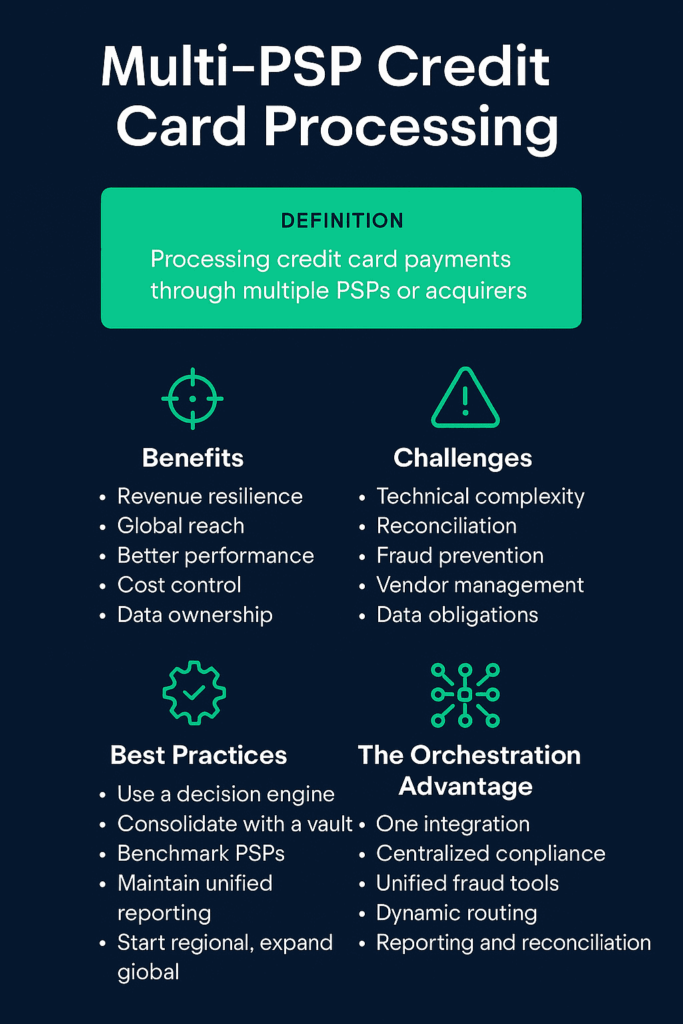
Understanding why payments fail is the first step to reducing losses. The second step is improving how payments move through providers. A single PSP creates a single point where declines and outages become unavoidable. Payment orchestration fixes this by enabling merchants to connect multiple PSPs, apply smart routing, and keep checkout active when one provider has issues. You can learn how routing avoids downtime in downtime in payments: how payment orchestration eliminates PSP outage risk.

This guide lists more than 35 reasons why credit card payments fail, grouped by the real source of the problem. It gives merchants a practical way to identify and reduce the most common causes of lost revenue.

Hard declines vs soft declines

Not every failure means the same thing. There are two broad types:

Hard declines

A permanent failure. Retrying the payment will not fix it. Example: a card that is blocked or expired.

Soft declines

A temporary issue. A retry later or a different routing path can lead to approval. Example: a brief issuer outage.

Merchants who treat all declines equally lose more sales than they should. Orchestration helps detect the type and shape the right recovery action.

35 reasons why card payments fail

A) Cardholder and issuer causes

These are the most well known to shoppers. They often look like simple issues, but they lead to a large share of failed transactions.

1. Insufficient funds: The most common consumer-related decline. Simple and final.

2. Credit limit reached: The cardholder still has the card, but no available credit.

3. Card expired: The card has a new expiration date, but the stored payment method has not been updated.

4. Incorrect card details: Typos in card number, CVV, or expiration. A checkout should validate entries clearly to reduce this.

5. Billing address mismatch: If the Address Verification System does not match the card issuer’s records, a decline may follow.

6. Fraud suspicion on issuer side: Unusual location or spending pattern triggers a block. This happens often with cross border transactions.

7. Card not activated: A new or replacement card exists but the cardholder never activated it.

8. Card blocked for security: Banks block cards used in leaked data incidents or suspected compromises.

9. Card closed or cancelled: A shopper may not realise the account is no longer active.

10. Issuer disabled online or international payments: Many banks restrict ecommerce by default to reduce fraud.

11. Premium card restrictions: Cards with rewards or benefits may require additional checks during authorization.

12. Cross border card usage not allowed: The shopper travels or buys online from another region and the card fails unless approved manually by the bank.

13. Velocity limits reached: Issuers limit how many transactions can occur in a short period.

14. Card network unsupported by merchant: For example, a shopper tries to use a local scheme that the merchant has not enabled.

15. Returned mail or identity verification problem: Issuers suspend cards when they suspect incorrect customer identity records.

Many of these failures are not permanent. With an orchestration platform, merchants can detect a soft decline and retry the payment with a different acquirer or a different authentication step. This approach is explained further in the internal guide multi PSP credit card processing: why flexibility matters.

B) Merchant or checkout flow issues

These failures originate on the merchant’s side or in the PSP connection. They are preventable with stronger design and monitoring.

16. Misconfigured gateway settings: Incorrect credentials, endpoints, or transaction type setup block approvals.

17. Checkout errors: Broken front end functionality or JavaScript errors interrupt the payment submission.

18. Duplicate transaction attempts: When a customer clicks twice or a request repeats, some PSPs auto block the transaction.

19. Unsupported payment types or currencies: If the card brand or currency does not match the configured merchant account.

20. Fraud rule rejects: Rules that are too strict decline legitimate customers. Balance matters.

21. Incomplete 3 D Secure authentication: If authentication fails or is not triggered when required, especially under PSD2 in Europe.

22. Stored card lifecycle issues: Cards expire. Token updates fail. Billing cycles do not match issuer patterns.

23. Device or browser tracking failure misread as bot activity: If a fraud tool cannot validate the session correctly, it may block the payment.

24. Insufficient transaction data submitted: Missing fields such as postal code or MCC cause issuers to decline.

25. Merchant descriptor confusion: If a customer does not recognise the statement name later, disputes and future declines follow.

These merchant side failures are some of the easiest to fix. They are also the most damaging to conversion because shoppers blame the store, not the bank. Good orchestration platforms include monitoring to catch these issues early and route transactions properly. That is part of why orchestration improves checkout stability, outlined in payment orchestration vs PSP in Europe: why flexibility and resilience matter.

C) Technical, routing, and network issues

These failures happen behind the scenes. The shopper did everything correctly, but the payment flow breaks somewhere between the merchant, PSP, acquirer, or issuer. This category often hides large revenue losses because merchants do not always see the cause in real time.

26. PSP downtime or interruption: A provider’s service goes offline. Merchants without backup routes lose every sale until it returns. Orchestration avoids this by switching traffic instantly. For more detail, visit downtime in payments: how payment orchestration eliminates PSP outage risk.

27. Slow or unresponsive API: High latency stops transactions from completing within the allowed time window.

28. Acquirer timeout: Even if the PSP responds, the acquirer might not. These timeouts often qualify as soft declines and succeed with retry or alternate routing.

29. Token vault mismatch: When storing card data, the PSP token might no longer match the underlying card or network rules. A tokenized transaction can fail if update services are not in place.

30. Data formatting errors: Incorrect field structure, character limits, or currency codes lead to automatic declines before authorization reaches the issuer.

31. Routing inefficiency: Without dynamic routing, some transactions travel farther to reach an issuer and expire before a response arrives.

32. Network outage between PSP and acquirer: Connectivity problems outside the merchant’s infrastructure are rare but expensive when they occur.

33. Fraud engine or risk tool conflict: When multiple systems evaluate a single payment, conflicting decisions can cause a decline without a clear rejection reason.

34. 3 D Secure challenge errors: Authentication may fail because of pop up blockers, browser incompatibility, or session timeouts.

35. System shows a generic decline code: Issuers sometimes return non descriptive decline messages like “Do not honor”. Merchants cannot act on these without deeper analytics or real time routing alternatives.

Most of these issues are invisible to merchants using a single PSP. A payment orchestration platform replaces blind spots with real transaction observability and automated fallback routes. It creates a clear log of failure points to prioritize fixes. This makes operations more resilient and reduces unnecessary declines.

D) Fraud, regulation, and business model issues

Not all declines are technical. Some result from risk controls and compliance requirements that protect the network.

36. Transaction flagged as high fraud risk: Issuer models see a pattern they do not trust. Passing better signals such as address and device increases approval probability.

37. Friendly fraud history on cardholder: If previous disputes occurred, issuers may treat new transactions cautiously. A clear descriptor helps reduce this risk.

38. Merchant under sanctions review: If a merchant or its industry faces increased regulatory scrutiny, issuers may stop accepting payments temporarily.

39. Country or region not permitted: Some issuers block payments by country. Local acquiring and regional schemes reduce this exposure.

40. SCA or 3DS compliance failure in Europe: If PSD2 rules are not met, issuers decline by default. Assisted authentication and orchestration workflows solve this. More guidance is available in embedded payments compliance in Europe: what merchants need to know.

41. High chargeback ratio: Card networks protect themselves from repeated loss by restricting merchants with excessive disputes.

42. Merchant category not supported by issuer: Some industries are considered too risky without proper onboarding controls.

43. Fraud scoring from merchant too low or too high: If risk tools block too many legitimate customers or approve too many bad ones, success rates drop.

44. Token update failure: Recurring payments fail when card data changes and the update is not processed. A multi PSP vault prevents this through automatic refresh. Learn more in what is an agnostic vault.

45. Digital wallets not configured correctly: Apple Pay, Google Pay, and other wallets require validation. Missing configuration leads to silent failures.

These risks grow as merchants expand globally. Regulations, networks, and fraud tactics vary by region. An orchestration strategy gives merchants flexible control over rules, authentication flows, and token lifecycles so revenue does not disappear due to preventable declines.

Smarter response: what merchants can do

With the right infrastructure, a decline is not always a lost sale. Merchants should:

  • Detect whether the decline is soft or hard
  • Retry transactions intelligently using alternate providers
  • Localize routing to relevant acquirers and schemes
  • Reduce friction with wallets and address validation
  • Monitor patterns and optimize checkout fields
  • Keep an eye on success rates by card network and issuer

Strong performance rules recover many failures that used to be accepted as normal loss.

To understand how multi PSP routing helps protect revenue at scale, read payment orchestration vs PSP in Europe: why flexibility and resilience matter.

How to reduce credit card payment failures

Card payment success should never depend on chance. Merchants that handle declines proactively keep more revenue, create better customer experiences, and earn trust through smooth checkout performance. Below are practical steps with direct revenue impact.

1. Apply dynamic routing

Different providers perform better in different regions and for different card types. Instead of sending every transaction through one PSP, apply routing rules that choose the best acquirer in real time. This reduces both issuer rejection and technical decline rates.

To understand how multi PSP setups improve performance, see multi PSP credit card processing: why flexibility matters.

2. Adopt fallback options during outages

If a provider experiences downtime, every transaction routed through them fails. Automatic fallback to another PSP keeps checkout active even when one route is unavailable.

Details are explained in downtime in payments: how payment orchestration eliminates PSP outage risk.

3. Use local acquiring and regional networks

Issuers trust domestic routing more than cross border. Local acquiring improves approval rates and reduces currency conversion fees. In Europe, support for Carte Bancaire, iDEAL, and regional debit rails increases first try success.

4. Improve data quality at checkout

Issuers require specific data characteristics to accept payments. A checkout form that prevents typos and collects accurate billing data protects revenue instantly.

Checklist for improving checkout trust signals:

  • Postal code validation
  • Full cardholder name
  • CVV entry that blocks incorrect digits
  • Clear address structure
  • Device fingerprinting for fraud intelligence

5. Smooth authentication flows

Under PSD2 in Europe, SCA friction is a common failure point. Keep the experience short. Enable exemptions when appropriate. Support wallet authentication that reduces friction entirely.

Merchants can find guidance on compliance strategy in embedded payments compliance in Europe: what merchants need to know.

6. Maintain token freshness for stored cards

Card on file success declines every month as credentials change. Use an orchestration vault that supports automatic lifecycle updates.

Learn how token portability supports this in what is an agnostic vault.

7. Understand decline codes and take action

Never treat declines as a single bucket. Review issuer feedback patterns and compare them by network, geography, and card type. Many soft declines succeed when retried through a different provider.

8. Track performance over time

Approval rates tell you whether revenue protection improves. Best practice is to review:

  • Success rate by currency
  • Success rate by device
  • Success rate by issuing bank
  • Fraud tool impact on performance

Reporting dashboards inside orchestration platforms provide this view across all PSPs.

FAQ

Why are card payments declining more often now?

More fraud controls, more authentication rules, and more cross border ecommerce increase rejection risk unless merchants optimize routing and authentication strategies.

Do most declines come from fraud suspicions?

Fraud suspicion is one major cause, but technical failures and misconfigurations are equally common and often ignored.

How many declines can actually be recovered?

A large share of soft declines can succeed when retried through another PSP or after re authentication. Orchestration automates this.

Do digital wallets reduce card failures?

Yes. Wallets carry stronger identity signals and reduce data entry errors, both of which improve issuer trust.

Should merchants monitor approval rate daily?

Large merchants should. Volume makes even small drops costly.

Can orchestration really help improve issuer trust?

Yes. By enriching data, localizing routing, and improving authentication quality, orchestration aligns transactions with issuer expectations.

Payment failures will always exist, but merchants should not accept them as a permanent revenue loss. Many declines happen far from the customer and can be recovered with better routing, better data, and better visibility.

Payment orchestration creates a unified way to connect multiple PSPs, optimize approval rates, and avoid stoppages when a provider breaks. It gives merchants full control over the payment path, reduces friction for shoppers, and protects every sale that is worth winning.

Contact Gr4vy to improve approval rates, recover more failed payments, and build a payment stack that keeps revenue flowing.

Merchant credit card fees: all you need to know

Accepting credit cards remains essential for merchants, but every swipe or online checkout comes with fees that quietly erode profit margins. These charges cover the costs of card networks, banks, processors, and risk management. Yet most merchants have limited visibility into how those costs are structured or where they can optimize them.

For many businesses, payment orchestration is changing that equation. Instead of relying on a single PSP or acquirer, orchestration connects multiple providers through one platform, allowing merchants to compare, route, and control transactions to reduce fees and improve approval rates.

What merchant credit card fees include

Every credit card transaction involves three core fee categories:

  1. Interchange fees – Paid to the issuing bank, these fees compensate for fraud risk and credit handling. They’re set by card networks like Visa or Mastercard and vary by card type, region, and risk level.
  2. Assessment fees – Paid to the card networks for maintaining their infrastructure. These are typically fixed percentages applied to all transactions.
  3. Processor markups – The portion charged by your PSP or acquirer to manage authorization, settlement, and reporting. This is the part you can negotiate or optimize.

Together, these costs can total 1.5% to 3.5% of each transaction. But the real challenge is that rates differ by country, industry, and transaction type. For instance, online (card-not-present) payments are riskier and therefore more expensive than in-person EMV or contactless ones.

To understand how acquirers and PSPs affect total transaction cost, see acquirer fee optimization in Europe: strategies for faster authorization and lower costs.

Where fees appear in the transaction flow

Each card payment involves several moving parts. A customer enters their card details, the payment request moves through the PSP, the acquiring bank, and the card network, then reaches the issuing bank for authorization. Each step adds a fee.

The problem for merchants is fragmentation. Different acquirers use different reporting systems, and PSPs don’t always provide full visibility. Payment orchestration solves this by consolidating all PSP and acquirer data into a single dashboard. That unified view helps merchants identify which route carries higher costs or lower approval rates.

For example, one provider might offer a lower interchange fee but higher cross-border charges. With orchestration, merchants can set routing rules to balance performance and cost.

You can read more about multi-PSP flexibility in payment orchestration vs PSP in Europe: why flexibility and resilience matter.

Common pricing models merchants face

Merchants encounter different billing structures depending on their provider:

  • Flat-rate pricing – A simple fixed percentage and per-transaction fee (for example, 2.9% + $0.30). Easy to predict but expensive for high-volume businesses.
  • Interchange-plus – The provider passes interchange and assessment costs directly to the merchant and adds a small markup. Transparent and ideal for scaling.
  • Tiered pricing – Cards are grouped into “qualified” and “non-qualified” buckets. The latter carry higher rates and less transparency.
  • Subscription or membership models – The merchant pays a monthly fee and low per-transaction costs. Works well for high-volume environments.

Each model shifts how risk and cost are distributed. Without orchestration, merchants have little flexibility to adapt pricing across markets. By contrast, orchestration enables dynamic routing — directing transactions toward acquirers or PSPs with lower fees, without adding technical overhead.

Cross-border and hidden fees

Hidden costs often appear once businesses start expanding internationally. Examples include:

  • Cross-border interchange surcharges for foreign-issued cards.
  • Dynamic currency conversion (DCC) markups.
  • PCI DSS compliance fees from PSPs or acquirers.
  • Chargeback handling fees per dispute.

These can quietly raise effective transaction costs by 0.3–0.8% depending on the market. Merchants operating across currencies benefit from orchestration’s ability to route transactions to local acquirers, reducing cross-border charges and improving authorization rates.

For more on this topic, explore why payment orchestration matters for merchants expanding cross-border.

The orchestration advantage in cost optimization

Traditional setups tie merchants to a single PSP, making it impossible to compare costs or performance. Payment orchestration platforms like Gr4vy change this dynamic by offering:

  • Centralized monitoring of interchange and acquirer costs.
  • Configurable rules for least-cost routing.
  • Real-time failover if a PSP experiences downtime.
  • Simplified management of tokens, currencies, and settlement.

This approach not only saves time but reduces cost by up to 20–30% in high-volume environments, especially when combined with local acquiring strategies and token portability.

Advanced strategies to reduce merchant credit card fees

Merchants have more power than they think when it comes to optimizing card acceptance costs. The key is combining operational awareness with the right technology stack — particularly payment orchestration — to turn fee management into an ongoing strategy instead of a static negotiation.

1. Use local acquirers where possible

Processing transactions through a local acquirer improves authorization rates and avoids cross-border fees. When a French cardholder pays on a site processed through a French acquirer, the transaction is treated domestically rather than as international. This reduces interchange and assessment costs.

Payment orchestration platforms simplify this by connecting multiple local acquirers under one integration, allowing merchants to route transactions automatically based on the card’s origin. This setup helps scale internationally without maintaining separate technical connections.

2. Monitor and adjust routing rules

Not every PSP performs equally in every market. Some charge higher markups for certain currencies or card types. Others have latency issues that affect approval rates and cost efficiency.

Through orchestration, merchants can monitor these differences and automatically direct transactions to the least-cost or highest-performing provider. For example, if one PSP raises fees for premium cards, you can instantly switch routing to another provider — no code changes needed.

A deeper look at routing and cost strategies is available in acquirer fee optimization in Europe: strategies for faster authorization and lower costs.

3. Leverage interchange optimization programs

Card networks often provide special interchange categories for specific industries or transaction types. Merchants processing recurring payments, for instance, can qualify for lower rates by correctly passing billing and cardholder data.

With orchestration, these parameters can be configured at the workflow level. This ensures all transactions are enriched with the right data to qualify for optimized interchange, reducing costs at scale.

4. Avoid unnecessary cross-border surcharges

Cross-border fees typically apply when the acquirer country doesn’t match the card-issuing bank’s location. These fees can reach 1% or more of the transaction amount.

By routing through local acquirers and currencies, merchants can bypass many of these costs. Orchestration layers detect card origin, currency, and region in real time, applying routing rules automatically.

If you’re expanding to new markets, read why payment orchestration matters for merchants expanding cross-border.

5. Automate reconciliation and fee reporting

Multiple PSPs often mean fragmented invoices and inconsistent reporting formats. Reconciling them manually adds cost and delays.

Orchestration centralizes fee and transaction data into one dashboard. This allows merchants to track their effective cost per transaction and identify where margin losses occur — whether through excessive markups, network fees, or low-performing acquirers.

This unified view also simplifies negotiations. When you know your approval rates and provider costs, you can demand better terms.

6. Combine orchestration with tokenization for stored cards

Recurring and saved-card payments often incur higher fraud and interchange rates if not tokenized properly. By using orchestration with a cloud vault, merchants can securely store and reuse payment credentials across providers, reducing declines and maintaining PCI compliance without multiple storage systems.

7. Calculate your true effective rate

Most merchants know their nominal rate but not their effective rate, which includes every cost across PSPs, refunds, and chargebacks. The formula is simple:

(Total fees ÷ total processed volume) × 100 = Effective rate (%)

Payment orchestration platforms automate this analysis, letting merchants benchmark their cost performance and identify outliers. Over time, this transforms fee management into a data-driven process instead of guesswork.

See key industry insights in 50 payment and merchant statistics shaping Europe in 2025.

Compliance and data portability

Fee optimization is also tied to compliance and data control. Every time merchants switch providers, they risk data lock-in or re-tokenization costs. An orchestration platform prevents this through data portability — allowing merchants to move encrypted tokens freely between PSPs.

This approach reduces both regulatory exposure and operational costs. It also aligns with emerging data localization standards across Europe and APAC, where merchants must process data within local jurisdictions.

For more information, see what is sovereign cloud? an updated guide.

FAQ: merchant credit card fees

What are merchant credit card fees?

They’re the total cost merchants pay to accept card payments, including interchange, network, and processor fees.

Why do credit card fees vary by region and card type?

Card networks set rates based on local regulation, transaction risk, and card benefits. Premium cards carry higher fees because they include rewards and insurance.

Can payment orchestration reduce merchant fees?

Yes. By enabling dynamic routing, local acquiring, and centralized reporting, orchestration helps merchants lower processing costs and improve transparency.

Are cross-border payments always more expensive?

Not necessarily. Merchants using orchestration can route transactions through regional acquirers, avoiding many cross-border surcharges.

How can merchants negotiate better fees?

Understand your effective rate, benchmark performance across providers, and use orchestration data to negotiate based on volume and approval performance.

Merchant credit card fees are complex, but they don’t have to stay opaque. By understanding fee components and leveraging orchestration, businesses can turn payment costs into controllable variables rather than fixed expenses.

A well-orchestrated payment stack lets you connect local acquirers, optimize routing, reduce interchange exposure, and unify compliance under one structure — all while maintaining resilience and uptime.

Contact Gr4vy to learn how orchestration helps merchants manage credit card fees effectively and build a smarter, more profitable payment strategy.

What is credit card encryption? A merchant’s guide to secure payments

Credit card encryption protects cardholder data as it moves through checkout. Every second, millions of transactions travel across networks, gateways, and PSPs. Without encryption, that data can be read, copied, or stolen. For merchants, this isn’t only about compliance; it’s about safeguarding customer trust and preventing fraud losses.

Encryption turns readable card information into unreadable code during transmission. Even if intercepted, it’s useless without the right decryption key. This makes encryption a critical layer of defense for merchants processing card-not-present payments, where most fraud occurs.

To understand how it fits into the broader payment security landscape, see what is payment fraud? an updated guide for 2025.

What credit card encryption does

When a customer enters card details at checkout or taps a card at a terminal, the data is immediately encrypted before leaving the device. The payment gateway or processor decrypts it only when authorized.

This process prevents exposure of sensitive fields like:

  • Card number (PAN)
  • Cardholder name
  • Expiration date
  • CVV or security code

Modern encryption uses advanced algorithms such as AES (Advanced Encryption Standard) and RSA to secure data in transit. The goal is simple: ensure that any intercepted information is useless to anyone but the authorized recipient.

Encryption also supports end-to-end protection. In a properly designed system, card data remains encrypted from the customer’s device to the acquirer. This minimizes the risk of data breaches during transmission or storage.

Encryption vs tokenization

Encryption hides card data while it travels. Tokenization replaces it entirely once stored. After a transaction, a token — a random string unrelated to the real card number — is generated and stored for future use.

Encryption and tokenization work best together. Encryption protects data in motion; tokenization protects it at rest. Merchants storing card-on-file for subscriptions, loyalty programs, or repeat payments should implement both.

Why merchants need encryption

Data breaches cost more than fines. They destroy customer confidence and damage brand reputation. With average breach costs now exceeding $4 million, encryption is a baseline requirement.

Beyond security, encryption reduces PCI DSS scope. Systems that never handle unencrypted card data require fewer compliance controls. This lowers audit costs and makes ongoing certification more manageable.

In the card-present world, EMV chips and contactless cards rely on encryption to protect transaction data. In ecommerce, end-to-end encryption plays the same role. For merchants handling both, maintaining consistent encryption across channels is key.

Orchestration simplifies this. By managing multiple PSPs and payment methods under one platform, merchants can apply uniform encryption and tokenization standards.

How payment orchestration strengthens encryption

Encryption alone cannot manage fragmented systems. Many merchants rely on multiple gateways, each with its own encryption keys, token format, and compliance rules. This increases the chance of inconsistency and error.

Payment orchestration centralizes encryption policies across all providers. Through a single control layer, merchants can:

  • Apply encryption and tokenization consistently.
  • Manage keys and credentials securely.
  • Maintain compliance across PSPs and acquirers.
  • Route transactions dynamically without exposing sensitive data.

This unified approach makes compliance audits faster and keeps data protection standards uniform across markets. It also enables data portability, a key requirement for merchants looking to switch providers or expand globally.

For more on orchestration’s role in global scale, see why payment orchestration matters for merchants expanding cross-border.

Implementing credit card encryption successfully

For merchants, the real challenge isn’t understanding encryption—it’s deploying it consistently across multiple systems, PSPs, and regions. Without a clear structure, encrypted and unencrypted data can coexist, leaving hidden vulnerabilities.

Step 1. Audit your payment flow

Start by mapping where cardholder data enters, moves, and gets stored. Identify points where raw card data may appear before encryption begins—such as checkout fields, terminals, or APIs. Every gap between capture and encryption increases exposure risk.

A good audit covers:

  • Card entry points (POS, mobile, or web checkout)
  • Transmission paths (gateways, APIs, third-party vendors)
  • Storage systems (databases, CRMs, loyalty programs)

By documenting this, merchants can define where encryption must start and where tokenization takes over.

Step 2. Choose point-to-point encryption (P2PE)

P2PE keeps card data encrypted from the entry device to the acquirer, ensuring no system in between can view or modify it. Hardware-based P2PE devices generate unique encryption keys for each transaction, protecting against skimming or malware.

Adopting P2PE-certified solutions not only improves security but can also simplify PCI DSS audits. Because unencrypted data never touches internal systems, the number of controls in scope decreases.

Step 3. Combine with tokenization for stored cards

Encryption alone doesn’t cover recurring payments or saved cards. Once a transaction is approved, a token should replace the real card number in all systems. These tokens allow merchants to offer one-click checkout or subscriptions without retaining sensitive data.

This approach also enables data portability, letting merchants move tokens between PSPs without re-entering card data. Platforms like Gr4vy simplify this process through a cloud-based vault designed for multi-PSP environments. Learn more in what is an agnostic vault?.

Step 4. Manage keys securely

Encryption is only as strong as its key management. Keys should rotate periodically and never be stored with the data they protect. Merchants should rely on secure hardware modules (HSMs) or trusted key management services offered by their orchestration or PSP provider.

Step 5. Monitor and test regularly

Security isn’t static. Test decryption processes, review logs, and verify that no plaintext card data appears in your systems. Automated scans and incident simulations help ensure encryption stays effective.

How orchestration simplifies encryption at scale

Merchants handling multiple PSPs, acquirers, and payment methods face fragmented encryption policies. Each provider can use a different key set or encryption standard, complicating audits and risking data mismatches.

A payment orchestration platform standardizes encryption across all routes. Through one integration, it applies uniform encryption, manages tokens centrally, and routes transactions securely based on region, cost, or performance.

It also enables fallback during outages. If one PSP becomes unavailable, orchestration redirects transactions through another provider without exposing data—keeping checkout secure and uninterrupted. For a detailed example, see downtime in payments: how payment orchestration eliminates PSP outage risk.

Encryption, PCI compliance, and data localization

In regions with strict privacy laws like the EU or APAC, encryption and tokenization also help merchants comply with data localization requirements. Sensitive data can be stored and processed within specific jurisdictions while tokens move freely across systems.

This balance between compliance and operational freedom is one of orchestration’s biggest advantages. Merchants can encrypt data locally while keeping reporting, routing, and analytics centralized. For context, what is sovereign cloud? an updated guide explores this approach further.

FAQ: credit card encryption for merchants

What is credit card encryption?

It’s the process of converting readable card data into code before transmission, making it inaccessible to anyone without the correct key.

How does encryption differ from tokenization?

Encryption protects data in motion; tokenization replaces data for storage. Used together, they secure both transmission and long-term records.

Does encryption make my business PCI compliant?

It helps reduce PCI scope but doesn’t replace compliance. Merchants still need certified devices, secure key management, and annual validation.

Is encryption expensive to implement?

Not necessarily. Many orchestration and gateway providers include encryption in their standard integrations. The cost of a breach, by contrast, is far higher.

Can orchestration help with encrypted data portability?

Yes. With a platform like Gr4vy, merchants keep control of their tokens and encryption logic, simplifying PSP migrations or market expansion.

Encryption is one of the simplest ways to protect customer trust and reduce payment risk. But encryption alone isn’t enough. To work across providers, channels, and markets, it must be integrated through a unified orchestration layer.

Contact Gr4vy to build a payment architecture where encryption, tokenization, and orchestration work together to protect every transaction.

Cross-border credit card acceptance: payment orchestration advantages

Cross-border commerce continues to grow, but accepting international credit card payments remains a source of friction for merchants. A customer in France trying to buy from a UK-based store may face a failed authorization, unexpected fees, or long settlement times. For the merchant, these problems translate into lost sales and higher costs.

While wallets and local rails expand rapidly, credit cards remain the foundation of global payments. They still account for most cross-border transactions, but success depends on how merchants manage acceptance, fraud, and compliance across regions.

Without the right infrastructure, each new market adds layers of complexity. Integrating multiple payment service providers (PSPs), meeting local regulations, and maintaining compliance drains time and resources. When a single PSP goes down or fails to support a local scheme, merchants lose control of their checkout.

Payment orchestration provides a way to manage these challenges through one integration. By connecting multiple acquirers and optimizing routing in real time, orchestration allows merchants to boost approval rates, lower costs, and stay compliant — all while ensuring uptime even during PSP outages.

For a detailed look at how orchestration supports global merchants, see why payment orchestration matters for merchants expanding cross-border.

Why cross-border card acceptance is complex

Decline rates rise when borders appear

Cross-border credit card payments often fail for reasons unrelated to fraud. Issuing banks may block foreign transactions by default. Currency conversions trigger additional checks. 3-D Secure (3DS2) or Strong Customer Authentication (SCA) requirements vary between regions, leading to mismatched verification flows that confuse both systems and buyers.

A UK merchant processing a card issued in Brazil, for example, may see a decline rate two or three times higher than with domestic cards. This happens even when the buyer is genuine. The result is lost revenue and frustrated customers who rarely retry after a failed payment.

Payment orchestration reduces this friction by dynamically routing transactions to acquirers with higher regional approval rates. It also provides better visibility into the cause of each decline, helping merchants make data-driven adjustments.

Hidden costs of cross-border fees and FX conversion

Each international transaction involves multiple intermediaries — issuer, network, acquirer, and PSP — each adding its own fee. Currency conversion adds another layer, often including hidden markups of 2–4%.

These costs reduce profit margins, especially for high-volume merchants. Without local acquiring, settlements may occur in the acquirer’s base currency, forcing conversion and inflating fees. Using orchestration, merchants can connect to local PSPs and acquirers in key markets to settle directly in local currencies, lowering costs and improving acceptance.

For more on optimizing card acquiring and cost control, see acquirer fee optimization in Europe: strategies for faster authorization and lower costs.

Fraud and compliance barriers

Fraud risk is higher in cross-border transactions because issuers have less data on the buyer. Regulatory frameworks also vary widely. In Europe, PSD2 requires strict authentication, while other regions rely on network rules and issuer discretion.

Merchants must comply with multiple standards simultaneously — from AML/KYC obligations to local tax rules and privacy laws. Many still rely on legacy payment systems that are not flexible enough to adapt quickly.

A payment orchestration platform helps unify fraud management and compliance. Merchants can centralize fraud tools, apply consistent risk rules across PSPs, and ensure authentication aligns with local requirements. This is similar to the benefits outlined in embedded payments compliance in Europe.

Settlement and reconciliation delays

Cross-border payments often move through multiple intermediaries before reaching a merchant’s account. This slows settlement and makes reconciliation difficult. Delays also affect cash flow and accounting accuracy.

With orchestration, settlement data from all PSPs can flow into one dashboard. Merchants can compare performance, fees, and timing by region or acquirer, giving full visibility over funds movement.

Local scheme differences

Card preferences and network rules differ from country to country. In France, Carte Bancaire remains dominant, while in Germany many consumers still prefer Girocard or SEPA-based payments. In Asia-Pacific markets, regional card schemes coexist with global brands.

If a merchant only supports Visa and Mastercard, acceptance gaps can appear. Orchestration bridges this by allowing merchants to connect to local schemes through a single integration. That means better reach without adding complex one-off PSP connections.

Legacy infrastructure limits growth

Many businesses still process payments through legacy PSP integrations built for domestic markets. Each new country requires another connection, API, or compliance review. Over time, this architecture becomes fragile and costly.

Orchestration replaces this patchwork with a future-ready payment layer that supports multiple PSPs, local acquirers, and fraud tools through configuration rather than code. Merchants no longer depend on one provider or one infrastructure, giving them freedom to expand quickly without rebuilding their checkout.

Strategies to improve international credit card acceptance

1. Use local acquiring partners

Approval rates rise when transactions are processed domestically. Local acquiring ensures the issuer, acquirer, and network operate within the same geography, reducing cross-border friction and avoiding unnecessary conversion steps. Through payment orchestration, merchants can connect to several acquirers in key markets without separate integrations.

2. Route transactions intelligently

Smart routing can direct traffic to the PSP or acquirer with the best historical approval rates for each region. With orchestration, this logic happens automatically, based on live performance data. Merchants can also define rules for cost-based routing, selecting the least-fee path when multiple PSPs support the same currency or network.

For examples of efficient routing and performance strategies, see acquirer fee optimization in Europe: strategies for faster authorization and lower costs.

3. Offer regional payment methods and schemes

Supporting local networks such as Carte Bancaire in France or domestic debit systems in Southeast Asia can lift conversion rates dramatically. Orchestration lets merchants activate these schemes through one unified integration, removing the need for individual contracts or long certification cycles.

4. Manage currency and settlement transparently

Presenting prices in the shopper’s currency reduces confusion and increases trust. Orchestration enables multi-currency processing and can settle in local currency through the preferred acquirer. It also centralizes reporting across currencies, simplifying reconciliation and accounting.

5. Simplify Strong Customer Authentication across borders

Under PSD2, European transactions must follow SCA. When routing across acquirers, the orchestration layer can preserve authentication tokens and trigger new exemptions automatically. This keeps compliance intact even when rerouting between providers during a PSP outage or latency spike.

6. Monitor performance and adapt continuously

Cross-border card performance changes as issuers update risk models and networks revise rules. Orchestration platforms give merchants a single dashboard to compare acceptance rates, fraud levels, and cost by region. That insight turns static global payment setups into adaptive systems that keep improving over time.

For broader context, why payment orchestration matters for merchants expanding cross-border explains how this visibility supports expansion and revenue growth.

The orchestration advantage for cross-border credit card acceptance

Traditional global setups depend on a single PSP or a network of custom integrations. Each PSP maintains its own reporting format, tokenization rules, and fraud settings. As transaction volume scales, this structure becomes rigid and expensive.

Payment orchestration replaces that model with a unified control layer. Merchants integrate once and gain access to multiple PSPs, local acquirers, and fraud vendors. The orchestration layer handles:

  • Real-time routing and failover when a PSP or acquirer underperforms.
  • Centralized token management for card-on-file payments across regions.
  • Unified compliance logic that applies SCA, PCI, and data-privacy standards consistently.
  • Consolidated reporting for reconciliation and fee comparison.

This approach removes single-point failure, cuts integration costs, and shortens time to market for new countries. It also helps merchants remain resilient during provider downtime, a topic explored in Downtime in payments: how payment orchestration eliminates PSP outage risk.

Implementation roadmap

  1. Audit performance – Identify where cross-border declines and chargebacks occur.
  2. Select regional PSPs – Choose acquirers with strong local approval rates.
  3. Integrate through orchestration – Connect once and configure routing, currencies, and fraud settings.
  4. Test and monitor – Compare pre- and post-orchestration performance.
  5. Scale gradually – Expand to additional countries using the same control layer.

FAQ: cross-border card acceptance for merchants

Why do cross-border credit card transactions decline more often?

Issuing banks apply stricter risk filters to foreign transactions. Different authentication rules and currency conversions also increase the chance of false declines.

How can merchants reduce FX and cross-border fees?

Process transactions through local acquirers when possible and use orchestration to settle in the cardholder’s currency, reducing unnecessary conversions.

Is it legal to surcharge international cardholders?

It depends on local regulations and card network rules. Some markets restrict surcharging, so merchants should review each region’s laws.

Does orchestration reduce compliance complexity?

Yes. It centralizes SCA, PCI, and data-privacy workflows across multiple PSPs, reducing duplication and risk.

When is local acquiring essential?

When cross-border approval rates or costs become too high, local acquiring improves success and lowers fees.

Cross-border credit card acceptance is essential for growth but difficult to manage. Currency conversion, regulatory diversity, and inconsistent approval rates make international expansion risky without the right structure.

Payment orchestration gives merchants the flexibility and control they need to succeed globally. By unifying connections, routing, and compliance, it turns complex cross-border card processing into a reliable, scalable system that drives revenue rather than risk.

Contact Gr4vy to build a cross-border payment stack that delivers higher acceptance, lower costs, and true global reach.

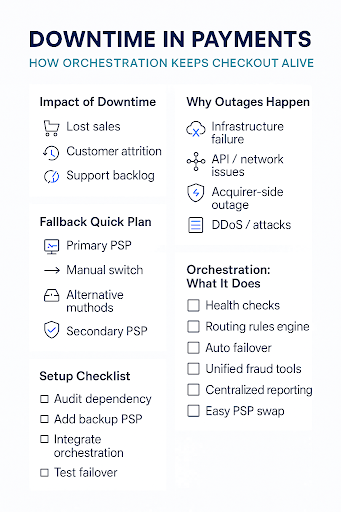
Downtime in payments: how payment orchestration eliminates PSP outage risk

Payment downtime stops revenue instantly. When a payment service provider (PSP) goes down, there is nothing merchants can do except wait until it comes back online. Shoppers abandon carts, support teams handle complaints, and every minute of silence costs money. Without a fallback connection, even short outages can turn into hours of lost sales.

PSP downtime is not rare. High transaction peaks, system upgrades, and unexpected technical issues can disrupt card authorization and wallet payments. Merchants relying on a single PSP have no safety net when that provider goes offline.

Payment orchestration changes this. By connecting multiple PSPs under one control layer, merchants can reroute transactions instantly and keep sales moving when one provider fails. This article explains why downtime in payments matters, what causes PSP outages, and how orchestration offers reliable fallback options to protect revenue.

The cost of PSP outages

Payment downtime is expensive in two ways.

Direct loss of sales

If a PSP outage hits during peak traffic — a flash sale or seasonal rush — customers cannot pay. Many abandon checkout instead of retrying later. The lost revenue is immediate.

Brand and support impact

Shoppers remember failed checkouts. Trust suffers, reviews reflect frustration, and support costs rise as teams manage complaints and refunds. For subscription businesses, failed initial charges mean churn before the customer even starts using the product.

Studies show downtime can cost large retailers hundreds of thousands of dollars per hour. Even mid-sized merchants lose thousands during a single PSP outage. Real uptime depends not just on a provider’s SLA but on having fallback routes ready.

For background on global payment system reliability and how merchants design modern stacks, see Why payment orchestration matters for European merchants expanding cross-border. While written for Europe, its principles apply globally.

Common causes of downtime in payments

PSP outages happen for many reasons:

  • Infrastructure failure: Data center or cloud issues cause API timeouts and declines.
  • Network and API disruptions: Integration endpoints go offline or respond too slowly.
  • Bank or acquirer outages: The PSP may depend on a bank network that fails.
  • Maintenance and upgrades: Scheduled work sometimes causes unexpected downtime.
  • Traffic surges or DDoS attacks: High demand can overload payment systems.

No provider is immune. Even PSPs promising 99.99% uptime experience incidents. Merchants should plan for failure as a certainty, not a possibility.

What to do when a PSP goes down

Merchants facing PSP downtime have several options, each with trade-offs:

Manual switching

Some teams keep backup PSP credentials and can reroute traffic manually. This avoids complete shutdown but is slow and error-prone, especially under pressure.

Redirect to alternative payment methods.

Offering digital wallets or local APMs can keep some sales alive during a PSP outage. But this only helps if customers adopt those methods, and checkout UX supports quick switching.

Queue transactions

Holding payments until service returns protects orders but delays fulfillment and creates customer frustration.

Automated failover

The most reliable strategy is automated failover; traffic moves to another PSP instantly when the primary fails. But building this logic in-house is complex and expensive.

For guidance on supporting more payment types globally, see How to accept alternative payment methods. Broad method coverage strengthens resilience when a single rail goes down.

Routing logic and fallback design

Fallback success depends on how routing is set up. Merchants can choose between static and dynamic approaches.

  • Static fallback: Define a backup PSP that only activates when the primary fails.
  • Dynamic routing: Evaluate performance in real time, switching traffic based on latency, approval rates, and cost.

Dynamic systems also allow cascading: if one PSP fails, traffic flows to the next available route automatically.

Static vs dynamic fallback

FeatureStatic fallbackDynamic routing & failover
Setup effortSimpleHigher, but scalable
Reaction speedManual or delayedReal time
OptimizationLimitedUses performance data
CoverageOne backup PSPMultiple PSPs with cascading paths
Best forSmall setups with one backupMerchants needing global resilience

Merchants serious about protecting revenue invest in dynamic routing. The challenge is complexity,  maintaining API connections, monitoring PSP health, and reacting in milliseconds. This is where orchestration becomes essential.

How payment orchestration mitigates PSP downtime

Many merchants still rely on legacy payment systems that make every new PSP integration slow and expensive. Each connection requires development work, compliance checks, and ongoing maintenance. This complexity often discourages businesses from diversifying their payment stack, leaving them exposed when one provider fails.

Payment orchestration eliminates this limitation by acting as a single control layer over multiple PSPs. Instead of rebuilding integrations one by one, merchants connect once to an orchestration platform that manages routing, tokenization, and reporting across all providers. This setup removes the dependency on legacy infrastructure and allows real-time switching if a PSP goes offline.

Single connection, multiple PSPs

Instead of integrating with each PSP separately, merchants connect once to an orchestration platform. Adding or swapping PSPs later takes configuration, not new development. With Gr4vy, the effort of building and maintaining new PSP connections is reduced by up to 80% compared to in-house development. This agility makes it easier to expand into new markets and ensures checkout stays live if one provider goes offline.

Real-time health checks and automatic failover

An orchestration layer monitors PSP uptime and latency. If a provider slows down or stops responding, the system automatically shifts transactions to an active route. Customers continue to see a smooth checkout rather than an error screen. Merchants can also define custom routing rules to prioritize the least-cost provider, balance traffic by region, or apply business logic to specific payment methods. This turns failover into a strategic advantage, not just a backup plan.

Unified routing engine

Merchants can define rules by card type, issuer country, cost, or historical approval rates. When the primary PSP fails, these rules control where traffic goes next. For example, Visa debit from a certain BIN range can route to the PSP with the highest approval rate for that card.

Consistent fraud and security

Without orchestration, each PSP runs its own fraud checks. During a failover, merchants risk inconsistent screening. An orchestration platform applies one fraud policy across all PSPs so risk controls remain steady even during outages. For more on unified fraud management, see Fraud prevention for ecommerce: best practices for merchants.

Clear reporting and reconciliation

Switching PSPs mid-transaction can make finance teams work harder. Orchestration centralizes transaction logs, approval metrics, and settlement data, so payment operations stay clear even when traffic moves between providers.

Best practices for deploying orchestration against downtime

A strong orchestration strategy is not just about adding a second PSP. It requires planning and testing.

Start with risk mapping

Audit each market and payment method. Identify where you depend on a single PSP or acquirer and where outages would have the biggest revenue impact.

Add redundancy gradually

Start with two PSPs in one high-volume market. Configure fallback rules and monitor results. Expanding step by step reduces complexity and avoids major rollout issues.

Monitor health and decline codes

Track error rates and network latency in real time. Knowing the difference between a technical failure and a card issuer decline helps you route correctly. Merchants that analyze decline codes can choose the best fallback logic for each failure type.

Keep compliance central

When adding PSPs, card data exposure increases. Use orchestration with a secure vault to stay PCI DSS compliant and reduce audit scope. This also supports regulations such as GDPR for European customers and other privacy laws worldwide.

For merchants exploring global expansion and risk management, see Why payment orchestration matters for European merchants expanding cross-border. The same principles apply when building resilient fallback strategies.

Compliance and operational factors

Outage planning is not only technical; it is also regulatory and operational.

  • PCI DSS: Storing or transmitting cardholder data requires strict controls. An orchestration platform with a PCI-compliant vault reduces your scope.
  • Regional data rules: Europe, Brazil, and parts of Asia restrict where payment data can be stored. Orchestration platforms often support data localization to meet these laws.
  • Strong Customer Authentication (SCA): In Europe, rerouting a transaction during downtime must still comply with PSD2 Strong Customer Authentication (SCA) requirements. Merchants need orchestration that can reinitiate authentication or apply exemptions when switching PSPs. For example, if a transaction through Carte Bancaire in France fails because the PSP goes offline, the orchestration platform can automatically reprocess it through another provider while maintaining full SCA compliance.
  • Fraud continuity: Fallback routes should keep the same risk controls to avoid opening gaps during outages.

Operationally, payment, engineering, and finance teams need shared visibility. Dashboards, alerts, and reporting from orchestration reduce silos and help teams respond quickly when a PSP goes offline.

A strategic roadmap for reducing downtime risk

Merchants that want to prepare for PSP outages can follow a staged approach:

  1. Audit current PSP dependencies: List providers, their uptime history, and approval rates per market. Identify single points of failure and high-volume regions.
  2. Evaluate fallback needs: Decide which regions or payment types need redundancy first. Look at peak sales periods and high-value markets.
  3. Integrate payment orchestration: Replace manual routing with an orchestration platform. This step simplifies adding more PSPs and centralizes fraud and reporting.
  4. Build dynamic routing and health monitoring: Use real-time health checks and approval data to send traffic intelligently. Set cascading fallback rules for primary, secondary, and tertiary routes.
  5. Test failover regularly: Simulate PSP outages in a controlled way to verify fallback logic and keep teams prepared.
  6. Expand and optimize: Once failover works in one region, roll it out globally. Add local PSPs where they outperform global ones. Monitor cost and success rates continuously.

For merchants planning global expansion while staying resilient, see Card acquiring for international markets and Top 10 benefits of using payment orchestration. Both provide insight into building multi-provider strategies that balance uptime, cost, and compliance.

FAQ

Can orchestration guarantee zero downtime?

No system can promise absolute uptime, but orchestration removes single-point PSP failure and limits service disruption. Gr4vy goes further by using a single-instance cloud deployment model, which isolates each merchant’s environment. Unlike multi-tenant POPs that share infrastructure, this approach ensures that downtime in one environment never affects another. Combined with real-time failover between PSPs, it provides the highest possible availability and visibility into every transaction.

Will fallback logic slow down checkout?

Not when well configured. Health checks and routing decisions run in milliseconds. Customers typically experience no delay during PSP failover.

Is adding multiple PSPs worth the extra cost?

Yes, for most merchants processing significant volume. Resilience and higher approval rates often outweigh the added platform and contract costs.

How much work is required to add backup PSPs through orchestration?

Far less than direct integrations. Once connected to an orchestration platform, adding or replacing PSPs is mostly configuration, not custom code.

Downtime in payments costs more than lost transactions. It damages customer trust, increases support workload, and disrupts revenue during critical sales moments. PSP outages are unavoidable, but merchants do not need to be unprepared.

Payment orchestration creates the resilience modern commerce demands. It centralizes multiple PSPs, automates failover, maintains fraud consistency, and gives real-time control over routing. With orchestration, merchants can survive provider outages, keep checkout online, and focus on growth rather than firefighting.

Contact Gr4vy to design a payment stack that stays live when PSPs fail and protects revenue across every market.

What are agentic payments? A merchant’s guide to payment automation

AI shopping agents are starting to buy on behalf of consumers. They search, compare, negotiate, and pay without a person clicking checkout. This shift, often called agentic commerce, is moving quickly from idea to practice. For merchants, it creates a new kind of buyer: one that is software driven, fast, and unpredictable. It also exposes weak spots. When a payment service provider (PSP) fails, these automated buyers cannot adapt without the right infrastructure. Lost transactions, poor customer experience, and higher support demand follow.

Companies preparing for this change are looking at payment orchestration. Orchestration helps merchants build payment flows that can reroute instantly, add new fraud tools, and handle multiple providers through one integration. It already helps global businesses manage PSP downtime and regional compliance. The same flexibility will be essential as AI-driven checkouts become mainstream.

What are agentic payments

Agentic payments happen when an AI agent — rather than a human — initiates and completes a transaction. Unlike rule-based automation, these agents make decisions in real time. They can pick merchants, compare prices, and select payment methods based on context rather than a fixed script.

Early adopters describe it as a step beyond machine learning. Traditional fraud systems, for example, train on labeled data to score transactions. Agentic systems instead adjust their logic as they operate, acting more like a digital assistant than a predefined filter.

For merchants, this means checkout is no longer limited to people using a browser or app. Transactions may arrive through APIs or automated agents that do not follow human patterns. A buyer could ask an AI to reorder weekly groceries or book travel, and the agent would complete the task — including payment — with little or no user interaction.

These new behaviors demand a payment stack built for adaptability. Static integrations tied to one PSP or gateway will struggle to support AI-driven flows. Merchants already modernising their infrastructure for cross-border trade — as explained in Why payment orchestration matters for merchants expanding cross-border — are better positioned to handle this next wave.

Why merchants should pay attention now

Liability is unclear

When an AI agent buys on behalf of a person, the traditional buyer–merchant relationship becomes uncertain. If the agent misorders or purchases the wrong item, the human customer may dispute the charge. Existing chargeback systems were not designed for non-human shoppers. Merchants could face more friendly fraud, where the user claims a refund because the agent’s decision did not match their intent.

Brand visibility can disappear

Some current shopping agents mask the merchant’s name on bank statements. Instead of your store appearing, the consumer may only see the platform or AI service they used. This weakens post-sale trust and loyalty, making it harder to manage disputes or build recognition.

Fraud tools may misfire

Fraud detection systems often flag non-human behavior. Today’s device fingerprinting and bot-detection models can mistakenly block legitimate AI agents. As AI-driven checkout grows, merchants need fraud strategies that distinguish safe automated buyers from real attacks. Using orchestration helps by letting merchants centralize fraud tools and replace or upgrade them without new integrations. Our guide on fraud prevention for ecommerce explains how layered defenses can evolve with new buying models.

Key challenges in agentic payments

Authentication is not ready

Current checkout authentication assumes a human buyer. Tools like 3-D Secure and Strong Customer Authentication were built for browsers and apps, not for autonomous agents. When an AI pays on behalf of a person, there is no shared way to prove that the buyer is authorized. Transactions may be declined as fraud or, worse, approved without proper validation.

John Lunn pointed out on Behind the Checkout that the industry lacks standards for this: merchants will need “a way to verify that an agent has been authorized by a real consumer before allowing payment.” Until such systems exist, both fraud and false declines will increase.

Fraud detection needs a rethink

Most fraud tools rely on device fingerprinting and behavior patterns that expect human activity. Soups Ranjan noted that “most agentic browsers still look like bots” to current detection systems. This means genuine AI-driven purchases could be blocked, while new attack types slip through.

Merchants must rethink fraud prevention. As explained in fraud prevention for ecommerce: best practices for merchants, layered detection and flexible tooling are essential. Orchestration helps by letting you integrate and swap fraud providers quickly without rebuilding your stack.

Fake merchants and spoofed sites

AI buyers can be tricked. Fraudsters already create fake stores that look legitimate to humans; automated agents are easier to fool. Lunn warned that a bot searching for the cheapest item could land on a scam site because “you can set up hundreds of convincing stores and the agent will find them first.”

To remain trusted, merchants should provide verified API endpoints and clear identifiers that future trusted-agent directories can use.

How payment orchestration protects merchants

Resilience against PSP outages

AI-driven transactions demand uninterrupted uptime. If a PSP fails, automated checkouts stall instantly. Payment orchestration gives merchants a single control layer to connect multiple PSPs and switch traffic in real time. Instead of losing sales when a provider goes down, you can reroute payments seamlessly.

The article payment orchestration vs PSP shows how relying on a single processor exposes businesses to costly downtime. Those lessons apply directly to AI-driven buying.

Smarter routing and payment choice

Orchestration lets you manage multiple payment methods and dynamically select the best path. This keeps agentic checkouts fast and reliable. You can set fallback rules if a card fails or a PSP is unavailable, so the AI does not cancel the purchase.

Centralized fraud and compliance

With orchestration, merchants can test and upgrade fraud tools without rebuilding integrations. You can add AI-aware detection or replace outdated systems as agents evolve. It also simplifies complex regulations such as PSD3 and Strong Customer Authentication. Articles like embedded payments compliance in Europe show how orchestration keeps evolving rules manageable.

Data portability for the future

Future agentic commerce will depend on better authentication and new payment rails. Merchants using orchestration with tokenization and portable vaulting can adapt without disruption. Instead of being locked to one PSP, you keep control of customer credentials and can support new standards as they appear.

Preparing your payment stack

To prepare for AI-driven checkout, merchants should:

  • Build API-first commerce that can support non-human buyers.
  • Add multi-PSP connections for instant failover.
  • Strengthen fraud detection with tools that spot malicious bots but allow trusted agents.
  • Keep compliance flexible with a single orchestration layer.
  • Monitor trusted agent and merchant directory standards as they emerge.

The article why payment orchestration matters for merchants expanding cross-border explains how the same flexibility helps with regulation and local payment diversity — the same strategy will help with agentic buyers.

Agentic payments: Industry outlook and early adoption

Some industries are more likely to embrace agentic payments early. Grocery delivery and everyday essentials are prime candidates because the tasks are repetitive and predictable. Travel booking is another area where customers already face complex comparisons and tedious data entry. Soups Ranjan described this type of automation as “making the technology around it more efficient, more API based,” so that agents can work faster and reduce friction for users.

B2B payments could also change significantly. Invoices, reconciliation, and approval workflows are still manual in many companies. Agentic systems could automate these checks, paying suppliers automatically when terms match previous patterns. For high-value retail and luxury goods, adoption may be slower. People still want to control expensive or emotional purchases themselves.

Experts also expect a co-pilot stage before full autonomy. AI will assist with recommendations and checkout but leave final approval to the user. Full hands-off shopping will require stronger authentication and clear liability rules.

The future of payments with AI buyers

John Lunn observed that “there is no clear standard yet for authenticating AI shoppers or handling liability if something goes wrong.” This means the next few years will likely focus on building those standards. Trusted agent directories, merchant verification, and better fraud signals are likely to emerge.

New payment rails may also appear. AI shoppers could use virtual cards, specialized wallets, or even stablecoins if on-boarding and compliance become simpler. Merchants should expect rapid experimentation in how AI agents hold and spend funds.

Payment orchestration will remain a bridge while these standards develop. Platforms that provide multi-PSP routing, token portability, and real-time failover will help merchants stay resilient as buying patterns shift. Articles like payment orchestration vs PSP and acquirer fee optimization show how orchestration already supports complex routing and cost control. The same strategies will apply when AI agents become routine buyers.

Frequently asked questions

What are agentic payments?

Payments initiated and completed by AI agents that act on behalf of human users. These agents search, compare, and check out automatically.

How do agentic payments differ from machine learning or simple automation?

Machine learning follows pre-trained models. Agentic AI can adapt its decision-making while it runs, changing how it shops and pays based on context.

Are merchants liable if an AI buyer makes a wrong purchase?

Current chargeback rules were built for human shoppers. Liability is still unclear. Merchants may face more friendly fraud until new standards define who is responsible.

How should merchants protect against fraud with AI shoppers?

Use adaptive fraud tools and an orchestration layer to test and swap providers. Keep detection flexible enough to distinguish trusted agents from malicious bots. See fraud prevention for ecommerce: best practices for merchants for guidance.

How does payment orchestration support agentic commerce?

It lets merchants connect multiple PSPs, build failover routing, centralize fraud tools, and stay flexible as new authentication and payment standards appear.

Preparing now

AI-driven payments will grow steadily. Merchants that act early will avoid outages, false declines, and fraud while staying visible to both human and agent buyers. Building an API-first checkout and using payment orchestration to manage PSPs, fraud, and compliance will protect revenue as agentic commerce matures.

Contact Gr4vy to learn how our orchestration platform helps you stay resilient and ready for the next generation of payments.

Credit card fraud prevention for merchants: all you need to know

Credit card fraud drains billions from businesses every year. For merchants, it means more than lost revenue. Fraud drives up chargeback fees, damages reputation, and increases operational workload. Customers who experience fraud often lose trust and may not return.

This article explains what credit card fraud is, why merchants are exposed, and how to fight it with practical tools and strategies. It also shows how payment orchestration helps unify fraud prevention across providers and markets.

Understanding credit card fraud

Credit card fraud happens when someone uses stolen or unauthorized card information to make purchases. It ranges from simple theft of card numbers to complex identity fraud rings.

Card-not-present (CNP) fraud dominates ecommerce. Criminals use stolen details online where the card does not have to be physically shown. Account takeover occurs when fraudsters gain access to a customer’s account and use stored cards. Synthetic identity fraud combines real and fake data to create new profiles for fraud.

Card networks and banks play a role in prevention. When asked “How do credit card companies prevent fraud?”, the answer is layered controls:

  • Real-time transaction scoring
  • Address Verification System (AVS) and CVV checks
  • Velocity and spending pattern analysis
  • Strong Customer Authentication (SCA) in markets like Europe

But these protections do not stop all fraud. Merchants still face chargebacks when fraud bypasses issuer defenses.

For a deep look at evolving threats, see What is payment fraud: an updated guide for 2025.

Friendly fraud: when customers dispute real purchases

Not all fraud comes from criminals. Friendly fraud happens when a legitimate customer disputes a charge they actually made. This could be accidental — such as forgetting a subscription renewal — or intentional, when someone tries to get goods for free.

Friendly fraud is hard to fight because it starts with a real transaction and passes security checks. By the time the customer disputes the charge, the merchant has shipped the product or delivered the service.

Early warning signs include:

  • Customers who frequently claim non-delivery
  • Unusually high refund requests after delivery
  • Chargebacks soon after recurring billing

For details on prevention and dispute handling, see What is friendly fraud: a guide for merchants.

How merchants deal with credit card fraud

When merchants ask “How do merchants deal with credit card fraud?”, the answer is layered defense:

  1. Risk screening tools to score every transaction.
  2. 3-D Secure 2 and SCA to authenticate customers.
  3. Device fingerprinting and behavioral analytics to detect bots or account takeover.
  4. Manual review for suspicious high-value orders.
  5. Chargeback response systems to dispute fraudulent claims with evidence.

Merchants that sell across borders also need region-specific rules. For example, BIN attacks (automated testing of stolen card numbers) are common in the US and Latin America. In Europe, fraud often exploits SCA exemptions or recurring payment flows.

Merchant liability and compliance

Many businesses wonder “How are merchants liable for credit card fraud?” Liability depends on authentication and payment type:

  • If a merchant does not apply required Strong Customer Authentication under PSD2 and a fraud case occurs, they often bear the cost.
  • In card-not-present environments outside Europe, merchants usually carry the liability once the issuer authorizes the payment.
  • Chargebacks shift the financial loss to merchants when customers dispute fraudulent transactions.

Understanding liability helps merchants choose the right fraud controls and weigh risk against conversion.

Global regulatory examples

Fraud prevention is shaped by local laws. PSD2 in Europe made SCA mandatory to cut card-not-present fraud. The Philippines introduced RA 8484, also known as the Access Devices Regulation Act, to punish credit card fraud and protect cardholders. While RA 8484 targets criminals, it also forces businesses to handle card data securely and cooperate with investigations.

Similar regulations exist elsewhere: the US enforces PCI DSS, Brazil enforces LGPD on data, and many APAC markets are strengthening consumer fraud protections. Merchants with global reach must follow each region’s rules while keeping a consistent fraud strategy.

Key fraud prevention tools for merchants

Fraud prevention is most effective when merchants combine multiple tools into one defense system rather than relying on a single check.

Address Verification System (AVS) and CVV checks

AVS compares the billing address entered at checkout with the address on file with the card issuer. CVV (Card Verification Value) adds another security layer by verifying the three- or four-digit code on the card. Together they stop basic card theft but remain invisible to customers when entered correctly.

3-D Secure 2 and Strong Customer Authentication

3-D Secure 2 (3DS2) has become a core part of fraud prevention. It uses step-up authentication such as biometrics or SMS codes. In Europe, PSD2 requires Strong Customer Authentication (SCA), which often relies on 3DS2 to verify customers. When implemented well, it reduces unauthorized transactions and protects merchants from liability.

Device fingerprinting and behavioral analytics

Fraudsters often hide behind stolen credentials but still leave technical traces. Device fingerprinting collects browser and hardware data to detect risky sessions. Behavioral analytics tracks patterns like typing speed, mouse movement, and navigation flow. Unusual behavior can trigger extra checks or manual review.

Risk scoring and velocity checks

Transaction scoring engines combine multiple data points — location, spend history, card BIN, and IP address — to assign a fraud risk score. Velocity checks flag unusual spikes, such as many purchases from one account in a short time.

Manual review for edge cases

No automated system catches every threat. High-value or suspicious orders benefit from manual review by trained staff. This approach balances security with customer service by approving genuine but unusual transactions.

When businesses ask “How do merchants deal with credit card fraud?”, these layers form the answer: use technology for speed, but keep human oversight for complex cases.

Balancing fraud prevention with conversion

Stopping fraud is critical, but being too strict can hurt revenue. False declines — rejecting good customers — cost merchants as much as fraud itself.

Adjust rules for each market

Fraud patterns differ globally. Rules that work in the US may reject too many legitimate European shoppers, and vice versa. Merchants should segment by region, card type, and channel rather than applying a single global rule set.

Test and tune thresholds

Fraud tools often use scoring thresholds. Merchants should test and adjust these regularly to maintain an acceptable balance between blocking fraud and approving real buyers.

Use step-up authentication selectively

Trigger 3-D Secure 2 only when risk is high. For low-risk customers, keep checkout smooth to preserve conversion rates.

For more detail on tuning fraud defenses while keeping payments seamless, see Fraud prevention for ecommerce: best practices for merchants.

How payment orchestration helps

Fraud prevention becomes harder when merchants work with multiple PSPs. Each provider has its own risk tools and dashboards. Orchestration unifies these moving parts.

Centralized fraud rules

Orchestration platforms let merchants create one set of risk policies across all PSPs. Instead of managing separate rules per provider, merchants maintain a single control layer that applies consistently to every transaction.

Easy integration of fraud tools

Connecting third-party risk services to multiple PSPs individually is complex. Orchestration allows merchants to plug in tools like device fingerprinting or risk scoring once and apply them across the stack.

Routing to reduce fraud exposure

Dynamic routing can send high-risk transactions to PSPs with better fraud detection or liability coverage. Merchants can keep low-risk traffic on cost-effective routes while protecting themselves on riskier segments.

Unified reporting for chargebacks and disputes

Fraud data, dispute rates, and chargeback codes become visible in one dashboard. Merchants can spot attack patterns faster and respond with better evidence.

This consolidation helps merchants scale fraud prevention as they expand globally and use more PSPs.

Compliance and liability revisited

Fraud strategy cannot ignore liability rules. As discussed earlier in “How are merchants liable for credit card fraud?”, merchants bear the cost of most card-not-present fraud unless they meet authentication requirements.

  • Using 3-D Secure 2 and SCA shifts liability to issuers in many regions.
  • PCI DSS compliance is mandatory when storing or transmitting card data for fraud checks.
  • Regional privacy laws, including GDPR and Brazil’s LGPD, govern how merchants can collect and use customer data for fraud scoring.

Fraud prevention also intersects with local laws like the Philippines’ RA 8484, which punishes credit card fraud and sets expectations for businesses to cooperate with investigations and protect cardholder data. Global merchants must track these rules to avoid penalties while protecting revenue.

Building a fraud prevention roadmap for merchants

Fighting credit card fraud is not a one-time task. Merchants need an evolving plan that adapts as threats change and new payment methods appear.

1. Audit your current exposure

Start by reviewing fraud rates, chargeback ratios, and false decline levels. Segment by country, card type, and channel. Look for patterns, such as high fraud in a single market or spikes during holiday seasons.

2. Map your tools and gaps

List all fraud controls in place — AVS, CVV, 3-D Secure, device checks, manual review — and note where they fail. Some merchants discover their tools overlap while missing key steps like velocity checks or BIN attack monitoring.

3. Strengthen authentication

Adopt 3-D Secure 2 where supported. Apply PSD2 Strong Customer Authentication correctly to reduce liability and fraud. In non-EU markets, use adaptive authentication based on risk scoring.

4. Layer technology intelligently

Combine risk scoring, device fingerprinting, behavioral analytics, and manual review. Avoid relying on one provider or PSP for all fraud prevention.

5. Integrate orchestration

If you use multiple PSPs, centralize fraud controls through orchestration. This makes rules consistent, simplifies compliance, and provides a single view of disputes and chargebacks.

6. Train and review

Ensure customer support and payment teams know how to respond to fraud claims and manage chargebacks. Review rules and thresholds regularly to stay ahead of new attack patterns.

FAQs

Are 3-D Secure and SCA enough to stop fraud?

No. They reduce unauthorized use but do not prevent friendly fraud or all synthetic identity attacks. Merchants still need layered defenses and chargeback management.

Can fraud tools hurt conversion?

Yes, if rules are too strict. High false decline rates can frustrate customers. Test thresholds regularly and use risk-based authentication to avoid unnecessary friction.

Does orchestration reduce fraud management complexity?

Yes. It provides one place to apply rules, integrate third-party tools, and review chargeback data across all PSPs.

How often should fraud rules be reviewed?

At least quarterly. Review after major seasonal peaks or new fraud trends. Payment data changes quickly, so stale rules can block good customers or miss new attacks.

Credit card fraud is a cost every merchant faces, but it does not have to drain revenue or trust. Merchants that understand the types of fraud, apply layered tools, and balance security with conversion outperform those that rely on basic checks.

Payment orchestration makes fraud prevention scalable. It unifies risk rules, integrates third-party tools, centralizes reporting, and adapts across regions. For merchants running global operations or using multiple PSPs, orchestration is the fastest path to a consistent and effective anti-fraud strategy.

Contact Gr4vy to simplify fraud prevention, reduce chargebacks, and protect your business while keeping payments seamless for customers.

Credit card retries and routing logic: an updated guide

Every declined card costs more than the lost sale. It disrupts cash flow, frustrates customers, and raises support costs. Across global ecommerce, card decline rates can range from 5% to 20% depending on market and card type. Many of those declines are recoverable if merchants use the right retry and routing strategy.

Credit card retries and routing logic form the foundation of a modern payment stack. They decide when and where to send a transaction after an initial failure. They also determine which payment service provider (PSP) or acquirer should process each card to maximize approvals and control cost.

Merchants that rely on a single PSP often leave money on the table. A more advanced approach uses smart retry timing and dynamic routing to recover failed payments, reduce fees, and maintain global uptime.

What credit card retries are

A retry is an additional attempt to process a card after an initial decline. Declines happen for many reasons that are not permanent:

  • Temporary network failures
  • Issuer timeouts
  • Insufficient funds that resolve later in the day
  • Risk or fraud flags that can clear on a second try

Instead of losing the sale, merchants can attempt the charge again using predefined rules.

Types of retries

Simple retries: The same PSP resubmits the transaction after a delay. This approach is easy to set up but limited. If the PSP itself had a technical issue or if the card network flagged the transaction, repeating it on the same route often fails again.

Intelligent retries: The merchant applies logic about timing, amount, and routing. Examples include:

  • Waiting until a different time of day when bank systems are less busy.
  • Changing the amount if an authorization hold was partially approved.
  • Switching to another PSP if the first one failed.

Cascading retries: The transaction moves through a chain of PSPs or acquirers until one approves it. Each step uses different credentials or routing to improve success rates.

Why retries matter

Card declines cost more than lost revenue. They trigger support tickets, frustrate loyal customers, and cause subscription churn. Research shows that a well-planned retry strategy can recover 10–20% of failed payments in subscription businesses and reduce involuntary churn significantly.

Retries also help with cost control. Merchants can route retries through cheaper acquirers if the first attempt was declined for cost-related reasons such as cross-border interchange or network issues.

Finally, retries protect conversion in markets with complex banking systems. In Latin America, for example, local issuers sometimes reject global PSP traffic on the first attempt but approve later or through a local acquirer.

Common causes of card failures

Understanding decline reasons is the first step to planning retries.

  • Insufficient funds: Customers may have low balances early in the day but cover charges later.
  • Expired or replaced cards: Without updated details, recurring charges fail.
  • Issuer risk rules: Banks decline transactions that seem suspicious; a retry with clearer data can pass.
  • Incorrect authentication: PSD2 Strong Customer Authentication failures in Europe lead to soft declines. A second attempt after proper SCA can succeed.
  • Technical outages: PSP or network issues can cause temporary declines.

Merchants that collect decline codes and analyze patterns gain insight into how to time and route retries.

Basic retry strategies

Time-based retries

Retry after a set period, such as one hour or one day. This works for temporary issues like insufficient funds or network timeouts.

Dynamic timing

Adjust the retry interval based on decline reason or customer profile. For example, retry faster for network errors but wait a day for insufficient funds.

Amount adjustments

If the issuer allowed a partial hold, merchants can retry with the approved amount or split a payment into smaller charges.

Payment method update prompts

For recurring payments, trigger a card update request when retries fail due to expiration or replacement. Network tokenization also helps here by updating card data automatically.

Multiple route retries

Send the transaction to a different PSP or acquirer if the first attempt fails. This combines retry and routing logic for better results.

Why routing logic is the other half of the solution

Retries alone help, but routing decides where the payment goes in the first place. Merchants with more than one PSP can use rules to send each card to the path most likely to succeed.

Routing logic considers:

  • Card brand (Visa, Mastercard, Amex)
  • Card type (credit, debit, prepaid)
  • Issuer country
  • Currency
  • Historical approval rates by PSP

Static routing sends all transactions to one PSP per market. Dynamic routing evaluates each transaction in real time and chooses the best route.

Dynamic routing also enables cascading retries: if one PSP declines, the transaction moves to the next best route automatically.

Global impact of retries and routing

Worldwide merchants face different failure patterns:

  • In North America, interchange fees and fraud checks drive declines. Smart retries and routing to cost-efficient acquirers save money and improve approvals.
  • In Europe, PSD2 SCA failures cause many soft declines. Merchants need SCA-aware retries and routing that shifts to PSPs with better SCA handling.
  • In APAC, network errors and local issuer rules vary widely. Local PSPs often outperform global ones, making routing critical.
  • In Latin America, cross-border PSPs see higher declines than domestic acquirers. Retries through local routes often rescue sales.
  • In Middle East & Africa, mobile money and local card rails coexist. Merchants must route intelligently to match payment preferences.

For more on regional PSP and acquirer performance, see Card acquiring for international markets

Advanced routing models and real-time decisioning

Basic routing sends traffic to a single PSP per region. Advanced models evaluate each transaction in real time. They use performance data, card type, and regulatory factors to decide where to send a payment.

  • Real-time decision engines analyze approval rates, cost, and technical uptime.
  • Machine learning routing predicts which PSP will approve based on similar historical transactions.
  • Failover routing automatically moves traffic when one PSP times out or returns a soft decline.

This dynamic approach requires live data and strong integrations. Merchants that build it themselves face heavy development work. Those using orchestration platforms can configure rules and update them without code.

Static vs dynamic routing

FeatureStatic routingDynamic routing
PSP selectionFixed per market or card typeReal-time based on transaction attributes
Response to outagesManual switchAutomatic failover
Approval optimizationLowHigh, uses historical performance and cost data
Implementation effortLower upfront, harder to scaleHigher setup but easier to adapt long term
Global scalabilityLimitedDesigned for multi-market, multi-PSP

Dynamic routing is a key upgrade for merchants aiming to reduce decline rates worldwide.

Advanced retry strategies

Retries become more powerful when combined with dynamic routing:

  • Smart intervals: Instead of retrying every decline at the same time, adapt intervals to issuer behavior. For example, retry insufficient funds after a full day but retry network errors within minutes.
  • PSP cascading: Send a failed transaction to another PSP rather than retrying with the same one.
  • Card type rules: Some acquirers perform better with debit vs credit or prepaid. Merchants can retry by switching PSP based on card type.
  • Amount adjustments: Break a high-value charge into smaller retries if the first attempt failed due to issuer risk filters.

Retries must respect card network rules. Excessive retries can look like fraud and trigger higher decline rates.

Compliance considerations

Retries and routing must fit within the rules set by regulators and card networks.

PSD2 and SCA

In Europe, PSD2 requires Strong Customer Authentication for most transactions. If a transaction fails due to SCA, a retry must trigger proper authentication or apply a valid exemption.

PCI DSS

Owning card data to power retries and routing requires compliance with PCI DSS standards. Merchants must secure data storage and tokenization.

Data localization

Some countries require payment data to remain within their borders. Merchants must choose PSPs and vaults that comply.

Card network rules

Visa and Mastercard monitor retry behavior. Merchants should avoid repeated identical attempts that look like fraud.

For a deeper look at compliance frameworks in complex payment setups, see Why payment orchestration matters for European merchants expanding cross-border.

Regional adaptation of retries and routing

Different markets require different strategies:

  • North America: Interchange costs matter. Route retries to acquirers with better cost structures and strong risk tools.
  • Europe: PSD2 SCA soft declines require retry flows that re-trigger authentication or use exemptions.
  • APAC: Local PSPs often outperform globals, especially with domestic card schemes. Routing to them first raises approval.
  • Latin America: Retry cross-border declines through local acquirers. Approval lifts are often double-digit.
  • Middle East & Africa: Combine card routing with local methods like mobile wallets. Retries should consider alternative rails where card acceptance is low.

These patterns highlight the need for flexible architecture. Merchants tied to a single PSP cannot adapt quickly.

How orchestration simplifies retries and routing

Managing retries and routing across multiple PSPs is difficult without a unifying layer. Payment orchestration solves this by bringing control, compliance, and flexibility into one platform.

One integration for many PSPs

Merchants integrate once with an orchestration platform. Adding a new PSP or acquirer no longer requires building and testing new code. This keeps development teams focused on product rather than maintaining payment pipes.

Centralized compliance and security

Handling card data across multiple providers triggers PCI DSS responsibilities. Orchestration platforms provide a single secure vault, reducing exposure and making compliance audits easier. They also help meet regional requirements such as data localization laws in Europe, Brazil, and parts of Asia.

Dynamic routing without custom development

Orchestration engines make it possible to create complex routing rules through a dashboard. Merchants can route by card type, issuer country, or cost without writing custom code. They can also create failover paths to protect against outages automatically.

Unified fraud and risk tools

When PSPs use different fraud filters, gaps appear. Orchestration platforms let merchants apply one fraud policy across all routes. This keeps protection consistent and reduces unnecessary declines.

Reporting and reconciliation in one place

Finance teams no longer have to pull reports from several PSP dashboards. Orchestration combines settlement data, dispute records, and authorization metrics into a single view.

For a deeper comparison, see Payment orchestration vs PSP in Europe and Top 10 benefits of using payment orchestration in 2025.

Strategic roadmap for global merchants

Building a high-performance retry and routing system is a staged process. Merchants can follow this roadmap:

1. Audit current PSP performance

Track approval rates, downtime, and processing fees. Identify regions or card types with weak results.

2. Map decline reasons

Analyze issuer response codes. Separate soft declines (recoverable) from hard declines (permanent). This drives retry timing and routing rules.

3. Select pilot markets

Choose one or two regions with clear performance or cost gaps. Avoid launching worldwide at once.

4. Deploy orchestration

Integrate an orchestration platform to handle routing, retries, and fraud. This avoids building custom infrastructure.

5. Configure smart routing

Set rules by brand, BIN, or cost. Add failover PSPs. Monitor approval rate changes.

6. Implement intelligent retries

Schedule retries based on decline reason and region. Use PSP cascading for better recovery.

7. Benchmark and renegotiate

Use performance data to negotiate better rates with PSPs. Merchants with volume spread across providers gain leverage.

8. Scale globally

Once the model works in pilot markets, expand to new countries. Add local PSPs or acquirers where they outperform global ones.

9. Maintain continuous optimization

Payments are not static. Routinely review data, update rules, and adjust PSP mix to maintain cost and approval efficiency.

FAQ

What is the difference between retries and routing logic?

Retries are additional attempts after a decline. Routing logic decides where a payment goes initially and where it should be retried for better success.

Do retries violate card network rules?

No, if done correctly. Excessive identical retries can look like fraud. Merchants should space retries and follow network guidance.

Does dynamic routing always improve approvals?

It usually does, but results depend on the quality of data and the PSP mix. Merchants must track performance and adjust rules.

Is PCI DSS compliance harder with multi-PSP setups?

Yes, unless using orchestration. A central vault keeps card data secure and reduces scope.

Can orchestration work with both global and local PSPs?

Yes. Orchestration is designed to connect global providers and regional specialists through one integration.

What role does SCA play in retries?

If a transaction fails due to PSD2 SCA, the retry must trigger correct authentication or apply a valid exemption to succeed.

Card declines are not always final. Merchants that use credit card retries and routing logic can recover lost revenue, reduce fees, and improve global performance. The challenge is complexity: building and maintaining multiple PSP connections, applying smart retry timing, and staying compliant across regions.

Payment orchestration turns this challenge into a manageable strategy. It centralizes data, automates routing, and applies consistent fraud and compliance controls. Merchants gain the flexibility to add PSPs, reroute in real time, and negotiate better rates.

Contact Gr4vy to simplify retries and routing logic, reduce failed payments, and build a payment stack ready for global growth.

Multi-PSP credit card processing: global strategies for merchants

Merchants who operate across countries face constant pressure on payments. Customers expect cards to work every time, regulators demand compliance, and acquirers vary widely in performance. Relying on a single PSP leaves businesses exposed to outages, high fees, and approval gaps.

A multi-PSP strategy spreads that risk. By connecting to several payment service providers, merchants improve resilience, expand reach, and protect revenue. The challenge is managing the complexity that comes with it. This article explores what multi-PSP credit card processing means, why global merchants are adopting it, the challenges they face, and how orchestration solves the gaps.

What is multi-PSP credit card processing?

Multi-PSP processing is the practice of working with more than one payment service provider to handle card transactions. Instead of sending every transaction through one PSP, merchants use routing logic to decide where each payment goes.

The setup usually includes:

  • Routing engine: rules that direct payments to the right PSP.
  • Fallback path: if one PSP goes down, traffic shifts to another.
  • Data control: owning the card vault so data is not locked into one provider.
  • Reconciliation tools: dashboards and reports that combine data from several PSPs.

This approach is different from relying on one PSP that controls the entire process. With a single PSP, merchants have less flexibility and less control over costs and approval rates. For a deeper look at how card schemes and acquirers connect, see How does a credit card scheme work?.

Why merchants adopt multi-PSP strategies

Higher resilience

A single PSP outage can stop payments in one or more markets. Multi-PSP setups allow merchants to route payments elsewhere and avoid downtime. This protects revenue and customer trust.

Global reach

No PSP is strong everywhere. Local acquirers often perform better than global ones in certain markets. Working with multiple PSPs ensures merchants can meet regional scheme requirements and customer preferences.

Better approval rates

Routing to the provider with the highest approval rates for a card type or region reduces declines. This is one of the main reasons merchants see revenue lift when adopting a multi-PSP model.

Cost optimization

Competition between PSPs gives merchants leverage. By comparing fees and routing volume strategically, they reduce processing costs.

Data ownership

Owning the card vault keeps merchants independent. They are not locked into one PSP’s token system and can move traffic freely. For more context, see Top 10 benefits of using payment orchestration in 2025.

Challenges of a multi-PSP approach

Technical complexity: Integrating and maintaining multiple PSPs requires development time and constant updates. Each PSP has its own API structure and operational quirks.

Reconciliation issues: Reporting across providers can be messy. Settlement timing, formats, and fee structures differ, making it difficult to build a clear financial picture.

Fraud management: When PSPs apply fraud tools differently, gaps appear. Merchants must create a unified fraud strategy that sits above the PSP layer.

Vendor management: Working with multiple PSPs increases contract complexity. Merchants must manage separate service levels, pricing agreements, and compliance obligations.

Data security and compliance: Handling card data across multiple providers heightens PCI DSS responsibilities. Merchants must also consider regional data localization rules.

Global and regional considerations

Multi-PSP adoption looks different across regions.

North America

The US and Canada remain card-heavy, with high interchange fees and growing fraud challenges. Multi-PSP setups give merchants flexibility to work with local acquirers or specialized providers that handle high-risk segments.

Europe

Regulation drives much of the strategy. PSD2 and Strong Customer Authentication add layers of compliance. Local schemes like Girocard in Germany or iDEAL in the Netherlands make regional PSPs valuable.

APAC

This is one of the most fragmented markets. Super-app wallets dominate in some countries, while credit card penetration remains high in others. Merchants need local PSPs to reach customers effectively.

Latin America

Approval rates are often stronger with local acquirers than with global PSPs. Installment payments and regional methods add complexity. A multi-PSP model is often essential for conversion.

Middle East & Africa

Card penetration is growing, but regulation and banking structures vary widely. Mobile money and local rails are often more trusted than cards. Merchants that combine PSPs gain access to these regional methods.

For more insight on regional strategies, see Card acquiring for international markets.

Best practices for multi-PSP credit card processing

Adopting a multi-PSP model is not only about connecting to more providers. Merchants must design the system so it improves performance without overwhelming teams. The following practices have proven effective:

Use a decision engine for routing

Transactions should not be distributed randomly. A decision engine applies rules based on card type, geography, and historical performance. For example, a merchant might send Visa transactions in Brazil to a local PSP with higher approval rates, while routing Mastercard transactions to a global PSP with lower fees.

Consolidate card data in a secure vault

Owning the vault means card data remains portable. Merchants who depend on a PSP’s vault find it hard to switch. A unified vault ensures that tokens work across PSPs, reducing lock-in and enabling smooth migration.

Benchmark PSP performance regularly

Authorization rates change over time. Merchants should run A/B tests across providers to find the best-performing route. Benchmarks also give leverage in negotiations, showing PSPs they must stay competitive.

Maintain unified reporting dashboards

Having five different PSP portals is not sustainable. Consolidated dashboards give finance teams one view of revenue, fees, and disputes. This is essential for reconciliation and compliance audits.

Start regional, expand global

Rolling out multi-PSP globally in one step adds too much risk. The better path is to pilot in one region, refine routing rules, then expand. This phased approach helps merchants manage complexity while scaling.

For merchants balancing multiple regions and payment types, see How to accept alternative payment methods for broader strategies.

multi psp credit card processing

The orchestration advantage

Without orchestration, multi-PSP setups are difficult to manage. Orchestration platforms solve these challenges by creating one control layer between merchants and PSPs.

One integration for many PSPs: Instead of building and maintaining multiple APIs, merchants integrate once with the orchestration platform. Adding a new PSP becomes a configuration task instead of a full development project.

Centralized compliance: PCI DSS, PSD2, and data localization are major concerns when handling card data across borders. Orchestration provides a single vault, reducing exposure and ensuring compliance frameworks are applied consistently.

Unified fraud tools: Fraud prevention can sit above the PSP layer, applying the same rules to every transaction. This prevents gaps caused by PSPs using different tools or standards.

Dynamic routing and failover: Orchestration engines route payments in real time, using rules based on approval rates, cost, or risk. If one PSP fails, the system automatically retries with another, keeping the checkout experience smooth.

Reporting and reconciliation: Orchestration collects transaction data from every PSP and presents it in one interface. Finance teams gain visibility across providers, making it easier to reconcile fees and settlements.

For more, see Payment orchestration vs PSP in Europe and Why payment orchestration matters for European merchants expanding cross-border. While both articles emphasize Europe, the orchestration value applies worldwide.

Strategic roadmap for global merchants

Building a multi-PSP strategy requires planning. The following roadmap helps merchants approach it step by step:

  1. Audit current PSP performance: Measure downtime, authorization rates, and costs. This baseline reveals where a second PSP might add the most value.
  2. Select a test market: Choose one region where performance or costs are a problem. Use this as the pilot for multi-PSP integration.
  3. Implement orchestration: Connect PSPs through an orchestration layer to simplify routing, fraud prevention, and reconciliation.
  4. Benchmark and refine: Run comparisons between PSPs. Adjust routing rules to maximize approval rates and minimize fees.
  5. Expand globally: Once the pilot is successful, scale to other regions. Use local PSPs where they outperform global providers.
  6. Leverage negotiation: Use performance data to negotiate better terms with PSPs. Merchants with multi-PSP setups have more bargaining power.
  7. Maintain continuous monitoring: PSP performance changes over time. Regular monitoring ensures the routing strategy stays optimal.

This roadmap helps merchants move from single PSP reliance to a resilient, data-driven multi-PSP system.

FAQ

What is the difference between a PSP and an acquirer?

A PSP provides the technology layer to connect merchants with acquirers. An acquirer is the financial institution that processes the card transaction. Merchants often use PSPs to access multiple acquirers.

Does multi-PSP processing always reduce costs?

Not always. Savings depend on routing strategy and negotiation. Costs can increase if the setup is not managed well. Orchestration helps optimize for both fees and approval rates.

How does reconciliation work across PSPs?

Each PSP settles funds differently, creating reporting challenges. Orchestration platforms unify settlement data, making reconciliation easier.

Does fraud risk increase with multiple PSPs?

If managed poorly, yes. But orchestration allows merchants to apply consistent fraud rules across all providers, reducing overall risk.

Can orchestration integrate both global and local PSPs?

Yes. Orchestration is designed to connect global players and local champions, giving merchants the best of both worlds.

Multi-PSP credit card processing is no longer a luxury for global merchants. It is a strategy that protects revenue, improves performance, and creates leverage with providers. The challenge lies in managing the complexity, which is where orchestration proves essential.

Merchants that adopt orchestration gain control over routing, compliance, and fraud prevention. They build resilience into their payment stack and keep pace with customer expectations in every market.

Contact Gr4vy to simplify multi-PSP credit card processing and scale payments worldwide.