GR4VY

Acquirer fees optimization strategies to reduce payment costs in 2026


Payment processing fees can quietly erode profit margins, especially at scale. Among those fees, acquirer costs often go unnoticed, even though they can represent 20 to 40 percent of the total cost of accepting payments, depending on the region and card type.

For businesses expanding into new markets or managing high volumes of transactions, how payments are routed can have a direct effect on both cost and conversion rates. Yet many merchants still rely on a single PSP or a mix of disconnected integrations. This makes it difficult to adjust routing rules, compare provider fees, or recover revenue from failed transactions.

Many businesses try to manage costs by negotiating better rates or adding new providers, but without the right infrastructure in place, these efforts rarely go far enough. When you’re juggling multiple PSPs, it becomes difficult to see where fees are adding up or which provider is actually performing best. That’s where smarter strategies come in strategies that rely on real-time data and the flexibility to make changes without rebuilding your entire payment setup.

Understanding acquirer fees: What’s really on the bill?

Before you can reduce your costs, it helps to understand where they come from. Acquirer fees are just one part of a broader set of charges that appear in every transaction. When combined, these costs can be significant.

Here’s a breakdown of what usually makes up the total cost of payment acceptance:

  • Interchange fees: These go to the issuing bank and are typically the largest portion of the fee structure.
  • Acquirer markup: This is the portion kept by the acquiring bank or PSP for handling the transaction.
  • Scheme fees: Networks like Visa and Mastercard charge their own access fees.
  • Gateway fees: Some providers also charge for the technical infrastructure that connects the merchant to the acquirer.
  • FX fees: For cross-border payments, foreign exchange costs can add up quickly.
  • Chargeback and dispute fees: When things go wrong, penalties can stack on top of the regular fee structure.

Many of these costs vary by geography, currency, and provider. Without full visibility across all your transactions, it’s difficult to know where you’re losing money. That’s why more businesses are moving toward payment orchestration to centralize and analyze their payment stack. It creates a single control layer that brings these hidden costs into the light.

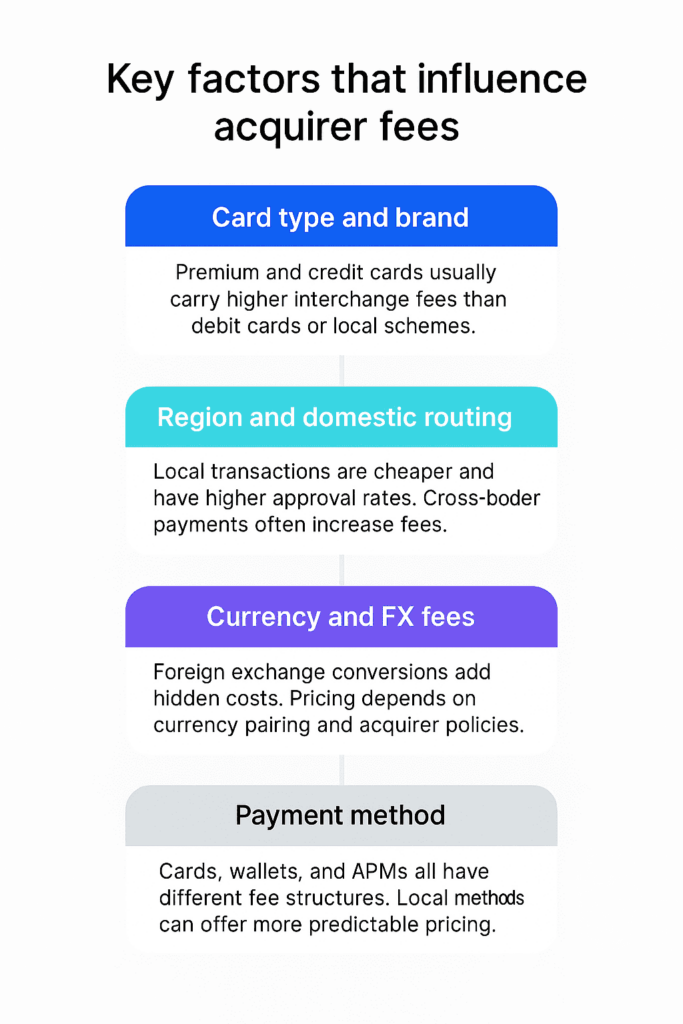
What really influences your acquirer fees?

No two transactions are priced the same. While most businesses are aware of base processing rates, fewer understand the variables that push fees higher or lower across markets and providers. The difference can be small on a single transaction but enormous when scaled across thousands or millions.

Here are the primary factors that influence acquirer fees and why they are significant.

1. Card type and brand

Not all cards are created equal. Credit cards often carry higher interchange and scheme fees than debit cards. Premium cards like business or rewards programs cost more for merchants to accept. Even within Visa or Mastercard networks, pricing varies depending on the card’s classification.

Accepting more debit-based or local card schemes where available can significantly reduce costs. The challenge is knowing when and how to prioritize those options, especially across markets. This is where orchestration helps by automatically routing payments based on card type and cost structure.

2. Region and domestic routing

Payments processed domestically are usually cheaper than those routed through international channels. Local acquiring not only reduces FX and cross-border fees, but can also improve approval rates since the transaction aligns with regional banking norms.

For example, a payment coming from a customer in France might be cheaper and more successful when routed to a French acquirer rather than a global one. Platforms that rely on a single PSP can’t make this distinction, but orchestration platforms like Gr4vy allow merchants to route payments based on location, card origin, and cost factors.

3. Currency and foreign exchange

Cross-border ecommerce often involves currency conversion. If you’re not careful about how and where FX takes place, you could be paying hidden fees on every transaction. Some acquirers automatically convert currencies at higher-than-market rates, which eat into margins.

Offering customers the option to pay in their local currency while managing settlement in your preferred currency is one way to control FX exposure. Orchestration can help automate this by pairing the right acquirer and currency combination, depending on geography and business rules.

4. Payment method used

Each payment method comes with its own fee structure. Card networks, digital wallets, bank transfers, and local APMs (alternative payment methods) all charge differently. Wallets like Apple Pay or Google Pay often rely on tokenized transactions, which can benefit from lower risk-based pricing, while local bank transfers may have flat, predictable fees.

A common mistake is relying too heavily on card payments in regions where local methods are cheaper and preferred. Payment orchestration enables merchants to dynamically offer and prioritize the most cost-effective methods in each region without maintaining multiple individual integrations.

5. Transaction volume and tiered pricing

Acquirers often offer volume-based pricing, where rates improve once you cross a certain monthly transaction threshold. But this only works if volume is properly distributed. Spreading your payments across too many PSPs without strategic routing can dilute your leverage and increase fees.

With orchestration, you can consolidate volume intelligently, routing higher volumes through lower-cost providers to hit better pricing tiers, while keeping flexibility with secondary PSPs for redundancy and optimization.

6. Fraud risk and compliance profile

Merchants with higher dispute rates or weak compliance setups may face higher acquirer markups. Some PSPs charge more to offset perceived fraud risks. Others penalize for things like missing 3DS flows or poor chargeback management.

Using orchestration, merchants can enforce stronger risk logic, enable step-up authentication when needed, and route risky transactions to providers with stronger fraud mitigation tools. This reduces fee penalties and protects against future pricing increases tied to fraud profiles.
Common tactics for lowering acquirer fees

Before we get into orchestration-driven strategies, let’s review some of the basic fee-reduction methods many merchants already use. These tactics often provide solid initial improvements, especially for businesses that have recently scaled past their first provider.

While valuable, most of these strategies require manual effort, workarounds, or limited visibility into long-term performance.

1. Multi-PSP setup

Working with more than one payment service provider can open up better rates and reduce reliance on a single acquirer. It also improves redundancy and gives merchants more flexibility in how they route transactions.

However, most businesses stop at the connection phase. They integrate a second or third PSP but rarely implement dynamic logic to switch based on geography, card type, or cost. Without orchestration, these setups often go underutilized.

2. Support for local payment methods

Offering region-specific methods like iDEAL in the Netherlands or Pix in Brazil can reduce reliance on costly international cards. Local methods also tend to have more predictable fee structures and higher approval rates.

The downside is integration. Each new method often means a separate technical build, testing phase, and long-term maintenance. This slows down expansion and limits agility.

3. Use of local acquirers

Routing transactions to domestic acquirers can lower scheme and FX fees. It can also boost approval rates since banks are more likely to trust local transactions.

To fully benefit, merchants need to know which acquirer to use per market and have a system to route payments intelligently. Without orchestration, most businesses rely on static routing or business rules that are hard to update.

4. Fraud and chargeback prevention

Many acquirers adjust pricing based on merchant risk profiles. Merchants with fewer chargebacks and better fraud management tend to see lower markups and fewer penalties.

Tools like 3D Secure, AVS checks, and machine learning fraud engines can help reduce exposure. But they need to be applied consistently across all transactions and providers, something orchestration platforms can manage at scale.

5. Delayed capture and smart refund flows

By capturing funds only when inventory is confirmed or the service is delivered, merchants can avoid unnecessary interchange or reduce refund-related costs. Some acquirers also allow partial captures or flexible refund windows, which can be used strategically.

These practices can improve efficiency, but without centralized control, merchants struggle to manage them across multiple systems.

6. Manual data reviews

Teams often rely on spreadsheets or siloed dashboards to compare performance and fees. While this can uncover insights, it is rarely sustainable. Manual reviews are time-consuming and often miss trends in real-time behavior.

A modern payment orchestration platform gives merchants a unified view across all providers, making it easier to understand fee drivers and optimize accordingly. For a full breakdown of what orchestration can unlock, check out this guide on the top 10 benefits of using payment orchestration.

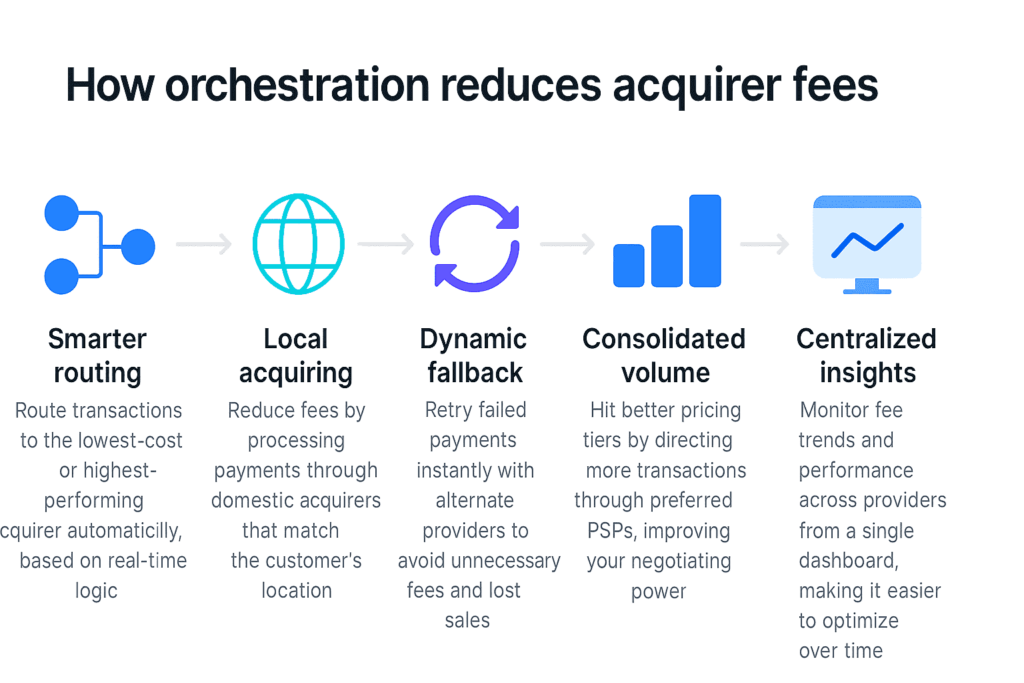
Orchestration: Multiply your fee-saving impact

Basic fee reduction strategies can help, but they rely on manual work and limited control. Payment orchestration builds on those foundations by introducing automation, flexibility, and visibility into every transaction.

Let’s explore how orchestration delivers a much deeper level of optimization for acquirer fees and overall payment performance.

1. Dynamic, automated routing

One of the biggest benefits of orchestration is the ability to route each transaction based on real-time conditions. This could include geography, card type, currency, issuer response, or even cost thresholds.

Instead of applying static rules or relying on a default provider, orchestration lets you build logic that adapts to your business needs. This routing engine can be updated without code and supports experiments across providers, so you can learn what works best in each market.

2. Add global payment methods without reworking your stack

Expanding into a new region typically means integrating new local payment methods. This process is often time-consuming and technically heavy. With orchestration, you can add payment methods from across the world using a single integration.

Gr4vy’s platform supports over 400 payment methods, giving merchants the flexibility to offer what customers prefer without spending months building and testing each one.

3. Automated fallback and retry flows

Failed transactions don’t just hurt conversion rates. They also increase your effective fee cost because you pay for gateway services, fraud tools, and other infrastructure without earning revenue from the transaction.

Orchestration can detect soft declines or timeouts and automatically retry the payment with a different provider. This reduces failures, boosts approval rates, and ensures that each transaction has the best chance of succeeding without increasing cost.

4. Reduce foreign exchange exposure with local routing

Cross-border fees and currency conversions can quickly inflate your costs. Orchestration allows you to route transactions through local acquirers whenever possible, avoiding unnecessary FX charges and reducing decline risk from unfamiliar payment flows.

This setup also improves customer trust, since customers are more likely to approve transactions that feel local.

5. Hit volume discounts with smart routing

Many PSPs and acquirers offer discounted pricing based on monthly volume. If your traffic is spread thinly across providers without strategy, you might be missing out on those lower tiers.

Orchestration helps consolidate volume intelligently. For example, you can direct more transactions through a primary provider until you meet a volume threshold, then reroute overflow to backup acquirers for load balancing or region-specific needs.

6. Fraud logic tailored to each region or provider

Different markets and PSPs have different fraud tolerances. Orchestration lets you apply fraud checks like 3D Secure or velocity filters only where needed, reducing unnecessary friction for trusted users while still protecting your business.

This balance helps you avoid chargebacks, reduce penalties, and meet compliance standards without compromising user experience.
How Gr4vy helped Baby Bunting cut costs and boost performance

A clear example of acquirer fee optimization in action comes from Baby Bunting, one of Australia’s leading baby product retailers. As the business expanded, so did the complexity of its payment infrastructure. With more customers and growing regional reach, the team needed better control over payment performance and costs.

By implementing Gr4vy’s payment orchestration platform, Baby Bunting was able to route transactions based on provider performance and geography. This allowed them to reduce reliance on underperforming PSPs and prioritize higher-performing ones depending on the transaction type and location.

As a result, the company achieved a noticeable increase in authorization rates. At the same time, they gained visibility into payment data and reduced the number of failed or retried transactions. These improvements translated into lower processing costs, fewer customer complaints, and more predictable revenue.

You can explore the full story in the Baby Bunting case study. It shows how greater control over routing and provider selection can lead to stronger results without changing how your customers pay.

When orchestration is the right next step

Not every business needs orchestration from day one. But as payment complexity grows, the limitations of a single provider or a static integration model become harder to ignore. If your team is spending more time managing failed transactions, chasing insights across dashboards, or juggling multiple providers without a unified view, it might be time to consider a more scalable approach.

Orchestration becomes especially valuable when:

  • You operate in multiple regions or plan to expand internationally
  • Your approval rates are inconsistent or lower than expected
  • You use more than one PSP but lack visibility or control over routing
  • Your checkout experience suffers from slow response times or failed attempts
  • You want to add new payment methods but avoid long integration cycles
  • Your finance or operations teams struggle to track payment costs accurately

Gr4vy’s orchestration platform is designed to handle this complexity while giving you control and flexibility through a single layer. Whether you’re looking to reduce fees, improve performance, or simplify expansion, orchestration creates the foundation to scale payments with less friction.

Frequently asked questions

What are acquirer fees in payment processing?

Acquirer fees are the charges that a merchant pays to the acquiring bank or payment service provider for processing card transactions. These fees often include markups on top of interchange, scheme, and gateway fees, and they can vary by provider, region, and payment method.

Why do acquirer fees vary so much between transactions?

Several factors influence acquirer fees, including the card type used, whether the transaction is domestic or cross-border, the payment method selected, and the level of risk or fraud associated with the transaction. Fees also differ by provider and pricing model.

How can payment orchestration help reduce acquirer fees?

Orchestration platforms like Gr4vy give merchants the ability to route payments based on real-time cost and performance data. This allows businesses to prioritize lower-cost acquirers, avoid unnecessary FX fees, retry failed transactions, and access local providers without maintaining multiple integrations.

Can I still use orchestration if I already work with multiple PSPs?

Yes. Orchestration does not replace your existing providers, it makes them work better together. With Gr4vy, you can centralize the logic that determines where each payment goes, manage all connections through one API, and monitor results from a single dashboard.

What kind of cost savings can I expect from acquirer fee optimization?

Results vary, but businesses that use orchestration to manage PSPs, reduce retries, and optimize routing often see cost reductions between 10 and 30 percent. The more complex your setup or the more markets you serve, the greater the potential savings.

Acquirer fees are one of the most overlooked drivers of payment costs. While many businesses try to negotiate rates or work with multiple providers, few have the infrastructure to optimize those decisions in real time. Without visibility, flexibility, and control, it becomes harder to scale efficiently or protect your margins as your payment volume grows.

Payment orchestration changes that. It gives you the tools to route payments based on logic, cost, and performance without rebuilding your stack every time you expand or adjust. Whether you want to reduce fees, improve success rates, or support global growth, orchestration helps you take full control of your payments.

Contact Gr4vy to see how orchestration can help your business reduce processing costs and improve your entire checkout experience.

How payment orchestration powers global expansion for ecommerce brands

Reaching global customers is easier than ever. But supporting localized payments preferences? That’s where many businesses struggle.

Studies show that nearly 70% of online shoppers are more likely to complete a purchase when local payment methods are available. For global businesses, this isn’t just a UX detail—it’s a revenue driver.

As merchants expand into new regions, offering localized checkout options becomes critical. Yet, managing separate integrations for every payment provider, method, and currency creates a complex, fragile infrastructure that doesn’t scale easily.

Payment orchestration solves this by giving businesses a single, unified layer to support local methods, currencies, and providers—all without rebuilding their payment stack every time they enter a new market.

Why localized payments matter for global growth

Shoppers are more likely to complete purchases when they see payment options they know and trust. According to several studies, conversion rates can drop by more than 50% if a customer doesn’t see their preferred method at checkout.

Localizing payments increases:

  • Customer trust and loyalty
  • Approval rates, especially for card transactions
  • Conversion in cross-border ecommerce
  • Operational efficiency by reducing cart abandonment and chargebacks

Each market has its own expectations. In the Netherlands, consumers often use iDEAL. In Australia, POLi and PayID are common. In Germany, SEPA transfers are preferred. If your platform only supports cards, you’re leaving money on the table.

The cost of doing it manually

To meet global demand, many businesses turn to regional PSPs or gateways. That works—but only to a point.

Managing multiple integrations creates a host of problems:

  • Engineering time spent on onboarding, updating, and maintaining APIs
  • Inconsistent reporting across providers
  • Complex compliance environments (e.g. PCI, 3DS, local data regulations)
  • High risk of downtime or errors when one provider fails
  • Difficulty switching or adding providers as you grow

This setup is not only inefficient, it becomes increasingly fragile the more markets you enter. Teams spend their time managing infrastructure instead of optimizing revenue.

What orchestration solves

Payment orchestration offers a single control layer that sits above your PSPs, routing transactions based on geography, payment method, cost, and performance. You get one integration, but the flexibility to support many providers, currencies, and local methods.

Here’s what that looks like in practice:

  • Show local payment methods automatically based on location
  • Route transactions to the best-performing PSP in that region
  • Offer multi-currency pricing and local settlement
  • Centralize reporting and token management
  • Swap providers without rebuilding your checkout

By using orchestration, your platform becomes modular and scalable. You can localize experiences for customers in any market while keeping your payment stack manageable.

Supporting local methods around the world

Let’s look at how this works in real markets:

Europe

Buyers expect methods like SEPA, iDEAL, Bancontact, and Klarna. Supporting these boosts trust and ensures compatibility with local banking systems. You can explore popular payment methods in Europe to see just how diverse the region is.

Australia

Customers are used to POLi, PayID, and increasingly, mobile wallets. For merchants entering this market, this guide to payment orchestration in Australia provides a clear roadmap.

United States

The U.S. still leans heavily on credit and debit cards, but digital wallets like Apple Pay and ACH-based methods are rising. Merchants need to manage evolving fraud rules and regulatory changes, which we explore in our 2025 guide to U.S. payment regulation.

In each case, the orchestration layer gives you the ability to match local expectations and optimize for each region—without starting from scratch every time.

Multi-currency and local settlement

Localization isn’t just about payment methods. It also means showing prices in the local currency, settling funds appropriately, and ensuring that refund logic follows local laws.

With orchestration, you can:

  • Display and accept payments in the customer’s preferred currency
  • Choose the best settlement currency for your business needs
  • Avoid unnecessary FX conversions that cut into margins
  • Comply with country-specific tax and refund requirements

This adds flexibility for your finance team and creates a smoother experience for international buyers.

Cross-border ecommerce without the friction

Cross-border ecommerce has been growing rapidly, but payment friction still holds it back. Currency mismatches, card declines, and unfamiliar payment flows cause users to abandon carts.

Orchestration helps reduce that friction by:

  • Routing transactions to local acquirers for better success rates
  • Offering familiar methods without delay or redirects
  • Supporting global digital wallets like Apple Pay and Google Pay
  • Automatically retrying failed transactions through a secondary provider

These features don’t just improve UX—they protect revenue.

The big advantage: control without complexity

With orchestration, you’re not tied to a single provider. You gain the ability to experiment, localize, and optimize your stack—without rebuilding your payment infrastructure every time you scale.

Key benefits include:

  • Faster expansion into new markets
  • Improved customer experience and higher conversion
  • Consolidated compliance management
  • Lower operational and engineering overhead

And when you want to explore or prioritize new geographies, you can do so confidently—knowing your payment stack won’t become a bottleneck.

FAQ

What are localized payments?

These are payment options, currencies, and checkout flows that are tailored to each customer’s country or region.

How do I support multiple payment methods without separate integrations?

Use a payment orchestration platform that connects to many providers through a single interface.

What is payment orchestration?

It’s a layer that lets you route, manage, and optimize payments across multiple PSPs and payment methods with one integration.

Can orchestration help reduce cart abandonment in international markets?

Yes. By offering local methods and optimizing routing, orchestration improves approval rates and builds trust.

Is this approach scalable for cross-border ecommerce?

Absolutely. Orchestration is built to simplify complex, multi-market payment flows as your business grows.

Localization is no longer a nice-to-have. It’s a requirement for any business with global ambition. Customers expect local experiences, and they expect them at checkout.

But delivering that doesn’t have to mean dozens of integrations or months of development time. With the right orchestration platform, you can support localized payments, streamline your global expansion payments strategy, and improve your cross-border ecommerce performance from a single control layer.

Contact Gr4vy to learn how we help businesses localize payments, reduce complexity, and scale faster.

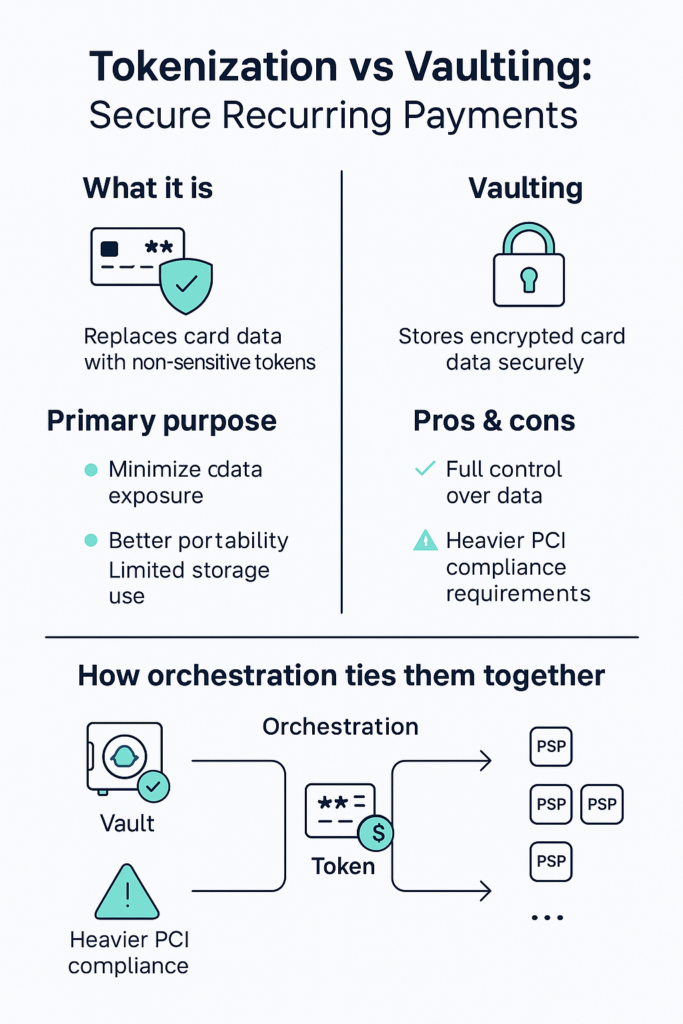
Tokenization vs vaulting: What’s best for securing recurring payments?

Recurring payments are the financial engine behind many digital businesses. Tokenization vs. vaulting becomes a question. Whether you run a subscription service, offer memberships, manage a marketplace, or sell software, one thing is always true: you need a safe and reliable way to store and reuse your customers’ payment details.

But storing card data comes with risks. Security breaches, regulatory pressure, and customer churn are all top of mind. That’s where card tokenization and payment vaults come in. These two technologies are often discussed together, but they’re not the same thing, and the differences matter.

In this article, we’ll explain how each works, how they support secure payment storage, and how orchestration helps you build a system that’s not just secure, but also portable and scalable.

Why recurring payments demand smarter storage

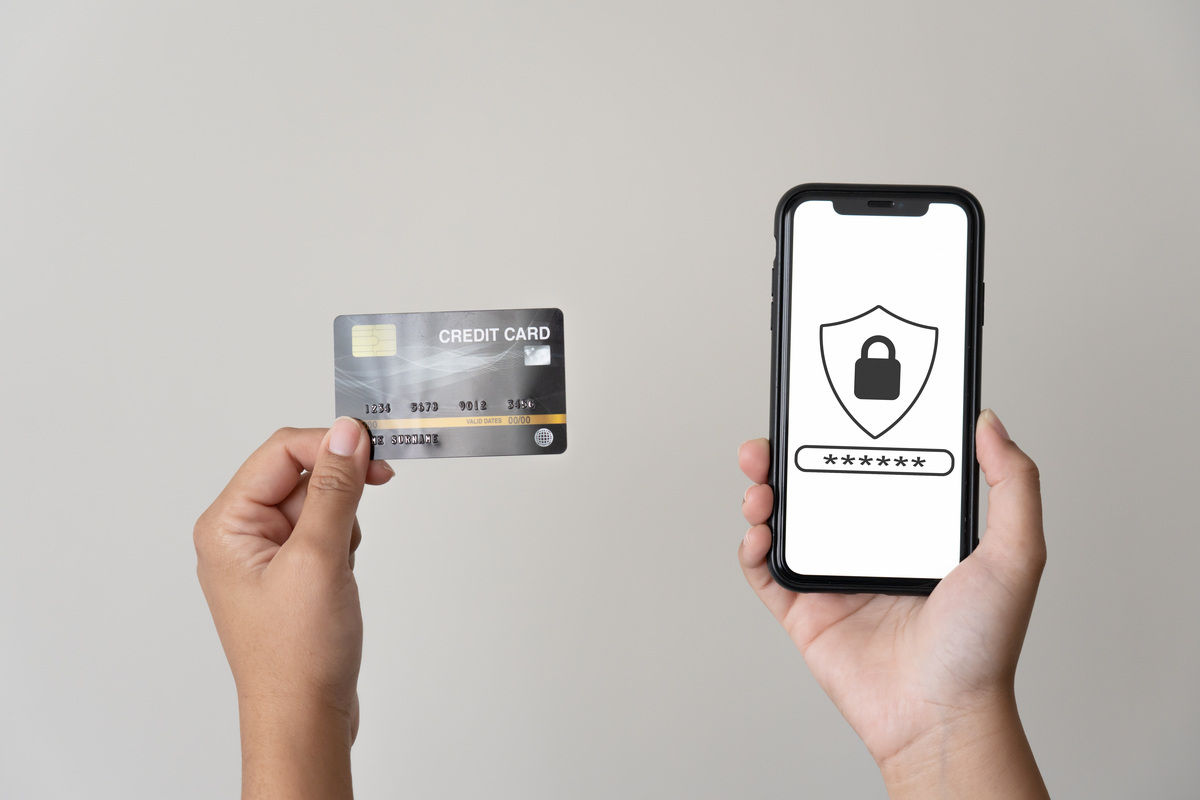
Recurring billing is convenient for customers, but it requires platforms to retain and reuse payment credentials. Without a system in place to do this securely, businesses face significant risks:

  • PCI DSS compliance obligations
  • Higher fraud exposure
  • Increased chance of failed payments due to outdated card data
  • Friction during renewal or reactivation

Most businesses today use either a tokenization strategy, a vaulting strategy, or a mix of both. But understanding the role of each is essential to building a secure, modern payment stack.

What is card tokenization?

Tokenization replaces sensitive card details, like a PAN (Primary Account Number), with a unique, non-sensitive token. This token is useless to attackers if intercepted and can only be mapped back to the original card by the system that issued it.

There are two main types of tokenization:

  • Gateway or PSP tokenization, where a payment provider generates the token and keeps the original card data.
  • Network tokenization, which is a newer approach where the token is generated and maintained by the card networks (like Visa or Mastercard).

Network tokenization in particular has become popular for recurring payments because it offers benefits like:

  • Higher approval rates
  • Automatic updates when cards expire or are reissued
  • Increased security through issuer participation

If you’re not familiar with how this works, check out network tokenization for beginners for a simple overview.

What is a payment vault?

A payment vault is a secure, PCI-compliant environment where the actual card data is encrypted and stored. Tokenization can happen within or alongside the vault, but the vault is what enables the business to safely retain access to the original card for future use.

There are two main options:

  • Provider-specific vaults, which are tied to a single PSP or gateway.
  • Agnostic vaults, which are platform-agnostic and allow you to route tokens through multiple providers.

Provider-specific vaults are convenient but can lead to vendor lock-in. That’s why more businesses are shifting toward agnostic vaults, which give them control over their payment data and flexibility in how they process transactions.

You can learn more about this in what is an agnostic vault?

Tokenization vs vaulting: What’s the difference?

Tokenization and vaulting are related, but they play different roles.

  • Tokenization is about replacing card data with a non-sensitive placeholder.
  • Vaulting is about securely storing the actual card data, usually in an encrypted format, in a PCI-compliant environment.

In most systems, vaulting and tokenization work together. The vault holds the real data, while the token is what your systems use in daily operations. But how you implement both makes a big difference in your flexibility and compliance exposure.

The importance of control and portability

One of the biggest concerns with recurring payment infrastructure is ownership of the data. If you’re using a PSP’s vault and token system, you might not be able to switch providers easily. Your tokens are tied to their system, and your customers’ data stays with them.

This makes it hard to:

  • Improve authorization rates by testing different PSPs
  • Localize payments for global customers
  • Respond quickly to outages or rate changes
  • Keep your business portable and independent

That’s why orchestration and agnostic vaulting matter. With the right architecture, you can store card data once, tokenize it, and route it through the best provider for each transaction, geography, or customer segment.

To explore why this matters at a deeper level, see the importance of card vaulting and data localization

tokenization vs vaulting

How payment orchestration supports secure storage

Gr4vy’s payment orchestration platform offers built-in tokenization, network token support, and agnostic vaulting—all in one place. This gives merchants full control over how they store and route payments, without being locked into a specific provider.

With Gr4vy, you can:

  • Use a single integration to connect multiple PSPs
  • Store cards in a PCI Level 1 certified vault
  • Access network tokenization to improve approval rates
  • Migrate or update tokens without needing re-entry from customers
  • Route transactions dynamically by geography or provider performance

If you’re wondering how network tokens flow through your system and why issuers like them, how does network tokenization work? offers a clear explanation.

So, what’s best for securing recurring payments?

The short answer: you need both.

Tokenization reduces exposure and streamlines recurring transactions. Vaulting gives you the foundation to manage those tokens securely and in a compliant way. Together, they protect your customers’ data and help you build a more resilient payment operation.

But the real differentiator is control. The more control you have over how payment data is stored, tokenized, and routed, the better your chances of reducing churn, increasing approvals, and adapting to change.

FAQ

What is card tokenization?

Tokenization is the process of replacing sensitive card data with a unique, non-sensitive token that can be used for future transactions.

What does a payment vault do?

A vault securely stores the original payment details in an encrypted, PCI-compliant environment, enabling secure access when needed.

Do I need both tokenization and vaulting?

Yes. Tokenization prevents exposure during transactions, while vaulting provides the secure foundation to retain and manage card data.

Can I switch PSPs if I use network tokens?

Yes, especially when using an agnostic vault and orchestration platform that supports portability and token migration.

Is network tokenization better than PSP tokenization?

It often is. Network tokens are more secure, support card updates, and are recognized by card issuers, which can lead to higher approval rates.

Recurring payments depend on trust. Your customers trust that their payment info will be stored safely, charged only when expected, and never compromised. That trust needs to be backed by infrastructure that’s secure, compliant, and future-ready.

With Gr4vy, you get more than just tokenization or vaulting. You get a fully orchestrated platform that puts you in control of your recurring payment stack, from storage to routing to compliance. Contact Gr4vy to learn how we help businesses secure recurring payments through modern vaulting and tokenization strategies—without locking you in.

Global revenue: How to localize payments without multiple integrations

Selling globally is easier than ever. But getting paid globally? That’s where many businesses hit a wall.

Cross-border ecommerce has opened the door to new markets, yet fragmented payment preferences, local regulations, and multiple integration requirements make scaling payments internationally a real challenge. The moment your platform tries to support customers in different countries, complexity creeps in—new currencies, new providers, new payment methods, and new compliance rules.

Supporting localized payments is no longer optional for global growth. But integrating every payment method separately is neither scalable nor efficient.

The good news is there’s a better way. With payment orchestration, businesses can offer local experiences across markets while managing payments through a single unified layer. This article explores how orchestration simplifies global expansion payments, improves cross-border ecommerce performance, and helps future-proof your platform for international growth.

The problem with going global the old way

Expanding into new countries often means rewriting parts of your payment stack. Each region has different expectations:

  • In Germany, shoppers trust bank-based options like SEPA or Giropay.
  • In Brazil, Pix and Boleto Bancário dominate.
  • In Australia, PayID and POLi are increasingly common.
  • In the U.S., cards are still king, but wallets and Buy Now Pay Later are growing.

To support these preferences, many businesses take the path of least resistance integrating new PSPs one by one. But with every added provider comes a new API, another dashboard, more reconciliation steps, and different compliance requirements.

At scale, this creates a fragile, expensive, and hard-to-maintain system. Teams spend more time managing payment connections than improving the customer experience.

What customers expect in local markets

Consumers don’t think in terms of “cross-border ecommerce.” They think in terms of what feels normal to them. If your checkout doesn’t offer their preferred local payment methods or show prices in their own currency, it introduces friction.

Here’s what global customers typically expect:

  • Familiar, trusted payment methods
  • Prices displayed in local currencies
  • Support for mobile wallets on local devices
  • Language and tax information that matches their location
  • Fast, transparent settlement and refunds

These expectations impact conversion directly. Even something as simple as offering SEPA in Europe or showing AUD pricing in Australia can dramatically improve trust and checkout completion.

For a breakdown of how expectations vary by region, see the largest payment methods in Europe: a comprehensive guide.

Why payment orchestration changes the game

Payment orchestration allows merchants to connect multiple PSPs, support local payment methods, and manage payment logic all from a single platform. Instead of building a patchwork of custom integrations, you plug into one orchestration layer that handles routing, compliance, retries, and reporting.

This unified approach gives you:

  • A consistent API for all payments
  • Dynamic routing to optimize performance by region
  • Built-in support for local payment methods and currencies
  • Centralized reporting and reconciliation
  • The ability to turn providers on or off without code changes

In practical terms, this means you can launch in new countries faster, offer better customer experiences, and reduce engineering overhead.

Localized payments without the complexity

Let’s break down how payment orchestration simplifies global payments:

1. Support for local payment methods

From iDEAL in the Netherlands to Klarna in Sweden and Pix in Brazil, orchestration platforms offer out-of-the-box support for region-specific methods. You don’t need to research and integrate each one manually.

For examples across the European market, see popular payment methods in Europe: localized payment solutions

2. Multi-currency pricing and settlement

With orchestration, you can display prices in local currencies, convert at competitive rates, and settle funds in the currency that suits your business. This reduces confusion for customers and simplifies accounting for your team.

3. Smart PSP routing by region

Not all payment providers perform equally in every market. Orchestration lets you route transactions through the best-performing PSP based on location, card type, or success rates. This helps improve authorization rates and reduce declines.

4. Faster expansion into new markets

Once you’re plugged into an orchestration platform, adding a new payment method or provider is a configuration change, not a new dev project. This shortens the time it takes to enter a new country or region.

5. Built-in compliance tools

Operating globally means navigating data privacy laws, local licensing requirements, and regional fraud rules. Orchestration helps with this by offering integrations with fraud tools, tokenization, and support for regulations like 3DS2, SCA, and PCI DSS.

To better understand regulatory shifts in specific regions, see payment regulation in the USA: a 2025 guide.

Australia: A real-world case study

Take Australia, for example. It’s a fast-growing ecommerce market, but local preferences differ from North America or Europe. Payment methods like POLi, PayID, and BPAY are well-known, while credit card usage is steadily shifting toward digital wallets and bank transfers.

To succeed here, merchants need to localize their offerings without rebuilding infrastructure. That’s exactly where orchestration delivers value.

Instead of integrating a local PSP just for Australia, a business can use orchestration to activate POLi and PayID through existing channels, route through a regional PSP, and still manage all payments through a single dashboard.

Read more in payment orchestration in Australia 2025: a complete guide for businesses

Cross-border ecommerce that scales

Scaling globally means offering a native checkout experience in every market, without turning your platform into a tangle of custom code and disconnected systems.

Here’s how orchestration supports cross-border ecommerce at scale:

  • One integration for dozens of markets and payment methods
  • Intelligent routing based on real-time data
  • Consolidated reporting and analytics for finance teams
  • Streamlined dispute resolution and chargeback tracking
  • Centralized token vaults for returning customers across borders

This not only improves conversion and trust, but also frees up resources to focus on growth instead of maintenance.

The impact on conversion and revenue

When customers see their preferred payment method, in their currency, with no delays or errors, they’re more likely to complete a purchase.

Businesses using orchestration often report:

  • Increased approval rates in new regions
  • Lower cart abandonment in international checkouts
  • Fewer failed payments due to PSP or method mismatch
  • Faster expansion into new markets
  • Reduced fraud and chargeback risk

Localized payments improve the customer experience, and orchestration makes delivering that experience possible without adding complexity behind the scenes.

FAQ

What are localized payments?

Localized payments refer to supporting local payment methods, currencies, and preferences specific to each customer’s region.

How do I accept payments in multiple countries without separate integrations?

A payment orchestration platform connects you to multiple providers and methods through a single API, avoiding the need for one-off integrations.

What is the difference between orchestration and payment gateways?

Orchestration layers sit above PSPs and gateways, letting you manage multiple connections, routes, and logic from one place.

Does payment orchestration help with currency conversion?

Yes, it can support multi-currency pricing and settlement while offering tools to manage FX transparently.

Is this approach scalable for cross-border ecommerce?

Absolutely. Orchestration is designed to handle complex international payment flows efficiently and at scale.

Localized payments, global reach, single layer

If your business has global ambitions, your payments need to scale with you. But scaling shouldn’t mean building and maintaining dozens of separate integrations. That’s where orchestration delivers its greatest value.

With a single orchestration layer, you can offer localized experiences, support global payment methods, and manage everything from one place. No more juggling PSP dashboards, chasing compliance requirements, or missing out on conversions due to gaps in your checkout flow.

The infrastructure that powers your payments is just as important as your product. If you want to grow globally, start by making your payment stack just as flexible. Contact Gr4vy to see how payment orchestration can support your global expansion, simplify operations, and boost revenue.

Real-time payments vs traditional invoicing: What your platform needs to know

B2B payment models are evolving rapidly. In the U.S. alone, real-time payment volumes are expected to grow by more than 10x by 2027, fueled by instant rails like FedNow and an increasing demand for faster, more flexible transactions. But if your platform still leans heavily on traditional Net 30 or Net 60 invoicing, you’re not alone.

Many businesses continue to rely on invoicing cycles built decades ago. The problem? These models no longer align with the speed and expectations of modern platforms, suppliers, or buyers, especially those operating globally.

In this article, we’ll explore how real-time payments are reshaping B2B finance, where digital invoicing still makes sense, and how payment orchestration bridges both models so your platform doesn’t have to choose one over the other.

The case for traditional invoicing until it breaks

Invoicing has long been the backbone of B2B commerce. It’s structured, well understood, and often aligned with existing procurement or accounting processes. Industries like manufacturing, legal services, enterprise SaaS, and logistics all run comfortably on Net 30, 60, or 90 terms.

But traditional invoicing comes with baggage:

  • Delayed cash flow: You’re often waiting weeks or months to get paid.
  • Manual reconciliation:  Matching invoices to payments can slow down accounting.
  • Missed payments and chasing receivables: Increases workload for finance teams.
  • Limited visibility: Until the money lands, it’s hard to know where things stand.

As customer expectations shift toward faster fulfillment, flexible billing, and just-in-time services, these friction points start to stand out.

What real-time payments unlock for B2B platforms

Real-time payments (RTP) are exactly what they sound like instant money movement, 24/7/365, with immediate confirmation and no waiting period.

Platforms using RTP benefit from:

  • Immediate settlement:  Funds clear in seconds, not days.
  • Improved cash flow predictability: Vendors and suppliers know exactly when they’ll be paid.
  • Streamlined operations:  No need to issue or chase invoices for smaller or high-frequency transactions.
  • Better vendor and partner experiences:  Instant payouts improve satisfaction and loyalty.
  • Lower fraud risk:  Transactions are verified and settled quickly, reducing exposure.

Globally, we’re seeing real-time systems like SEPA Instant (EU), Faster Payments (UK), and FedNow (U.S.) push B2B platforms toward faster transaction cycles.

Comparing the two: Invoicing vs real-time payments

To understand which model makes sense for your platform, or when a hybrid is best, it helps to compare them side-by-side.

FeatureTraditional InvoicingReal-time Payments
Speed30–90 daysInstant
ProcessingManual / ERPAPI-driven
Cash flowDelayedImmediate
CostsWire/ACH feesLower per transaction
RiskMissed or late paymentsLower fraud exposure
User experienceFamiliar to finance teamsPreferred by vendors and platforms

Invoicing isn’t going away anytime soon, but for fast-moving platforms, especially those in eCommerce, digital marketplaces, or SaaS, real-time capabilities are quickly becoming a competitive differentiator.

Most platforms need both, and orchestration makes that possible

The reality is that most B2B platforms can’t go all-in on real-time payments overnight. Large enterprise clients may still prefer (or require) traditional invoicing workflows. Finance teams are still adapting their processes. Not all partners are RTP-ready.

This is where payment orchestration shines. Instead of forcing your business into a one-size-fits-all model, orchestration allows you to support both approaches, without multiplying your operational overhead.

With a centralized orchestration layer, your platform can:

  • Automatically route payments through different providers based on speed, cost, or geography
  • Offer real-time payouts for supported partners, while handling invoices for others
  • Tokenize payment details securely and handle recurring billing or invoice-based flows
  • Adapt to user preferences without hardcoding custom logic

For a full breakdown of what this infrastructure unlocks, see payment orchestration platform: what it is and why your business needs one.

Real-world use cases: When each model fits best

Let’s take a closer look at which scenarios align with each payment model:

When real-time payments make sense

  • Onboarding new vendors or freelancers
  • Restocking inventory quickly for DTC brands
  • Gig economy platforms that need instant payouts
  • Cross-border marketplaces operating on slim margins

These situations benefit from speed, flexibility, and automation.

When invoicing is still the better fit

  • Long-term contracts with procurement approval steps
  • Services billed in phases or milestones (e.g. consulting or development)
  • Enterprise SaaS licenses tied to renewal cycles
  • Regulated industries with internal payment policies

The common denominator: the need for control, approvals, or internal alignment.

Supporting both models with orchestration

Orchestration isn’t just about connecting multiple PSPs. It’s about creating logic and infrastructure that responds to business context automatically.

For example:

  • A supplier in the U.S. under $5,000? Offer a FedNow payout.
  • An enterprise client in Europe? Generate a Net 30 invoice with multi-currency support.
  • A returning buyer with saved credentials? Trigger a tokenized payment via Click to Pay.

The orchestration layer handles routing, retries, and even fraud checks—all without adding engineering complexity.

This flexibility is especially important when your business operates across multiple markets or serves both SMBs and enterprises. You need infrastructure that can adapt without breaking down or holding you back.

As we explain in top 10 benefits of using payment orchestration in 2025, orchestration gives you the agility to meet users where they are while future-proofing your stack.

Is RTP the future? Yes, but not the whole future

Real-time payments are growing for a reason. They reduce friction, boost transparency, and align with how people (and businesses) want to move money today. But we’re not yet at a point where every buyer or vendor prefers instant payments.

That’s why hybrid models are gaining traction. Smart platforms are offering multiple options, letting the context drive the flow. And that’s only possible when your infrastructure is flexible enough to support it.

If you’re currently stuck between legacy billing logic and new demands for instant settlement, this is where orchestration can make the difference.

You can learn more about how orchestration compares to legacy platforms in payment orchestration vs payment aggregators.

And if you’re working to simplify the checkout and payment experience as part of that evolution, tools like Click to Pay play a growing role in reducing manual steps, especially when paired with orchestration.

FAQ

What are real-time payments in B2B?

These are transactions that settle instantly, often using infrastructure like FedNow or SEPA Instant, giving businesses immediate access to funds.

Is digital invoicing still relevant in 2025?

Yes. Many companies still use invoicing workflows for approvals, compliance, and accounting alignment.

Can a platform support both RTP and invoicing?

Absolutely. With payment orchestration, platforms can route each transaction appropriately based on customer type, region, or amount.

How does orchestration support hybrid billing models?

It allows logic-based routing, supports multiple providers, and integrates with both instant and delayed settlement methods.

Is RTP more secure than ACH or wires?

Real-time payment systems offer built-in verification and near-instant confirmation, reducing the risk of fraud or lost payments.

Infrastructure that adapts to your users

Modern B2B platforms aren’t defined by whether they offer invoices or real-time payments. They’re defined by whether they let the use case dictate the method, not the other way around.

With payment orchestration, you can:

  • Support traditional and real-time flows in parallel
  • Optimize routing for speed, cost, or provider performance
  • Simplify integration and maintenance
  • Scale faster without adding technical debt

Whether your partners want a same-day payout or a Net 45 invoice, you’ll be ready. Contact Gr4vy to see how our orchestration platform helps you support real-time payments, digital invoicing, and everything in between.

How payment orchestration improves checkout performance across devices and regions

Mobile shoppers abandon over 70% of their carts during checkout. That’s not a typo. Research from the Baymard Institute shows just how much revenue is slipping through the cracks—not because customers changed their minds, but because the checkout experience didn’t meet expectations.

Slow load times, failed payments, limited wallet support, and unfamiliar payment options all create friction. And when your customers are spread across different countries, languages, devices, and platforms, fixing that friction becomes a real challenge.

The answer isn’t just better UX or faster hosting. For many businesses, improving checkout performance starts with something deeper: a smarter payment infrastructure. That’s where payment orchestration comes in.

What’s really slowing down your checkout?

If you’re seeing high drop-off rates at the final step, it’s usually not just one issue—it’s a mix of hidden bottlenecks. Here are some of the most common:

  • Slow PSP response times: Not all payment providers perform equally in every region. If your checkout relies on a single PSP, and they’re having a bad day, or just slower latency in a particular geography, your customers feel it.
  • Missing wallet and APM support: If Apple Pay or Google Pay doesn’t show up when expected, or if local payment methods aren’t available, users hesitate or leave.
  • Overcomplicated forms and redirects: Long fields, unnecessary pages, and redirection to external gateways all increase friction, especially on mobile.
  • Inconsistent UX across devices: What looks polished on desktop might feel clunky on a smaller screen. Unsupported browsers or OS limitations can also block wallet buttons from appearing.
  • Regional limitations: A customer in Germany expects different payment options than someone in Brazil. If those aren’t available, trust and conversions take a hit.

Checkout speed and performance across devices

Speed matters, especially on mobile. The longer your checkout takes to load or process, the more likely you are to lose the sale.

Payment orchestration allows you to route each transaction through the most efficient provider available. That means if a particular PSP is experiencing downtime or slow processing in a specific region, your platform can switch to a backup automatically. No user ever knows the difference, and the transaction completes without interruption.

It also enables one-tap checkout experiences with tools like Click to Pay, Apple Pay, and Google Pay, so mobile users can check out with minimal steps and without re-entering card details every time.

Related: Click to Pay – how does it work?

Meeting global expectations with local precision

Payment preferences vary dramatically around the world. In the Netherlands, iDEAL dominates. In Brazil, Pix and Boleto rule. In Australia, POLi and PayID are widely used.

If your checkout doesn’t reflect local norms, conversion suffers.

Orchestration lets you support local payment methods across markets, all through one integration. You don’t need to stitch together multiple PSPs on your own or guess which options to show. The orchestration layer detects the user’s location or device and dynamically displays the right mix of methods and currencies.

This results in a checkout experience that feels familiar and trustworthy, regardless of where your customer is.

Explore: Popular payment methods in Australia – a complete guide for 2025

Better routing = higher conversions

When a payment fails, it’s not always the customer’s fault. Sometimes the card is fine, but the provider’s network is slow or the transaction is flagged unnecessarily.

With orchestration, you can implement smart routing rules that decide how and where to send each transaction, based on real-time data, geography, transaction amount, or historical performance.

For example:

  • Route Visa transactions in Europe through PSP A for better approval rates
  • Send high-risk transactions through a provider with stronger fraud tools
  • Automatically retry soft declines using a secondary PSP

This kind of control helps reduce failed payments and increases the number of successful checkouts, especially on mobile, where every second counts.

Learn more: Top 10 benefits of using payment orchestration in 2025

Why mobile wallet support drives better performance

Mobile wallets aren’t just a nice-to-have anymore. They’re a core part of global checkout flows, especially on mobile devices where typing card details is a hassle.

Orchestration platforms make it easier to:

  • Add support for Apple Pay, Google Pay, Click to Pay, and other wallets
  • Ensure those options display correctly based on the user’s browser and OS
  • Handle secure tokenization and pass-through for repeat purchases
  • Reduce friction during checkout with biometric or device-based authentication

This kind of support doesn’t just make things more convenient. It removes barriers to completion, especially for repeat customers who expect one-tap payments.

Identifying and fixing drop-off points

Another underrated benefit of payment orchestration? Visibility.

Instead of juggling analytics across different PSP dashboards, you get a centralized view of your payment performance:

  • Which devices are converting better?
  • Where are users dropping off?
  • Are certain PSPs underperforming in key markets?

With this data, you can pinpoint friction points and adjust accordingly whether that means routing differently, optimizing your UX, or switching providers entirely.

What kind of impact are we talking about?

When checkout is fast, reliable, and localized, merchants typically see:

  • Uplift in mobile conversion rates
  • Reduced cart abandonment
  • Higher approval rates in global markets
  • Faster checkouts for repeat customers
  • More successful retries on failed payments

It’s not about squeezing out a 1% improvement. For some businesses, the jump in authorization rates and drop in failures is enough to justify orchestration on its own.

FAQ

How does payment orchestration improve mobile checkout?

It enables fast routing, wallet support, and dynamic optimization based on device, location, and PSP performance, resulting in faster, more reliable payments.

Can orchestration help reduce cart abandonment?

Yes. By simplifying the checkout flow, reducing latency, and increasing payment success rates, orchestration directly impacts abandonment.

What are the best payment methods for international checkout?

It depends on the region. With orchestration, you can easily support local favorites like iDEAL, Pix, Klarna, SEPA, and more—without extra work.

How do I ensure wallets like Apple Pay work on all devices?

Orchestration ensures proper device detection and wallet compatibility, so payment buttons show up only when supported.

Does orchestration really improve conversion rates?

Absolutely. From approval rate improvements to faster retries and wallet adoption, the cumulative impact on conversion is significant.

Better infrastructure builds better experiences

Designing a great checkout experience is one thing. Delivering a fast, secure, and reliable one across browsers, devices, and regions is something else entirely.

Payment orchestration gives your team the tools to go beyond UX improvements and fix the underlying payment logic that affects every transaction. It’s the invisible layer that makes fast checkouts possible, keeps customers from bouncing, and helps you adapt globally, without adding complexity. Contact Gr4vy to explore how orchestration can improve your checkout across devices, payment methods, and markets.

The complete guide to optimizing B2B payments in 2026

B2B payments have quietly entered a period of transformation. Where paper checks and 60-day invoice cycles once ruled, businesses are now shifting toward digital-first models, real-time rails, and subscription-style billing. Buyers expect the same frictionless payment experiences they get from consumer apps—while finance teams demand more control, transparency, and compliance across every transaction.

But meeting these expectations is no small task.

Today’s B2B transactions come with their own set of challenges: high values, complex approval flows, multiple currencies, and strict regulatory oversight. And as businesses scale globally, the pressure to streamline payments without sacrificing flexibility becomes impossible to ignore.

This is where payment orchestration enters the picture—not just as a nice-to-have, but as a foundational layer for modern B2B commerce. In this guide, we’ll walk through the biggest payment pain points merchants face in 2026, and how orchestration platforms like Gr4vy help solve them.

What makes B2B payments uniquely challenging?

There’s a reason B2B payment systems haven’t evolved as quickly as their B2C counterparts—they’re simply more complex.

Some of the key differences include:

  • Larger transaction values — Average B2B transactions are often 10x larger than consumer payments.
  • Multiple decision-makers — Finance, procurement, and legal teams are usually involved.
  • Longer payment terms — Net-30, Net-60, and even milestone-based contracts are still the norm.
  • Variable billing models — From one-time invoices to usage-based billing and tiered subscriptions.
  • Higher compliance burden — VAT, GST, 3DS2, PCI DSS, and AML all factor in.
  • Fragmented infrastructure — Legacy ERPs, siloed PSPs, and disjointed fraud tools make payments harder to manage.

In short: B2B payments aren’t just a “checkout problem”—they’re an operational one. And without the right infrastructure, they quickly become a drag on growth.

6 pain points merchants face with B2B payments

Let’s break down the recurring issues we see across scaling B2B businesses:

1. Manual invoicing and reconciliation

Even in 2025, many finance teams are still dealing with emailed PDFs, spreadsheets, and siloed billing systems. This creates delays, errors, and revenue leakage—and makes it nearly impossible to scale.

2. Rigid billing systems that don’t support modern models

B2B SaaS platforms often need to offer usage-based billing, trial periods, flexible subscriptions, and mid-cycle changes. But most legacy billing tools struggle to accommodate that kind of flexibility.

3. Failed payments and customer churn

A single failed transaction—due to an expired card or PSP outage—can trigger service suspensions, manual recovery processes, or lost customers. The stakes are higher when your contract value is in the tens of thousands.

Related reading: Payment timeout: why it happens and how to avoid it

4. Cross-border complexity

If you’re selling to customers in different countries, you’ll need to support multiple currencies, handle local tax compliance, and work with region-specific PSPs. Doing that without orchestration is costly and slow.

5. High processing and foreign exchange (FX) fees

When payments are routed inefficiently—or when FX is handled by the wrong provider—margins shrink. On large B2B deals, these losses add up fast.

6. Compliance and fraud exposure

Handling large sums of money comes with scrutiny. From PCI compliance to anti-money laundering (AML) checks, merchants need to reduce risk without blocking legitimate customers.

What payment orchestration actually does

Payment orchestration platforms unify how merchants manage payments. Instead of integrating one PSP at a time, businesses can plug into multiple providers, payment methods, and fraud tools through a single orchestration layer.

This gives B2B companies the flexibility to:

  • Route transactions intelligently (e.g. by geography, cost, or success rate)
  • Add or remove PSPs without disrupting checkout
  • Tokenize and store payment credentials securely
  • Automate retries, billing logic, and account updates
  • Visualize and report on payment performance across systems

In other words, orchestration turns payment infrastructure into a strategic advantage rather than a technical burden.

Learn more: Top 10 benefits of using payment orchestration in 2025

Real-time payments: the future of B2B cash flow?

Real-time payment rails like FedNow in the U.S. and SEPA Instant in Europe are redefining how fast money moves between businesses. These systems eliminate the waiting period between issuing an invoice and receiving funds.

Benefits include:

  • Faster order fulfillment and onboarding
  • Improved vendor satisfaction
  • Less reliance on credit-based terms

Orchestration platforms help B2B companies adopt RTP without ditching traditional rails like ACH or SWIFT. You can offer real-time payments to specific buyers or markets while keeping full control over routing and settlement.

Subscription billing: managing complexity at scale

As B2B companies move toward recurring revenue models, their billing systems need to keep up. This means supporting:

  • Free trials and upgrades
  • Mid-cycle adjustments
  • Usage-based pricing
  • Annual vs. monthly options
  • Multi-seat and enterprise licenses

Payment orchestration supports this by allowing secure tokenization, smart retries, and billing automation—all while reducing engineering overhead. You can adjust pricing models without rewriting your entire billing system.

Want to understand how orchestration compares to traditional platforms? Read: Payment orchestration vs. payment aggregators

Going global: local payment methods and FX management

Let’s say you’re selling to buyers in Brazil, Germany, and Australia. You’ll likely need to support:

  • Pix and Boleto (Brazil)
  • SEPA and Giropay (Germany)
  • POLi or PayID (Australia)
  • Multiple settlement currencies
  • Local tax compliance and invoice formats

Without orchestration, you’d be stuck maintaining a complex web of PSPs and integrations. With orchestration, you can manage all of this through one platform—with dynamic routing and localization built-in.

Explore: Popular payment methods in Australia

Fraud prevention and compliance without the chaos

No B2B business wants to compromise on security—but implementing PCI DSS, 3DS2, AML checks, and fraud scoring across multiple regions is a massive effort.

Orchestration platforms let you:

  • Enforce 3DS rules only when needed (based on risk or geography)
  • Tokenize payment credentials in a compliant vault
  • Route high-risk transactions through trusted PSPs
  • Plug in third-party fraud tools without rewriting code

Related read: How blockchain payments work: everything you need to know

What to look for in a B2B-ready orchestration platform

Not all orchestration providers are built with B2B complexity in mind. Here’s what should be on your checklist:

  • Multi-PSP support with dynamic routing
  • Vaulting and network tokenization
  • Support for real-time payment rails and ACH
  • Usage-based and subscription billing logic
  • API and no-code tools for fast deployment
  • Built-in fraud, compliance, and reporting capabilities
  • Transparent, modular pricing

Whether you’re building a SaaS platform, a B2B marketplace, or a procurement network, your payment infrastructure should scale as fast as your product.

FAQ

What is B2B payment orchestration?

It’s a centralized way to manage billing, routing, fraud, and payment providers across global B2B transactions—making it easier to scale and optimize.

Can payment orchestration reduce churn in B2B subscriptions?

Yes. With features like automated retries, card updates, and tokenization, orchestration helps reduce failed renewals and customer drop-off.

Is payment orchestration secure?

Very. Leading platforms support PCI DSS compliance, tokenized storage, 3DS2, and secure vaulting.

How does orchestration help with international payments?

You can add local payment methods, route transactions based on region, and manage FX—all without creating dozens of custom integrations.

What industries benefit from B2B payment orchestration?

SaaS, wholesale, logistics, marketplaces, manufacturing, and procurement networks all benefit from orchestration due to their high-volume, high-complexity payments.

Rethinking B2B payments in 2026

Modern B2B buyers want payment options that are fast, flexible, and global. Finance teams want transparency, cost control, and compliance. And engineering teams want to stop maintaining brittle PSP integrations.

Payment orchestration bridges all three. It enables businesses to create powerful, automated payment flows that adapt to market needs without adding complexity. It’s not just about collecting money—it’s about designing infrastructure that powers growth.

Contact Gr4vy to see how our orchestration platform helps B2B merchants simplify operations, reduce payment failures, and unlock global scale.

Payment orchestration and subscription-based e-learning platforms

The global e-learning market is expected to surpass $460 billion by 2027, fueled by a growing need for personalized, flexible, and skill-based education. From enterprise upskilling programs to online coding bootcamps and microlearning apps, today’s digital learning platforms are built for scale. But with scale comes operational complexity—especially around payments.

Whether it’s managing recurring subscriptions, handling cross-border enrollments, or adapting to regional payment preferences, e-learning platforms must offer frictionless, secure, and scalable payment experiences. Payment orchestration has emerged as a key enabler, helping platforms automate billing workflows, prevent churn, and expand globally—without disrupting the learner journey.

Behind every smooth enrollment is a complex payment system

For learners, signing up for a course takes seconds. But under the surface, processing that enrollment involves:

  • Handling recurring billing or one-time purchases
  • Verifying payment credentials
  • Dealing with card expirations or failed authorizations
  • Supporting multiple currencies and payment providers
  • Managing regional tax compliance and invoicing

With thousands of students across borders, even a slight delay or error in payment processing can result in lost revenue and user frustration. Platforms offering tiered pricing, trials, or subscription access need flexible infrastructure to manage these complexities.

That’s where payment orchestration makes a difference—allowing e-learning platforms to centralize their payment stack, streamline provider integrations, and respond dynamically to issues in real time.

Learn more: Top 10 Benefits of Using Payment Orchestration in 2025

Subscription learning demands reliability and flexibility

Most online learning platforms use recurring billing to deliver ongoing value—monthly course access, annual certification renewals, or tiered content models. But these recurring models face common challenges:

  • Card expiration and declines
  • Subscription pauses or resumptions
  • Dynamic pricing for regional markets
  • Manual recovery of failed payments

With payment orchestration, platforms can:

  • Automate subscription renewals and billing cycles
  • Integrate account updater services to avoid card expiration issues
  • Use smart retries to recover soft declines
  • Offer localized billing options for global learners

This not only reduces churn but also improves cash flow predictability and enhances learner retention.

Read next: How to Store Card Data Safely

Balancing compliance and trust in digital learning payments

Handling personal and financial data—especially in regulated sectors like healthcare, tech, or finance training—demands strict compliance with data protection and security regulations. Platforms must align with:

  • PCI DSS v4.0 for secure card handling
  • 3D Secure (3DS2) for authenticating transactions
  • GDPR and CCPA for user data management
  • Local tax requirements in regions like the EU or Canada

Without orchestration, ensuring consistent compliance and fraud protection across providers and regions requires manual oversight.

With payment orchestration, platforms can:

  • Route sensitive transactions through compliant PSPs
  • Enable 3DS only when needed, reducing friction
  • Integrate third-party fraud detection and scoring tools
  • Maintain unified reporting for audits and tax records

Scaling globally means supporting local payment expectations

A learner in the U.S. might pay for a course with a credit card. One in Germany might use SEPA, while a student in Brazil prefers Pix or Boleto. As e-learning platforms expand, failing to offer local payment methods leads to drop-offs and failed conversions.

Payment orchestration allows e-learning businesses to:

  • Offer local payment methods (LPMs) without multiple integrations
  • Handle multi-currency pricing and settlement
  • Automatically route payments to the best-performing PSP in a region
  • Display region-specific checkout options with dynamic localization

Instead of building and maintaining custom payment logic for every market, orchestration enables global reach through a single integration.

Learners expect modern, mobile-friendly payment experiences

Today’s students expect the same checkout flow they find in top e-commerce apps. That means fast, intuitive, and mobile-first payments. With the rise of in-app learning, live classes, and embedded course marketplaces, seamless payment options are more critical than ever.

Key learner expectations now include:

  • Apple Pay, Google Pay, and other wallet-based payments
  • One-click re-subscriptions
  • Free trials with auto-renewal
  • Embedded payment buttons in onboarding flows or mobile apps

Platforms can meet these needs with orchestration by:

  • Instantly deploying digital wallets and APMs
  • Creating custom billing logic without code
  • Adapting checkout flows for mobile-first formats
  • Running A/B tests on different payment methods or flows

Learn how: How to Accept Alternative Payment Methods

FAQ

What is payment orchestration in e-learning?

It’s a way to manage billing, subscriptions, and transactions across multiple providers using a centralized platform that improves payment reliability and flexibility.

How do online education platforms handle recurring billing?

By using features like tokenized cards, smart retries, and automated account updates—often via a payment orchestration layer.

Can I use Apple Pay or Google Pay for online courses?

Yes. Orchestration platforms allow fast integration of mobile wallets to support one-click payments on web and mobile.

How do learning platforms support students in other countries?

They use orchestration to offer local payment methods, currencies, and PSPs—all managed through one API.

What happens if a payment fails for a subscription course?

Payment orchestration platforms can retry the transaction at the right time, update expired cards, or switch PSPs to reduce failure rates.

Build better learner experiences through better payments

As digital education continues to grow, e-learning platforms must deliver not just engaging content—but also seamless, secure, and intelligent payment experiences. Whether you’re offering corporate certifications, creative tutorials, or lifelong learning subscriptions, your revenue depends on every payment flowing smoothly.

With payment orchestration, platforms can reduce churn, prevent failed transactions, support global learners, and future-proof their billing systems. Instead of letting payment friction hold back growth, orchestration enables you to scale faster—and smarter.

Contact Gr4vy to explore how payment orchestration can simplify billing for your e-learning platform.

How payment orchestration powers secure, scalable donation experiences

The global crowdfunding and donation market is booming, projected to exceed $42 billion by 2028. What started as a grassroots fundraising channel for nonprofits has evolved into a multifaceted ecosystem supporting personal campaigns, social impact initiatives, disaster relief, and recurring donor programs. But with this growth comes a new level of complexity—particularly when it comes to managing donations securely, compliantly, and at scale.

Today’s donors expect fast, frictionless payment experiences, no matter where they are or how they choose to give. From one-click donations to mobile wallets and recurring subscriptions, the payment experience plays a direct role in donor retention and trust. And as fraud risks, expired card issues, and regulatory requirements mount, donation platforms are turning to payment orchestration to simplify and secure the entire transaction lifecycle.

Behind every seamless donation is a complex payment stack

It’s easy to overlook the infrastructure powering a donation. For the donor, it’s a single click or tap. But for platforms, each transaction may involve:

  • Multiple PSPs (Payment Service Providers)
  • Tokenization and card storage tools
  • Fraud screening solutions
  • Currency conversion and settlement logic
  • Automated retry mechanisms for failed transactions

The pressure to maintain a high-performing donation flow increases with scale. A donor in the U.S. might prefer using Apple Pay, while one in Germany wants to donate via SEPA. Meanwhile, a single outage from a payment provider can result in thousands of failed donations if there’s no redundancy built in.

Payment orchestration addresses this complexity by centralizing how transactions are routed, secured, retried, and monitored—without the need to manage dozens of APIs individually.

Learn more: Top 10 Benefits of Using Payment Orchestration in 2025

Recurring giving depends on reliable infrastructure

Recurring donations are the lifeblood of many modern fundraising platforms. Subscription-based giving models create predictable revenue and help organizations build stronger donor relationships over time. But they also introduce a unique set of payment challenges:

  • Cards expire or are replaced
  • Bank accounts are closed or moved
  • Network outages disrupt scheduled transactions
  • Failed payments go uncollected, leading to donor churn

This is where payment orchestration shines. Platforms can implement:

  • Automated account updater services to keep card info current
  • Tokenization to securely store and reuse credentials
  • Smart retries to recover failed payments at optimal times
  • Multiple PSPs to increase transaction success rates

Not only do these capabilities reduce failed donations, but they also minimize manual intervention and increase donor lifetime value.

Read next: How to Store Card Data Safely

Staying compliant while reducing fraud risk

With online donations come heightened risks of fraud and abuse. Fraudsters may test stolen cards on donation forms, or abuse systems with refund or chargeback exploits. Meanwhile, platforms must also comply with a growing list of security and data regulations, including:

  • PCI DSS v4.0
  • 3D Secure 2 (3DS2)
  • GDPR and CCPA (for platforms operating in Europe and California)
  • KYC/AML requirements for large donations or campaign organizers

Without orchestration, this means manually integrating multiple fraud detection tools, setting static rules across all transactions, and risking delays or false declines.

Payment orchestration simplifies this process. With a platform like Gr4vy, donation platforms can:

  • Add or switch fraud providers with no code
  • Set dynamic risk rules per country, campaign type, or payment method
  • Route sensitive transactions through more secure or compliant PSPs
  • Reduce false positives by using real-time decisioning

Supporting global donors with local preferences

Donors today are global. A single campaign may receive support from users in over 50 countries. But payment preferences vary significantly by region:

  • United States: credit cards, Apple Pay, PayPal
  • Europe: SEPA, iDEAL, Klarna
  • Asia: Alipay, Paytm, GrabPay
  • Latin America: Pix, Boleto Bancário

Without local payment methods and currency support, platforms risk cart abandonment and lost donations.

Payment orchestration enables platforms to offer local payment methods (LPMs) via a single integration. Instead of building dozens of regional PSP relationships, orchestration platforms allow:

  • Intelligent routing to the best local PSP per region
  • Dynamic checkout experiences with country-specific options
  • Currency conversion and settlement management
  • Fallback options if one provider fails

The future of giving is embedded, mobile, and personalized

Crowdfunding platforms are increasingly embedding donation flows into social media posts, campaign pages, and mobile apps. Whether it’s a TikTok donation link or a QR code on a flyer, the payment infrastructure must adapt in real time.

Emerging expectations from donors include:

  • One-click donation using stored credentials
  • Mobile-first checkout with Apple Pay or Google Pay
  • Personalized payment flows based on donation history or geography
  • Buy-now-pay-later (BNPL) for large charitable contributions

To keep up with these expectations, platforms need flexibility. With Gr4vy’s orchestration layer, teams can:

  • Add Apple Pay, Google Pay, and other APMs in minutes
  • Test alternative flows without engineering resources
  • Launch embedded donation buttons with built-in fraud logic
  • Route traffic to the fastest or most cost-effective processor

Learn how: How to Accept Alternative Payment Methods

FAQ

What is payment orchestration in fundraising?

It’s the process of managing and routing donations through multiple payment providers and services in a centralized way, ensuring higher approval rates, fewer failures, and improved donor experience.

How do donation platforms manage recurring payments?

Through features like card tokenization, account updaters, and smart retries, powered by a payment orchestration layer that automates the process.

What’s the best way to prevent fraud in crowdfunding payments?

Integrating fraud tools via a payment orchestration platform allows platforms to dynamically assess risk, enforce 3DS2, and adapt to evolving threats.

How can donation sites support international donors?

By using payment orchestration to support local payment methods, currencies, and regional PSPs—all without adding dev complexity.

Can you use Apple Pay for donations?

Yes. Many orchestration platforms like Gr4vy support Apple Pay and other digital wallets, enabling one-click mobile donations with minimal friction.

A better donation experience starts with orchestration

Crowdfunding and donation platforms are evolving quickly. As donor expectations rise and payment landscapes grow more complex, payment orchestration becomes essential—not optional. It allows platforms to optimize approval rates, reduce donor churn, ensure regulatory compliance, and scale globally with ease.

Rather than building and maintaining dozens of isolated integrations, platforms can rely on a unified orchestration layer to manage every transaction with intelligence and flexibility.

Contact Gr4vy to learn how we simplify payments for donation and crowdfunding platforms.

Apple Pay for businesses: How payment orchestration enhances transactions

The rise of mobile wallets is changing how consumers interact with payments. In 2024, over 500 million people worldwide use Apple Pay, making it one of the most popular digital wallets. This surge in adoption isn’t just a passing trend—it’s a shift in the way people view payments. As of 2024, Apple Pay is accepted by over 85% of retailers in the U.S. alone, contributing significantly to the growth of contactless transactions.

For businesses, offering Apple Pay as a payment option isn’t just an option anymore; it’s a necessity. But integrating Apple Pay effectively and ensuring seamless, secure transactions requires more than just adding a payment method to your checkout process. That’s where payment orchestration comes in. By leveraging payment orchestration platforms, businesses can enhance the Apple Pay experience, streamline payment processes, and optimize payment success rates, all while reducing friction for their customers.

In this article, we’ll explore how Apple Pay works for businesses, how payment orchestration enhances Apple Pay integration, and why you should consider adopting both for a more efficient payment process.

What is Apple Pay for businesses?

Apple Pay is a mobile payment and digital wallet solution that allows customers to pay for goods and services using their Apple devices, including iPhones, iPads, and Apple Watches. By using Near Field Communication (NFC) technology, Apple Pay allows customers to complete transactions with just a tap, making it faster and more convenient than traditional payment methods.

For businesses, Apple Pay offers multiple advantages:

  • Faster checkouts: Customers can pay quickly using their Apple devices, speeding up the transaction process.
  • Improved customer experience: The use of biometric authentication, such as Face ID or Touch ID, ensures secure transactions, making customers feel safer while shopping.
  • Increased customer loyalty: Apple Pay users tend to make more frequent purchases because of the convenience it offers.

How to set up Apple Pay for merchants?

Setting up Apple Pay for your business involves several steps:

  1. Choose a payment processor: Ensure that your payment processor supports Apple Pay integration.
  2. Apply for an Apple Merchant ID: You will need to sign up for this ID through Apple’s Developer Portal to enable Apple Pay.
  3. Integrate with your website or POS system: Whether you’re operating a physical store or an online business, make sure your system is equipped to handle Apple Pay payments.

Learn more about payment orchestration and how to integrate it with Apple Pay here.

How payment orchestration enhances Apple Pay integration for businesses

Payment orchestration refers to the process of integrating and managing various payment methods across multiple payment service providers (PSPs) through a single platform. This can include credit cards, Apple Pay, debit cards, digital wallets, and other payment options.

By integrating payment orchestration, businesses can optimize the Apple Pay experience in the following ways:

  • Smart routing: Payment orchestration platforms allow businesses to route Apple Pay transactions to the best-performing provider based on factors like transaction cost and approval rate. This ensures that Apple Pay transactions are processed efficiently, even during periods of high traffic or downtime with one provider.
  • Multi-provider integration: Payment orchestration platforms let businesses integrate Apple Pay with multiple providers, ensuring they can offer the best payment experiences to customers around the world.
  • Improved fraud detection: Payment orchestration enhances security by incorporating real-time fraud detection tools, ensuring that Apple Pay transactions are secure and reliable.

Can I pay a vendor with Apple Pay?

Yes, businesses can also use Apple Pay to pay vendors, provided the vendor accepts Apple Pay as a payment method. This functionality makes Apple Pay an ideal choice not only for customers but for B2B transactions as well.

The benefits of using Apple Pay for businesses

Integrating Apple Pay into your payment processing system offers several benefits for businesses, such as:

  • Seamless Payment Experience: Apple Pay allows customers to make quick and easy payments with just their mobile devices, significantly reducing checkout times and eliminating the need for physical credit cards.
  • Security: Apple Pay uses tokenization to protect sensitive payment details, replacing actual card numbers with random numbers (tokens), making it more secure than traditional card payments. This reduces fraud and chargeback risks.
  • Higher Conversion Rates: A faster, more secure checkout process leads to higher conversion rates. Customers are more likely to complete their purchases if they feel their information is secure and the process is convenient.
  • Global Reach: Apple Pay is widely accepted in multiple countries, making it an ideal payment method for international businesses looking to expand their reach and cater to global customers.

What are the disadvantages of Apple Pay for merchants?

Despite its many advantages, there are some disadvantages of Apple Pay for merchants, including:

  • Fees: Apple Pay typically operates through credit card networks like Visa and Mastercard, meaning merchants still face the associated processing fees, which may be higher than other payment options.
  • Limited adoption: Not all customers use Apple Pay, especially in regions where mobile wallets are not as widely adopted. Businesses may need to offer alternative payment methods to accommodate all customers.
  • Device compatibility: Customers must have an Apple device to use Apple Pay, limiting its accessibility for those who don’t own an iPhone, iPad, or Apple Watch.

How to set up Apple Pay for your business

Setting up Apple Pay for your business is simple, and the benefits far outweigh the initial setup. Here’s how to get started:

  1. Partner with a Payment Processor: Choose a payment provider that supports Apple Pay integration, such as Stripe, PayPal, or Square.
  2. Create an Apple Merchant ID: Sign up through Apple’s developer portal to get your Apple Merchant ID. This ID is essential for processing Apple Pay transactions.
  3. Integrate Apple Pay with Your POS or E-commerce Platform: Make sure your website or POS system is configured to accept Apple Pay. Your payment gateway will typically provide the necessary tools for integration.
  4. Test the Integration: Before going live, conduct thorough testing to ensure your system processes Apple Pay transactions correctly.

How payment prchestration works with Apple Pay

With payment orchestration, businesses can integrate Apple Pay seamlessly into their existing infrastructure while benefiting from the optimization of multiple payment providers. This enables businesses to offer multiple payment methods and ensures that they can route transactions through the most reliable providers in real-time.

Key benefits of using payment orchestration with Apple Pay include:

  • Dynamic routing: Ensure that Apple Pay transactions are routed through the best-performing provider for the lowest cost and highest success rate.
  • Fraud prevention: Payment orchestration platforms provide enhanced fraud detection, protecting businesses from fraudulent Apple Pay transactions.
  • Increased conversion rates: With smoother payment processing and fewer failures, businesses can enjoy higher conversion rates and fewer abandoned transactions.

Frequently Asked Questions (FAQs) about Apple Pay for businesses

What is Apple Pay for businesses?

Apple Pay is a mobile payment solution that allows businesses to accept payments from customers using their Apple devices, such as iPhones and Apple Watches, through a secure NFC-based process.

How do I set up Apple Pay for my business?

To set up Apple Pay, you need a payment processor that supports Apple Pay, an Apple Merchant ID, and an integration into your POS or e-commerce system.

Can I pay a vendor with Apple Pay?

Yes, as long as the vendor accepts Apple Pay, you can use it for B2B payments, including paying invoices or making business purchases.

Is Apple Pay secure for businesses?

Yes, Apple Pay uses tokenization, encryption, and biometric authentication to protect payment details, making it one of the most secure methods for processing transactions.

What are the disadvantages of Apple Pay for merchants?

The main disadvantages are transaction fees, the need for Apple devices from customers, and the limited adoption in some regions.

Optimizing payments with Apple Pay and payment orchestration

Adopting Apple Pay for your business is no longer optional—it’s a strategic decision that can boost your payment acceptance, streamline checkout processes, and enhance security. By integrating Apple Pay with payment orchestration, businesses can ensure a seamless and optimized payment flow, handling multiple payment methods efficiently while enhancing customer satisfaction.

Whether you’re looking to improve payment success rates, reduce fraud risks, or offer a faster checkout experience, payment orchestration helps your business manage Apple Pay alongside other payment methods with ease.

For businesses looking to future-proof their payment infrastructure, exploring Gr4vy’s payment orchestration solutions is the next step in optimizing your payment processes.

Contact Gr4vy to learn more about how our platform can help you streamline payments and integrate Apple Pay seamlessly.